
How Australian businesses should preserve messages, report review extortion and assess legal escalation when someone demands value for deleting or avoiding Google reviews. The Australian strategy should be precise, proportionate and evidence-led. Businesses often move too quickly from reputation anxiety to a takedown demand. A stronger file treats the review as a publication, a Google policy event, a customer-record question and a legal-risk decision at the same time.
For deeper context, read platform policy and legal notice strategy in Australia and legal online reputation strategy. Those Pimlegal resources connect the article to the broader Australian review-removal framework without turning one review dispute into an overbroad legal threat.

Australian Legal Issue Framing
For Google review blackmail in Australia, the first task is precise classification. The issue is preserving the demand, linking it to the review and escalating without negotiating publicly or destroying evidence. A damaging review can be lawful opinion, rhetorical criticism, a privacy problem, fake engagement, misleading conduct, harassment or a defamatory publication. The route depends on the words, context, evidence and harm.
The uniform defamation framework is reflected in statutes such as the Defamation Act 2005 (NSW). A file should test publication, identification, defamatory meaning, serious harm, eligible corporation issues, limitation, concerns notice requirements and defences such as truth, honest opinion, contextual truth and public interest.
Serious harm is not a formality. An individual must be ready to show serious harm to reputation, and an eligible corporation may need to show serious financial loss. In a Google review dispute, that means preserving customer enquiries, cancellations, messages referring to the review, local ranking impact, conversion shifts and staff time spent managing the damage.
Online publication analysis also matters. Trkulja v Google LLC shows why search and online context can matter; Google LLC v Defteros draws limits around hyperlinks and search results; Fairfax Media Publications Pty Ltd v Voller illustrates participation in publication of third-party comments; and Kabbabe v Google LLC is a practical reference for anonymous review identification.
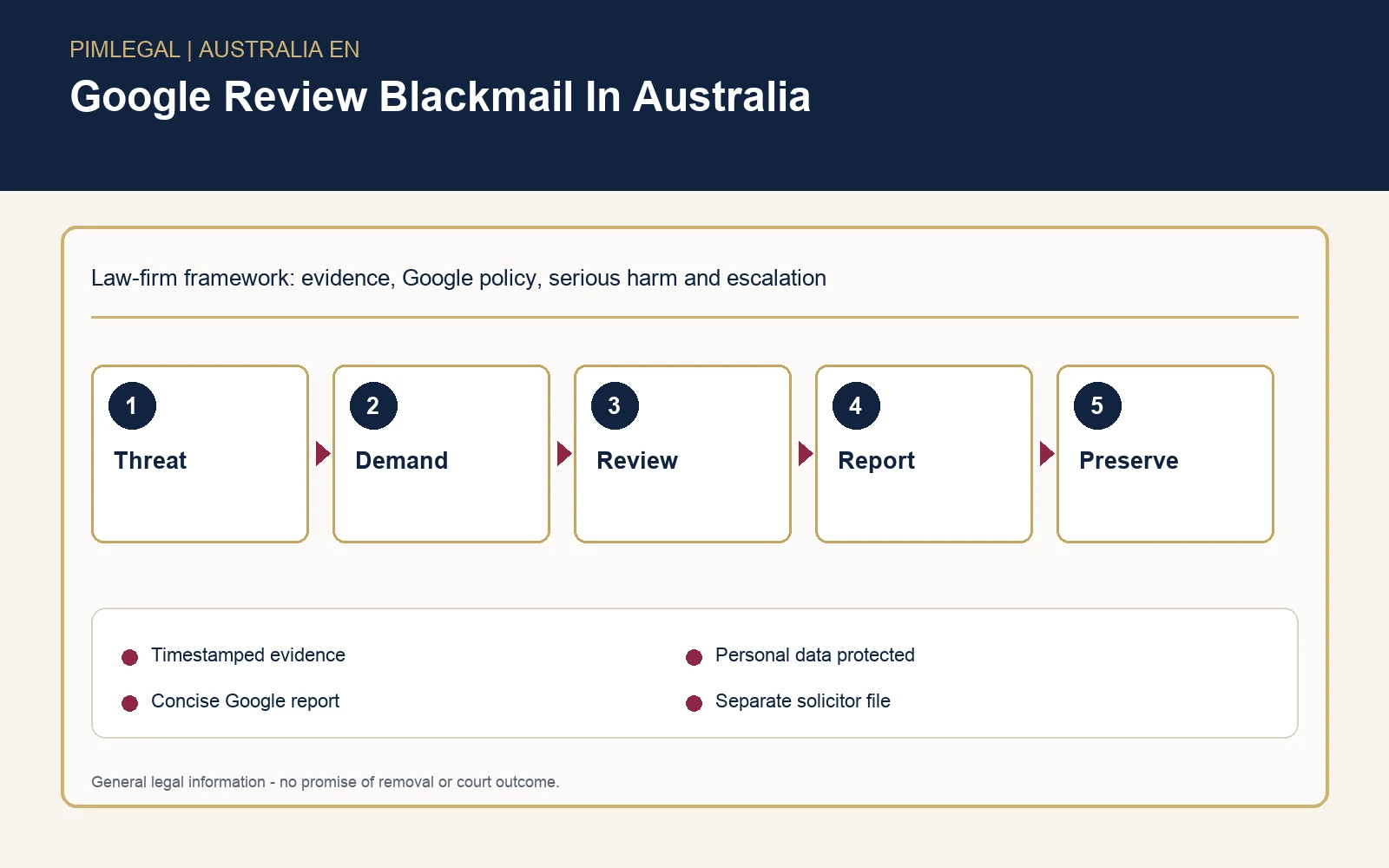
Here the focus is a threat to post, maintain or multiply negative Google reviews unless money, refunds, discounts or free services are provided. The strongest strategy combines five readings: legal imputation, business records, Google policy, public response and escalation risk. The file is more persuasive when it explains why a precise passage crosses a line instead of calling the whole review unlawful.
Evidence Checklist Before Reporting Or Replying
The evidence standard is practical: original messages, phone numbers, email headers, review URLs, Google profile links, dates, demands, deadlines, internal notes and report IDs. The file should be readable by management, Google, counsel and, if necessary, a court. A dated chronology usually does more work than a folder of unexplained screenshots.
- Capture the complete review, rating, reviewer name, profile URL, visible date, images, replies and Google Business Profile context.
- Save screenshots with the browser address bar visible and preserve the source URL separately.
- Search bookings, CRM, invoices, payments, refunds, calls, emails, complaints and service records.
- Record who performed each search, when, which systems were checked and which terms were used.
- Keep public proof suitable for Google separate from confidential records reserved for counsel.
- Measure harm with customer messages, cancellations, local ranking impact, conversion changes and internal response costs.
- Prepare a concise Google report and a fuller solicitor-ready evidence bundle.
The business should also keep personal information and sector obligations in view. Health, education, finance, professional services, employment and child-related services may all involve confidentiality issues. Proving the reviewer wrong does not mean the business should publish private records in a public reply or upload them unnecessarily to a platform form.
Google Policy And Australian Consumer-Law Context
Google removal is not identical to an Australian defamation claim. The Google Business Profile prohibited and restricted content policy addresses fake engagement, misrepresentation, harassment, personal information, conflicts of interest and off-topic content. The platform report should match the facts to the strongest available category.
For this topic, the Google angle is: Google reporting should connect the review activity to the demand without exaggeration or unnecessary confidential material. The report should identify the review, category, objective indicators and non-confidential evidence. It should avoid long legal argument unless a legal-removal route is specifically being used.
The Google Legal Help Center may be relevant where policy reporting is insufficient. Australian consumer-law context also matters. The ACCC publishes guidance on online reviews for products and services and warns that online reviews must be genuine. Those materials help where reviews appear fabricated, incentivised, employee-linked or competitor-driven.
The platform file and legal file should be consistent but not identical. Google receives a concise policy submission. Counsel receives the complete chronology, exhibits, harm evidence, concerns notice analysis and risk assessment. Mixing the two can create privacy and persuasion problems.
Escalation Criteria And Risk Controls
Escalation should follow the proof. For this file, serious threats may justify counsel review, preservation letters, platform reports and separate civil or criminal-law triage. In practice, escalation may mean a second Google report, a neutral public reply, a preservation letter, a concerns notice, preliminary discovery, an injunction analysis or litigation.
Risk cautions are central: do not negotiate in public, retaliate with fake reviews, delete messages or expose private customer information. The business should also avoid suppressing legitimate reviews, offering improper value for removal, posting fake counter-reviews, making unsupported public accusations, disclosing customer or employee information, or threatening court action before the serious-harm and defence analysis is complete.
A concerns notice is not just an angry letter. It should identify the matter complained of, where it can be accessed, the imputations of concern, the serious harm or financial loss issue and the correction, apology, removal or other remedy sought. It should preserve options without exaggerating criminal or civil consequences that are not supported by the facts.
Case Study: Sunshine Coast Clinic Threatened By Messages
A Sunshine Coast clinic receives messages demanding a refund and free treatment or three one-star reviews will remain online. One review already alleges dangerous treatment and fraud.
A disciplined response begins with preservation, not accusation. The business freezes screenshots, copies URLs, checks records, identifies who may review confidential material and decides whether the first route is Google reporting, a public reply, a letter or quiet monitoring.
The file should then be split into three versions. The internal version contains the full chronology and private records. The Google version states the policy category and non-confidential indicators. The external notice version, if needed, quotes only what is necessary and asks for a defined remedy.
If the facts remain uncertain, restraint may be the right answer. A business can preserve evidence, reply carefully and continue checks. Not every harmful review calls for litigation, and not every platform report should contain legal threats.
Operational Method For The Business
The review dispute should become a working file, not a thread of emotional messages. The first page should state the discovery date, affected profile, words complained of, proposed classification, people allowed to view confidential evidence and next authorized action. That keeps customer service, marketing, management and counsel aligned.
The second part should be a sentence-by-sentence chart. Each phrase is classified as opinion, verifiable fact, serious imputation, personal information, threat, conflict of interest or irrelevant content. The next column identifies available proof: booking record, invoice, email, complaint history, staff note, branch record or no customer match.
In the context of a threat to post, maintain or multiply negative Google reviews unless money, refunds, discounts or free services are provided, timing is critical. Record when the review appeared, when it was captured, when records were checked, when the report was submitted, when Google responded and when the next action was chosen. If the review is edited, preserve the previous version. If the profile disappears, early captures become essential.
- Do not ask employees to post fake positive reviews to offset the disputed review.
- Do not offer improper value for removal of an honest review.
- Do not expose customer, patient, employee or payment records in public to prove the reviewer wrong.
- Do not confuse a subjective criticism, even an unfair one, with an automatically defamatory imputation.
- Do not threaten litigation before checking standing, serious harm, concerns notice requirements and defences.
The final control is whether the action reduces harm. A weak report can be rejected. A long public reply can draw attention. An aggressive letter can provoke republication. A measured strategy can obtain correction, prepare a stronger report or document urgency if legal process becomes necessary.
Australian Execution Checklist
Before anyone sends a report, letter or public reply, the business should run a legal execution check. First, confirm whether the business itself can sue or whether the review primarily targets an individual owner, director, practitioner or staff member. The uniform defamation framework limits corporate claims unless the claimant falls within an excluded-corporation category. This standing issue is easy to miss when management focuses only on the business profile.
Second, prepare the concerns-notice packet before using legal language. The packet should include the publication location, screenshots, profile details, the exact words complained of, the imputations said to arise, serious harm or serious financial loss evidence, and the remedy requested. A short but precise packet is more credible than a long letter that calls every sentence defamatory. It also keeps open the statutory offer-to-make-amends pathway.
Third, test the likely defences. Truth may defeat the complaint if the substantial sting is true. Honest opinion may matter where the review is clearly evaluative and based on stated or known facts. Public interest can arise where the review concerns safety, professional conduct, consumer protection, workplace conditions or regulated services. Contextual truth may also affect the practical value of pursuing a narrower imputation. A law-firm file should test those points before threatening proceedings.
Fourth, decide whether the author is known, unknown or only suspected. If the author is unknown, the file may need a different route: better Google reporting, preservation of profile information, preliminary discovery analysis or a request directed to another identifiable actor. If the author is suspected to be a competitor, employee or contractor, keep that suspicion internal until there is evidence. Publicly naming the suspected organiser can create a second dispute.
Fifth, separate Australian Consumer Law and defamation issues. Fake or misleading reviews can raise consumer-law concerns, especially where reviews are fabricated, incentivised, employee-linked or competitor-driven. That does not automatically prove defamation. Conversely, a defamatory allegation may not fit the ACCC route. The same evidence file can support both analyses, but the legal labels should remain separate and accurate.
For a threat to post, maintain or multiply negative Google reviews unless money, refunds, discounts or free services are provided, the manager summary should answer seven questions: what was said, who is identified, why the meaning matters, what records prove or disprove it, what Google rule fits, what serious harm evidence exists and what action is authorised next. That summary lets counsel move quickly without asking the business to reconstruct the dispute from memory.
Finally, review the public response against the legal file. The response should not admit facts the business disputes, disclose private records, allege criminality without proof or contradict the Google report. A measured reply can say that the business takes feedback seriously and cannot verify the described facts from its records, while inviting private contact. The heavier legal analysis belongs in the evidence file, not in a public review thread.
Practical Conclusion
The practical answer to Google review blackmail in Australia is evidence-led. An Australian business should preserve the review, classify the words, check records, select the strongest Google policy category, protect confidential information, measure harm and choose a proportionate remedy. That remedy may be a Google report, public reply, concerns notice, preliminary discovery step or no immediate public action.
This content is informational only. It does not promise removal, does not replace Australian legal advice and does not mean every negative review is unlawful. The value of a law-firm approach is that it challenges false or abusive content while respecting legitimate criticism and avoiding a second reputation problem.
Key References
- Defamation Act 2005 (NSW): model framework for publication, serious harm, concerns notices and defences.
- Google Business Profile policy: fake engagement, conflicts of interest, harassment, personal information and misrepresentation.
- ACCC online reviews guidance: consumer-law context for fake or misleading online reviews.
- Trkulja v Google LLC, Google LLC v Defteros and Voller: online publication context.
- Kabbabe v Google LLC: preliminary discovery in an anonymous Google review setting.