
A practical Australia guide to preserving profile-level evidence, separating review reporting from user-profile reporting, and escalating fake reviewer profile abuse without overclaiming.
Why Profile Abuse Needs More Than A Normal Review Report
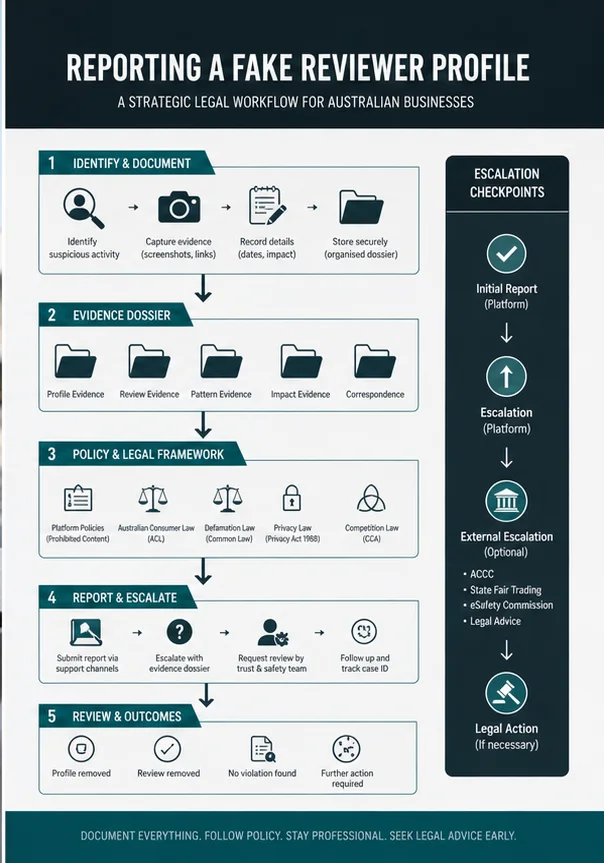
Sometimes the problem is not just one negative review. The stronger signal is the reviewer profile itself: a misleading name or photo, repeated attacks across multiple places, rapidly changing text, impossible customer history, or a wider pattern of fake engagement. In Australia, businesses should preserve that broader profile trail before they accuse anyone publicly.
That distinction matters because Google treats a review report, a user-profile report and a legal-removal request as different routes. Local counsel also asks a different question: whether the profile evidence supports platform abuse, impersonation, privacy harm, defamation, or another defined escalation basis. A weak file that collapses all of those routes into one emotional complaint often loses force.

Evidence Checklist Before Chasing Identity
Preserve the full review URL, reviewer profile URL, star rating, publication date, screenshots, visible edits, owner replies, ranking position and business impact. Then record the internal checks: CRM search, booking logs, invoices, support tickets, call notes, staff recollection and any reason why the alleged event appears impossible or unmatched. If several profiles are involved, build a chronology showing timing, wording similarities and pattern indicators.
Review Reporting, Profile Reporting, And Legal Reporting Are Different
Google's current guidance lets businesses report the individual review and, where appropriate, the broader user profile that contributes policy-violating content. The safer submission explains why the profile appears abusive: fake engagement, impersonation, misleading identity, repeated policy-violating contributions, harassment, or privacy-sensitive conduct. It should not ask Google to remove a profile merely because the business dislikes criticism that may still be genuine.

Local Privacy And Data-Disclosure Constraints
Identity disclosure is usually constrained by privacy and data-protection rules. In Australia, a business should assume that Google or another intermediary will not casually reveal account data just because the review feels false. That is why a lawyer-led request normally starts with necessity, proportionality, a defined legal objective and a clean evidence file. The local privacy framework remains relevant even where the business believes the reviewer acted maliciously.
Public Response While Identity Is Unknown
If the business replies publicly before the author is identified, the response should stay short and non-accusatory. It can say that the business cannot verify the described matter from its records and invites private contact through an official channel. It should usually avoid guessing who the reviewer is, naming a competitor or former employee without proof, or disclosing customer or staff data in an effort to rebut the post.
When Identification Review Becomes More Serious
Counsel-led identification review becomes more realistic when the review is part of a repeated campaign, links to blackmail or refund threats, names staff with misconduct accusations, discloses sensitive data, or is already affecting contracts, regulators, lenders or referral partners. Even then, the safer sequence is usually preserve first, report to Google, assess urgency, and only then consider whether any court-backed or otherwise lawful disclosure route is proportionate in that jurisdiction.
Related PimLegal Reading
For related reading, see our local resource on fake-customer review evidence and the Australia Google review removal page. These two internal resources connect anonymous-review triage with the wider removal and escalation strategy for Australia.
Selected Official References
- Privacy Act 1988 (Cth), Federal Register of Legislation
- Google Business Profile review reporting guidance
- Google user profile reporting guidance
- Google legal content removal guidance
- Google prohibited and restricted content policy
Practical Conclusion
A fake Google reviewer profile file is strongest when the business captures the profile pattern, keeps the public response restrained, uses the narrowest supported Google route, and reserves legal escalation for facts that can actually be defended.
This article is general information only and not legal advice for a specific dispute in Australia. Formal identification, disclosure or court steps should be reviewed locally before action is taken.