
A practical Austria guide to investigating a Google review that alleges a data breach, exposed customer information or failed cybersecurity controls without compromising the incident file.
Why Personal-Data Reviews Need A Different Legal Reading
A review claiming that a business was hacked, leaked customer data, ignored a cyber incident or concealed weak security can affect trust, contracts, insurers and regulators. In Austria, the allegation must be separated into testable propositions: what system or data was supposedly affected, when the event occurred, how the reviewer could know, and whether the statement describes a confirmed incident, a misunderstanding or speculation. Serious wording is not automatically false, unlawful or removable.
That is why a lawyer-grade file separates three questions from the start. First, what exact data appears in the review and whose data is it. Second, what removal route best fits the facts: Google policy, a privacy complaint, a legal notice, a measured public response or a broader reputation strategy. Third, what information should stay out of public view even when the review is false. The discipline matters because a business can turn a bad review into a more serious privacy problem by repeating the data itself.

Evidence Checklist Before Anyone Responds
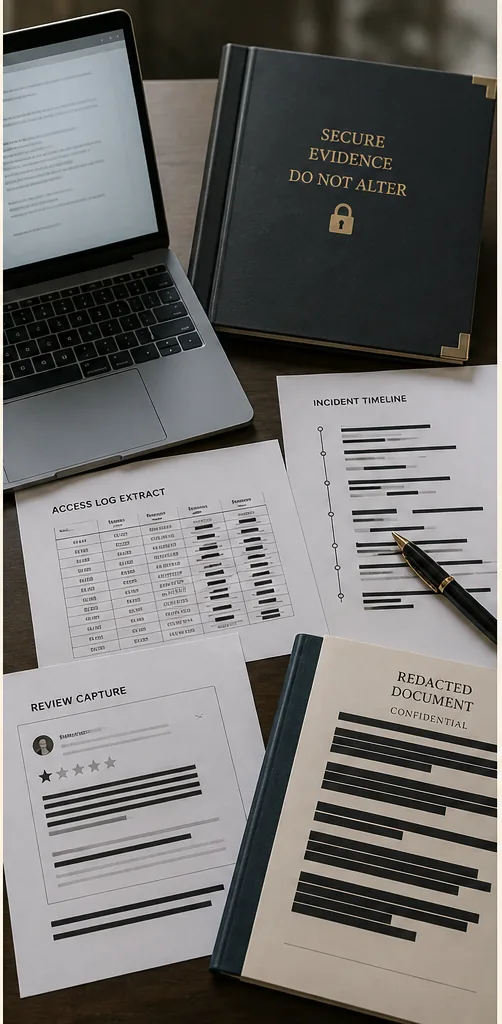
Preserve the full review before contacting the author. Build a restricted incident chronology containing the URL, profile, publication and edit times, exact breach wording, attachments, access logs, alerts, tickets, processor notices, forensic findings, affected-data categories, containment steps and legally approved notifications. Keep raw records separate from working notes, record chain of custody, and do not upload security architecture, credentials, personal data or privileged forensic advice to Google.
A privacy-safe evidence file keeps originals separate from working copies. If screenshots are annotated, preserve the untouched capture as well. Internal checks should record who reviewed the booking, CRM, HR, billing or incident systems and what was or was not found. The point is not to create a dramatic dossier. The point is to show, calmly and consistently, why the review contains personal information that should not stay public and why the business can support that classification without exposing even more confidential data.
Google Policy And The Local Privacy-Law Angle
Google will not remove a review simply because a business feels offended. The report should speak Google's policy language: personal information, harassment, off-topic content, fake engagement, impersonation, conflict of interest or misleading content when those categories are genuinely supported by the facts. A useful submission quotes the problematic wording, explains why the data is sensitive, and asks for removal or review without reproducing every private detail unnecessarily.
In parallel, the internal team should assess the review under GDPR, Regulation (EU) 2016/679. That source matters because it shapes how the business stores screenshots, shares the file, redacts customer information and drafts any reply. Even where the review itself is wrongful, the business should still minimise what it discloses back to the platform or to the public. Google moderation and local privacy compliance are not the same exercise, but they should support one another rather than collide.
Public Response Strategy Without Creating A Second Privacy Problem
A public reply should be short, factual and restrained. In many files the safest wording is that the business takes privacy seriously, is reviewing the matter through the appropriate channel, and invites the reviewer to contact an official private point of contact. What the reply should usually avoid is confirming whether the reviewer is a customer, patient, employee or parent if that confirmation would itself disclose protected information. It should also avoid copying the private data back into the thread in order to deny it.
This is especially important for regulated or sensitive sectors: healthcare, education, legal services, hospitality, financial services, real estate, childcare, wellness, HR-heavy businesses and any company handling minors' data. A reply written in anger can become a second publication, a confidentiality breach or a contradiction of the Google report. The public audience needs reassurance, not a line-by-line debate using private records.
When Escalation Becomes More Serious
Escalate promptly when the review appears to reveal a real uncontained incident, exposes credentials or personal data, conflicts with a mandatory notification assessment, attributes another organisation's breach to the business, or forms part of extortion or coordinated manipulation. Incident response and reputation response must remain coordinated but distinct. Never use a removal request to conceal a genuine breach or make a categorical public denial before technical and legal review is complete.
The key caution is not to overpromise results. Removal is never guaranteed, police or regulator action is never automatic, and a privacy law does not erase the need for a careful factual file. But businesses usually improve their position when they preserve the review early, classify the personal-data issue precisely, redact internal material carefully and keep public messaging aligned with the platform submission.
Related PimLegal Reading
For related reading, see our local article on responding to harmful Google reviews and the Austria Google review removal page. These two internal resources help connect the privacy issue with the wider removal, response and escalation framework for Austria.
Selected Official References
- GDPR, Regulation (EU) 2016/679
- Google prohibited and restricted content policy
- Google Business Profile review reporting guidance
- Google reporting for legal reasons
Practical Conclusion
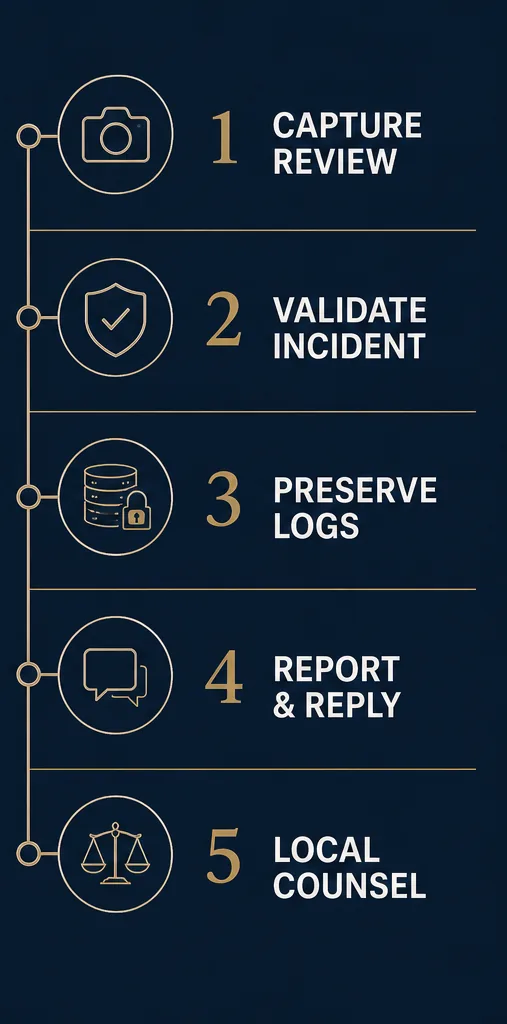
Treat the review as both a publication and a potential incident signal. Preserve it, validate the technical facts, control access to evidence, assess local notification duties, select the narrowest honest Google category and publish only a restrained response. This improves decision quality without guaranteeing removal, regulator action or a legal outcome.
This article is general information only and not legal advice for a specific dispute in Austria. Businesses should seek local advice before sending formal notices, disclosing records, or assuming that any review will be removed.