
How German businesses should respond when a Google review alleges fraud, scam, forged invoices, deliberate deception or unlawful business practices. A Germany-related Google review dispute should not be handled as a marketing complaint alone. It may involve personality rights, corporate reputation, competition law, privacy, platform rules and evidence preservation at the same time. A strong strategy does not promise removal; it builds a file that Google, opposing counsel and a German court can understand.
Read this article together with civil and criminal defamation rules in Germany and online reputation legal strategy. Those two internal PimLegal links connect the country page, evidence method and review-removal strategy.
Legal Issue Framing
For a review attacking a German business's honesty, billing, qualification, compliance or legal integrity, the analysis starts with the exact wording, not the star rating. A bad rating, angry tone or harsh service criticism is not automatically unlawful in Germany. The key question is whether the statement is a value judgment, factual allegation, abusive criticism, personal information, competitor attack or ordinary customer experience.
Civil analysis often starts with section 823 BGB, section 824 BGB and removal or injunctive logic derived from section 1004 BGB. Criminal-law vocabulary may involve section 185 StGB, section 186 StGB and section 187 StGB. Those provisions do not replace fact work. A lawyer-grade strategy first identifies which exact statement is false, reputation-harming, credit-endangering, privacy-sensitive or competitively relevant.
The core issue is whether words such as fraud, scam or rip-off function as factual allegations in context and whether the business can rebut them without disclosing private records. This matters because Google, an opposing party and a German court ask different questions. Google needs a policy category and concise proof. The opposing party needs to understand what wording is challenged. A court needs evidence, legal basis, proportionality, repeat-risk and, for urgent relief, timing. A single emotional complaint usually serves none of those audiences well.
German law also weighs freedom of expression and the public interest in customer experiences. Even uncomfortable criticism may be lawful where it is recognizably subjective and based on a genuine experience. The position changes where the review invents customer contact, states false facts, publishes confidential data, uses extreme personal abuse or appears to be part of a coordinated pressure campaign.
Evidence Checklist
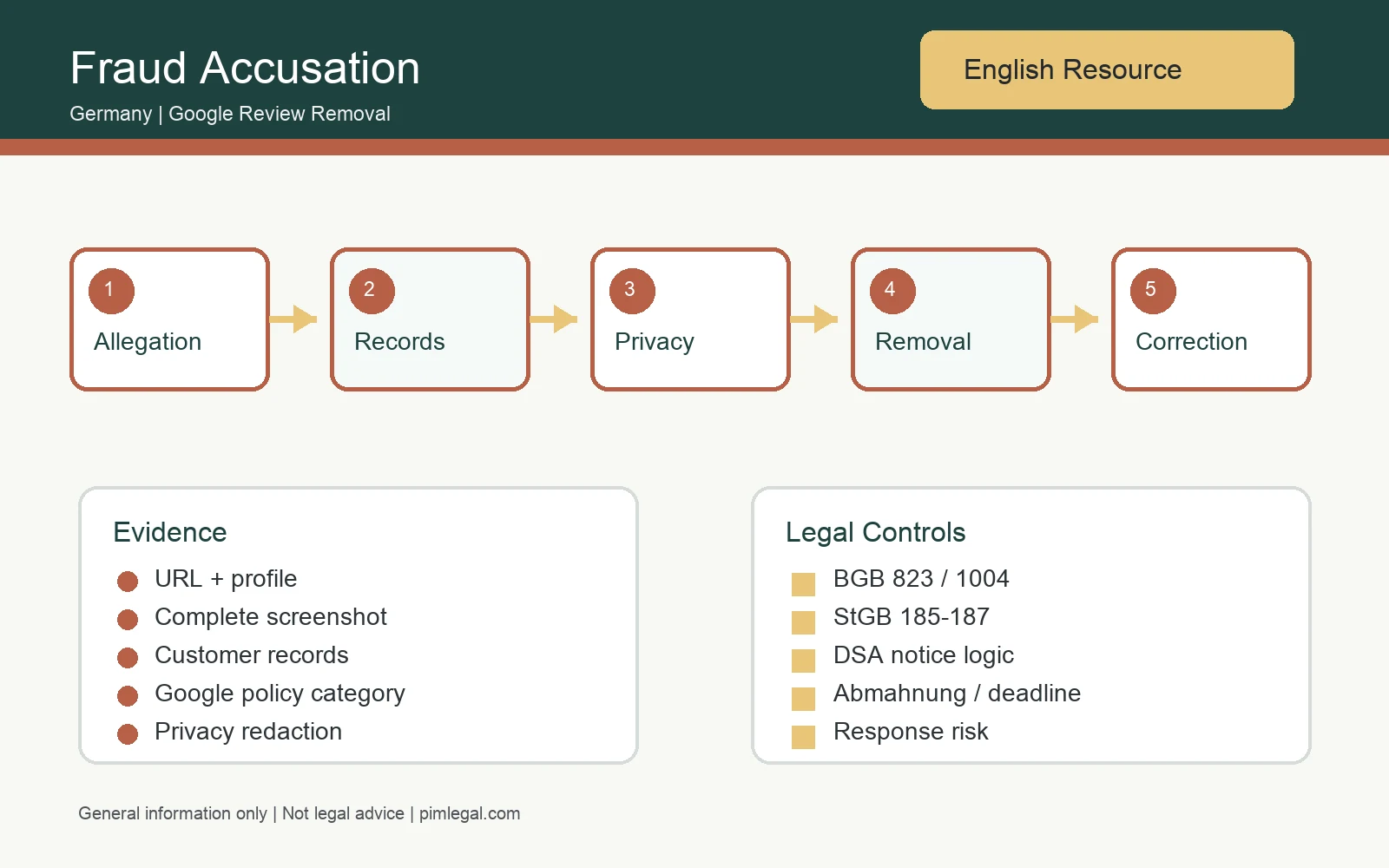
The key evidence in this file is: enrolment documents, terms, payment records, service records, certificate files, emails, complaint history and enquiry impact. Screenshots are only the beginning. They should show the URL, Google Business Profile, reviewer display name, visible date, star rating, complete text, images, public replies and browser address bar. If the review changes, preserve both old and new versions.
The next step is internal verification. CRM records, booking systems, invoices, till receipts, email archives, phone notes, delivery records, patient or client files and location records should be checked but not dumped into a public forum. The file should record who searched, what terms were used, which period was checked, what near matches were excluded and what uncertainty remains.
- Preserve the full review URL, reviewer profile, date, rating and wording.
- Search customer, booking, billing, delivery and communication records.
- Classify each sentence as fact, opinion, insult, private information, threat or fake engagement.
- Separate the Google policy category from the German legal category.
- Redact confidential material before sharing anything externally.
- Document harm and urgency: lost enquiries, customer messages, staff burden, rating movement and commercial impact.
Case Study: Frankfurt Training Provider Called A Scam
A Frankfurt education provider receives a review calling it a scam and claiming certificates are worthless and fees are intentionally withheld. Contracts, attendance records and emails contradict that version.
The first twenty-four hours should not become a public argument. The business should preserve evidence, alert relevant teams, pause deletion of records, avoid impulsive replies and appoint one person to own the file. If the review is shared or repeated on other platforms, each publication should be captured separately.
The review should then be split into three layers. Layer one is for Google: concise, policy-based and non-confidential. Layer two is for business decision-making: harm, customer relationship, communications strategy and commercial risk. Layer three is for counsel: legal basis, evidence, Abmahnung, cease-and-desist wording, urgency, possible objections and court options.
Google Policy Angle
The platform report should separate misrepresentation, fake engagement, harassment, personal information and legal removal arguments. Google's policy categories include fake engagement, conflict of interest, harassment, personal information, misrepresentation and irrelevant content. A report is stronger when it identifies the exact passage, the exact category and the non-confidential evidence that supports removal.
The Google Business Profile review reporting workflow is not a court process. It needs moderation logic: which rule is violated, which passage violates it, what proof can be reviewed safely and what action is requested. If the first report is rejected, an appeal should add structure, a better category and redacted evidence rather than repeat the same emotional statement.
The Digital Services Act reinforces the importance of precise notice-and-action reasoning. For practical purposes, that means a notice should identify the content, explain why it is unlawful or policy-violating, provide evidence and state the requested measure. The DSA is useful as structure, not as a magic deletion label.
Escalation Criteria: Abmahnung, Injunction And Court Strategy
The notice should explain the specific meaning of the fraud allegation, why it is false, what harm it causes and what correction or removal is requested. A legal notice should not read like a general complaint. It should identify the publication, challenged wording, legal violation, evidence summary, cease-and-desist or correction request, deadline and preservation demand. The request should be narrower than all criticism where part of the review may be lawful opinion.
Escalation is more realistic where the review alleges criminality, professional unreliability, unsafe practice, data breach, corruption, discrimination, systematic deception or coordinated review extortion; where no customer contact can be found; where multiple reviews appear coordinated; where direct threats exist; or where measurable commercial harm is developing. Ordinary dissatisfaction may call for a careful response or monitoring instead.
Privacy has its own track. GDPR Article 17 may matter where personal data appears, but not every business review is automatically a data-protection case. Health, client, employee, payment, student and internal contract data should be handled especially carefully. A business should not defend reputation by publishing confidential records.
Risk Cautions And Public Response
The main risk is this: Publishing customer payment or education records in a public reply can turn a reputation problem into a privacy problem. A public response is written for future customers, not for the anger of the moment. It should be short, calm and privacy-conscious. A safer response often says that the business takes feedback seriously, cannot verify the described facts from available records where appropriate, and invites private contact.
Unsafe responses call the reviewer a liar, criminal, extortionist, competitor or former employee without evidence and legal review. They also reveal customer names, diagnoses, contract details, payments, personnel files or internal investigations. Those responses may create new defamation, privacy or employment issues.
Operational Method For Businesses In Germany
A useful internal method is to create a review file on the first business day. The first page should state the discovery date, affected Google Business Profile, exact URL, reviewer name, visible date, star rating, affected location, internal owner and next authorized step. That simple structure prevents marketing, management, customer service and counsel from preparing inconsistent responses.
The second page should be a sentence-by-sentence table. Column one quotes the exact wording. Column two classifies the phrase as factual allegation, value judgment, abusive criticism, insult, personal information, threat, conflict of interest, fake engagement or ordinary dissatisfaction. Column three lists the available record: invoice, booking, patient file, client file, email, receipt, delivery note, support ticket or no customer match. Column four states the Google category. Column five states the recommended action.
The third page handles privacy and confidentiality. Many German review disputes involve health data, client relationships, employee data, payment information, student records or internal contract details. A company can be right on the facts and still respond wrongly if it exposes confidential information. Decide early what stays internal, what counsel can review and what can be safely redacted for Google.
The fourth page defines escalation triggers. Faster legal review is more justified where the review alleges criminality, professional dishonesty, health danger, data breach, corruption, discrimination, systematic deception or coordinated review pressure. Patterns also matter: several reviews in a short period, similar wording, no customer matches, prior threat messages, competitor links or sudden rating collapse.
The fifth page defines success. Success may be complete removal, correction of a false allegation, deletion of personal data, a cease-and-desist declaration, stopping further reviews, a documented platform report, a better public reply or a deliberate decision not to escalate. Without that definition, every review dispute becomes an overbroad deletion project.
German Review-Platform Logic
German review-platform case law helps structure Google matters. In BGH VI ZR 34/15, the court addressed platform duties after a concrete notice. For businesses, the lesson is simple: a vague complaint is weak, while a concrete notice with URL, wording, reason and evidence can make platform review more credible.
BGH VI ZR 1244/20 is especially practical in no-customer-contact cases. A business should not merely say the reviewer is unknown. It should explain which systems were checked, which period was reviewed and why a genuine customer or guest relationship is unlikely. That turns frustration into a verifiable platform and legal argument.
For multi-location businesses, this is particularly important. A no-match in one branch may not be enough if the reviewer could have visited another branch, used another name or dealt with a group booking. The file should record location, period, name variants, booking channels and indirect customer relationships. A fair internal check makes the legal position more credible.
Final Lawyer-Style Control Before Action
Before sending a report, notice or public response, the file should be read from the perspective of a neutral reviewer. Can someone outside the business understand exactly what is challenged? Is it clear why the statement is false, confidential, abusive, competitively suspicious or policy-violating? Is the evidence strong enough without exposing unnecessary personal data? Is the requested remedy narrower than all criticism? Does the tone show a business acting carefully rather than trying to erase every uncomfortable comment?
This final control matters because review disputes are emotionally charged. Managers often want an immediate denial, marketing teams may want a public reply and staff may want to mass-report the review. The legally useful response is usually calmer: precise wording, precise category, precise evidence, privacy boundaries and a realistic objective. That discipline is what separates a credible removal strategy from a public online argument.
A final check should also ask whether delay or overreaction is the greater risk. Some reviews need immediate preservation and counsel review because they allege fraud, unsafe conduct, criminality or confidential information. Others mainly require monitoring and a careful public response. The decision should be written down. If the business later escalates, that note helps show that each step was proportionate and evidence-led.
Practical Conclusion
The practical answer in Germany is a calm, evidence-led sequence: preserve, classify, verify internally, choose the Google category, protect confidential data, align the public response and only then decide whether an Abmahnung, injunction or court route is proportionate. That sequence is less dramatic than an immediate threat, but it is stronger before Google, opposing counsel and court.
This article is general information only. It is not legal advice for a specific German review dispute, injunction, Abmahnung, criminal complaint, platform notice or court filing. Formal escalation should be reviewed by qualified counsel with the full evidence file, jurisdiction, urgency and proportionality analysis.
Legal And Policy References
- Section 823 BGB, section 824 BGB and section 1004 BGB: civil-law hooks for reputation, credit, removal and cease-and-desist analysis.
- Sections 185, 186 and 187 StGB: insult, defamation and intentional false defamation.
- Section 4 UWG: unfair-competition context for competitor-linked review manipulation.
- Digital Services Act and GDPR Article 17: notice-and-action and privacy context.
- Google Business Profile prohibited and restricted content policy and Google review reporting workflow: platform categories and reporting routes.
- BGH VI ZR 34/15 and BGH VI ZR 1244/20: German review-platform duty and no-customer-contact context.