
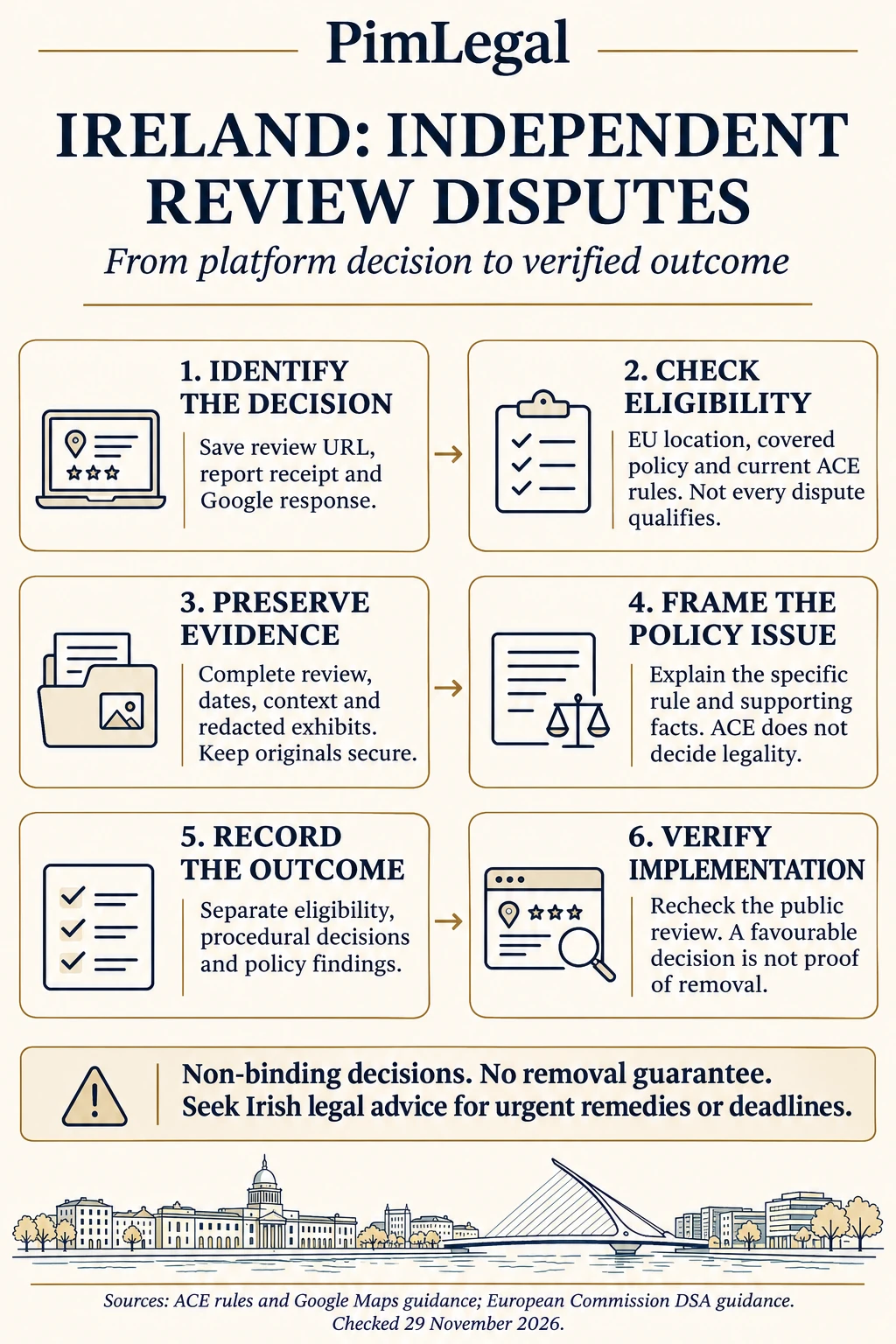
An Irish business receives a message saying that Google will leave a reported review online. The owner has screenshots, customer records and a strong disagreement with the accusation. An independent dispute may provide another assessment of Google's policy decision, but it does not automatically turn those records into a defamation judgment. Before escalating, identify the decision, the applicable policy and the result the business actually needs.
This guide addresses the external review stage. For the preceding platform process, see the Ireland guide to appealing a rejected review report. The distinction matters because an unresolved report, a refusal to remove content and a court claim require different submissions.
Recent development — transparency report published 17 November 2026
Appeals Centre Europe published its third transparency report on 17 November 2026, covering October 2025 to September 2026. Its accompanying announcement identifies missing platform content and limited visibility into implementation as obstacles to meaningful review. This is a report about the operation of dispute settlement, not a new Irish defamation law. Read the Centre's announcement.
For an Irish business, the practical connection is direct: preserve enough material to let a reviewer understand the challenged decision, then separately verify what happened to the public review. An outcome in a case file and a change on Google Maps are different events. Independent reporting also describes procedural decisions made when material was unavailable; such decisions should not be represented as findings that a particular review was false. Read PA Media reporting on the findings.

Which issue can an independent body decide?
Coimisiún na Meán certified Appeals Centre Europe for applying and enforcing platform terms and conditions. Its certification runs from 26 September 2024 to 26 September 2029. The regulator expressly explains that these decisions are non-binding. A business should therefore describe the alleged policy error rather than ask the Centre to determine damages or declare that a reviewer committed an offence. Check the Irish regulator's certification announcement.
Keep three questions separate in the case summary. What did the review say? Why does that content allegedly breach the relevant platform rule? What further legal question requires an Irish solicitor's advice? For example, a review might disclose a staff member's private information while also criticising a service. A narrowly evidenced policy complaint can identify the disclosure without claiming that every critical sentence must disappear.
Check eligibility before preparing a long submission
The Centre's rules require an EU location and specify the types of content and policies it can review. They distinguish challenges to enforcement actions from complaints about content left online. The rules exclude some categories, and the Google Maps page gives a separate platform-specific list. Do not assume that calling a review “fake” resolves eligibility: check the current portal category and ask for clarification where the wording does not align. The Centre does not determine whether content is unlawful. Its rules encourage a platform appeal first but do not make exhaustion of that appeal a prerequisite. Read the current eligibility and procedural rules.
Describe the actual status accurately. A report awaiting assessment has not become a refusal simply because the business expected a faster response. Google's own guidance distinguishes a pending decision from a finding of no policy violation, and describes a one-time appeal for eligible rejected reports. Retain the email as well as the status displayed in the tool. Google explains review reports and appeal statuses.
Evidence checklist for the external review stage
- Save the direct review link and listing URL, complete text, rating, displayed author and capture date. Preserve context around the disputed wording rather than cropping away qualifying language.
- Retain the original report, selected policy category, receipt and decision. Add the appeal submission and result if an internal appeal was used.
- Identify who controls the business profile and who is authorised to submit the dispute. Keep account credentials out of the evidence pack.
- Prepare a short chronology that distinguishes publication, first observation, reporting and decision dates. An observation date is not proof of when the reviewer submitted the text.
- Link each factual contention to an exhibit. State when the customer search covered only bookings rather than walk-in purchases or transactions under another person's name.
- Retain originals securely and submit proportionate copies. Remove unrelated customer information from working copies without altering material context.
The Centre's Google Maps guidance asks for identifying details, links, relevant dates and the reasons for disagreement. Its page also identifies excluded areas. Use those instructions to check the submission rather than sending the entire customer database. Consult the Google Maps submission guidance.

Write the argument around one identifiable decision
A useful submission begins with the review URL, the date of Google's decision and the policy issue. Explain which words or circumstances support the complaint, what evidence supports that explanation, and what remains uncertain. Avoid treating a missing booking as conclusive proof of a fabricated experience. If there is a competing explanation, address it briefly. This makes the record easier to assess and reduces the risk of an exaggerated allegation becoming the focus of the dispute.
Illustrative example: a café's records show no reservation under the reviewer's displayed name, but the café accepts walk-in customers. That evidence alone does not establish that the review is invented. If the review also includes an unrelated person's home address, the privacy issue should be explained on its own evidence. This example is hypothetical, not a reported Irish judgment or a prediction of a platform outcome.
Escalation and risk cautions
The European Commission describes certified dispute settlement as an additional avenue alongside internal complaints and national courts. A body must cover the relevant dispute and language; certification does not make every body suitable for every complaint. Parties must engage in good faith, but the body cannot impose a binding settlement. The Commission explains the framework and lists certified bodies.
Seek individual legal advice where the business needs urgent relief, disclosure of an author's identity, compensation or an assessment of an allegedly defamatory statement under Irish law. Do not assume an external platform dispute extends a legal deadline. Keep public responses factual and restrained while the case is assessed. Threatening prosecution, publishing customer records or announcing that a reviewer has been proved dishonest can create a further dispute.
Close the file only after checking the result
Maintain separate entries for admissibility, the decision on the policy issue, any procedural outcome and implementation. Check the public review link after an update and record the observation date. If content changes, preserve the new version beside the original. A screenshot of a favourable email is not evidence that the review has disappeared from public view.
Businesses considering Google review removal assistance in Ireland should prepare a redacted chronology and state the remedy they need. Start with the correct forum and a checkable record; avoid promises based on aggregate appeal statistics. This article provides general information only, not advice on an individual Irish dispute. No removal, regulator action or legal outcome is guaranteed.