
How to document a suspected competitor-linked fake Google review in Italy without turning suspicion into an unsupported accusation. For an Italian business, the strongest approach is precise, documented and proportionate. Many companies jump from reputational alarm to a removal demand. A stronger file treats the review as a publication, a Google policy event, a business-records issue and a legal-risk decision.
For related Pimlegal guidance, read coordinated review campaign case study in Italy and legal online reputation strategy. These two internal links keep the article connected to a broader Italy removal strategy rather than treating the page as a standalone SEO note.

Italian legal framing
For fake Google review posted by a competitor in Italy, the first task is careful classification. The issue is proving fake engagement or conflict of interest rather than converting commercial suspicion into a defamatory counter-accusation. A review can be unfair, commercially painful and still lawful. A short phrase can also be serious if it attributes fraud, theft, falsification, health risk, discrimination, professional misconduct or another fact that readers may believe to be true.
The criminal-law starting point is Article 595 of the Italian Criminal Code, which addresses defamation. Civil exposure may also be assessed through the Italian Civil Code, including the unlawful-act framework. Those references do not turn every one-star review into a case. They show why the wording, audience, proof, harm and remedy must be analysed before escalation.
Freedom of expression remains central. Article 21 of the Italian Constitution protects expression and criticism, so counsel should separate opinion, hyperbole, consumer frustration, factual allegation, personal information, threat, conflict of interest and fake engagement. The safer strategy challenges the false or abusive segment, not the existence of criticism itself.
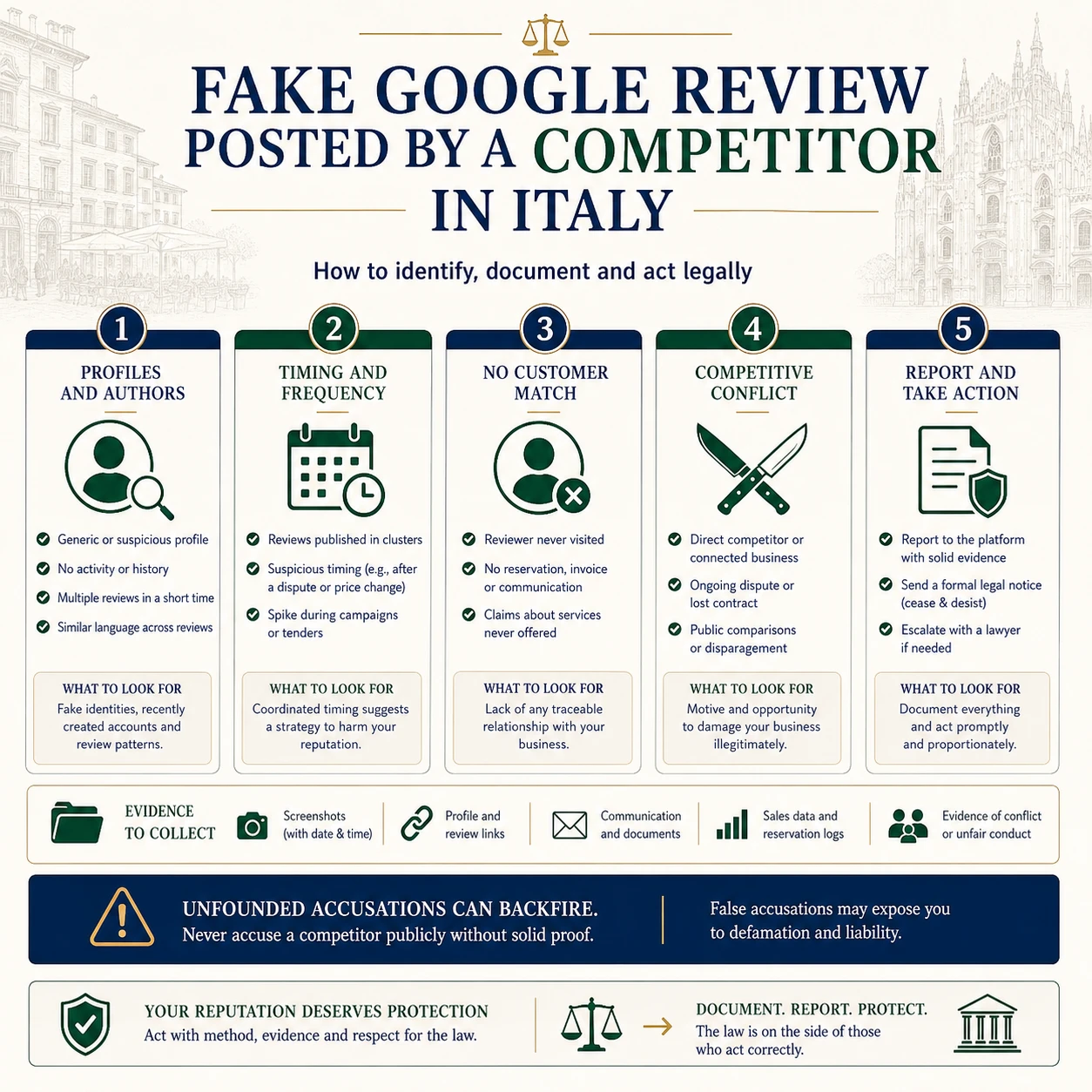
This article focuses on a pattern of facts suggesting review manipulation by a competitor or a person connected to the local market. A strong file combines five readings: the legal meaning of the words, the business evidence, Google policy, the public-response risk and escalation proportionality. The file becomes more persuasive when it explains calmly why a precise sentence crosses a line instead of describing the whole review as malicious.
Evidence checklist before reporting or replying
The evidence required is practical: profiles, times, wording similarities, review history, absence of bookings, competitive context, screenshots and rating movement. The same file should be intelligible to a Google moderator, management, opposing counsel and, if needed, an Italian court. A pile of screenshots is weaker than a short dated chronology with source URLs, record checks and exhibit labels.
- Capture the full review, star rating, profile name, profile URL, visible date, images, owner replies and Google Business Profile context.
- Save screenshots with the browser address bar visible and record the source URL in a dated note.
- Search CRM, bookings, invoices, payments, refunds, calls, emails, complaints and service logs before alleging falsity or non-customer status.
- Record who searched which systems, when the search was done and what terms were used.
- Separate the public Google packet from confidential exhibits that should stay with counsel.
- Document harm through cancelled enquiries, customer messages, conversion changes, staff concern, partner concern or internal response cost.
- Prepare a concise platform summary and a fuller legal file; do not merge every confidential document into the Google report.
Privacy must be part of the evidence plan. The GDPR is relevant when proof contains customer, patient, employee, payment or internal business data. The fact that a document helps the business does not mean it belongs in a public owner response or a platform packet.
For multi-location businesses, each profile should be handled separately. The review, branch, address, team, date and customer records must be tied to the correct location. Branch confusion is common and can weaken an otherwise solid removal request.
Google policy and Digital Services Act angle
Google review removal does not follow the same test as an Italian defamation action. The Google Business Profile prohibited and restricted content rules address fake engagement, rating manipulation, impersonation, conflicts of interest, harassment, offensive content, personal information and irrelevant content. A report is stronger when it maps the review to a specific category.
For this topic, the Google angle is: Google's rules on fake engagement, conflicts of interest and rating manipulation are central; AGCM context on non-genuine reviews reinforces the market-harm issue. The report should not read like a court pleading. It should identify the review, state the policy category, summarise objective indicators and attach only what is necessary.
The Digital Services Act reinforces the value of clear notices for illegal or terms-violating content. If a normal report is insufficient, the Google Legal Help Center may be relevant, but that route should be reserved for precise, supportable legal removal requests.
Competition context may also matter. The Italian Competition Authority decision concerning non-genuine online reviews shows why manipulated reviews can affect markets and consumers. That background does not prove abuse in an individual case, but it supports disciplined evidence of fake engagement or conflicts of interest.
Escalation criteria and risk controls
Escalation should follow the evidence. In this file, a legal notice or external complaint should name the competitor only if the evidence is strong and preserved. Escalation may mean a second Google report, neutral public reply, preservation request, diffida, identification work, urgent proceedings or civil or criminal assessment. The order should remain proportionate to the harm.
A legal notice is not a shortcut. It should identify the URL, date, disputed phrases, alleged meaning, evidence, requested remedy, response deadline and preservation request. It should avoid threatening remedies the file does not support. A broad letter can strengthen the author's reply and make the business look like it is trying to silence criticism.
The risks are real: publicly attributing the campaign to a competitor without proof can turn the defamation risk back against the target business. The business should also avoid fake positive counter-reviews, offers in exchange for deleting honest criticism, unsupported public accusations, unnecessary personal-data disclosure and letters that demand silence rather than correction of a precise passage.
Platform measures and author measures should remain distinct. Google evaluates policy categories and legal requests. The author may respond on facts, opinion, truth or customer experience. Each document should be written for the right recipient.
Italy case study: Naples restaurant and coordinated wave
A restaurant in Naples receives six negative reviews in forty-eight hours. No names match reservations, two profiles have also posted positive reviews for a competitor and several phrases use the same vocabulary.
The disciplined response starts with preservation, not accusation. The business freezes screenshots, copies URLs, checks records, limits access to confidential proof and decides whether the first move is Google reporting, a public reply, a private letter or monitoring without immediate public action.
The file should then be split into three versions. The internal version contains the full chronology and confidential documents. The Google version gives the policy category and non-confidential indicators. The external version, if a notice is needed, quotes only what is useful and asks for a defined remedy. This separation protects sensitive information while keeping the strategy firm.
If facts remain uncertain, restraint may be the right conclusion. The business can preserve evidence, publish a careful reply and continue checking records. Not every harmful review justifies litigation, and not every platform report should contain legal threats.
Operational method for the business
A Google review dispute should not live only in the head of the owner, marketing lead or general manager. It should become a working file. The first page should record discovery date, affected profile, disputed wording, provisional classification, people authorised to access confidential proof and the next approved action. That prevents improvised replies, duplicate reports and contradictions between customer service, management, communications and counsel.
The second section should be a sentence table. Each phrase is classified as opinion, verifiable fact, serious accusation, personal data, threat, conflict of interest or irrelevant content. The next column identifies available proof: contract, invoice, booking record, email, complaint history, internal policy or absence of a customer match. This method forces the business to deal with words, not just the emotion created by a low star rating.
The third section separates audiences. Google receives a short, objective, non-confidential report. The author, if known, may receive a more precise but proportionate letter. Counsel receives the full file, including private evidence, assumptions, risks and measurable harm. The public sees only a careful response if a response is necessary. That separation often distinguishes a professional file from a crisis reaction.
In the context of a pattern of facts suggesting review manipulation by a competitor or a person connected to the local market, the calendar matters as much as the content. Record when the review appeared, when it was captured, when records were checked, when the report was submitted, when Google responded and when a new action was approved. If the review is edited, the prior version should remain in the file. If the profile disappears, the initial screenshots become even more important.
- Do not ask staff or partners to post fake positive reviews to offset the disputed review.
- Do not offer ambiguous benefits in exchange for deleting honest criticism.
- Do not expose customer, patient, employee or payment records in public to prove the reviewer wrong.
- Do not confuse subjective criticism, even if unfair, with an automatically defamatory factual allegation.
- Do not threaten litigation before checking evidence, limitation issues, likely defences and proportionality.
The final control is whether the proposed action actually reduces the harm. A weak report may be rejected. A long public reply may attract more attention to the review. An aggressive notice can trigger a new publication. A measured strategy can obtain voluntary correction, prepare a stronger report or document urgency if formal action becomes necessary.
Quality control before sending
Before filing a report, publishing a reply or sending a notice, the team should quality-check the file for fake Google review posted by a competitor in Italy. The check is not designed to make the tone harsher. It confirms that every disputed phrase is quoted accurately, that the referenced proof exists, that unnecessary personal data has been removed and that the remedy requested matches what the business can prove.
This is especially important where the file concerns a pattern of facts suggesting review manipulation by a competitor or a person connected to the local market. If the internal review shows uncertainty about identity, customer status or falsity, the strategy can be staged: preserve, monitor, reply carefully, strengthen the Google report or seek counsel before making a formal accusation. A slower but verified file is often more effective than an immediate action built on suspicion.
Practical conclusion
The practical answer to fake Google review posted by a competitor in Italy is an evidence-led method. The Italian business should preserve the review, classify the wording, check records, select the strongest Google category, protect personal data, measure harm and choose a proportionate remedy. The remedy may be a report, public response, legal notice, identification route, urgent application or no immediate action.
This article is informational. It does not promise review removal, does not replace advice from Italian counsel and does not mean every negative review is unlawful. The value of a lawyer-grade approach is to challenge false or abusive content without attacking legitimate criticism and without creating a new reputation risk.
Key references
- Google Business Profile policy: fake engagement, conflicts of interest, personal information, harassment and rating manipulation.
- Article 595 of the Italian Criminal Code: the central criminal-defamation reference for reputational publications.
- Italian Civil Code: civil-liability framing where facts support harm and remedy analysis.
- Digital Services Act: the EU notice-and-action framework for illegal online content.
- GDPR: personal-data discipline for customer, patient, employee and reviewer evidence.