
How Dutch businesses distinguish harsh customer criticism from a defamatory or unlawful Google review under Netherlands law and Google policy. For Dutch businesses, this is not only a marketing problem. A Google review is a publication, an evidence item, a platform report, a privacy risk and sometimes a legal claim. The right approach therefore starts not with anger or automatic removal requests, but with wording, context, evidence and proportionality.
This article concerns the line between permitted negative opinion and a damaging factual allegation that affects reputation, revenue and trust. The central question is whether the review is still within ordinary customer experience or whether it publishes a testable and harmful allegation. A professional approach accepts that customers may be critical, while protecting the business against demonstrably false facts, misleading patterns, privacy breaches and review abuse.

Dutch Legal Framework: Unlawful Act, Smaad, Laster And Platform Policy
For the line between permitted negative opinion and a damaging factual allegation that affects reputation, revenue and trust, the legal analysis often begins with Article 6:162 of the Dutch Civil Code. The questions are practical: was there an unlawful publication, can it be attributed to the author, is there damage, is there causation and does the violated norm protect the business interest? A bad Google review is not automatically unlawful. Dutch businesses must tolerate robust criticism, disappointment and subjective customer experience.
The threshold changes when the review sounds to an ordinary reader like a concrete factual allegation. Words such as slow, expensive or unfriendly are usually value judgments. Words such as fraud, theft, forgery, dangerous conduct, scam, illegal practice or breach of professional secrecy carry a different weight. Counsel should not build a general story about hurt feelings; counsel should build a sentence table with exact wording, context, likely meaning, evidence for or against the statement, Google policy category and requested remedy.
Criminal law may appear in serious files, but it is rarely the first line of a good letter. Dutch provisions concerning smaad, laster and insult are found in the Dutch Criminal Code, including article 261 Sr and the nearby provisions on false accusation and insult. Those concepts must be used carefully. A civil claim, Google report, DSA notice, correction request or controlled public response will often be more proportionate than immediate criminal language.
Google policy is a separate layer. The Google prohibited and restricted content rules focus on categories such as fake engagement, misrepresentation, harassment, personal information, conflict of interest and content not based on a genuine experience. The Google legal help center can be relevant when a request is legally framed. Google does not, however, decide the entire Dutch civil claim. The platform report must therefore be policy-readable and factually compact.
The Digital Services Act makes specificity important for notice-and-action. A useful notice identifies the exact location of the content, explains why it is illegal or policy-breaching, gives appropriate contact information and includes a good-faith statement. At the same time, the GDPR matters because a business should not upload unnecessary customer, patient, staff or payment information to a general platform report.
The Netherlands framework is therefore not a simple delete button. It is a balancing exercise between freedom of expression, protection of reputation, evidence, privacy, proportionality and platform procedure. The strategy becomes stronger when each document has its own job: the Google report is short and policy-focused, the legal analysis is complete, the demand letter quotes the contested passages and the public response remains reputation-safe.
Dutch Case Law As A Practical Check
Google review case law in the Netherlands shows that courts do not automatically accept removal requests. In Rechtbank Amsterdam 2016, ECLI:NL:RBAMS:2016:987, the court made clear that businesses must generally tolerate negative online reviews. A pseudonym, a sharp tone or management anger is not enough. The file must show why the specific wording crosses the legal line.
At the same time, a review can be unlawful. Rechtbank Amsterdam 2017, ECLI:NL:RBAMS:2017:8063 is useful because false online reviews, including Google Maps reviews, could be unlawful where evidence, context and attribution were strong enough. The business lesson is simple: the file is won by records, not by outrage.
In matters involving Google itself, such as Rechtbank Amsterdam 2020, ECLI:NL:RBAMS:2020:2653, the quality of the notice to the platform matters. If the notice is general, Google has little to assess. If the notice identifies exact statements, evidence indicators and a legal or policy ground, the platform assessment becomes more concrete.
Anonymous or pseudonymous reviewers require a separate analysis. Rechtbank Zeeland-West-Brabant 2020, ECLI:NL:RBZWB:2020:6923 and the older Lycos/Pessers Supreme Court decision show that identifying information is not handed over lightly. There must be a real interest, the alleged unlawfulness must be sufficiently plausible and the balance of interests must be carefully explained.
That case law explains why a good Google-review file serves several readers at once. Management wants speed, Google wants policy information, the reviewer needs to know which words are disputed and a court wants proportionality. A file that serves those readers with the same facts is stronger than a file that only repeats that the review feels unfair.
Evidence: Build The File Before Asking For Removal
contract, order confirmation, invoices, payment records, complaint log, service reports, customer communications, revenue impact and a sentence-by-sentence evidence table. Evidence starts with a complete capture of the review. Preserve the Google Business Profile page, not only a cropped screenshot. Keep the URL, date, time, browser context, star rating, full text, images, reviewer profile, owner replies and any later edits.
Then perform the internal check. Search CRM, appointment systems, point-of-sale records, accounting, booking tools, patient administration, client portals, email, WhatsApp, call notes, complaint logs and payment data. Record negative results too: no customer found, no appointment, no product delivered, no employee by that name, no complaint received or no invoice matching the accusation. A clean negative search note can be valuable in fake-review matters.
Make the verification repeatable. A moderator, opposing lawyer or judge should later be able to see who searched, which systems were checked, on what date, with which search terms and with what result. A broad management statement saying 'we do not know this customer' is weaker than a short factual search note with system names and outcomes.
Separate confidential evidence from platform evidence. Google usually does not need the entire customer file. A non-confidential summary may be enough: the named treatment is not offered, the alleged date was a closing day, the order number belongs to another party, the reviewer names an employee who never worked there or five reviews use unusually similar wording. The full evidence file remains for counsel or court.
Measure reputational harm with concrete indicators. Consider cancelled appointments, customer questions mentioning the review, lower lead volume, ranking or conversion impact, partner concerns, staff burden and reputational risk in licensing, procurement or professional relationships. Damage does not always need to be precisely quantified at the first step, but the file becomes stronger when it contains more than general anxiety.
Preserve the company's own actions too. Google reports, appeals, emails, draft responses, demand letters and internal decisions must remain consistent. If the business says today that there is no customer relationship and tomorrow publicly refers to details from the customer file, the strategy becomes vulnerable. Evidence discipline includes the company's response discipline.
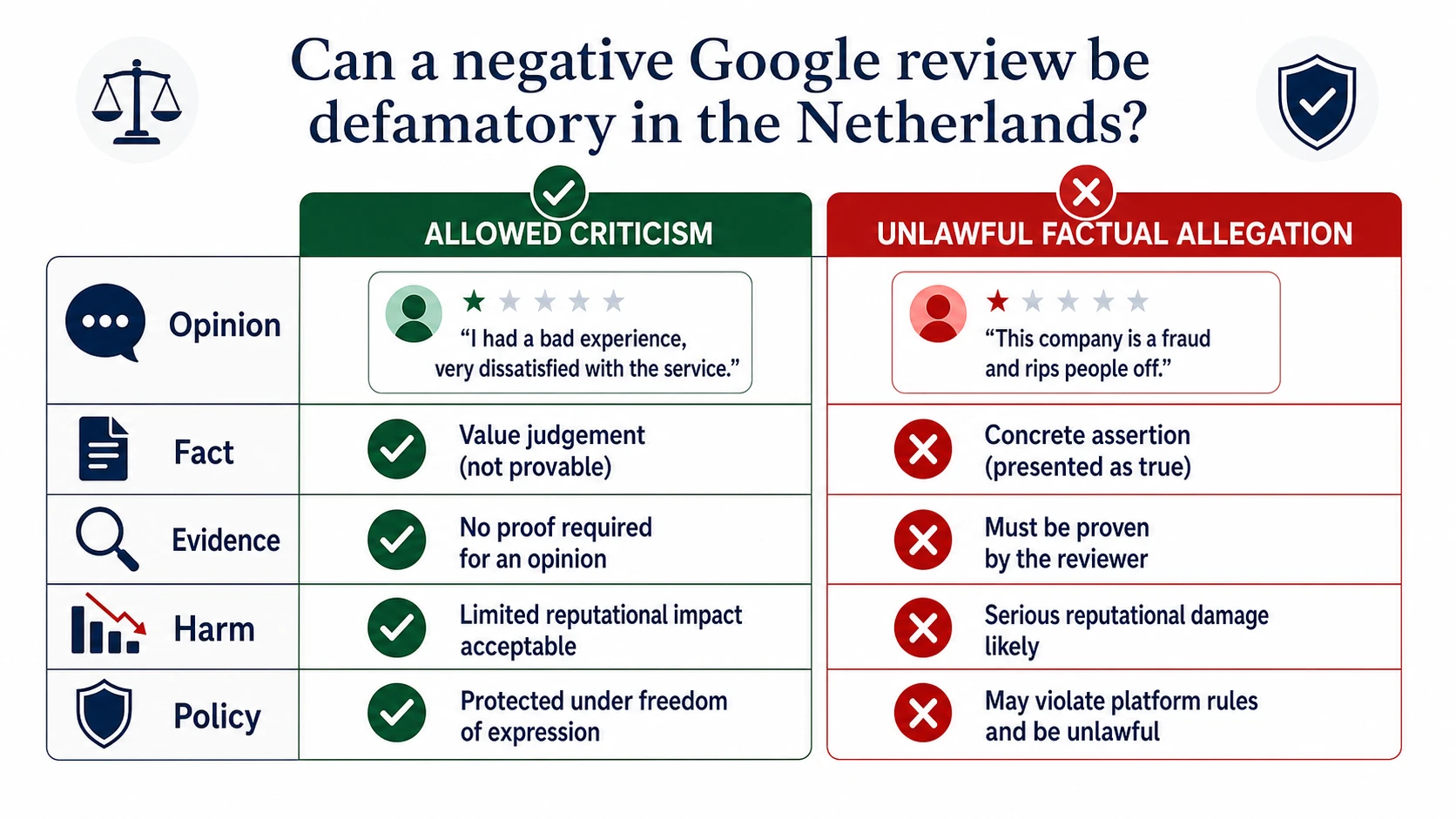
Case Study: Utrecht Service Provider And Harsh Review Language
A Utrecht service provider receives a review saying 'too expensive', 'poor communication' and 'they steal money from customers'. The first two statements may remain subjective criticism. The third can read to future customers as a factual allegation of dishonest or criminal conduct. The first instinct is understandable: respond immediately, ask Google to remove the review and search internally for the author. Legally, that is not the best order. The business should first preserve the publication, then verify the facts and only then choose the route.
The core problem in this scenario is classifying each sentence as opinion, exaggeration, insult, verifiable fact, private information or platform-policy breach. That requires a sentence-by-sentence approach. A review can be a real complaint, exaggerated opinion, false factual allegation, privacy problem and Google-policy issue at the same time. Treating everything as one accusation makes the file harder for both Google and a court.
A first internal meeting can be short, but it should assign roles: who preserves evidence, who checks systems, who is allowed to respond for the business, who contacts counsel and who speaks to staff. That prevents several people from sending different reports or public replies with inconsistent facts.
Then the route is chosen. If the review is mainly normal dissatisfaction, repair communication may be better. If it contains demonstrably false fraud language, a legal notice may be appropriate. If it shows conflict of interest or a non-customer experience, Google policy becomes central. If personal data or health information appears, privacy may dominate. If threats or pattern evidence exist, escalation can be faster.
The best approach may sound less dramatic than the harm feels: record calmly, classify sharply, share minimally, request proportionately and litigate only when the evidence and business interest justify it. That order is the difference between reputation management and a second dispute.
Google Report, DSA Notice And Demand Letter
Google normally does not remove ordinary dissatisfaction; the report must focus on the specific part that is false, misleading, personal, harassing or not based on a genuine experience. Write the Google report as a short technical note. Start with the review URL and exact wording. Then explain the policy category, the non-confidential facts supporting it and the requested result. Avoid emotional background that the moderator cannot verify.
A DSA notice or legal submission must be more specific than a standard inappropriate-review report. It should identify the content location, explain the reason for illegality or policy breach and state in good faith why the request is made. That does not mean sending Google the whole litigation file. It means writing a precise, factual and readable summary.
The demand letter serves a different role. It is addressed to the author, organiser or involved party, not only to the platform. A good letter quotes the contested passages literally, explains what is false or unlawful, summarises evidence, requests removal or correction, asks for evidence preservation and gives a realistic deadline.
legal escalation is stronger when the false factual core is clearer than the offensive tone. Escalation should not read like intimidation. It should read like a legally understandable route. If the business later goes to court, the court should be able to see that the business first tried proportionately to limit the harm.
The Google report, demand letter and public response must not contradict one another. The Google report can use policy language, the letter can use legal language and the public response can use customer-facing language, but the core facts must remain the same. A strong reputation strategy is not a pile of separate texts; it is one controlled file with different outputs.
If Google rejects the first report, repeating the same submission ten times is usually weaker than improving the appeal. Add missing context, remove confidential details, clarify the policy category and explain why the review is more than ordinary dissatisfaction. If that still fails, counsel can assess a formal route against the author, organiser or, in exceptional cases, the platform.
Public Response And Risk Control
An owner response is not a pleading. Future readers mostly want to see that the business acts professionally, reliably and privacy-consciously. A good response is short, calm and invites private contact. It can say that the business cannot verify the described situation from available records and would welcome contact through a private channel.
suing too quickly over a real customer's opinion can amplify the review and make the business look as if it is trying to suppress legitimate criticism. Do not publish medical information, payment data, staff information, legal files, internal camera footage or complaint-file details. Even where the business is right, a careless reply can create a new privacy or confidentiality problem.
Internal communication matters too. Do not ask employees to mass-report the review with different stories. Do not ask customers to post counter-reviews because of the dispute. Do not delete documents that may later explain the matter. Keep a short timeline of decisions, reports, replies and contact moments.
Read within Pimlegal also defamatory Google reviews in the Netherlands and Pimlegal online reputation strategy. Those two internal references are deliberately limited, so this article can explain the Netherlands route without scattering the evidence analysis.
The result can vary by review. Sometimes removal is realistic. Sometimes correction or rectification is more realistic. Sometimes a controlled public response is better than legal escalation. Sometimes the business should preserve evidence and wait until more pattern information is available. A Netherlands lawyer-led approach chooses the lightest effective route that limits harm without weakening the evidence file.
Checklist For Dutch Businesses
- Preserve review URL, profile, date, star rating, full text, images, profile page and owner replies.
- Create an internal search note listing checked systems, search terms, responsible person and result.
- Separate opinion, verifiable fact, exaggeration, insult, personal data, threat and Google policy category.
- Use a non-confidential summary for Google and keep full customer, patient or HR files for counsel.
- Check that the public response does not contradict the Google report or legal letter.
- In a demand letter, request removal, correction, evidence preservation and no reposting where proportionate.
- Measure reputational harm with concrete signals such as cancellations, customer questions, revenue, leads, ranking and partner concerns.
- Have a formal DSA notice, summary proceedings, identification request or criminal-law step reviewed by qualified counsel.
Sources And References
- Article 6:162 Dutch Civil Code for the civil-law basis of unlawful act.
- Article 6:196c Dutch Civil Code and the Dutch Criminal Code for intermediary and defamation-related context.
- Google prohibited and restricted content rules and Google legal help for the platform route.
- Digital Services Act for notice-and-action requirements and platform procedure.
- GDPR for privacy, data minimisation and public-response risk.
- ECLI:NL:RBAMS:2016:987, ECLI:NL:RBAMS:2017:8063, ECLI:NL:RBAMS:2020:2653 and ECLI:NL:RBZWB:2020:6923 for Dutch review and platform jurisprudence.
This article is general information for Netherlands Google-review disputes. It is not legal advice for a specific review, demand letter, DSA notice, criminal complaint, summary proceeding or identification request. Concrete steps should be reviewed for facts, evidence, jurisdiction, privacy, proportionality and litigation risk.