
A practical Switzerland guide for businesses facing Google reviews that accuse them of buying fake reviews, using insider ratings, or manipulating review sentiment.
Why This Accusation Needs A Dual File
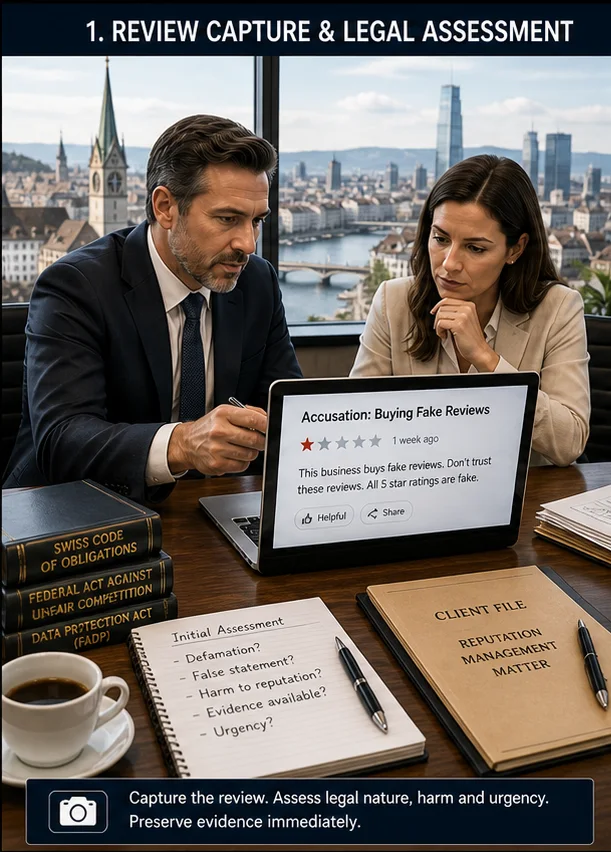
A review that says a business buys fake reviews is not just insulting rhetoric. It can imply deceptive conduct, undisclosed insider activity, consumer manipulation, or deliberate rating fraud. In Switzerland, the first question is therefore not only whether the reviewer is wrong. It is whether the accusation points to a provable commercial practice and whether the business has a disciplined file to test that claim before replying in public.
That is why the legal framing should stay dual from the first hour. One track tests whether the accusation is false, exaggerated, unsupported, or policy-violating. The second track checks the business's own review workflow: staff requests, agency instructions, CRM campaigns, incentives, QR codes, family or employee activity, and any process that could be misread as review manipulation. A business weakens its removal position if it denies everything publicly before checking both Swiss Federal Act against Unfair Competition and Swiss Civil Code, article 28.
Evidence Checklist Before Any Public Denial
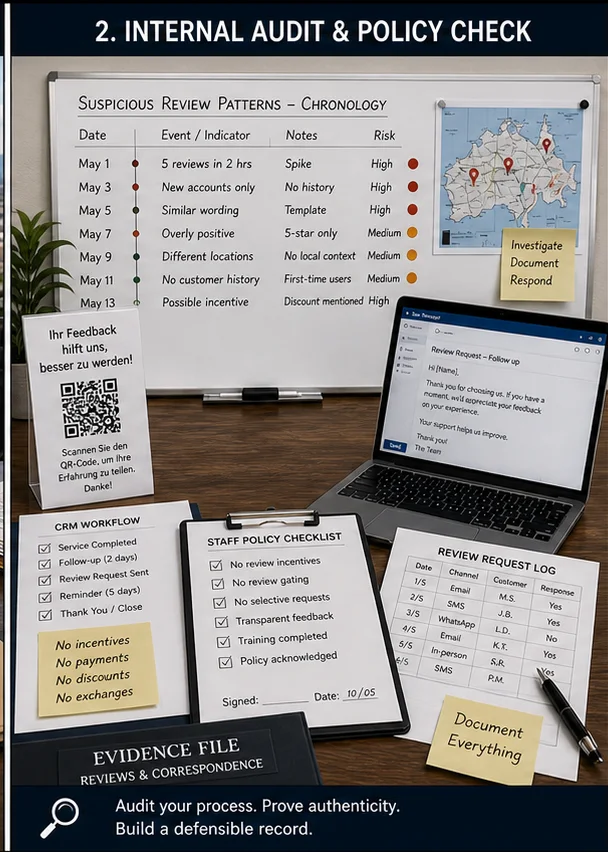
Preserve the full review URL, reviewer profile, star rating, exact wording, screenshots, visible edits, owner replies, report status, and the surrounding Google Business Profile context. Then preserve the internal review-solicitation file: review-request messages, vendor contracts, staff guidance, QR destinations, customer follow-up flows, incentive policies, and any chronology showing what review practices were actually active when the accusation was posted.
The useful audit question is narrower than management often expects. Did the business ask all eligible customers neutrally, or only satisfied customers. Were employees, relatives, agencies, or affiliates ever encouraged to leave ratings. Were discounts, refunds, loyalty credits, or benefits tied to reviewing, changing, or deleting a review. A lawyer-grade file should identify what can be disproved cleanly, what requires internal remediation, and what should never be said in a public reply.
Google Policy, Consumer-Law Risk, And Reputation Harm
Google policy matters on both sides of this dispute. The review itself may be false, provocative, non-genuine, or unsupported by a real experience and may justify ordinary reporting where the facts support that route. At the same time, Google's prohibited and restricted content rules and Business Profile fake-engagement enforcement mean that the business should not treat the report as a substitute for auditing its own review practices.
Local legal review should also account for Swiss Federal Act against Unfair Competition and Swiss Civil Code, article 28. Those sources matter because an accusation of buying fake reviews can sound like deceptive commercial conduct, unfair trading, or dishonest publication rather than mere insult. Even if the business ultimately disputes the accusation, the safer posture is to preserve the workflow, classify any real compliance exposure, and keep public wording aligned with what the internal file can actually support.
What A Measured Public Reply Usually Says
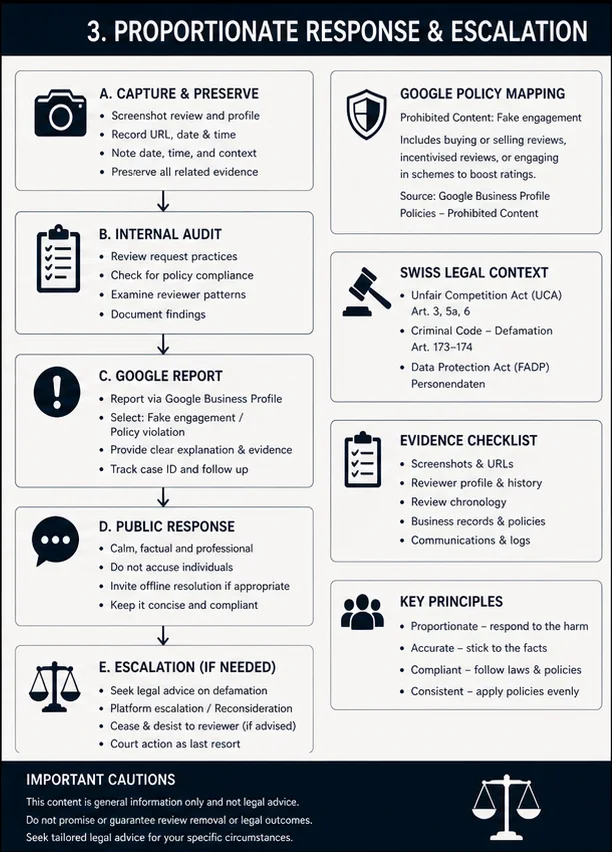
In many files, a defensible response does four things: it stays brief, avoids insults, avoids confirming confidential facts, and offers a private contact route. It can be enough to say that the business takes feedback seriously, cannot verify the described events from available records, and invites the reviewer to contact an official channel so the matter can be examined carefully.
What the reply should usually avoid is calling the reviewer a liar, scammer, extortionist, criminal, or competitor before the file supports that allegation clearly enough. It should also avoid publishing names, order numbers, screenshots, or internal explanations simply to prove the reviewer wrong. The public response is a risk-control step, not a courtroom submission.
When Escalation Deserves Closer Review
Closer escalation review may be justified when the review accuses the business of fraud or criminal conduct, names staff, exposes private data, threatens safety, appears coordinated, or affects lenders, regulators, licensing, or major contracts. In those files, the public reply should normally become even narrower while the evidence file becomes more detailed.
No result should be promised. A careful reply does not guarantee removal, court relief, regulator action, or reputational repair. Its practical value is narrower: it protects the record, reduces avoidable admissions, and keeps the business aligned with the strongest available Google or legal route.
Related PimLegal Reading
For related reading, see our local guide on fake Google reviews, consumer protection and removal strategy and the Switzerland Google review removal page. These two internal links connect fake-review-buying accusations with the wider removal, evidence, and escalation strategy in Switzerland.
Selected Official References
- Swiss Civil Code, article 28
- Swiss Federal Act against Unfair Competition
- Google prohibited and restricted content policy
- Google Business Profile review reporting guidance
- Google Business Profile restrictions for policy violations
Practical Conclusion
A Google review accusing a business of buying fake reviews should be handled as a dual-track file: test whether the accusation is factually supportable, test whether the business's own practices were compliant, map the dispute to Google's policy language, and keep the public response shorter than the internal audit.
This article is general information only and not legal advice for a specific dispute in Switzerland. Businesses should seek local advice before sending formal notices or publishing detailed accusations.