
A practical Switzerland guide for businesses when a Google review republishes website photos, marketing images, treatment photos, product shots, or other original visual assets and creates overlapping copyright, platform, evidence, and public-response risk.
Why Copyright Changes The Review-Removal Analysis
The first question in Switzerland is not whether the review feels unfair. It is whether the business can prove ownership or authorised control of the images, identify the exact copied material, and separate a copyright complaint from the wider review dispute. A reviewer may be a real customer and still reuse protected photos. A reviewer may also be fake and use copied visuals to make the post look authentic.
That distinction matters because copyright, privacy, defamation, and platform policy do not run on the same track. If management rushes into a public accusation without checking the chain of title, licence terms, agency contracts, employee-creator rules, or franchise ownership, it can weaken both the Google submission and any later legal notice. The stronger file starts by classifying the image-rights issue under Fedlex Federal Act on Copyright and Related Rights while preserving the review exactly as published.
Ownership And Chain-Of-Title Before Any Notice
A business should confirm who actually owns the rights in the images before asking Google to remove them for copyright reasons. The website operator is not always the copyright owner. Ownership may sit with a photographer, design agency, production studio, franchise group, platform contractor, employee, or another supplier depending on local law and the contract wording. Where the business relies on a licence rather than ownership, the file should identify whether the licence is broad enough to support a takedown request.
The practical evidence set should therefore include the original publication source, publication date, licensing or assignment documents, invoice or commissioning records, and a clean comparison showing where the same visual appears inside the Google review. That work is slower than a quick report, but it prevents a common mistake: using copyright language as pressure in a dispute that is really about fake engagement, privacy, or a false factual allegation rather than image ownership.
Evidence Checklist For A Copyright-Focused Review File
Preserve the full review URL, reviewer profile, star rating, exact review text, every attached image, visible edits, owner replies, report status, and the surrounding Google Business Profile context. Then preserve the original business-side image set: the full-resolution source file where available, website publication screenshots, metadata, content-management timestamps, campaign files, booking or product context, and any licence or assignment paperwork.
A lawyer-grade comparison should place the published review image next to the original business image, identify whether it is identical, cropped, filtered, overlaid with text, turned into a collage, or mixed with other misleading material, and keep untouched originals separate from annotated working copies. Google usually needs the shortest non-confidential explanation that shows ownership and reuse. The complete contract and damage analysis should stay in the internal file unless a more formal route becomes proportionate.
Google Photo Reporting, Legal Notices, And Platform Fit
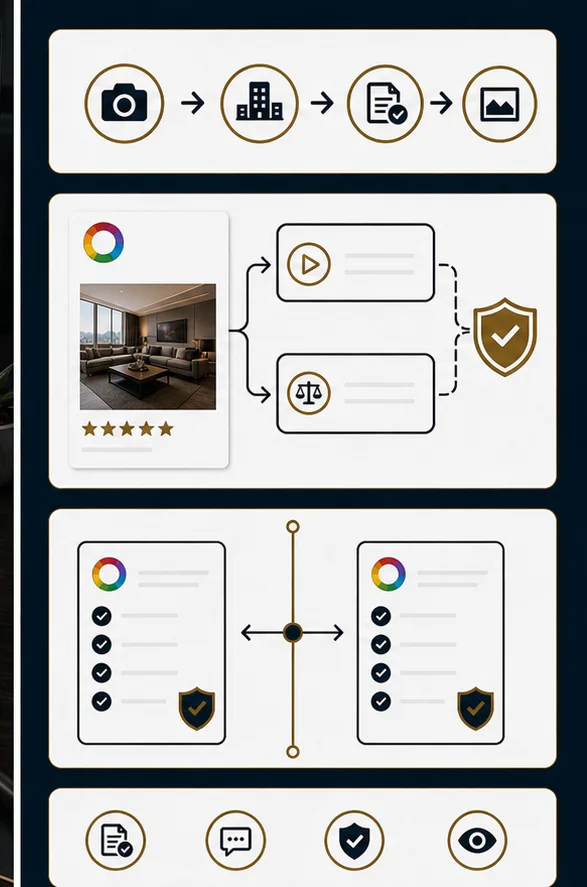
Google provides more than one route. If the image itself violates product policy, the business may use the photo or video reporting path. If the issue is legal ownership of the image, the stronger route may be Google's legal-removal process for copyright complaints. The submission should stay narrow: exact review URL, exact image, original source location, ownership basis, and the shortest explanation of unauthorised reuse that Google can review without having to resolve the entire customer dispute.
The internal team should also test whether the same review raises other issues besides copyright: misleading context, fake engagement, privacy-sensitive disclosures, impersonation, or false factual accusations. Those issues should be classified honestly instead of being forced into a copyright box. Google may reject a weak copyright complaint even when the review is still harmful for other reasons. That is why the public response should remain shorter and calmer than the legal file while the business decides whether copyright, platform policy, or a combined strategy is the right path.
When Escalation Deserves Closer Review
Closer escalation may be justified when a copied image is paired with fraud accusations, medical or treatment claims, threats, extortion, confidential materials, staff targeting, or a coordinated review attack. In those files, copyright is only one lane. The business may need a combined strategy involving evidence preservation, photo-level Google reporting, copyright notice review, privacy analysis, a controlled public response, and local counsel input on proportionality and proof.
The key caution is not to overpromise outcomes. Copyright ownership does not guarantee Google removal. A valid licence may defeat an ownership assumption. A strong copyright file does not automatically prove the rest of the review is false. The most defensible posture is narrower: prove the image-rights position first, preserve the public record carefully, and choose the least aggressive effective route that matches the evidence.
Related PimLegal Reading
Selected Official References
- Fedlex Federal Act on Copyright and Related Rights
- Google Business Profile photo and video reporting guidance
- Google Legal Help reporting for legal reasons
- Google Legal Help copyright complaint guidance
Practical Conclusion
When a Google review reuses a business's copyrighted photos in Switzerland, the strongest route is to prove ownership first, preserve the review and image evidence carefully, choose the correct Google path, and keep any public response short and non-inflammatory while local legal review checks chain-of-title, licence scope, and proportionality.
This article is general information only and not legal advice for a specific dispute in Switzerland. Businesses should seek local advice before sending formal copyright notices, disclosing customer or patient records, or assuming that any review or image will be removed.