
A practical Switzerland guide for businesses facing Google reviews that accuse them of deleting, censoring, hiding, filtering, or otherwise suppressing customer feedback and needing an evidence-led, platform-safe response strategy.
Why A Review-Suppression Accusation Needs Its Own File
A review-suppression accusation is different from an ordinary false-review dispute because the business has to inspect its own conduct as well as the review text. In Switzerland, the real question is whether the company asked customers to edit or delete reviews, flagged genuine criticism as fake, hid complaints in private channels, routed only favorable feedback into public view, or used pressure that could look like suppression even if management believed it was only handling a complaint.
A disciplined file should therefore separate rhetoric from records. A reviewer may overstate what happened, but management still needs to test the actual workflow: owner replies, report IDs, CRM automations, refund or goodwill offers, request-to-edit messages, branch scripts, agency instructions, support tickets, and any legal or policy notices sent after the review appeared. The business weakens its position if it denies everything publicly before that audit is complete.

Evidence Checklist Before Anyone Replies
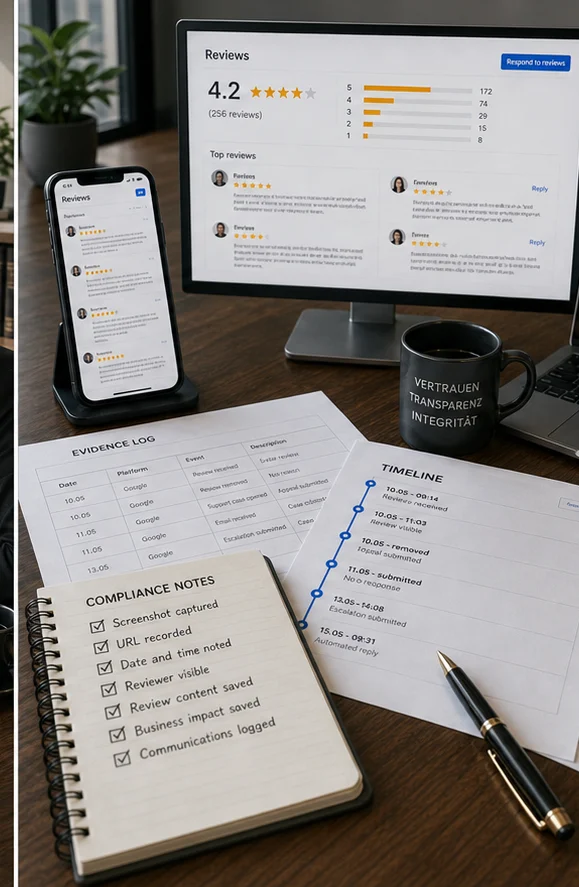
Preserve the public side first: the full review URL, reviewer profile, rating, exact wording, screenshots, timestamps, visible edits, owner replies, and any later change to the review text or rating. Then preserve the internal side: review-request templates, complaint-routing flows, report and appeal confirmations, requests for revision or deletion, refund discussions, staff escalation notes, and a chronology showing what the business asked the reviewer to do before and after the accusation was posted.
The key audit question is whether the business handled public criticism neutrally. Did all customers retain the same ability to leave or keep a review. Were unhappy customers pushed to private channels while positive reviewers were nudged toward Google. Were refunds, credits, replacements, or service recovery tied to rewriting, deleting, or withholding a review. Were truthful negative reviews flagged as fake without a supportable basis. A short public reply is much easier to defend when the internal file already answers those questions calmly.
Google Policy And The Local Consumer-Law Angle
Google policy matters on more than one level here. The review itself may still be false, provocative, or non-genuine and may justify ordinary reporting if the facts support that route. But Google's review and content policies also matter because a business should not use platform tools as a shortcut to suppress real criticism. The stronger approach is to map only supportable facts to a narrow policy category and to keep the report consistent with what the internal file can actually show.
Local legal review should also take account of Swiss Federal Act against Unfair Competition. That source matters because a review-suppression accusation can sound like deceptive commercial conduct rather than mere insult. Even if the business ultimately disputes the accusation, the safer posture is to preserve the workflow, classify any genuine compliance risk, and keep the public wording aligned with what the evidence can support. The legal objective is not to win a rhetorical fight. It is to avoid turning a weak accusation into a stronger regulatory or platform problem.
What A Measured Public Reply Usually Says
Where a public reply is needed, it is usually safer to acknowledge the concern, say the business is reviewing both the feedback and its review-handling practices, and invite the reviewer to an official private contact channel. The reply should not promise that the accusation is impossible unless the business has already audited the exact workflow that the accusation is actually about.
The public reply should also avoid overreaction. Do not accuse the reviewer of lying, blackmail, extortion, or bad faith unless the file supports that allegation clearly enough. Do not publish internal screenshots, staff names, private customer facts, or a long procedural defense merely to prove a point. And do not use the reply to pressure the reviewer into deletion. The public response is a risk-control step, not the whole compliance analysis.
When Escalation Deserves Closer Review
Closer escalation review may be justified when the accusation is repeated across multiple reviews or platforms, appears tied to a competitor or former insider, is paired with threats or refund demands, or exposes a real internal practice that now creates Google or consumer-law risk. In those files, the business may need both tracks at once: a narrow Google report for any false or policy-violating review statements and an internal compliance clean-up that is preserved rather than hidden.
No result should be promised. Google policy does not guarantee removal. Local consumer-law context does not guarantee regulator action. And not every complaint about moderation, deleted comments, or unhappy-customer handling is false or defamatory. The narrower goal is more realistic: preserve the accusation, audit the workflow, correct any real weakness, and keep every public or private step proportionate to the evidence.
Related PimLegal Reading
For related reading, see our local guide on review gating, selective solicitation, and Google review risk and the Switzerland Google review removal page. These two internal links connect review-suppression accusations with the wider removal, response, and escalation framework in Switzerland.
Selected Official References
- Swiss Federal Act against Unfair Competition
- Google prohibited and restricted content policy
- Google Business Profile review reporting guidance
- Google Business Profile guidance on managing customer reviews
- Google legal content removal guidance
Practical Conclusion
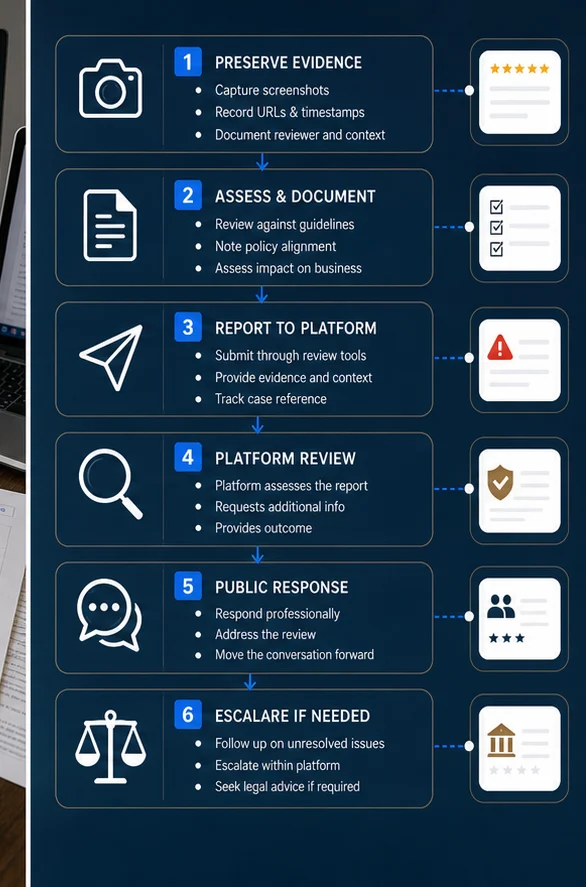
A Google review accusing a business of suppression should be handled as a dual-track file. Preserve the accusation, audit the real review-handling workflow, map only supportable facts to Google and local consumer-law frameworks, and keep the public reply narrower than the internal compliance review.
This article is general information only and not legal advice for a specific dispute in Switzerland. Businesses should seek local advice before sending formal notices, disclosing records, or assuming that any review will be removed.