
A practical Switzerland guide when a Google review appears to describe the wrong business, wrong branch, or wrong location: evidence, Google policy, public response, and escalation.
Why Wrong-Business Reviews Need A Separate File
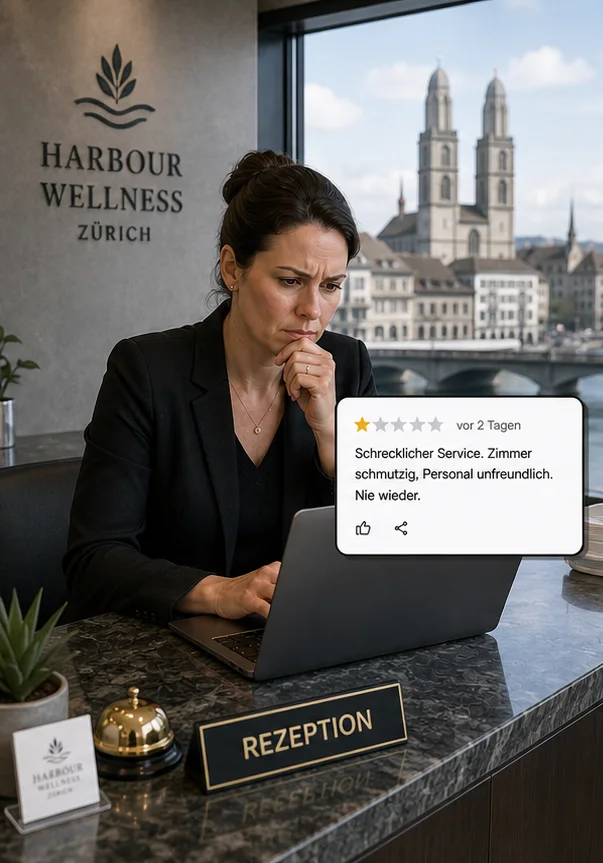
A wrong-business review is different from an ordinary fake-review dispute because the problem may be misidentification rather than invention. In Switzerland, the review may describe another branch, another franchise, a neighboring business, a former tenant, or a business with a similar trading name. The first question is therefore not whether management feels attacked, but what location, service, and business identity the review is actually talking about.
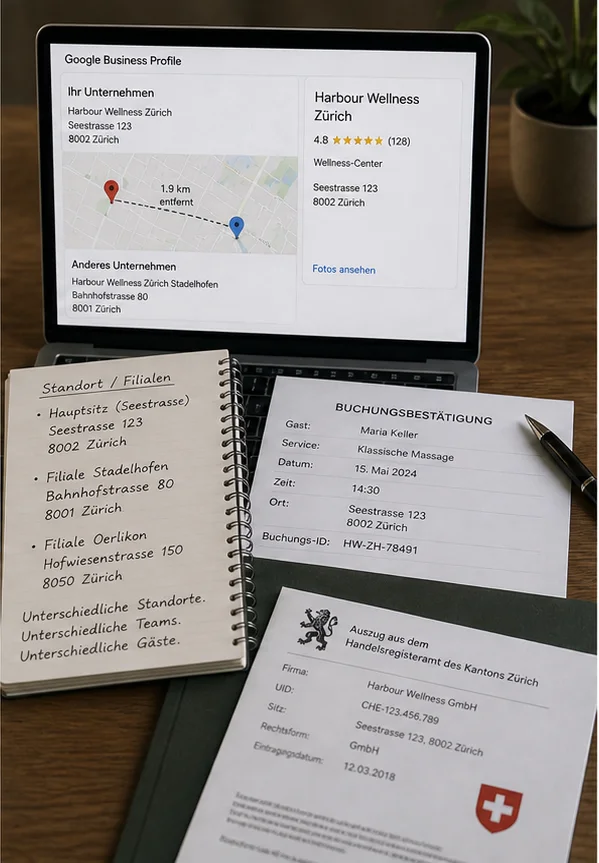
A disciplined file therefore separates listing facts from emotional rebuttal. Check the exact profile URL, map pin, branch address, category, photos, claimed visit details, booking records, staff recollection, and nearby businesses likely to be confused with the listing. A rushed accusation that the reviewer is lying can weaken the record if the platform profile itself contains old, duplicated, or ambiguous location data.
Evidence Checklist Before Anyone Replies
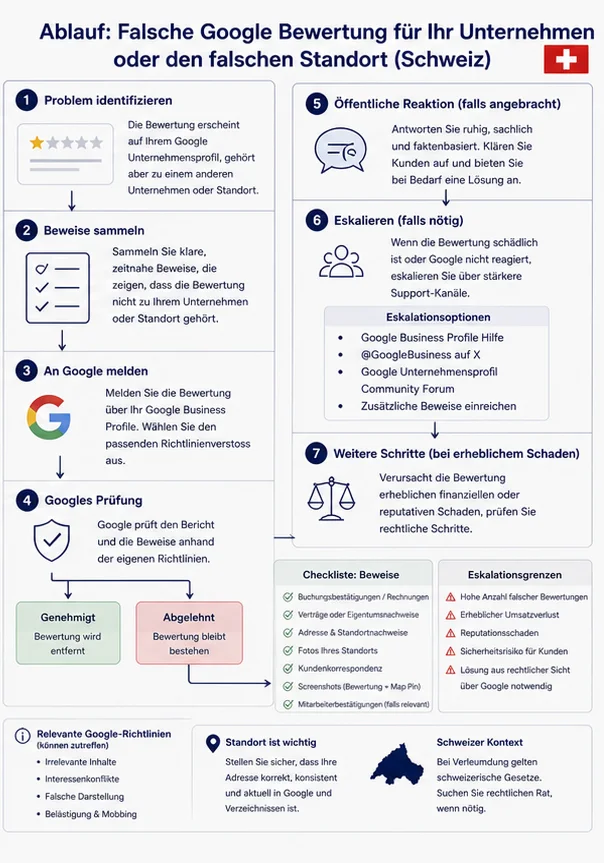
Preserve the full review URL, reviewer profile, rating, exact wording, screenshots, timestamps, visible edits, attached images, and any owner reply draft. Then preserve the business-profile context: official name, address, phone number, category, website, branch photos, map result, and any public directories or archived pages showing why a customer might have confused this listing with another location.
The internal note should record whether the reviewer can be matched to this location, to another branch, to another business, or to no customer file at all. Search bookings, invoices, CRM entries, staff schedules, visit logs, and complaint channels in a privacy-safe way. The objective is to classify the mismatch precisely: wrong company, wrong branch, wrong city, wrong service, old tenant, or merged profile problem.
Google Policy And The Local Consumer-Law Angle
The Google route often starts with off-topic content, misrepresentation, or a review not based on the right customer experience rather than with a broad defamation complaint. A useful report explains, briefly and factually, that the review appears to relate to another business or another location, identifies the mismatch, and attaches only the supporting records needed to show why the profile attribution is wrong.
Local review should also consider Swiss Federal Act against Unfair Competition. That source matters because a misdirected review can mislead the public about which business actually provided the service. Even where the reviewer had a real bad experience somewhere, the safer legal posture is to solve the identification issue first, keep the Google report compact, and make sure the public wording stays inside what the evidence file can actually prove.
What A Measured Public Reply Usually Says
If a public reply is commercially necessary, it is usually safer to say that the business cannot presently match the described visit to this location or this business name, that it is reviewing the matter, and that the writer is invited to a private official contact channel to verify the details. The response should normally avoid calling the writer dishonest unless the internal file already resolves the mismatch clearly.
What the reply should usually avoid is calling the reviewer a liar, scammer, extortionist, criminal, or competitor before the file supports that allegation clearly enough. It should also avoid publishing names, order numbers, screenshots, or internal explanations simply to prove the reviewer wrong. The public response is a risk-control step, not a courtroom submission.
When Escalation Deserves Closer Review
Closer escalation review may be justified when wrong-location reviews are repeated, when map-pin confusion affects several customers, when duplicate or merged profiles exist, when the issue involves a same-brand multi-branch structure, when a former tenant or neighboring business is being confused with the listing, or when the review makes serious fraud, safety, or misconduct allegations against the wrong premises. In those files, the business may need both a Google correction route and broader profile-cleanup work.
No result should be promised. A careful reply does not guarantee removal, court relief, regulator action, or reputational repair. Its practical value is narrower: it protects the record, reduces avoidable admissions, and keeps the business aligned with the strongest available Google or legal route.
Related PimLegal Reading
For related reading, see our local guide on fake customer review evidence and removal strategy and the Switzerland Google review removal page. These two internal links connect public-response drafting with the wider removal and escalation strategy in Switzerland.
Selected Official References
- Swiss Federal Act against Unfair Competition
- Google prohibited and restricted content policy
- Google Business Profile review reporting guidance
- Google Business Profile guidance on managing customer reviews
Practical Conclusion
A wrong-business Google review should be handled as an identification file before it is handled as a legal fight. Confirm which business and location the review actually describes, preserve the listing evidence, map the strongest Google category, and escalate only after the factual record is aligned.
This article is general information only and not legal advice for a specific dispute in Switzerland. Businesses should seek local advice before sending formal notices or publishing detailed accusations.