
A practical Belgium guide for businesses facing suspicious AI-generated, synthetic, or chatbot-written Google reviews and needing an evidence-led removal strategy.
Why AI-Sounding Reviews Need A Narrower Legal Analysis
The legal problem is rarely the use of AI by itself. In Belgium, the sharper question is whether the review falsely presents itself as a genuine customer experience, fabricates factual detail, hides a commercial connection, or forms part of fake engagement. Businesses weaken their position when they treat polished wording alone as proof of unlawfulness.
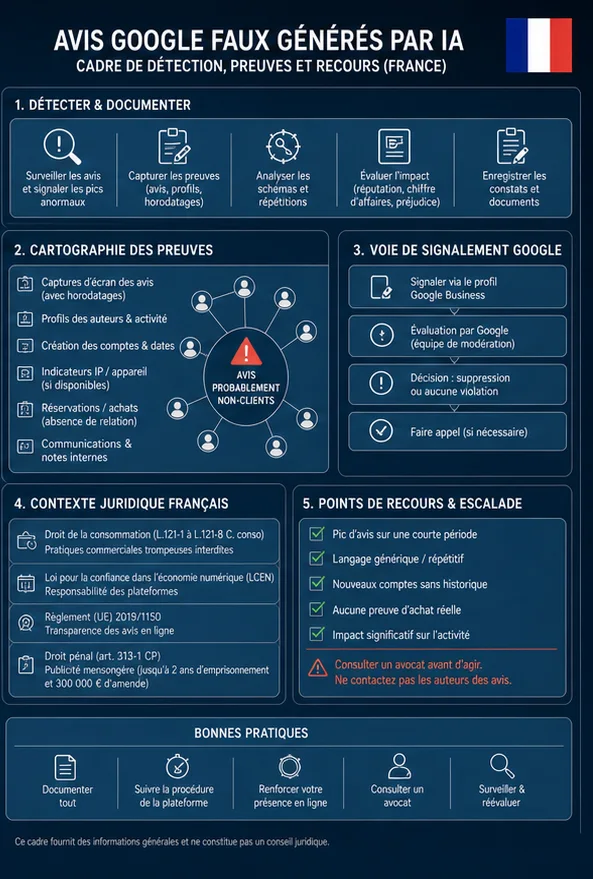
A lawyer-grade file should therefore separate three issues early. First, what pattern makes the review look synthetic: repeated phrasing, improbable chronology, recycled details, or multiple profiles using the same structure. Second, what platform route fits best under Google's policy and the wider consumer-law context of Unfair Commercial Practices Directive 2005/29/EC. Third, what should the business avoid saying publicly until it has checked records, reviewer history, and any privacy limits under GDPR, Regulation (EU) 2016/679.

Evidence Checklist Before Calling It AI-Generated
Preserve the full review URL, reviewer profile, star rating, exact wording, images, timestamps, visible edits, owner replies, and surrounding Business Profile context. Internal checks should test whether the reviewer matches bookings, invoices, consultations, deliveries, complaint files, or other genuine records. A no-match can be important, but only when the search method is documented and proportionate.
Pattern evidence matters as much as the record check. Compare suspicious reviews for repeated sentence architecture, improbable specificity, stock-like praise or criticism, identical emotional cues, machine-like wording, and clustered posting times. Keep that pattern work separate from public accusation. A business should not say bot, AI scam, or competitor automation in public unless the file can support the allegation cleanly.
Google Policy, Synthetic Signals, And Local Consumer Law
Google does not remove a review merely because it sounds polished or machine-assisted. The report should stay focused on the stronger point: the contribution does not appear to reflect a genuine experience, contains misleading or fabricated detail, or forms part of fake engagement. The submission should quote only the needed wording and explain the pattern in factual, restrained language.
In parallel, the business can assess whether the same conduct also fits the wider market-integrity context under Unfair Commercial Practices Directive 2005/29/EC. That matters because synthetic reviews can distort consumer choice even when the wording sounds plausible. The business should also keep internal handling aligned with GDPR, Regulation (EU) 2016/679, especially when comparing customer files, staff data, or private communications while preparing the report.

Public Response Strategy Without Overclaiming
A public reply should usually stay shorter than the internal evidence file. In many cases the safer wording is that the business cannot verify the described experience from available records and invites the author to an official private contact channel. It is riskier to post that the reviewer is a bot, fake profile, or automated attacker before the evidence packet is complete.
Businesses should also avoid bad countermeasures of their own: buying positive reviews, asking staff or family to drown out the post, using synthetic replies that overstate the evidence, or threatening legal steps that the file cannot support. Those moves can worsen Google-policy risk, consumer-law exposure, and credibility in the same dispute.
When Escalation Merits Closer Review
Closer escalation review may be justified when synthetic-looking reviews appear in waves, coincide with a competitor dispute, involve hidden commercial relationships, reuse the same factual template across profiles, or escalate into fraud, safety, extortion, or staff-misconduct accusations. In those files, the business may need a combined strategy: evidence preservation, Google appeals, profile-level reporting, internal compliance review, and measured local legal advice.
The key caution is not to promise outcomes. Google policy does not guarantee removal. Consumer-law context does not guarantee regulator action. Suspicious language alone does not prove automation. The stronger objective is narrower: preserve a coherent record, classify the conduct accurately, and keep every public and private step proportionate to the evidence.
Related PimLegal Reading
For related reading, see our local guide on suspicious reviewer profiles and Google reporting and the Belgium Google review removal page. These two internal links connect fake-review proof with the wider removal and escalation strategy in Belgium.
Selected Official References
- Unfair Commercial Practices Directive 2005/29/EC
- GDPR, Regulation (EU) 2016/679
- Google prohibited and restricted content policy
- Google Business Profile review reporting guidance
- Google legal content removal guidance
Practical Conclusion
A suspicious AI-generated Google review should be treated as a genuine-experience and fake-engagement file, not as a technology buzzword exercise. Preserve the wording, test the customer match, explain the synthetic pattern carefully, and keep public accusations narrower than the proof.
This article is general information only and not legal advice for a specific dispute in Belgium. Businesses should seek local advice before sending formal notices or accusing any person or company of review manipulation.