
How Canadian businesses should handle Google reviews alleging fraud, scams, theft, forged records or dishonest billing. The Canadian strategy should be precise, proportionate and evidence-led. Businesses often move too quickly from reputation anxiety to a takedown demand. A stronger file treats the review as a publication, a Google policy event, a customer-record question and a legal-risk decision at the same time.
For deeper context, read civil and criminal defamation rules in Canada and Google review removal in Canada. Those two Pimlegal resources connect the article to a Canadian and international strategy without turning one review dispute into an overbroad legal threat.

Canadian Legal Issue Framing
For Google review accusing a business of fraud in Canada, the first task is precise classification. The issue is whether the fraud allegation is understood as a serious factual accusation and whether business records can rebut it without exposing personal information. A commercial review can be painful and still lawful. A few words can also be serious if they allege fraud, theft, falsified records, unsafe practice, discrimination, professional misconduct or another fact readers may treat as true.
The Supreme Court of Canada has long recognized reputation as an important legal interest, including in Hill v. Church of Scientology of Toronto. Canadian law also protects expression. WIC Radio Ltd. v. Simpson helps distinguish comment, opinion and factual accusation, while Grant v. Torstar Corp. frames responsible communication on matters of public interest.
The method is therefore more careful than a simple takedown demand. The business should isolate the exact words, assess ordinary meaning, confirm that the business is identified, prove publication to third parties, document what is false or misleading, measure harm and anticipate possible defences. Common law provinces, Quebec civil liability, limitation periods, procedural notice rules and anti-SLAPP procedure can all affect the route.
The Criminal Code of Canada still contains defamatory libel provisions. Those sections do not convert every Google review into a criminal matter. They show why serious accusations should be handled with evidence, restraint and proportionality rather than automatic threats.
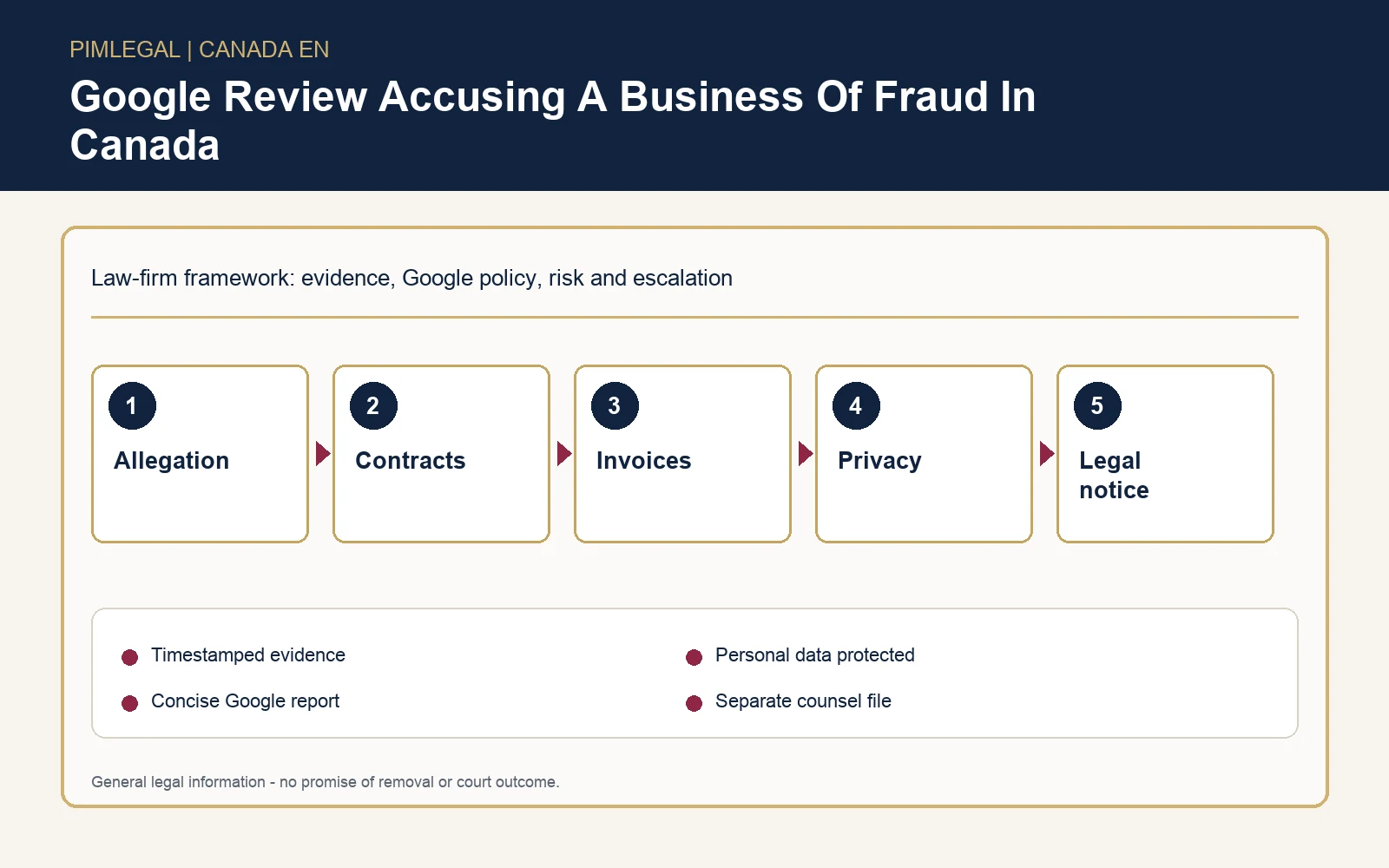
Here the focus is a Google review directly attacking the commercial honesty of a Canadian business. The strongest strategy combines five readings: legal meaning, business records, Google policy, public response and escalation risk. The file is more persuasive when it calmly explains why a specific passage crosses a line instead of calling the whole review malicious.
Evidence Checklist Before Reporting Or Replying
The evidence standard is practical: terms, invoice, payments, refund policy, correspondence, proof of service, prior complaint history and impact on enrolment enquiries should be organized. The file should be understandable to Google, management, opposing counsel and, if necessary, a court. A dated chronology usually does more work than a folder of unexplained screenshots.
- Capture the complete review, rating, reviewer name, profile URL, visible date, images, replies and Business Profile context.
- Take screenshots with the browser address bar visible and save the source URL in a dated note.
- Search CRM, bookings, invoices, payments, refunds, calls, emails, complaints and service records.
- Record who performed the search, when, which systems were checked and which keywords were used.
- Separate public proof suitable for Google from confidential records reserved for counsel.
- Document harm with cancelled enquiries, customer messages, local conversion shifts, partner concerns or internal handling costs.
- Prepare a short platform summary and a fuller legal file without mixing the two.
Privacy must be built in from the start. PIPEDA and relevant provincial privacy rules require care when evidence involves customers, patients, employees, payments or internal files. A record can help the business without belonging in a public Google reply.
For multi-location businesses, each profile should be documented separately. Preserve the affected branch, address, team, date and local customer records. Location confusion is common in Google review disputes and can weaken otherwise strong reports.
Google Policy And Platform Angle
Google removal is not identical to a Canadian defamation claim. The Google Business Profile prohibited and restricted content policy addresses fake engagement, rating manipulation, impersonation, conflicts of interest, harassment, personal information and misleading or irrelevant content. A report is stronger when it maps the review to a specific category.
For this topic, the Google angle is: the platform needs to understand whether the review is false, misleading, harassing, not based on a real experience or exposing personal information. The submission should not read like a pleading. It should identify the review, state the policy category, summarize objective indicators and avoid unnecessary confidential data.
Where ordinary reporting is not enough, the Google Legal Help Center may be relevant. Legal-removal routes should be used carefully. A weak legal submission may be slower and less persuasive than a well-supported policy report. The business should decide whether the main problem is fake engagement, defamation, privacy, harassment, extortion, misleading competition or a mixture.
Canadian competition context also matters. The Competition Bureau has warned about fake online reviews and about employee-posted online reviews where connections are not disclosed. That context does not replace review-specific proof, but it supports a careful market-integrity analysis.
Escalation Criteria And Risk Controls
Escalation should follow the proof. For this file, fraud accusations often justify faster review because they attack probity, compliance and public trust. In practice, escalation may mean a second Google report, a neutral public reply, a preservation letter, a legal notice, identity-focused process, injunctive relief or a civil claim. The sequence should fit the harm.
1704604 Ontario Ltd. v. Pointes Protection Association and Bent v. Platnick show why proceedings connected to public expression may be challenged early. A business should avoid presenting litigation as automatic. It should explain why the review is more than criticism and why the requested remedy is necessary.
Risk cautions are central: answering publicly with payment details or enrolment records can create a privacy problem even where the business is right. The business should also avoid suppressing legitimate reviews, offering improper incentives for removal, posting fake counter-reviews, making unsupported public accusations, disclosing personal information or demanding silence rather than correction of a precise passage.
Measures involving online intermediaries are separate from measures against the author. Crookes v. Newton is useful for publication analysis online, and Google Inc. v. Equustek Solutions Inc. shows that digital injunction issues require serious analysis. These references help only when tied to the facts.
Case Study: Ottawa School Accused Of Being A Scam
A private school in Ottawa receives a review saying it is a scam and unlawfully kept registration fees. Signed terms support the disputed fees and several emails show attempts to resolve the complaint.
A disciplined response begins with preservation, not accusation. The business freezes screenshots, copies URLs, checks records, identifies who may review confidential evidence and decides whether the first route is Google reporting, a public reply, a letter or quiet monitoring.
The file should then be split into three versions. The internal version contains the full chronology and private records. The Google version states the policy category and non-confidential indicators. The external notice version, if needed, quotes only what is necessary and asks for a defined remedy. That separation keeps the strategy firm without broadcasting sensitive information.
If the facts remain uncertain, restraint may be the right answer. A business can preserve evidence, respond carefully and continue checks. Not every harmful review calls for litigation, and not every platform report should include legal threats.
Operational Method For The Business
A Google review dispute should not live only in the owner’s inbox or the marketing team’s chat. It should become a working file. The first page should state the discovery date, affected profile, words complained of, proposed classification, people allowed to see confidential proof and next authorized action. That avoids improvised replies and inconsistent reporting.
The second part should be a sentence-by-sentence chart. Each phrase is classified as opinion, verifiable fact, serious accusation, personal information, threat, conflict of interest or irrelevant content. The next column identifies available proof: contract, invoice, booking record, email, complaint history, internal policy or no customer match. The method forces the business to work with words, not just the feeling created by a low rating.
The third part separates audiences. Google gets a short, objective and non-confidential report. The author, if known, may receive a more precise but proportionate letter. Counsel receives the full file, including private records, hypotheses, risks and measurable harm. The public sees only a careful response if a response is needed.
In the context of a Google review directly attacking the commercial honesty of a Canadian business, timing also matters. Record when the review appeared, when it was captured, when records were checked, when the report was submitted, when Google responded and when the next action was chosen. If the review is edited, preserve the prior version. If the author deletes the profile, early screenshots become essential.
- Do not ask employees to publish fake positive reviews to offset the disputed review.
- Do not offer improper value for removing an honest review.
- Do not expose a customer, patient, employee or payment file in public to prove the reviewer wrong.
- Do not confuse a subjective criticism, even an unfair one, with an automatically defamatory factual allegation.
- Do not threaten litigation before checking province, timing, defences and proof of harm.
The final control is whether the proposed action actually reduces harm. A weak report can be rejected. A long public reply can draw more attention. An aggressive letter can provoke a further publication. A measured strategy can obtain correction, prepare a stronger report or document urgency if legal process becomes necessary.
Canadian Execution Checklist
Before anyone presses report, sends a letter or posts a reply, the business should run a final execution check. The first question is whether the review has been preserved in a form that can be understood later. A screenshot without a URL, a cropped image without profile context or a private note without a date is weaker than a complete capture package. The second question is whether the business has tested its own records with enough discipline to avoid a false denial.
The third question is whether the selected Google category is the strongest available category, not merely the category that feels most serious. Fake engagement is different from harassment. A privacy issue is different from an ordinary unfair review. A conflict-of-interest report is different from a legal-removal request. The business should not force the whole dispute into one label when the facts support a cleaner, narrower path.
The fourth question is whether the public response, if any, is consistent with the legal file. A reply that says the company has no record of the reviewer may be sensible where the record search is complete. A reply that accuses the reviewer of fraud or criminal conduct may be reckless unless that allegation has been verified. A calm response can protect trust while leaving the heavier arguments to the evidence file.
The fifth question is whether escalation will actually improve the position. In some cases, a second structured Google report is better than a letter. In others, a preservation letter is better than a lawsuit. In serious repeated attacks, counsel may need to consider identity, injunctive relief, civil liability and the risk of anti-SLAPP procedure. The route should follow the evidence, not the anger created by the rating.
For a Google review directly attacking the commercial honesty of a Canadian business, a useful manager summary is simple: what was said, why it matters, what records prove or disprove it, what Google rule fits, what private information must stay protected, what harm has been observed and what action is authorized next. That summary helps keep customer service, marketing, management and counsel aligned.
Practical Conclusion
The practical answer to Google review accusing a business of fraud in Canada is evidence-led. A Canadian business should preserve the review, classify the words, check records, select the strongest Google policy category, protect personal information, measure harm and choose a proportionate remedy. That remedy may be a report, public reply, legal notice, identity step or no immediate public action.
This content is informational only. It does not promise removal, does not replace local legal advice and does not mean every negative review is unlawful. The value of a law-firm approach is that it challenges false or abusive content while respecting legitimate criticism and avoiding a second reputation problem.
Key References
- Google Business Profile policy: fake engagement, conflicts of interest, harassment, personal information and rating manipulation.
- Hill v. Church of Scientology of Toronto: reputation as a protected interest in Canadian law.
- Grant v. Torstar Corp. and WIC Radio Ltd. v. Simpson: responsible communication, opinion and comment.
- Criminal Code of Canada defamatory libel provisions: criminal-law context requiring caution and proportionality.
- Competition Bureau Canada: fake-review and review-manipulation context.