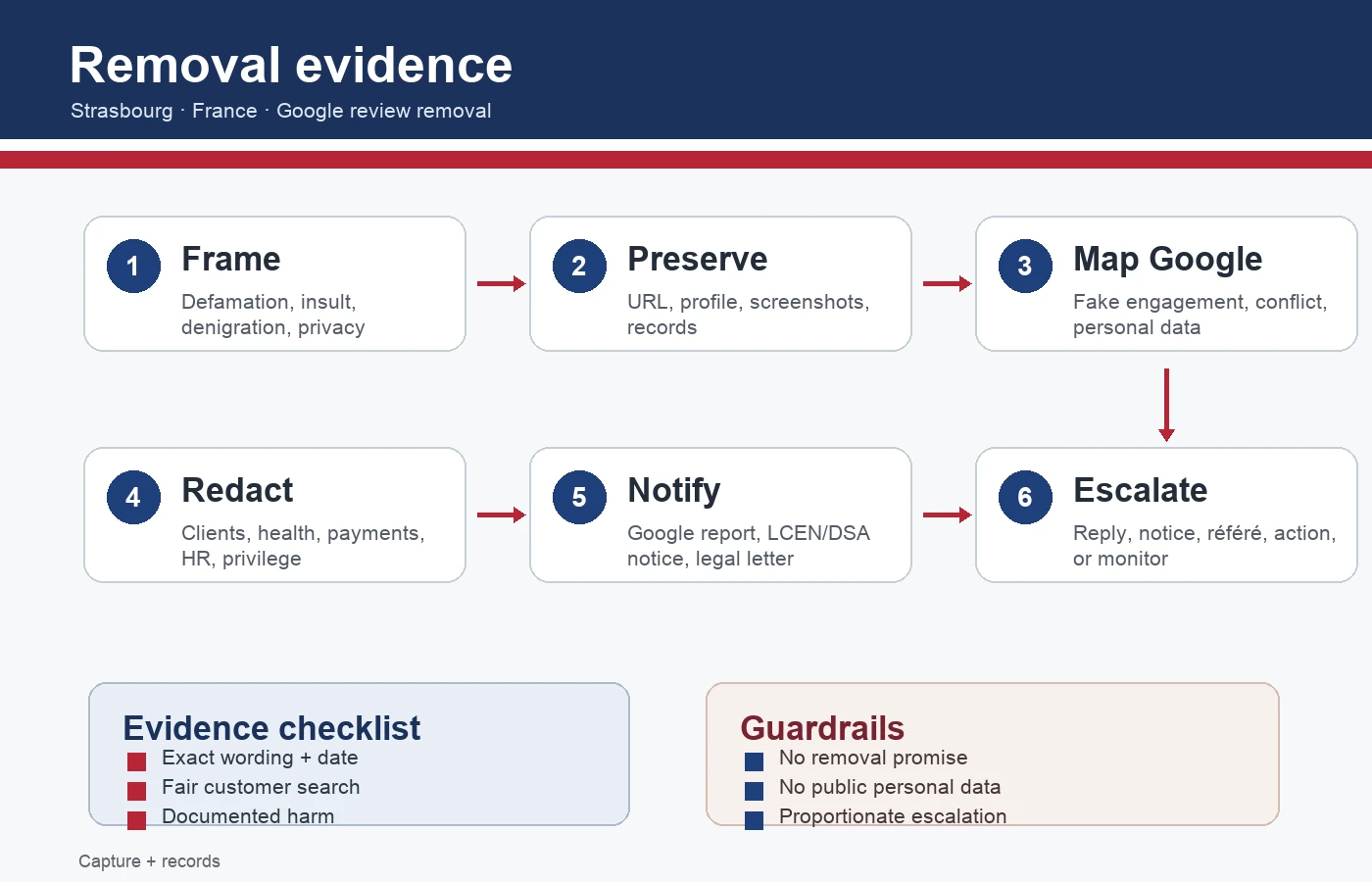
A France evidence checklist for Google review removal: screenshots, URL, reviewer profile, customer records, technical preservation, privacy controls and escalation file. For an English-speaking business operating in France, a harmful Google review is not just a marketing problem. It is a publication, an evidence event, a platform-policy issue and sometimes a French legal risk.
Read this article together with the France English guide to fake customer review evidence and France English Google review removal service. These two internal PimLegal links place the topic inside the France English resource library, country service page and wider online reputation strategy.
Legal issue framing: start with the exact words
The matter concerns the evidence packet to prepare before a Google report, appeal, legal notice or court step. In France, the first mistake is to start with the star rating or the business owner's understandable frustration. A one-star review, sharp tone or unfair-looking sentence is not automatically unlawful. The review must be read through its exact wording, publication context, target, evidence, author status and commercial impact.
The central issue is making the file readable, dated, proportionate and usable for Google, counsel, a bailiff or a court. That question controls the route. A factual accusation can raise defamation under the Law of 29 July 1881. Purely abusive wording may be analysed as insult. Statements attacking products, services or market conduct can point toward denigration or unfair competition. Personal names, health details, payment data, employee facts or customer records create a separate GDPR and CNIL layer.
French press law is precise. Article 29 of the Law of 29 July 1881 distinguishes defamation from insult. Article 65 makes timing critical because press-law claims have short limitation constraints. A business should not threaten proceedings in panic, but it should audit the publication date, legal category and available evidence quickly.
The file should also ask whether Article 1240 of the French Civil Code, denigration or unfair-competition analysis fits better than a press-law claim. Not every harmful review is defamation. A poor legal category can create limitation, admissibility, credibility and proportionality problems.
Evidence checklist: preserve before replying
For this issue, the priority evidence is: full screenshots, URL, profile, date, rating, photos, history, CRM searches, mandates, emails, calls, technical capture, harm proof and preservation log. Evidence should be preserved before any emotional public reply, before direct confrontation with the reviewer and before an underprepared Google report. Reviews can be edited, profiles can change and screenshots can lose context.
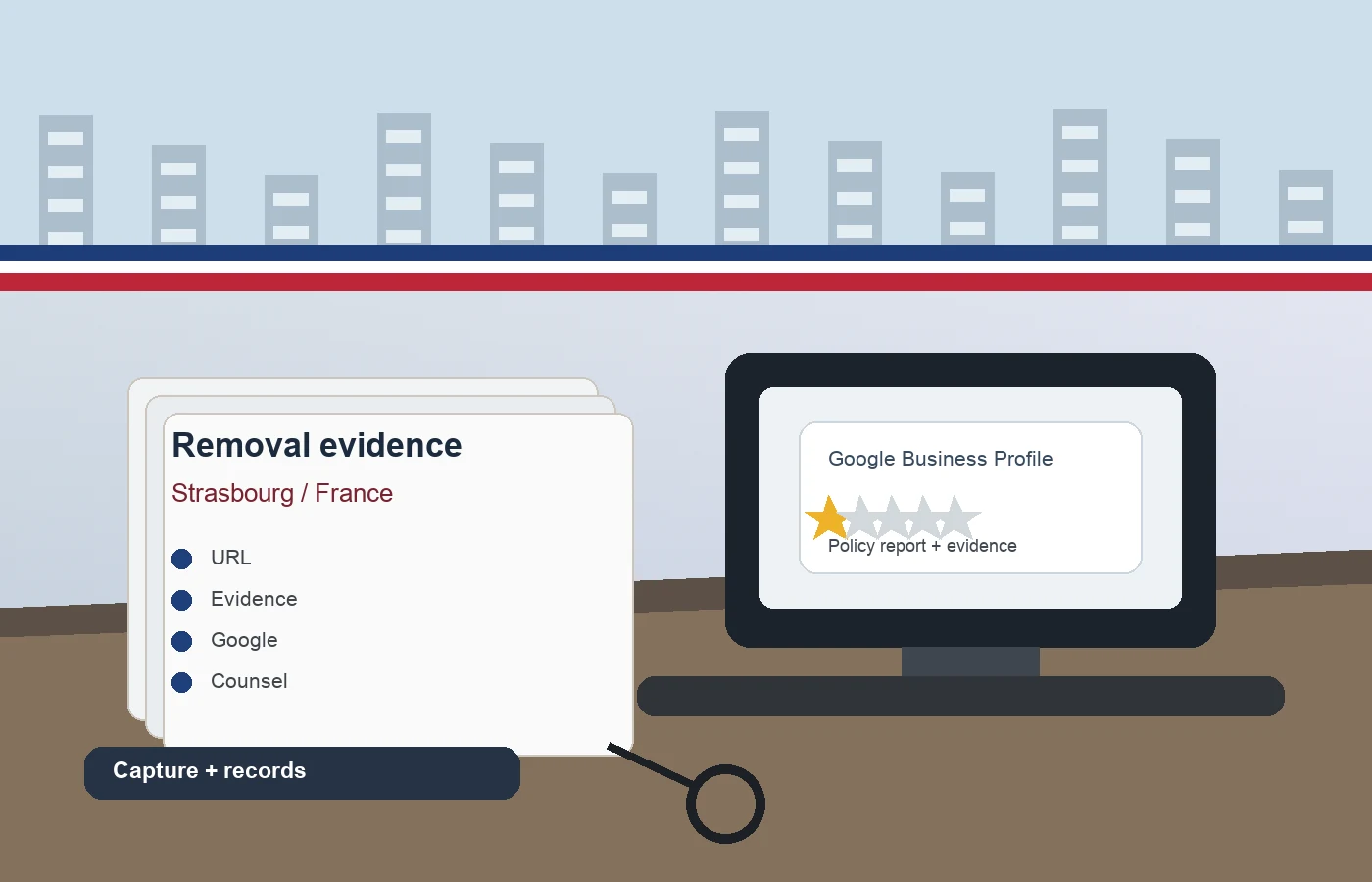
The evidence file should include the full URL, the affected Google Business Profile, reviewer name or pseudonym, profile link, visible date, star rating, exact text, photos, public replies, report IDs and the location or branch affected. Cropped screenshots may help presentation, but they should not replace original full-page captures. For serious matters, a bailiff-style capture by a commissaire de justice or a reliable technical capture can strengthen the file.
Electronic evidence is not excluded as such. Article 1366 of the French Civil Code addresses the evidential value of electronic writing where identification and integrity are established. If evidence may disappear before proceedings, Article 145 of the Code of Civil Procedure may be relevant to a pre-action preservation strategy. These tools are not automatic solutions; they are part of a proportional evidence plan.
- Capture the full review, URL, profile, date, rating, photos and business profile context.
- Search customer, booking, invoice, CRM, email, call, refund and complaint records fairly.
- Classify each sentence as opinion, factual allegation, insult, personal data, threat, conflict of interest, fake engagement or lawful criticism.
- Keep separate versions for Google, counsel, internal decision-makers and any public response.
- Redact sensitive information before external use, especially health, payment, employee, minor, client or privileged information.
- Record harm carefully: lost inquiries, cancellations, prospect messages, rating change and internal cost.
Case example: Strasbourg estate agency and no customer match
A Strasbourg estate agency is accused of fake visits and hidden fees. The profile is unknown, but several staff members managed similar files; the internal check must be methodical.
The first operational step is not a threat letter. The business should freeze the evidence, identify an internal owner for the file and stop staff from improvising replies. It should then test whether the reviewer could be a real customer, whether the review refers to an actual incident, whether there are similar posts and whether any threat, refund demand or competitor signal preceded publication.
The file should be split into three layers. The Google layer is short, policy-focused and non-confidential. The legal layer is more detailed and records the French legal category, evidence and possible escalation. The business layer records commercial impact, customer communications and the desired practical outcome: removal, correction, de-escalation, preservation, identification or a measured public response.
Lawyer-style working file for an English-speaking business
For an English-speaking company in France, the working file should be written so that a French lawyer, a Google reviewer, a manager outside the country and a future judge can all understand the same facts. The first page should identify the business profile, location, language of the review, discovery date, screenshot date, person responsible for the file and next approved step. This simple front page prevents marketing, customer service and management from sending inconsistent messages.
The second page should be a sentence-by-sentence table. Column one quotes the exact words. Column two translates or explains any French wording if the internal team works in English. Column three classifies the statement as opinion, fact, insult, personal data, threat, conflict of interest, fake engagement or normal customer criticism. Column four lists the available proof. Column five states the intended route: monitor, public reply, Google report, preservation letter, legal notice, emergency review or no action.
The third page should address proportionality. A single rude but genuine customer review may not justify the same response as a coordinated no-customer attack, a fraud accusation, a publication of medical data or a demand for money. The company should record why the chosen step is narrower than the whole review where possible. Narrower requests are often more credible: remove the unlawful phrase, remove a photo, redact personal data, preserve identity information or review a cluster of suspicious posts.
The fourth page should protect confidentiality. French review disputes often involve health, employment, payment, education, hospitality, legal or regulated-service records. Those records may prove the business is right, but they should not automatically be uploaded to Google or repeated in a public reply. The file should mark which exhibits are internal only, which can be used by counsel, and which redacted facts can safely support a platform submission.
Google policy angle
The Google packet should be shorter than the internal archive: policy category, non-confidential facts, minimal proof and a clear request.
Google's Business Profile content policy focuses on platform categories such as fake engagement, conflicts of interest, harassment, personal information and content that does not reflect a genuine experience. The review reporting tool is not a court filing. It needs clear moderation logic: which review, which policy, which non-confidential proof and what request.
A strong Google packet does not merely say 'this is defamatory'. It explains that the reviewer does not match a verified customer, that a factual accusation is false, that the account appears conflicted, that the review exposes personal data or that several reviews show a coordinated pattern. Each point should be linked to a simple exhibit that does not reveal unnecessary private information.
Escalation criteria: LCEN, DSA, notice and injunction logic
The legal file should include uncertainty and negative searches; no customer match should be shown by method, not just asserted.
French and EU frameworks reward precision. The LCEN is relevant to online content notification and cautions against bad-faith removal requests. The Digital Services Act reinforces notice-and-action structure for platforms: identify the content, explain the reason, provide contact details and preserve traceability. Neither text guarantees removal; both help structure a serious notice.
French case law also stresses proportionality. In Cour de cassation, 1st civil chamber, 26 February 2025, no. 23-16.762, the removal discussion involving Google Ireland turned on issues such as manifest unlawfulness and proportionality. For Google reviews, that means the requested measure should be tied to the specific passages and evidence, not to a broad dislike of criticism.
Escalation becomes more plausible where the review alleges crime, fraud, unsafe conduct, discrimination, falsification, data breach, misleading practices or an organised campaign. It also becomes more serious where there is no matching customer record, threats preceded the review, several profiles act together or contemporaneous commercial harm is documented.
Emergency relief or référé logic may be considered where the disturbance appears manifestly unlawful, evidence is strong and continued publication creates serious ongoing harm. Urgency does not remove the need for precise framing. Courts remain attentive to freedom of expression, proportionality, the wording targeted and whether the requested measure is narrower than the entire criticism.
Risk cautions
The main risk is sending uncensored customer documents to Google, cropped screenshots or a timeline reconstructed after the dispute. A business can be right on the merits and still damage its position through its reaction. Public replies that disclose personal data, add new accusations or threaten disproportionate action may become a second publication problem. Overstated Google reports can also look like attempts to suppress lawful criticism.
Fake reviews also have a consumer-law dimension. Article L.111-7-2 of the French Consumer Code addresses transparency in online reviews, and the DGCCRF has identified fake-review practices that can mislead consumers and distort competition. That market context is useful, but it does not replace proof for the specific Google review.
The GDPR matters when a review or a reply includes personal data. The GDPR and CNIL erasure guidance support analysis of erasure, minimisation, objection and limits linked to freedom of expression. In practice, businesses should not upload full customer files, health details, payment records or HR material to Google unless carefully redacted and necessary.
Public response: short, calm and privacy-safe
A public response is not a pleading. It is read by future customers before any legal decision is made. A safe response is usually short, respectful and data-minimising. It may say that the business takes the matter seriously, cannot match the facts as described with available records and invites the reviewer to contact a private channel. It should not expose the customer relationship or argue the entire legal file.
If a Google report or legal notice is under consideration, the public response should remain consistent with that strategy. Avoid statements that admit contested facts, promise compensation, insult the reviewer or publicly accuse the reviewer of fraud without a reviewed evidential basis.
Practical conclusion
Good evidence does not guarantee removal, but it improves the quality of the review and protects the business if escalation becomes necessary.
This article is informational only. It does not promise removal, damages, an injunction, reviewer identification or any Google outcome. The right route depends on the exact wording, publication date, proof, author status, sector, personal data issues and harm level. Formal action in France should be reviewed on the complete facts.
Official sources used
- Article 29 of the Law of 29 July 1881: French definitions of defamation and insult.
- Article 65 of the Law of 29 July 1881: short limitation period concerns for press-law offences.
- Article 1240 of the French Civil Code: civil liability framing for fault, harm and causation where the 1881 law is not the right route.
- Article 1366 of the Civil Code and Article 145 of the Code of Civil Procedure: electronic writing, integrity, identification and pre-action evidence preservation.
- Article L.111-7-2 of the Consumer Code and the DGCCRF guidance on fake online reviews: transparency, consumer review integrity and misleading-practice risk.
- LCEN, the Digital Services Act and Cour de cassation, 1st civil chamber, 26 February 2025, no. 23-16.762: notice-and-action logic, manifest unlawfulness and proportionality.
- GDPR and CNIL guidance on erasure: personal data, erasure rights and limits linked to freedom of expression.
- Google Business Profile prohibited and restricted content and Google review reporting tool: platform categories and reporting workflow.