
A practical France guide to preserving a disputed Google review, avoiding admissions, applying platform policy and escalating without compromising an active dispute.
Why Fact Versus Opinion Is The First Legal Question
A Google review published while a contract, employment, tenancy, refund, professional-service or other dispute is unresolved creates two records at once: a public platform record and a private dispute record. In France, the fact that a dispute exists does not by itself make criticism false, unlawful or removable. The task is to identify each verifiable factual allegation, separate it from opinion, and keep the public response consistent with the evidence and the position taken in the underlying matter.
Labels do not decide the issue. Writing “in my opinion” does not automatically convert a concrete accusation into protected opinion, while a vivid phrase may be obvious exaggeration when read with the star rating, images and surrounding narrative. A disciplined file identifies the implied facts supporting the evaluation, what the reviewer appears to claim first-hand, and what can actually be proved or disproved. That classification guides platform reporting, public response and any legal advice; it does not promise removal or a court outcome.

Evidence Checklist: Test Each Sentence, Not The Overall Tone
Preserve the review as it appeared, its URL, profile, date, rating, images, edits and owner responses. Keep the underlying agreement, notices, invoices, messages, call logs and a dated chronology in a controlled file. Record who collected each item and preserve native files where practical. Ask local counsel whether formal preservation duties, confidentiality rules or procedural deadlines apply; do not delete inconvenient records or create documents that pretend to be contemporaneous.
Preserve the complete review URL, reviewer profile, rating, publication date, exact text, photographs, visible edits and every owner reply. Then build a sentence table with four columns: exact words, proposed classification, available proof and proposed action. Useful classifications include verifiable fact, value judgment, rhetorical exaggeration, personal insult, private information, threat, off-topic content and possible fake engagement. Keep the original capture separate from annotated working copies so the evidence remains intelligible.
Match each factual proposition to contemporaneous material: contracts, bookings, invoices, payment and refund records, service logs, messages, policies, staff rosters and lawful CCTV retention. Record gaps as carefully as contradictions. Do not publish confidential customer files merely to win the public argument. If translation matters, preserve the original language and a careful working translation. The Google-facing packet should contain only the shortest non-confidential material needed for the chosen policy category; the fuller chronology belongs in the internal or lawyer file.
Google Policy And The Local Legal Frame
Google says a review is not eligible for removal merely because a business disagrees with it. The policy analysis should therefore remain separate from the local defamation analysis. A genuine but harsh opinion may comply with policy. A review may instead fit fake engagement, misrepresentation, harassment, personal information or another rule when the facts support that category. A legal request is a different route and should identify the exact URL, exact passage, local right relied on and why the requested action is proportionate.
For France, the working legal source is Loi du 29 juillet 1881 sur la liberte de la presse. It should be read with current local case law and procedure before any formal notice. Depending on the jurisdiction and context, the distinction may involve truth, honest opinion or fair comment, serious harm, reputation of legal persons, privacy, insult, public interest and available defences. Businesses should avoid copying a legal test from another country or treating a policy rejection as a final judicial decision.

A Public Response That Does Not Worsen The File
A public answer should usually be shorter than the evidence file. It can acknowledge the concern, say that the business is checking the matter against its records and invite the reviewer to a verified private channel. Avoid repeating the most damaging allegation, exposing personal data, calling the reviewer a liar or threatening proceedings before the classification and proof are complete. A restrained reply preserves options and reduces the risk that the business creates a second harmful publication of its own.
When Escalation Deserves Local Legal Review
Escalate carefully where proceedings have begun or are reasonably expected, a limitation or response deadline is near, confidential or privileged material is exposed, the review threatens witnesses or staff, the allegations affect a licence or regulator, or the public post materially contradicts formal evidence. Coordinate the platform report, public reply and legal correspondence so one channel does not undermine another.
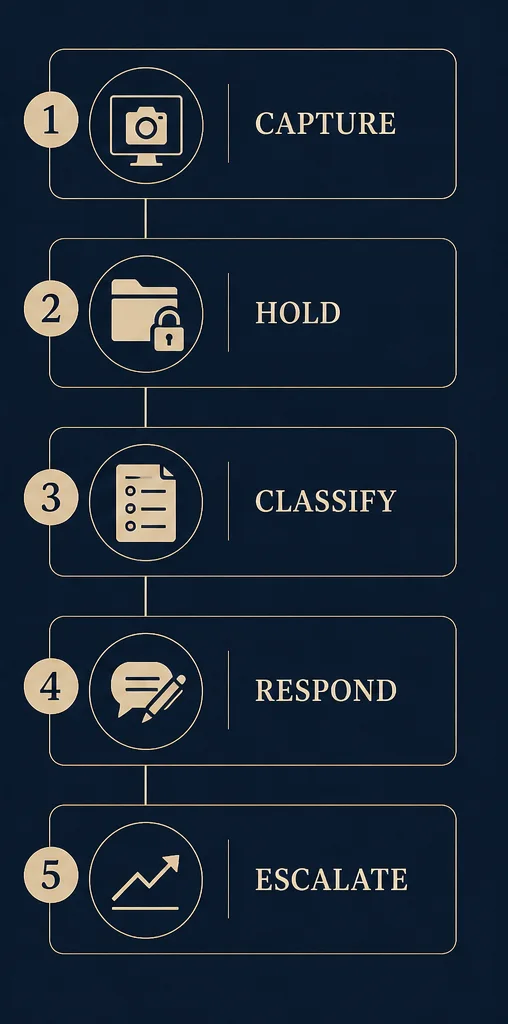
Closer local review may be justified when a passage alleges crime, fraud, professional misconduct, unsafe treatment or regulatory breach; names staff; discloses private information; affects licences or financing; appears across coordinated profiles; or is linked to threats or extortion. Escalation should still be staged: preserve, classify, report under the narrowest honest policy ground, assess a correction request or legal notice, and consider proceedings only with local advice on evidence, deadlines, jurisdiction, cost and proportionality.
Related PimLegal Reading
For the wider legal framework, read our local guide to civil and criminal defamation rules and the France Google review removal page.
Selected Authoritative References
- Loi du 29 juillet 1881 sur la liberte de la presse
- DGCCRF guidance on fake consumer reviews
- Google Maps prohibited and restricted content policy
- Google Business Profile review reporting guidance
- Google legal content removal guidance
Practical Conclusion
Treat the review and the underlying dispute as connected but distinct files. Preserve first, map allegation to evidence, classify the Google-policy issue, approve a restrained public response and then choose a proportionate local legal step if needed. That sequence protects consistency and credibility, but it cannot guarantee removal, settlement, regulator action or court relief.
This article provides general information only and is not legal advice for a specific dispute in France. Obtain local advice before sending a formal notice, disclosing confidential records, making allegations about a reviewer or assuming that Google, a regulator or a court will act.