
What businesses should document before reporting suspicious Google reviews in Indonesia. In Indonesia, a serious Google review dispute should be treated as a defamation, electronic-information, evidence and platform-governance matter, not only as a marketing problem. A harmful review may be lawful consumer criticism, but it may also contain a false factual imputation, fake engagement, personal information, harassment, threats or coordinated commercial pressure. A law-firm approach starts by identifying which category is actually supported by evidence.
For evidence preservation for fake customer reviews in Indonesia, the objective is not to promise deletion. It is to build a file that can be read by Google, the reviewer, opposing counsel and Indonesian counsel without embarrassment. The file should be calm, dated, source-linked and proportionate. It should separate what is provably false from what is merely unfair, unpleasant, exaggerated or subjective.
This distinction matters because Indonesian online-reputation strategy now sits at the intersection of the ITE Law as amended by Law No. 1 of 2024, the new Criminal Code in force from 2 January 2026, constitutional jurisprudence on electronic defamation, ordinary civil correspondence, privacy-sensitive business records and Google Business Profile policy. The same capture may be used in a Google report, a lawyer's notice, a negotiation, a complaint assessment or a court file. If the capture is weak at the start, every later step is weaker.

Law-Firm Analysis: What Must Be Proved
In the working scenario, a Bali villa operator receives seven reviews within one weekend from accounts that never booked a stay, repeat similar complaints about a non-existent pool incident and appear after a commission dispute with an online agent. Counsel should first read the review like a pleading. Who is identified? Which words are factual? Which words are opinion, insult, exaggeration or rhetorical anger? What would an ordinary reader understand in the context of a Google Business Profile in Indonesia? Does the text accuse the business, owner or staff of conduct that can be proved true or false?
The legal issue is not simply that the reviews are anonymous; it is whether the business can show absence of a customer relationship, objective signs of manipulation and false factual content. A one-star rating, a vague complaint or a sentence such as bad service can damage a business, but it may not justify an aggressive legal route. A concrete allegation of fraud, cheating, forged documents, dangerous service, unlawful licensing, discrimination, bribery, criminal conduct or disclosure of private facts needs a different analysis because it can affect trust, regulated relationships and commercial opportunity.
The lawyer then tests identification, publication, falsity, harm and possible defences. Identification is usually clear because the review appears on the business profile. Publication is usually clear because the review is visible through Google Search and Maps. The difficult work is falsity and harm: the business must show why the allegation is materially untrue, why records support that conclusion and how the review affects reputation, inquiries, bookings, staff safety, partner confidence or regulatory risk.
Indonesian Defamation Framework In 2026
Law No. 1 of 2024 changed the electronic defamation route by inserting Article 27A into the ITE framework. For Google reviews, the practical point is that the law focuses on an intentional attack on honour or good name by accusing someone of a matter so that it becomes publicly known through electronic information or electronic documents via an electronic system. The wording is closer to a targeted imputation analysis than the older, broader Article 27(3) formulation.
The current Criminal Code, Law No. 1 of 2023, has been in force since 2 January 2026. For review disputes, counsel should read the Criminal Code provisions on insult and defamation together with the ITE framework, instead of treating Google as a purely technical moderation issue. The fact that content appears online does not remove the need to analyse the words, the complainant, the author, publication, exceptions, public-interest context and proportionality.
Constitutional Court jurisprudence is essential. Decision No. 50/PUU-VI/2008 and the later report on Decision No. 36/PUU-XX/2022 confirm that electronic defamation under the ITE framework should not be detached from the underlying Criminal Code norms. The Court's approach helps a business avoid a lazy argument that anything negative online is automatically illegal. It also helps counsel explain why some reviews are lawful criticism while others cross into actionable imputations.
Decision No. 105/PUU-XXII/2024, recorded on the official BPK page for Law No. 1 of 2024, is also important because it narrows phrases used in Article 27A and Article 45(4). For businesses, the practical lesson is caution: a company should not assume that every criminal electronic-defamation theory is available in the same way to every entity. Local Indonesian counsel should assess whether the injured party is an individual, officer, profession, institution, corporation or other category, and whether a civil, platform or personal-complainant route is more suitable.
Civil Route, Criminal Route Or Google Route?
A Google report is usually the fastest route when the content clearly violates platform policy. A civil-style letter or mise en demeure is useful when the author or organiser is known and correction, withdrawal or non-republication is realistic. Criminal-law assessment may be relevant for grave imputations, but it should not be used casually as leverage in an ordinary customer dispute. A business that overstates criminal risk can turn a review problem into a speech-rights problem.
The decision should be evidence-led. If the review is a protected opinion about taste, price, waiting time or service attitude, the best route may be a measured public response or no legal escalation. If the review alleges bribery, forgery, unsafe service, fake qualifications, theft, discrimination or a non-existent transaction, counsel can assess Google policy, legal notice and formal remedies. If a cluster of reviews appears after a business conflict, the pattern may matter as much as the wording.
Strategic sequencing is critical. If the business sends a threatening notice before preserving evidence, the author may edit or delete the review. If the business posts a hostile public reply before counsel reviews the wording, that reply may become a second publication. If the Google report is vague, Google may reject it and later escalation becomes harder. The stronger sequence is preservation first, legal classification second, platform-policy mapping third, and only then a notice or formal step.
Digital Evidence In Indonesia: Screenshots Are Only The Start
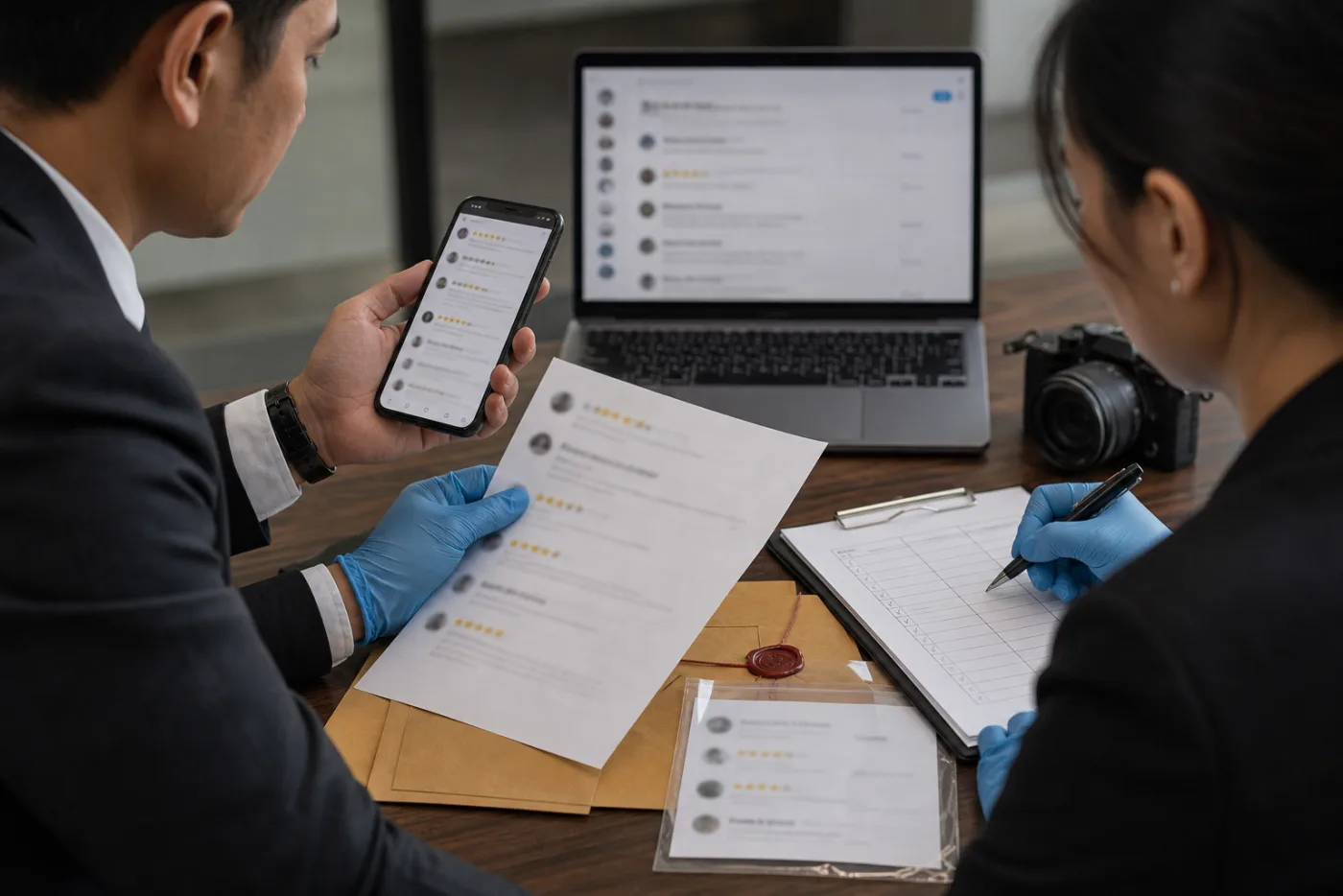
The villa should preserve booking-system searches, OTA records, guest registration forms, payment logs, WhatsApp messages, CCTV-retention notes where lawful, profile URLs, timestamps and wording similarities. A screenshot is useful, but it is not a complete evidence file. It should show the full review, the Google Business Profile name, the review URL, the author profile, the star rating, the publication date, any attached images, owner replies and the browser address. If the review is edited, each version should be preserved separately with a dated note.
The ITE framework recognises electronic information, electronic documents and printouts as legally significant evidence, but the practical value of a capture depends on integrity and context. A law-firm file should include a capture log recording who captured the content, when, on which device, from which URL, whether the browser was logged in, where the original file is stored and how working copies were made. If litigation or a police report is realistically contemplated, counsel may consider notarial, forensic or officer-in-charge support.
Business records must be preserved with the same care as public screenshots. Depending on the sector, the file may include invoices, booking data, guest registration forms, customer chats, call notes, refund requests, payment records, CRM searches, staff statements, licensing records, inspection notes and complaint history. The point is not to send all confidential records to Google. The point is to prove the business position privately while sending only necessary, redacted, policy-relevant material to the platform.
Digital evidence should also capture pattern indicators: review timing, repeated language, author profile history, whether several profiles reviewed the same competitors, whether the reviews appeared after a dispute, and whether threats or negotiation messages mention online pressure. In Indonesia, where reviews may be written in Bahasa Indonesia, English or mixed language, preserve the original wording and any translation used for counsel or Google.
Indonesia Case Study: From Review To Strategy
Assume the client is a Bali villa operator. The villa exports reservation searches, freezes the Google URLs, creates a chronology from the agent dispute to each review and submits a short policy pack before posting any public reply. The first deliverable is not a threat letter. It is a review matrix with four columns: exact review wording, internal evidence, Google policy category and Indonesian legal risk. This matrix makes the file readable and prevents the business from mixing emotional objections with provable facts.
The second deliverable is a chronology. It records when the customer relationship did or did not exist, when the disputed event allegedly occurred, when the review appeared, whether the profile posted elsewhere, whether similar wording appeared from other accounts and whether the review affected calls, bookings, walk-ins, staff safety or partner confidence. Chronology often turns a frustrated complaint into a credible case.
The third deliverable is a remedy recommendation. Counsel may recommend no action if the review is genuine opinion and the proof is weak. Counsel may recommend a public reply if future customers need reassurance. Counsel may recommend Google reporting if the policy breach is clear. Counsel may recommend a notice if the author is known and correction is realistic. Counsel may recommend formal proceedings only when the content, evidence, harm, complainant status and proportionality justify that step.
Google Policy Strategy For Indonesian Review Disputes
Google's fake-engagement route works best when the submission shows no matching guest, clustered timing, repeated language and a plausible conflict indicator without overloading the moderator. Google does not remove content merely because a business dislikes it or calls it defamatory. A report should map the facts to a policy category. Fake engagement requires indicators that the reviewer did not have a genuine experience or that reviews were manipulated. Harassment requires different facts. Personal information requires showing what private data was exposed. Irrelevant content requires explaining why the review is not about the business experience.
A good Google submission is short, sourced and non-emotional. It identifies the review URL, the business profile, the exact policy category, the supporting facts and the attachments. It avoids privileged legal analysis, excessive personal data and unsupported accusations. The goal is to help a moderator make a policy decision, not to litigate Indonesian defamation law inside a web form.
If Google refuses removal, repeating the same weak report is rarely the best next move. Counsel should review the rejection, improve the evidence, decide whether the problem is policy breach or local-law defamation, and choose between an updated report, a public response, a legal notice, negotiation, a law-enforcement complaint assessment or a civil route. The refusal may reveal that the legal theory is stronger than the platform theory, or the opposite.
Legal Notice And Mise En Demeure Strategy
A notice is most useful when there is a credible organiser, such as an agent, competitor, former employee or vendor connected by contemporaneous correspondence or threats. The French phrase mise en demeure is useful as a practical concept: a formal demand that fixes the dispute, preserves rights and gives the recipient a fair chance to remove, correct or stop the harmful publication. In Indonesia, the notice should be drafted as if it may later be read by the author, Google, opposing counsel, a prosecutor, a judge or a regulator.
The notice should not claim that every negative sentence is unlawful. It should identify the exact defamatory or policy-violating passages, explain the evidence of falsity, request preservation of accounts and communications, demand withdrawal or correction where justified, reserve civil and criminal remedies only where proportionate and give a reasonable response deadline. That tone is firmer than a customer-service email but more disciplined than a threat.
Calling every unknown reviewer fake can look speculative; the file should distinguish no-match records, pattern evidence and independent conflict proof. For that reason, the public response, Google report and legal notice must tell the same factual story. If the public response says the business cannot identify the customer, the notice should not later assert a different identity without explaining the new evidence. If the Google report says fake engagement, the legal file should show why that label is supported.
Public Response Without Creating New Risk
A public response may be useful because customers often read the review before any removal decision. The response should be brief, factual and privacy-safe. It can say that the business takes the issue seriously, cannot verify the described facts in available records, and invites the reviewer to contact a named channel. It should not disclose invoices, medical facts, legal files, employee data, settlement details or accusations about the author unless counsel has approved the wording.
The best response is written for future readers, not for the reviewer. It reassures customers that the business has a process and avoids escalating the dispute. It also supports the legal file by showing that the business acted proportionately and did not use legal language to silence legitimate criticism. That balance matters in Indonesia because reputation, electronic speech, consumer criticism and platform governance all sit in the same dispute.
References For An Indonesia Review-Defamation File
- Law No. 1 of 2024 on the second amendment to the ITE Law, the current electronic-information framework for attacks on honour or reputation through electronic systems, including Article 27A and Article 45(4).
- Law No. 1 of 2023 on the Indonesian Criminal Code, in force from 2 January 2026, including the current Criminal Code framework for insult and defamation offences.
- Constitutional Court report on Decision No. 36/PUU-XX/2022 and Decision No. 50/PUU-VI/2008, explaining that electronic defamation under the ITE framework must be read with the Criminal Code defamation norms and applied carefully.
- Constitutional Court Decision No. 105/PUU-XXII/2024 as recorded on the official BPK page for Law No. 1 of 2024, relevant to the meaning of "orang lain" and "suatu hal" in Article 27A/45(4).
- Google Business Profile prohibited and restricted content policy, including fake engagement, harassment, personal information and irrelevant content categories.
- Google Business Profile help on reporting inappropriate reviews, the operational channel for evidence-led review reports.
References should be used with discipline. A citation to Law No. 1 of 2024 does not make a review defamatory by itself. A citation to the new Criminal Code does not mean a criminal route is proportionate. A citation to Google policy does not replace proof. The references are tools for structuring the file, choosing the right forum and keeping the business response credible.
Two Internal Resources
For the broader country service page, see the Indonesia Google review removal page. For cross-border reputation strategy, escalation and service context, see the Pimlegal online reputation hub. These two internal resources help place the Indonesia article inside Pimlegal's wider online reputation framework.
Practical Counsel Checklist
- Capture the review with full URL, author profile, date, rating, text, images, business profile, owner replies and sorting context.
- Preserve internal records before contacting the author or replying publicly.
- Separate verifiable factual imputations from opinion, insult, exaggeration and genuine customer dissatisfaction.
- Map each problem to the correct route: Google policy, public response, legal notice, civil assessment, criminal-law assessment or no action.
- Check complainant status, Article 27A/45(4) limits and the new Criminal Code framework with Indonesian counsel before using criminal-law language.
- Prepare electronic-evidence support early, including capture logs, original files, translations and chain-of-custody notes.
- Keep public replies short, privacy-safe and consistent with the platform report and legal notice.
- Measure harm with contemporaneous proof such as lost bookings, client messages, staff impact, partner concern and rating movement.
- Use formal escalation only when the content, evidence, author identity, urgency and proportionality support that step.
The practical conclusion is that an Indonesian Google review dispute is strongest when it is treated like a legal evidence file from the first hour. Preserve the digital record, classify the words, test the customer file, choose the correct Google policy category, draft a proportionate notice and keep the public response disciplined. That approach gives the business the best chance of removal, correction, deterrence or negotiated resolution without turning a harmful review into a larger public dispute.
This article provides general information for online reputation and Google review strategy. It is not Indonesian legal advice for any specific complaint, limitation period, court filing, police report, electronic-evidence submission or platform legal request. Before formal action, the facts, jurisdiction, complainant status, evidence and proportionality should be reviewed by qualified Indonesian counsel.