
How Brazilian businesses can publicly respond to a negative Google review without undermining privacy, evidence, or legal strategy. In Brazil, a problematic Google review should be treated as a public publication, a digital-evidence event, a reputational risk, a platform-policy issue, and a possible legal matter. Rushing to erase it can damage the file; the strategy starts with exact words, context, evidence, and proportionality.
This article addresses an owner response that reassures future readers without revealing data, adding accusations, or contradicting the legal route. A company should not try to remove every criticism. Customers can complain, rate poorly, and describe real experiences. Legal action becomes stronger when it precisely identifies what is false, abusive, personal, coordinated, or contrary to Google policy.

Brazilian Legal Framework: Objective Honor, Unlawful Act, Marco Civil, And LGPD
For an owner response that reassures future readers without revealing data, adding accusations, or contradicting the legal route, Brazilian analysis starts with the Federal Constitution, especially protection of honor, image, private life, right of reply, and indemnification in article 5. That protection coexists with freedom of expression, information, and consumer criticism. The practical question is not whether the review is unpleasant. It is whether the review crosses from lawful criticism into false fact, personal-data exposure, abusive attack, or manipulated campaign.
On the civil side, the Civil Code structures unlawful act, abuse of rights, and the duty to repair harm, especially through articles 186, 187, and 927. Article 52 also helps when applying personality-rights protection to legal entities where compatible. In business-reputation work, the relevant concept is objective honor: commercial trust, credit, good name, professional image, and standing before customers. STJ Sumula 227 confirms that a legal entity may suffer moral damage, but a disciplined file still shows realistic reputational impact.
On the criminal side, the Penal Code addresses calunia, difamacao, and injuria in articles 138, 139, and 140. These terms can matter when a review imputes a crime, a reputation-offending fact, or a personal insult. Even so, a serious strategy avoids using criminal language as an automatic response to every bad review. In many cases, Google reporting, a measured public reply, extrajudicial notice, or targeted civil relief will be more proportionate.
The Consumer Protection Code is also part of the context. Reviews can serve a public interest by informing consumers about products and services. Criticism is not prohibited. Abuse appears when the review uses factual falsity, a profile with no real experience, personal attack, data exposure, blackmail, unfair competition, or rating manipulation. The company has to separate a legitimate complaint from unlawful or policy-violating content.
The Marco Civil da Internet and the STF Tema 987 are now essential to any platform-removal analysis. The STF merits judgment of 26 June 2025 recognized partial and progressive unconstitutionality in the former article 19 framework, while leaving a technical regime that still needs careful case-by-case legal review. For a Google Business Profile dispute, the safe operational lesson is unchanged: preserve exact URLs, exact words, and exact evidence before asking Google, the author, or a court for action.
Finally, the LGPD imposes minimization and security. Proving that a review is false does not authorize dumping patient files, employee records, payment data, or private messages into a Google form or public reply. The better file has two layers: a complete confidential legal dossier and a shorter non-confidential platform submission.
The result is a balancing matrix. A company should tolerate harsh opinion, but it does not have to accept a false crime accusation, sensitive-data exposure, a fake customer review, a coordinated attack, or a demand for advantage tied to review pressure. Each remedy should have a defined function: short Google report, privacy-safe reply, precise notice, and complete legal dossier for counsel or court.
Digital Evidence: Preserve The Publication Before Reporting
text, URL, profile, date, internal check, possible personal data, response draft, Google report, harm indicators, and legal review of the proposed wording. The first mistake is saving only a cropped screenshot. A reliable capture should show the Google Business Profile, URL, date, time, rating, full text, reviewer profile, attached photos, owner reply, and display context. If the review changes, preserve the new version separately. If the profile disappears, record when that was noticed.
In serious cases, the notarial record route under article 384 of the Civil Procedure Code can help document online facts. It does not prove every underlying commercial issue, but it can make the existence and presentation of the online content easier to prove. For technical removal requests, the STJ reference on specific URL identification is also practical: generic requests are weaker than requests with links, passages, and precise content identification.
After capture comes internal verification. Search CRM, appointment systems, booking records, invoices, payment logs, permitted administrative files, emails, WhatsApp, complaints, tickets, and staff reports. Record both positive and negative results. The sentence 'we cannot find this customer' is stronger when it states which systems were checked, by whom, on what date, and using which search criteria.
The evidence must also respect confidentiality. For Google, a non-confidential summary may be enough: the product does not exist, the date was a closed day, the name is absent from records, the photo belongs to another unit, or five profiles repeat the same expression. The complete file belongs with counsel, not in a public owner reply or unnecessary platform attachment.
Measure harm with contemporaneous signals. Save customer messages mentioning the review, cancellations, lost leads, rating movement, partner questions, procurement concerns, staff impact, and any local conversion data. Not every matter needs a full damages model on day one, but reputational harm is more credible when supported by business facts captured close in time.
Platform Liability And URL Discipline After STF Tema 987
Brazilian platform-liability doctrine moved materially after the STF's 2025 merits judgment on Tema 987 and Tema 533. The decision matters for social platforms and application providers, but it does not turn every disputed business review into an automatic deletion order. A Google review case still needs exact identification of the content, a legal or policy basis, and a proportionate remedy.
That is why URL discipline remains non-negotiable. Preserve the review URL, reviewer profile URL where available, Google Business Profile URL, screenshots, business name, address context, date, rating, review text, images, and owner replies. A request that says 'remove all defamatory content about us' is weaker than a request tied to a specific review and specific passages.
Separate the audiences. Google moderation needs a concise policy explanation. Opposing counsel needs a factual chronology and legal theory. A judge may need a specific order and preserved proof. A public reader needs a calm response that does not disclose private information. One emotional letter cannot serve all four audiences well.
International clients should be especially careful. Brazil may use familiar words such as defamation, injunction, platform notice, and damages, but the procedural route, evidentiary expectations, data-protection rules, and court practice are local. A cross-border template should be adapted by Brazilian counsel before formal escalation.
Case Study: Salvador Professional Practice Wants To Reply Now
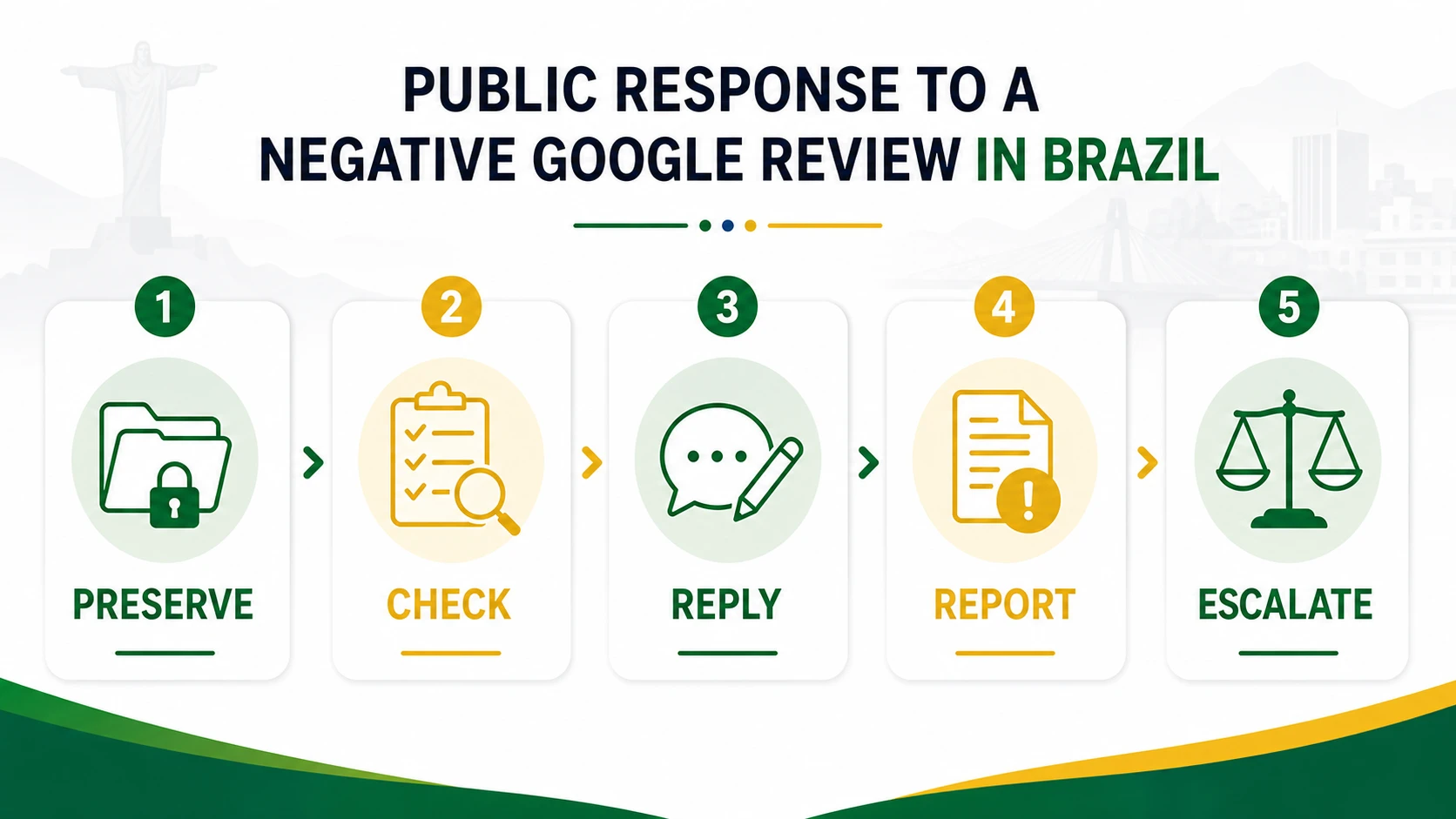
A Salvador professional practice receives an emotional review naming a staff member and accusing the team of lying. The manager wants to respond with service details, but counsel is preparing a report based on personal data and false factual allegations. The first reaction is usually emotional: reply immediately, ask Google to delete the review, and search for a culprit. The safer order is different. Preserve the publication first. Verify the records next. Only then decide whether the matter calls for reporting, reply, notice, negotiation, author identification, or court action.
The central problem is deciding whether a response is useful, what can safely be said, and how to align the response with Google reporting, notice, and private service recovery. One review may contain lawful criticism, exaggerated opinion, false allegation, personal data, and a Google policy breach at the same time. Treating everything as defamation weakens the request. Treating everything as opinion ignores real risk. The correct reading separates layers.
A small internal team should define who preserves evidence, who searches systems, who speaks with counsel, who is allowed to respond publicly, and who tracks Google reports. This prevents staff from filing inconsistent reports, publishing conflicting replies, or deleting relevant material.
If the review is genuine dissatisfaction, service recovery and communication may solve more than litigation. If it contains a false fraud accusation, a notice may be necessary. If it is a fake customer or competitor pattern, fake engagement may become central. If it exposes personal data, the LGPD moves to the front. If it is tied to a threat, preserving messages becomes urgent. The route follows the proof, not the irritation.
The goal is not to promise removal. The goal is to build a path that can be defended to Google, the author, counsel, and a court. When the company can show exact words, internal records, harm, and a proportionate request, the chance of removal, correction, negotiation, or litigation improves while the risk of a public backlash falls.
Google Report, Appeal, And Extrajudicial Notice
The operational route begins with Google's guidance for reporting inappropriate Business Profile reviews. Google explains that only reviews violating policy are eligible for removal and that disagreement alone is not enough. That is why the public response should not contradict the report; if the company says it cannot identify the reviewer, it should not confirm service details in the comment. The report should be short, specific, and supported only by necessary evidence.
The Google prohibited and restricted content policies include categories useful for business-review disputes: fake engagement, rating manipulation, misrepresentation, harassment, offensive content, personal information, conflict of interest, and irrelevant content. The Google Legal Help Center can be used when there is a legal basis. Platform policy and Brazilian law are related routes, not identical routes.
A rejected first report should not automatically become ten identical reports. A better appeal adds missing context, removes sensitive data, identifies the correct policy, explains falsity objectively, and shows why the case is not simple dissatisfaction. If the problem is only negative opinion, repeating reports may waste time while the review remains visible.
the response can stay short while the legal route stays detailed: preserve public trust and keep the real dossier out of the comment thread. An extrajudicial notice should cite the URL, exact passages, corrective facts, available proof, requested removal or correction, preservation demands, and response deadline. The language should be firm but not theatrical. A document that reads as intimidation can be used against the company.
The Google report, notice, and public response must tell the same factual story. The report may speak in platform categories. The notice may speak in Brazilian legal terms. The public reply may speak to future customers. But the core facts should not change from one document to another. Consistency is part of the evidence.
Public Response And Risk Control
An owner reply is not a pleading. It is read by future customers who are judging professionalism. A good response is usually short, polite, and privacy-safe: the company says it takes the concern seriously, cannot verify the described facts from available information, and invites the reviewer to a private channel. That shows care without litigating the whole file in the comment thread.
an ironic or aggressive reply can become a second publication, violate privacy, and encourage screenshots or more reviews. Do not publish medical files, payment details, employee data, private messages, internal images, contract details, or termination history. Even when the company is right, an imprudent response can create LGPD risk, professional-secrecy risk, moral-damage risk, or a new dispute.
Control the team as well. Do not ask staff to report the review in bulk using different stories. Do not encourage customers to publish retaliatory reviews. Do not delete internal records. Create a timeline of discovery, screenshots, internal searches, report, response, contacts, and decisions.
Also read Pimlegal's responding to harmful reviews in Brazil and assessing defamation in Brazilian reviews. Those two internal links are intentionally limited so this article stays complete while still connecting evidence, Google policy, response, and legal escalation.
The conclusion can vary. Some reviews should be answered. Others should be reported. Some deserve notice. Few justify immediate litigation. A Brazilian legal approach chooses the least aggressive measure that preserves proof, reduces harm, and avoids turning one review into a wider crisis.
Brazil Checklist
- Preserve URL, profile, date, rating, full text, photos, owner reply, and Google Business Profile context.
- Create an internal search note listing systems checked, responsible person, date, search terms, and result.
- Separate opinion, verifiable fact, exaggeration, insult, personal data, threat, fake customer, and Google policy issue.
- Use a non-confidential summary for Google and keep the complete dossier with counsel.
- Confirm that the public response, Google report, and notice do not contradict one another.
- Request removal, correction, preservation, and no republication only where the proof supports those demands.
- Measure harm with concrete indicators: cancellations, messages, leads, sales, rating movement, partners, and staff impact.
- Review litigation, author identification, and any criminal route with qualified Brazilian counsel.
Sources And References
- Federal Constitution for honor, image, reply, indemnification, and privacy.
- Civil Code for unlawful act, abuse of rights, legal entities, and reparation.
- Penal Code for calunia, difamacao, and injuria.
- Consumer Protection Code for the consumer-criticism context.
- Marco Civil da Internet and STF Tema 987 for removal and platform-liability analysis.
- LGPD and Civil Procedure Code article 384 for data minimization and digital evidence.
- STJ Sumula 227 and STJ specific-URL reference for objective honor and removal requests.
- Google policies, review reporting guidance, and Google Legal Help Center for the platform route.
This article is general information for Brazilian disputes involving Google reviews. It is not legal advice for a specific notice, report, lawsuit, author-identification request, criminal complaint, or LGPD strategy. Before formal action, facts, evidence, jurisdiction, limitation periods, privacy, and proportionality should be reviewed by qualified Brazilian counsel.