
An India-focused evidence checklist for screenshots, customer-record searches, electronic records, Google policy mapping and harm proof. In India, a Google review dispute should not be treated as a marketing complaint alone. It can be a publication issue, an evidence issue, a platform-policy issue, a consumer-trust issue and a legal-risk event at the same time. A strong strategy does not promise deletion; it identifies what is lawful criticism, what is a false factual allegation, what is a Google policy breach and what requires lawyer review.
Read this article together with fake customer review evidence in India and platform policy and legal notice. Those internal Pimlegal resources connect the India page, the evidence file and the removal strategy so the business does not treat every negative review in the same way.
Indian Legal Framework
For the review-removal evidence file prepared before asking Google, a reviewer, counsel or a court to act, the first question is whether the review contains a factual allegation or a consumer opinion. Indian law does not treat every negative review as unlawful. A harsh statement about delay, price, taste or service may be ordinary criticism. A statement alleging cheating, forged bills, fake certificates, unsafe treatment, bribery, discrimination, theft or professional dishonesty can be different because readers may understand it as a verifiable allegation.
The issue is proving the review, source, context, Google policy category, disputed facts, electronic-record discipline and confidentiality boundaries. A law-firm review should test identification, publication, meaning, falsity, harm, good faith, available defences and proportionality. The route may be a Google report, a public response, an advocate notice, preservation demand, civil injunction analysis, criminal complaint assessment, negotiation or no immediate escalation.
Since 1 July 2024, Indian criminal-law drafting should not rely mechanically on the former IPC sections 499 and 500. Criminal defamation now sits in section 356 of the Bharatiya Nyaya Sanhita, 2023. Procedure, electronic records and intermediary strategy also require attention to the Bharatiya Nagarik Suraksha Sanhita, 2023, the Bharatiya Sakshya Adhiniyam, 2023, the Information Technology Act and the IT Rules, 2021.
This matters because the same screenshot may appear in several places: a Google policy report, an appeal, an advocate notice, a court record, a police or complaint assessment, a negotiation file and a board-level reputation memo. If the first record is casual, cropped or inconsistent, every later step becomes weaker.
Building The Evidence File
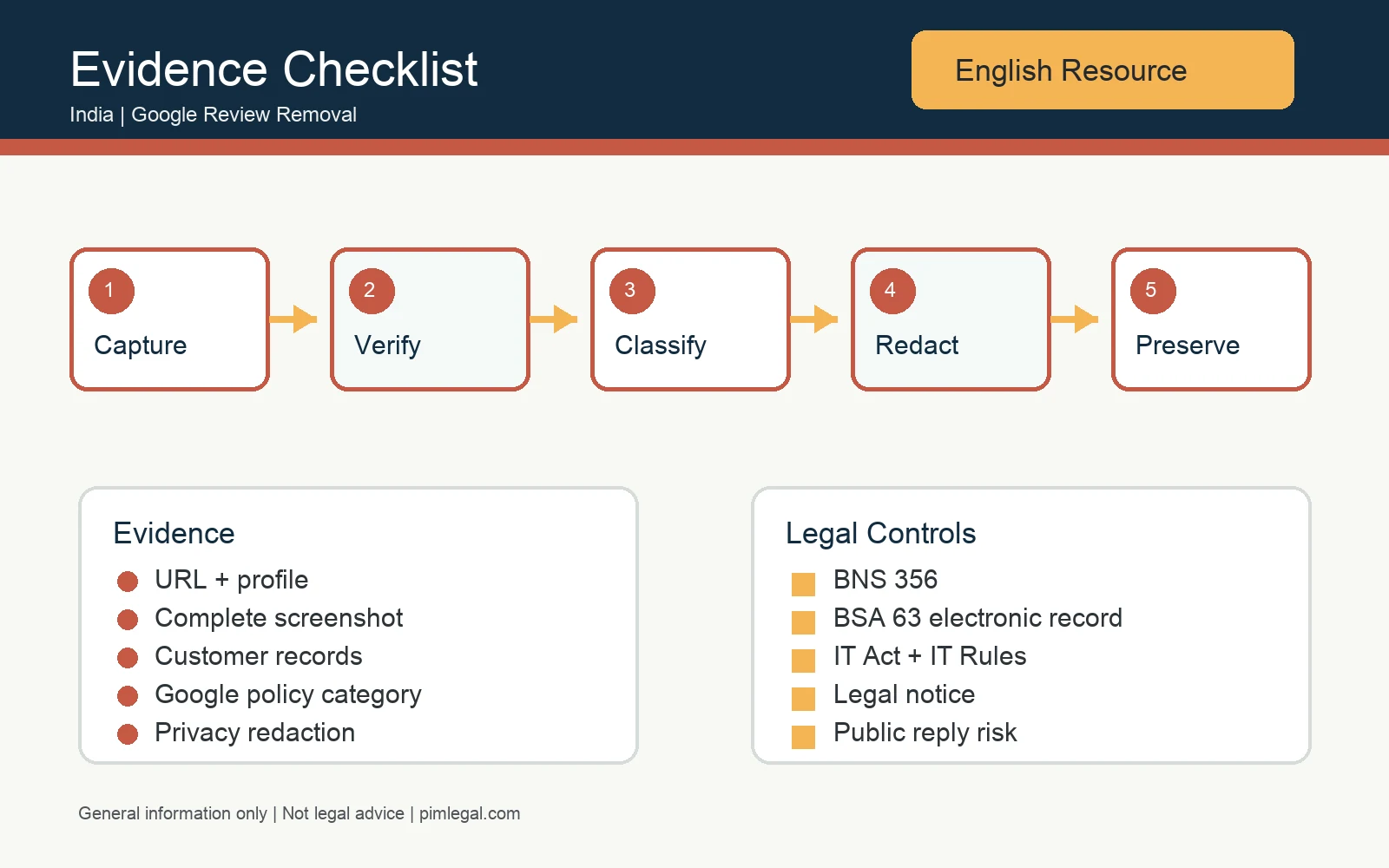
The core evidence for this file is: complete screenshots, URL, profile, visible date, rating, job records, invoices, messages, complaint logs, no-match searches, ranking impact and customer enquiries. A screenshot is useful, but it is not the whole file. A reliable file should show the full browser URL, reviewer profile, visible date, rating, exact text, business profile context, owner response, any image attachments, edit history if available, report history and internal record checks.
Electronic-record discipline should begin early. BSA section 63 is the current statutory reference point for admissibility of electronic records. Even where litigation is not yet certain, the business should identify the source device, custodian, original file location, working copies, capture method and certificate plan. A deleted review, edited profile or missing message thread can be difficult to reconstruct later.
Internal records should be checked, not dumped into a public forum. Clinics, schools, hotels, fintech companies, real-estate firms, education providers, restaurants and professional services often hold sensitive customer, patient, student, payment, employee or legal records. Google usually needs a concise and redacted policy explanation; counsel may need the complete confidential file.
- Capture the review, profile URL, visible date, rating and complete text.
- Search customer records, invoices, booking systems, payment logs, support tickets, emails and complaints.
- Record no-match searches with the names, phone numbers, emails and date ranges checked.
- Classify each exact phrase as fact, opinion, insult, private information, threat or fake engagement.
- Keep harm proof separately: lost bookings, enquiry drops, partner concerns, staff safety issues and rating impact.
- Prepare different annexures for Google, counsel, business decision-makers and any formal notice.
Case Study: Kolkata Service Business Builds The File
A Kolkata service business receives a review alleging dangerous work, wrong billing and refusal to respond. The manager wants to report immediately, but job records have not been checked.
The first twenty-four hours should not become a public argument. The business should freeze the review, stop evidence deletion, capture profile URLs and instruct staff not to reply emotionally. If the review is copied to other platforms, each URL should be preserved separately. If the author sends direct messages, the thread should be exported rather than reduced to a single cropped screenshot.
The file should then be separated into three layers. Layer one is for Google: policy category, non-confidential proof and requested action. Layer two is for business decision-making: harm, customer relationship, operational facts and public response. Layer three is for counsel: legal meaning, BNS, BNSS, BSA, IT Act, possible notice, jurisdiction, limitation and remedy. The facts should stay consistent across all layers even though the level of detail changes.
In this scenario, the practical result is that the business will use this platform angle: the Google file should be shorter than the legal file and map facts to policy categories with non-confidential proof. If the review is ordinary criticism, a measured response may be the correct remedy. If the review contains false factual allegations, fake engagement or private data, a Google report, appeal, notice or court route can be evaluated.
Google Policy And Platform Route
the Google file should be shorter than the legal file and map facts to policy categories with non-confidential proof. Google generally does not remove a review merely because the business disagrees with it. The report should identify the strongest policy category: fake engagement, conflict of interest, harassment, personal information, misrepresentation, irrelevant content or legal removal.
A strong Google report is not a long legal brief. It states the review URL, exact passage, policy category, short evidence summary and requested action. If the first report is rejected, the appeal should improve the file by adding missing facts, a better category and redacted proof. A legal-removal route and a court-order route are strategic paths, not substitutes for clear policy classification.
The Department of Consumer Affairs online reviews framework is useful for fake and misleading review context. It does not turn every private dispute into a legal claim, but it helps explain why competitor-linked reviews, agency-posted reviews, paid reviews, employee reviews or fabricated customer experiences are commercially and consumer-relevant.
Legal Notice And Escalation
a lawyer-ready file should include the exact allegation, falsity proof, harm evidence, urgency, author identity and likely defences. A good notice is short, exact and evidence-led. It identifies the publication, challenged words, why they are false, the record summary, harm summary, preservation demand, correction or removal request, non-republication request and response deadline.
References to BNS section 356 should be drafted carefully. Criminal language should not be used merely as pressure. Counsel should consider truth, good faith, public good, opinion, complaint to authority and other defence issues. If part of the review may be a genuine customer experience, a targeted correction may be more credible than a demand to delete everything.
Risk control is central: cropped screenshots, edited images or reconstructed timelines can damage credibility before Google, counsel and court. Businesses should not ask employees to post fake positive reviews, publicly shame the reviewer, disclose private data, delete messages or make unsupported competitor allegations.
Public Response
A public response is written for future customers, not to defeat the reviewer. A safe response is short, calm and privacy-conscious. It says the business takes feedback seriously, cannot verify the described facts from available records where appropriate, and invites private contact. It does not reveal customer history, diagnose the reviewer, accuse a competitor or publish confidential records.
If legal action is possible, counsel should review the response before publication. The response should not contradict the Google report or legal notice. If the report says there is no customer match, the public reply should not disclose customer details. If the notice focuses on a false fraud allegation, the reply should not add unrelated accusations.
Operational Method For Indian Businesses
A useful internal method is to turn the review into a working file within the first business day. The first page should record the discovery date, the affected Google Business Profile, the exact review URL, the reviewer name, the star rating, the publication date shown by Google, the suspected business unit, the person responsible for the file and the next authorized step. That prevents marketing, customer service, management and counsel from making inconsistent moves.
The second page should be a sentence-by-sentence table. Column one quotes the exact words. Column two classifies the phrase as fact, opinion, insult, private information, threat, fake engagement, off-topic content or ordinary dissatisfaction. Column three identifies the available record: invoice, booking, CRM search, refund correspondence, support ticket, delivery note, call log, lab report, staff statement or no matching customer record. Column four identifies the Google category. Column five states the recommended action.
The third page should handle privacy. Many Indian review disputes involve healthcare, education, professional services, financial services, real estate, hospitality or employment facts. The business may be able to prove the reviewer wrong, but that does not mean it should reveal the proof publicly. Redaction should be planned before the Google report, not after. A good report can state that no matching customer record exists without uploading a customer list or exposing unrelated people.
The fourth page should define escalation triggers. Escalation may be justified if the review alleges criminality, professional dishonesty, fake credentials, unsafe practice, discrimination, bribery, extortion or disclosure of private data; if the review is already affecting enquiries; if similar reviews appear in a pattern; if direct threats are received; or if the author is identifiable and refuses correction. Where the review is mainly dissatisfaction or opinion, monitoring or a careful public reply may be more proportionate.
The final page should decide what success means. Success is not always complete removal. It may be deletion of a private-data paragraph, correction of a false fraud allegation, a non-republication undertaking, a stronger Google appeal, an evidence packet ready for counsel, a calm public response or a documented decision not to escalate. Defining the goal avoids overreaction and keeps the business from using legal language when a platform or communication route is more realistic.
Execution Checklist For The Business
- Preserve the review and stop public argument by staff.
- Put exact allegations into a table: fact, opinion, insult, privacy issue, threat or fake engagement.
- Run internal record searches and keep dated no-match proof.
- Choose a Google policy category instead of relying on a generic defamation complaint.
- Redact sensitive records and keep confidential facts out of public replies.
- Collect harm evidence contemporaneously.
- Complete a BNS, BNSS, BSA, IT Act and likely-defences checklist before sending a notice.
- Define the goal: removal, correction, apology, preservation, identification, injunction, complaint or no action.
Key Legal And Policy References
- Bharatiya Nyaya Sanhita, 2023, section 356: the current Indian criminal defamation provision.
- Bharatiya Nagarik Suraksha Sanhita, 2023, section 222: prosecution procedure for defamation complaints.
- Bharatiya Sakshya Adhiniyam, 2023, section 63: admissibility of electronic records.
- Information Technology Act, 2000, section 79 and IT Rules, 2021: intermediary, grievance and platform-governance context.
- Google Business Profile prohibited and restricted content policy: fake engagement, harassment, personal information and misrepresentation categories.
- Google inappropriate review reporting workflow and Google Legal Help Center: platform report and legal removal routes.
- Department of Consumer Affairs online reviews framework: consumer-protection context for fake and misleading online reviews.
- Subramanian Swamy v. Union of India, Supreme Court of India: criminal defamation discussion under the former IPC framework, now read cautiously in the BNS era.
Practical Conclusion
The practical answer for India is evidence-led and proportionate. Preserve the review first, classify the words second, check customer records third, choose the Google policy category fourth, control privacy fifth and only then decide whether to publish a response, send a legal notice, pursue a platform appeal or escalate formally.
This article is general information only. It is not legal advice for a specific Indian proceeding, police complaint, court filing, limitation issue, injunction, intermediary notice or Google legal request. Formal action should be reviewed by qualified counsel in India with the full evidence file, jurisdiction, harm and proportionality analysis.