
A practical India checklist showing what proof usually matters when a business wants Google review removal, appeal, legal notice review or proportionate escalation.
Why Proof Sufficiency Matters More Than Outrage
Many businesses already have screenshots when they ask for Google review removal. The harder question in India is whether the file proves enough of the right things. Google usually wants a policy-based explanation tied to the exact words, profile behaviour, customer mismatch or privacy issue. Local counsel wants a file that also shows falsity, context, business harm and the limits of what can safely be said in public. A weak packet often fails not because the business is wrong, but because the proof does not answer those different audiences clearly enough.
A practical proof checklist therefore starts by separating four points. First, what exact statement or behaviour is challenged. Second, which Google category is actually supported by the facts. Third, which internal records confirm or contradict the claimed event. Fourth, what should stay in the private legal file rather than the Google-facing version. That discipline helps businesses avoid emotional reporting, over-disclosure and legal overstatement.

What A Strong Proof Packet Usually Contains
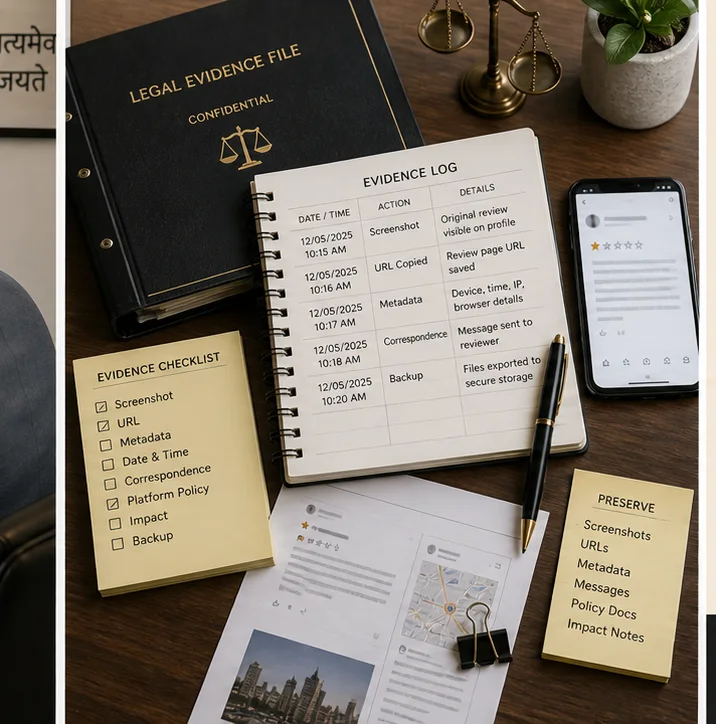
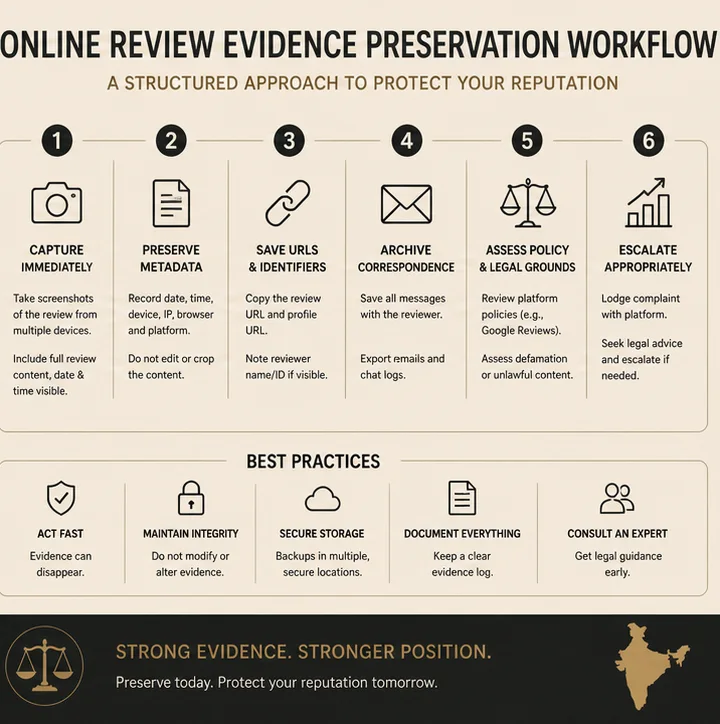
The proof packet should usually contain the full review URL, reviewer profile URL, star rating, publication date, screenshots showing the review in context, any visible edits, and a short chronology of relevant events. It should also contain the best internal checks: booking records, invoices, CRM results, support history, refunds, branch logs, delivery records, appointment systems or other objective material showing whether the reviewer appears genuine and whether the allegation can be tested. When there are several reviews, similarity of timing, wording or profile behaviour should be recorded as indicators, not exaggerated as final proof.
A usable chain-of-custody note should also identify who captured each item, on what date, from which account or device view, and whether the file is an original screenshot, annotated working copy or exported internal record. Customer searches, booking checks, invoice review, service logs and staff recollection should be logged without dumping unnecessary personal data into the public-facing set. The objective is disciplined preservation, not a dramatic dossier.
Controlled Internal Handling And Redaction
The business should assume that the evidence file may later be read by Google, local counsel, management, insurers, counterparties or a regulator. That is why the internal workflow should control copies, preserve untouched originals and redact more aggressively in the Google-facing version than in the private legal version. Local privacy and consumer-law sources still matter here: they shape how customer records, employee details, medical or payment data and internal messages are stored, shared and minimised while the file is being prepared.
Public Response Discipline While The File Is Built
A public response should not outrun the evidence file. If a reply is commercially necessary, it is usually safer to acknowledge the concern, state that the business is reviewing the matter through the appropriate channel and invite a private contact route. The reply should normally avoid factual concessions, overconfident accusations, copied private data or statements that later contradict the Google report or appeal packet.
How To Translate Proof Into A Google And Legal Strategy
The practical goal is not to send Google every document the business has. It is to translate the best proof into the strongest supported category: fake engagement, conflict of interest, impersonation, harassment, personal information, off-topic material, or another route genuinely reflected in the file. If the first report fails, the same checklist helps the appeal: clarify exact wording, identify which supporting record matters, and explain why the review does not match a genuine customer experience or why the content breaches a defined rule. Where local legal review is needed, the same proof packet also helps counsel decide whether a notice, privacy complaint or another proportional step is realistic.
If the first report fails, the same preservation file becomes even more important. The appeal should improve structure, chronology and category mapping rather than merely repeat frustration. Where a court order, privacy issue or other legal basis may later matter, the Google legal route should still rely on exact URLs, exact wording and a restrained evidence narrative. Weakly organised screenshots often fail long before the legal merits are reached.
When Chain Of Custody Matters Even More
Evidence preservation deserves extra attention when the review is already being edited, when multiple profiles appear together, when the author is anonymous, when staff are named with misconduct allegations, when the text accuses the business of fraud or dangerous conduct, when threats or refund demands sit around the review, or when the matter spans more than one language or jurisdiction. In those situations a missing screenshot or a confused timeline can damage both the Google route and the legal route.
The practical warning is simple: do not overpromise removal, do not let several employees create competing versions of the story and do not treat the evidence file as a marketing document. A lawyer-grade preservation file is quiet, chronological, redacted where necessary and usable across report, appeal, notice, negotiation and, if proportionate, later proceedings.
Related PimLegal Reading
For related reading, see our local guide on Google review evidence preservation and the India Google review removal page. These two internal resources connect anonymous-review triage with the wider removal and escalation strategy for India.
Selected Official References
- Department of Consumer Affairs scheme for Indian Standard 19000:2022 on online consumer reviews
- Digital Personal Data Protection Act, 2023
- Google Business Profile review reporting guidance
- Google prohibited and restricted content policy
- Google legal content removal guidance
Practical Conclusion
The best removal strategy often turns on proof quality rather than on how unfair the review feels. Build a packet that answers the platform question, the internal fact question and the local legal-risk question separately, then escalate from that stable file.
This article is general information only and not legal advice for a specific dispute in India. Formal identification, disclosure or court steps should be reviewed locally before action is taken.