
A practical India guide to whether a business should offer money, refunds, discounts or other value to make a Google review disappear, and what Google policy and local consumer rules mean in practice.
Why Paying For Review Removal Is Riskier Than It Looks
A business under review pressure often asks the wrong first question: how much will it cost to make the review go away. In India, that is not just a customer-service decision. It can become a Google policy issue, a consumer-law issue, an evidence issue and a reputation-risk issue at the same time. A business may still resolve the underlying complaint commercially, but paying specifically for removal, revision or silence is a different problem from settling the real service dispute.
That is why disciplined files separate three tracks from the start. First, does the reviewer have a genuine complaint with a real refund, repair or settlement issue. Second, is there a request to delete, soften or withhold a review in exchange for value. Third, does the review itself show fake engagement, pressure tactics, misinformation, privacy risk or another Google-policy category. When those tracks are mixed together, businesses make preventable mistakes: informal deals, inconsistent replies, weak reports and repeat demands.
What The First-Hour File Should Capture
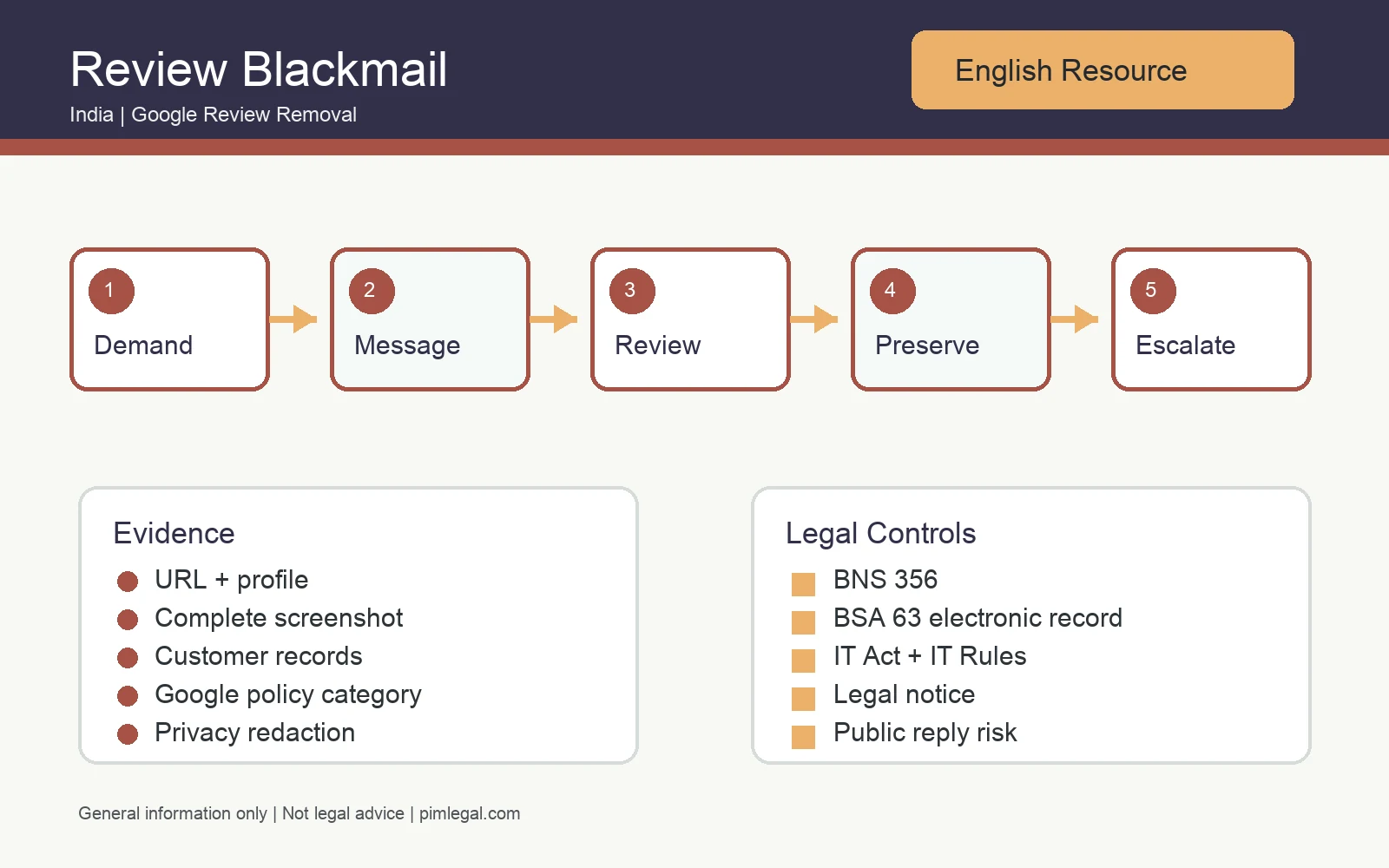
Preserve the full review URL, reviewer profile URL, star rating, publication date, visible edits, attached images, business-profile context, surrounding rating movement and the exact wording in the language used on the platform. If the review is in translation-sensitive wording, save the original language before anyone paraphrases it. If several reviews are involved, build a short chronology showing timing, repetition and any unusual pattern.
A usable chain-of-custody note should also identify who captured each item, on what date, from which account or device view, and whether the file is an original screenshot, annotated working copy or exported internal record. Customer searches, booking checks, invoice review, service logs and staff recollection should be logged without dumping unnecessary personal data into the public-facing set. The objective is disciplined preservation, not a dramatic dossier.
Google Policy, Incentives And Local Consumer-Law Context
Google’s current Maps user-generated content policy matters here because it expressly prohibits incentives such as payment, discounts, free goods or services in exchange for posting a review, revising it or removing a negative review. Google also now provides a dedicated Business Profile reporting path for negative review extortion scams where someone demands money, goods or services in exchange for removing reviews. That does not mean every hard customer negotiation is extortion. It does mean the business should not improvise payment or offer benefits simply to clean the profile.
At the same time, the underlying complaint still has to be assessed under Department of Consumer Affairs scheme for Indian Standard 19000:2022 on online consumer reviews and with attention to Digital Personal Data Protection Act, 2023. A business may owe a real refund for service failure, delay, cancellation or misdescription. But if the payment is structured as consideration for deleting, rewriting or suppressing the review, the platform and consumer-authenticity risks change. Internal teams should therefore record what refund right exists on the merits, what review request has been made, and what data must stay out of a public or Google-facing file.
Public Response And Settlement Discipline
A public response should not outrun the evidence file. If a reply is commercially necessary, it is usually safer to acknowledge the concern, state that the business is reviewing the matter through the appropriate channel and invite a private contact route. The reply should normally avoid factual concessions, overconfident accusations, copied private data or statements that later contradict the Google report or appeal packet.
If the business decides to discuss compensation at all, the public thread should stay boring. Do not write that a refund, discount, free service or other advantage is available if the reviewer edits the post. Do not ask staff or friendly customers to offset the rating. Do not answer pressure with public accusations of blackmail unless the evidence file is already strong and reviewed. The visible reply should protect trust while the real decision stays inside a controlled evidence and complaints workflow.
When Counsel Review Becomes More Important
Lawyer review becomes more useful when the review is paired with repeated demands, multiple profiles, non-customer indicators, sensitive-data exposure, serious fraud or danger allegations, or measurable commercial harm. In those cases the business should split the file into at least four parts: the review itself, off-platform messages, customer and payment records, and the proposed settlement position. That separation helps management see whether the problem is an ordinary complaint, a fake-review scenario, a policy report, a privacy risk, or a proportionate legal escalation issue.
Not every dispute needs a legal threat, and not every unhappy customer request is abusive. Sometimes a normal refund or corrective service is the right commercial result. The key caution is narrower: do not pay for review removal, and do not package legitimate settlement as a reward for changing the public record. A rushed payment can trigger repeat attempts, weaken the Google report, and make the later legal story harder to defend.
Related PimLegal Reading
our local guide to fake Google reviews and consumer-protection rules | India Google review removal page
Selected Official References
- Department of Consumer Affairs scheme for Indian Standard 19000:2022 on online consumer reviews
- Digital Personal Data Protection Act, 2023
- Google prohibited and restricted content policy
- Google Business Profile review reporting guidance
- Google negative review extortion reporting guidance
Practical Conclusion
The safest default in India is not to pay for review removal or revision. Preserve the review and any related messages, verify whether a real refund right exists independently of the review, keep the public response neutral, and use Google reporting or local legal escalation only on the facts the file can actually support.
This article is general information only and not legal advice for a specific dispute in India. Businesses should seek local advice before structuring settlements, making accusations, or assuming that a payment-linked review problem will be removed.