
Modern businesses rarely operate entirely on their own technology. Websites connect to payment gateways, CRMs exchange customer information with marketing platforms, cloud applications communicate through APIs, and businesses increasingly rely on external providers for analytics, artificial intelligence, cybersecurity, communications, and data processing.
These integrations can improve efficiency and reduce development costs. But every external connection can also introduce legal, privacy, cybersecurity, and operational risks.
A vendor may have access to personal data, confidential business information, customer accounts, intellectual property, or critical infrastructure. An API may create a direct technical connection between your systems and a third party’s environment. If the relationship is not properly assessed and documented, your business could face regulatory penalties, data breach liability, contractual disputes, or reputational damage.
Before integrating a vendor or API, businesses should therefore treat third-party risk as both a technology issue and a legal issue.
Understand What the Third Party Will Actually Access
The first question should not simply be:
“Is this vendor reputable?”
The more important question is:
“What will this vendor be able to access, process, modify, or control?”
A third-party service may have access to:
- Customer names and contact information
- Email addresses and telephone numbers
- Account credentials or authentication tokens
- Payment-related information
- Employee information
- Business documents
- Confidential communications
- Customer activity and behavioral data
- Location information
- Website analytics
- Intellectual property
- Proprietary databases
- Source code or technical infrastructure
The legal consequences depend significantly on the type and volume of information being shared.
Businesses should create a basic data and access map before approving an integration. This should identify what information leaves the business, where it goes, why it is processed, who can access it, and how long it is retained.
Determine Whether Personal Data Is Being Processed

One of the most important legal questions is whether the vendor will process personal data on behalf of the business.
If the answer is yes, privacy and data protection obligations may apply.
For businesses operating in Thailand, the Personal Data Protection Act (PDPA) should be considered when personal data is collected, disclosed, transferred, stored, or processed through third-party services.
Depending on the relationship, the third party may act as a data processor, data controller, or another legally relevant party. The distinction matters because different responsibilities can apply.
Before integration, businesses should determine:
- What categories of personal data are involved
- The purpose of processing
- The legal basis for processing
- Whether the vendor acts as a processor or controller
- Whether data is transferred outside Thailand
- Whether subprocessors are involved
- How long the information is retained
- How deletion and return of data are handled
- What happens after termination of the service
Simply accepting a vendor’s standard privacy policy is often not enough.
Review the Vendor’s Data Processing Terms
Where a third party processes personal data on behalf of your business, the contractual framework should clearly establish the parties’ respective responsibilities.
A data processing agreement or appropriate contractual provisions should address matters such as:
- The subject matter and duration of processing
- Categories of personal data
- Categories of data subjects
- Permitted processing activities
- Confidentiality obligations
- Security measures
- Subprocessor arrangements
- Data breach notification
- Assistance with data subject requests
- Data deletion or return
- Audit and compliance rights
- International data transfers
The objective is to avoid a situation where the business remains legally responsible for a data protection failure but has no contractual mechanism to obtain information, assistance, or compensation from the vendor responsible for the relevant processing activity.
Check Where the Data Will Be Stored
A vendor may be headquartered in one country while storing or processing information in several others.
This is particularly common with cloud platforms and global SaaS providers.
Before connecting a service to your systems, determine:
Where is the data stored?
Where is it processed?
Where are backups located?
Which countries can administrators access the data from?
Which subprocessors may receive the information?
International data transfers can create additional privacy and regulatory considerations.
Businesses should therefore avoid relying solely on a statement such as “your data is secure.” Security and data-location compliance are separate questions.
Examine International Data Transfers
Cross-border data transfers deserve particular attention when using international cloud providers, AI platforms, analytics services, CRM systems, payment providers, or hosting companies.
A business should identify:
- The originating country
- The destination countries
- The entities receiving the data
- The applicable transfer mechanism
- Whether adequate contractual safeguards exist
- Whether additional regulatory requirements apply
The legal analysis should be performed before the integration goes live rather than after personal data has already been transferred.
Do Not Ignore API Security
APIs are often treated as purely technical components. Legally, however, an insecure API can become the entry point for a serious security incident.
API integrations may involve:
- Authentication credentials
- API keys
- OAuth tokens
- Customer identifiers
- Database access
- Payment information
- Internal system functions
- Administrative privileges
The contract should therefore address security responsibilities as well as the technical implementation.
Important questions include:
- Who is responsible for securing the API?
- How are credentials managed?
- What authentication standards are required?
- Are access permissions limited to necessary functions?
- How quickly must compromised credentials be revoked?
- Who is responsible for monitoring suspicious activity?
- What happens if the vendor’s API causes unauthorized access?
- Who bears responsibility for security vulnerabilities?
The principle of least privilege should be applied wherever possible: the vendor should receive only the access necessary to perform the agreed service.
Define Cybersecurity Responsibilities in the Contract
A common mistake is to rely on general language such as:
“The vendor will maintain appropriate security.”
That wording may be too vague to provide meaningful protection.
Depending on the nature of the service, contracts should consider specifying requirements relating to:
- Encryption
- Access controls
- Multi-factor authentication
- Vulnerability management
- Security testing
- Logging and monitoring
- Incident response
- Employee access
- Backup and recovery
- Business continuity
- Security certifications or assessments
- Secure software development practices
The appropriate requirements will depend on the sensitivity and importance of the integration.
Establish Clear Data Breach Notification Obligations
A vendor may detect a security incident before the customer does.
The contract should therefore establish a clear process for notifying the business when a security incident or personal data breach occurs.
The agreement should address:
- What constitutes a reportable incident
- How quickly the vendor must notify the business
- Who must be contacted
- What information must be included
- How ongoing updates will be provided
- Cooperation with investigations
- Evidence preservation
- Regulatory notifications
- Customer communications
- Remediation responsibilities
A clause requiring notification “promptly” may be less useful than a clearly defined contractual timeframe and escalation procedure.
Investigate Subprocessors
Your vendor may not actually perform all of the services itself.
For example, a SaaS provider may rely on separate companies for:
- Cloud hosting
- Email delivery
- Analytics
- Customer support
- AI processing
- Database infrastructure
- Payment processing
- Security monitoring
These companies can become subprocessors or other downstream service providers.
Businesses should understand who they are and what information they receive.
The contract should ideally establish rules concerning:
- Prior authorization or notification
- Changes to subprocessors
- Due diligence requirements
- Equivalent privacy and security obligations
- Responsibility for downstream providers
A vendor should not effectively be able to transfer your data to unknown third parties without appropriate contractual controls.
Review Intellectual Property Rights
Third-party integrations can create unexpected intellectual property issues.
Before using an external API, SDK, software library, AI platform, or data service, determine:
- Who owns the data submitted to the service
- Who owns generated outputs
- Whether the vendor can use customer data to improve its products
- Whether the vendor receives a license to your content
- Whether the license survives termination
- Whether your data can be used for advertising or analytics
- Who owns modifications or integrations developed for your business
This is particularly important when integrating AI services, where contractual terms may determine whether submitted information can be retained, analyzed, or used for model improvement.
Businesses should never assume that they automatically retain exclusive rights simply because they uploaded or generated the information.
Check the Vendor’s Right to Use Your Data
A vendor agreement may contain broad language allowing the provider to use information for “service improvement,” “analytics,” “research,” or similar purposes.
Such provisions deserve careful review.
Ask:
Can the vendor use our data for purposes beyond providing the contracted service?
Can the vendor aggregate our information?
Can the vendor use it to train AI models?
Can the vendor share it with affiliates or partners?
Can the vendor retain it after termination?
The answer should be consistent with your business objectives, privacy obligations, confidentiality commitments, and customer expectations.
Negotiate Liability and Indemnification
One of the most important contractual issues is determining what happens when something goes wrong.
Vendor agreements often contain:
- Liability caps
- Warranty disclaimers
- Exclusions of consequential damages
- Indemnification provisions
- Security exclusions
- Data breach limitations
A standard liability cap may be inappropriate if the vendor has access to highly sensitive information or critical infrastructure.
Businesses should consider whether specific risks require different treatment, including:
- Data protection violations
- Confidentiality breaches
- Intellectual property infringement
- Cybersecurity incidents
- Unauthorized disclosure
- Regulatory penalties, where legally recoverable
- Vendor negligence or misconduct
The objective is not necessarily to eliminate liability limitations, but to ensure that the contractual allocation of risk reflects the actual risk created by the integration.
Consider Business Continuity and Vendor Lock-In
Legal risk is not limited to privacy and cybersecurity.
A third-party vendor may become essential to your operations.
What happens if:
- The vendor shuts down?
- The service becomes unavailable?
- Pricing increases significantly?
- The API is discontinued?
- The vendor changes its terms?
- Your account is suspended?
- The vendor is acquired?
- The vendor suffers a major cyberattack?
Contracts should address termination rights, transition assistance, data portability, and the return or deletion of business information.
For critical services, businesses should also consider whether a backup provider or alternative technical solution is necessary.
Review Audit and Compliance Rights
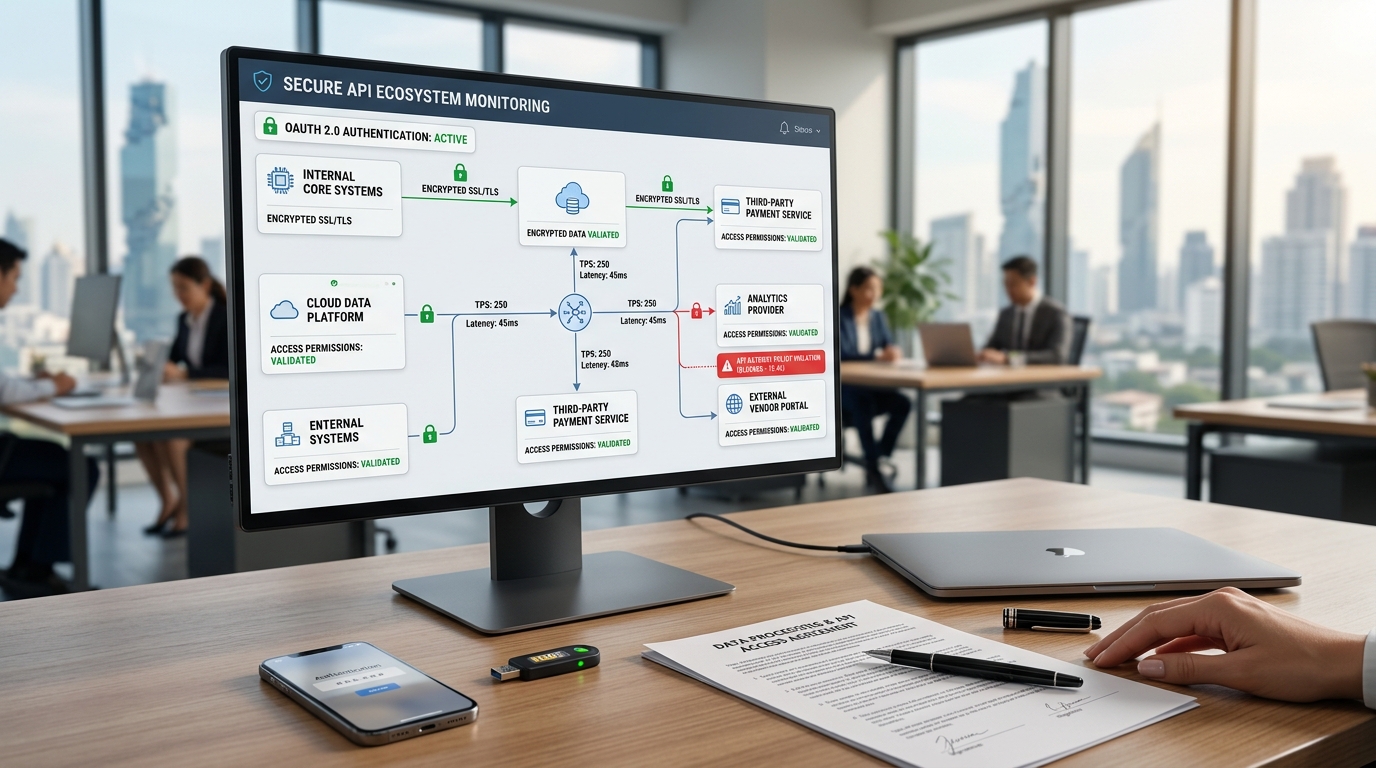
A business may need evidence that a vendor is actually complying with its contractual obligations.
Depending on the risk level, useful evidence may include:
- Security certifications
- Independent audit reports
- Penetration testing summaries
- Data protection documentation
- Security policies
- Incident response procedures
- Business continuity plans
- Subprocessor lists
The contract should provide an appropriate mechanism for obtaining compliance information without creating unreasonable operational burdens.
Perform Vendor Due Diligence Before Integration
A vendor’s sales presentation should not be the only source of information used to assess risk.
A practical third-party due diligence process can include:
Legal review
Check the terms of service, privacy terms, data processing provisions, liability clauses, intellectual property provisions, and termination rights.
Security review
Assess authentication, encryption, access controls, incident response, vulnerability management, and relevant security documentation.
Privacy review
Identify personal data flows, processing purposes, international transfers, subprocessors, retention periods, and data subject rights.
Business review
Evaluate financial stability, service availability, support, reputation, and business continuity.
Technical review
Assess API permissions, integration architecture, credentials, dependencies, logging, and access controls.
The depth of due diligence should be proportional to the risk.
Use a Risk-Based Approach
Not every vendor requires the same level of legal review.
A useful approach is to classify vendors according to risk.
Low risk:
A service has limited access to non-sensitive information and does not connect to critical systems.
Medium risk:
The vendor processes business or personal information and connects to important systems.
High risk:
The vendor handles sensitive personal data, critical infrastructure, authentication systems, financial information, large datasets, or core business operations.
High-risk vendors should generally receive deeper legal, privacy, cybersecurity, and technical assessment before integration.
Create an Integration Approval Process
Businesses can reduce third-party risk by establishing a formal approval process before employees connect external services to company systems.
A simple workflow could be:
1. Identify the vendor
↓
2. Identify the data and systems involved
↓
3. Classify the risk
↓
4. Conduct legal and privacy review
↓
5. Conduct cybersecurity and technical review
↓
6. Negotiate contractual protections
↓
7. Approve the integration
↓
8. Monitor the vendor
↓
9. Review periodically
This process helps prevent situations where a developer, marketing employee, or business team connects a third-party tool without realizing that it creates legal or security obligations.
Do Not Forget Vendor Offboarding
Third-party risk continues after the contract ends.
When terminating an integration, businesses should confirm:
- Access credentials are revoked
- API keys are disabled
- Accounts are closed
- Personal data is deleted or returned
- Backups are addressed where applicable
- Subprocessors are notified where necessary
- Confidential information is no longer accessible
- Data retention periods are respected
- Documentation is updated
Offboarding should be treated as part of the integration lifecycle rather than an afterthought.
A Practical Legal Checklist Before Integrating a Vendor or API
Before approving an external integration, ask:
- What data will the vendor access?
- Is personal data involved?
- What is the legal basis for processing?
- Is the vendor a processor, controller, or another type of party?
- Where will the data be stored?
- Will information leave Thailand?
- Are subprocessors involved?
- What security controls does the vendor use?
- What happens after a data breach?
- How quickly must incidents be reported?
- Who is responsible for cybersecurity?
- Who owns the data?
- Can the vendor use the data for AI training or analytics?
- What happens to the data after termination?
- What are the vendor’s liability limits?
- Are indemnification provisions appropriate?
- Can the business audit or assess compliance?
- Can data be exported if the relationship ends?
- What happens if the vendor or API becomes unavailable?
- Who approves the integration internally?
If several of these questions cannot be answered, the integration may not yet be ready for approval.
Third-Party Risk Is a Legal Responsibility, Not Just an IT Problem
Modern businesses depend on an increasingly complex ecosystem of vendors, SaaS platforms, APIs, cloud providers, AI services, payment processors, analytics platforms, and other technology partners.
Each connection can create a new pathway for data, access, liability, and regulatory exposure.
The objective is not to avoid third-party technology. Instead, businesses should understand the risk before accepting it.
A strong third-party risk framework combines legal due diligence, privacy compliance, cybersecurity controls, contractual protections, technical access management, and ongoing vendor monitoring.
For businesses operating in Thailand or serving customers internationally, reviewing these issues before integration can be far more effective than trying to resolve them after a data breach, contractual dispute, or regulatory problem occurs.
Pimlegal helps businesses navigate the legal issues surrounding data, online, cybersecurity, technology, and digital operations. Before integrating a significant vendor, API, SaaS platform, cloud service, or AI provider, obtaining legal advice can help ensure that the technology is supported by an appropriate contractual and compliance framework.