
A practical scenario showing how evidence, conflict indicators and platform rules fit together in United Kingdom. A coordinated review attack is different from one dissatisfied customer. The concern is a pattern: several reviews appearing close together, similar wording, newly created profiles, impossible facts, a known dispute, a competitor signal, a former employee conflict, or a demand connected to removal. In the United Kingdom, the strategy should combine evidence preservation, Google policy, consumer-law context and careful legal escalation.
This case study links to the UK guides on fake customer review evidence and platform policy and legal notice strategy. Those pages give the legal and procedural background; this page shows how the pieces fit together in a practical UK scenario.
Scenario: Weekend Attack On A London Clinic
A private clinic in London receives twelve one-star Google reviews between Friday evening and Monday morning. Several profiles have no previous review history. Four reviews use the same unusual phrase. Three mention a treatment the clinic does not provide. Two refer to an appointment date when the clinic was closed. One reviewer uploads a photograph from a different business. The clinic recently ended a contract with a marketing consultant who had access to customer-facing materials.
The clinic's first instinct is to reply publicly and accuse the consultant. That would be risky. Similar wording and timing are indicators, not proof. A better first step is to freeze the evidence, create a chronology, search internal records, preserve the contractor dispute file and make separate Google reports for each review using the strongest policy category.
Step One: Preserve The Pattern
A coordinated attack must be shown as a pattern, not just a list of bad reviews. The clinic should screenshot each review with the URL visible, capture profile links, star ratings, dates, images, owner replies and page position. It should also preserve the sequence in which reviews appeared and whether Google sorted them as most relevant, newest or highest profile.
A simple spreadsheet can help. Columns should include review URL, reviewer display name, profile URL, date, text, factual allegations, service mentioned, customer-record result, suspected policy category, evidence file reference, report date, Google report ID, appeal result and current status. That structure makes the case easier to understand for Google and for solicitors.
Step Two: Test Customer Records
A fake-review allegation is strongest when internal records contradict the review without exposing private information publicly. The clinic should check bookings, invoices, payment records, emails, telephone logs, consent forms, treatment records, refund records and staff schedules. If the review claims a service not offered, preserve the service menu and website archive. If the review claims an event on a closed date, preserve opening hours and appointment logs.
The evidence file should use neutral wording. Instead of saying 'the reviewer is a liar', write: 'No matching booking, invoice, payment, enquiry or treatment record was found for the reviewer name, date, phone number, email pattern or service described.' That language is more credible and safer.
Step Three: Classify Under Google Policy
The relevant Google categories may include fake engagement, conflict of interest, harassment, misrepresentation, off-topic content or personal information. The report should map each review to the category. A review from a suspected former contractor is not reported merely as "defamation"; it may be a conflict-of-interest or fake-engagement problem if the evidence supports that classification.
Google reports should be short. A platform reviewer is not deciding a full English defamation claim. The submission should explain why the content violates Google policy and attach or describe the minimum evidence needed. If several reviews form a pattern, the business can reference the pattern, but each review should still be reported on its own facts.
Step Four: Assess UK Legal Routes
If the reviews contain false factual allegations that attack honesty, safety, regulatory compliance or professional competence, civil defamation may be relevant. Section 1 of the Defamation Act 2013 requires serious harm, and trading bodies must address serious financial loss. The clinic should therefore preserve evidence of reputational and commercial impact, such as cancellation messages, reduced enquiries or patients mentioning the reviews.
If there are threats, payment demands or repeated abusive messages, the matter may also involve harassment, malicious communications or other communications offences. Those issues should be separated from the defamation analysis. A police or criminal route should not be used as a pressure tactic in an ordinary review dispute, but serious threats should be preserved and assessed.
Step Five: Anonymous Identification
If the responsible actor is unknown, English disclosure tools may be considered in serious cases. Totalise plc v Motley Fool Ltd and Sheffield Wednesday Football Club Ltd v Hargreaves are useful examples involving anonymous online publication and disclosure. A business should not expect Google to hand over account data informally; proportionality and legal process matter.
The clinic should ask whether identification is necessary. If the objective is removal and Google policy evidence is strong, identification may not be proportionate. If the campaign is repeated, defamatory, extortion-linked or competitively motivated, solicitors may consider preservation letters, platform legal channels and disclosure options.
Regulatory And Research Context
CMA work on fake reviews, including undertakings and enforcement signals involving major platforms, supports the idea that coordinated review manipulation is a consumer-market problem. The Digital Markets, Competition and Consumers Act 2024 adds further consumer-protection context. Academic research on online ratings also shows that reviews affect consumer behaviour, which helps explain why a coordinated attack can cause commercial harm quickly.
That broader context should support, not replace, the case evidence. The clinic still needs to show what happened on its own Google Business Profile, which reviews are suspicious, which facts are false, and why the requested removal is proportionate.
Case Study Outcome
In the scenario, the clinic prepares a spreadsheet, preserves screenshots, confirms no matching records for nine of the reviews, identifies repeated wording, documents the closed appointment dates, and sends a concise Google report for each review. It avoids a public accusation. For the two reviews with potentially identifiable patients, it drafts neutral public replies and checks privacy obligations before posting.
If Google removes several reviews under policy, the legal route may stop there. If the campaign continues or direct evidence links the former consultant to the attack, the clinic can consider a legal notice requesting preservation, cessation and removal. The notice should identify the specific reviews, attach a factual chart, avoid unsupported allegations and preserve rights under English law.
Attack Response Checklist
- Capture all reviews immediately and keep a timestamped chronology.
- Create a review-by-review evidence chart instead of a general complaint.
- Check customer records before replying publicly or accusing anyone.
- Report each review under the strongest Google policy category.
- Preserve related threats, payment demands, contractor disputes or competitor signals.
- Assess defamation, malicious communications, harassment and consumer-law context separately.
- Escalate to solicitors only when the evidence justifies a proportionate legal notice or formal process.
Key England And Wales References
- Defamation Act 2013: serious harm, truth, honest opinion, public interest and website-operator provisions.
- Defamation Act 2013 section 1: serious harm, including serious financial loss for bodies trading for profit.
- Civil Procedure Rules Part 53: media and communications claims, including defamation and misuse of private information.
- Pre-Action Protocol for Media and Communications Claims: expected detail before a defamation or privacy claim.
- Limitation Act 1980 section 4A: one-year limitation period for libel and slander claims.
- Digital Markets, Competition and Consumers Act 2024 and CMA guidance: consumer-review manipulation and fake-review enforcement context.
- Google Business Profile prohibited and restricted content policy: fake engagement, conflicts of interest, harassment, off-topic content and personal information.
- Google Legal Help Center: legal removal pathways where a policy report is not enough.
Practical Evidence Standard
A strong English review-removal file should not rely on screenshots alone. It should preserve the review URL, reviewer name, profile link, star rating, publication date, screenshots with the browser address bar visible, the Google Business Profile affected, internal booking or CRM searches, invoices, email records, staff notes, report IDs, appeal dates and any public reply that has already been posted. The aim is to make the chronology understandable to Google, to a solicitor and, if necessary, to a court.
The file should also separate private evidence from material that can safely be sent to a platform or reviewer. A business can say that no matching customer record exists without exposing customer lists. It can say that the site was closed on a date without publishing staff schedules. In England and Wales, privacy, data protection and proportionality are part of the strategy, not an afterthought.
How To Use These References In A Removal File
The references above should be used as a framework, not as decoration. For each disputed review, the business should identify the Google policy category, the factual allegation, the evidence contradicting it, the legal issue that may apply and the practical remedy requested. If the issue is fake engagement, the Google report should lead with the authenticity evidence. If the issue is a serious false allegation, the legal review should lead with meaning, falsity, serious harm and financial impact. If the issue is personal information, privacy and data-minimisation should shape both the platform report and the public reply.
A useful internal packet has three versions. The full evidence file is kept privately for solicitors and decision-makers. The platform version is shorter and focused on Google policy. The recipient-facing notice is precise, proportionate and limited to what the reviewer or responsible actor needs to understand the complaint. Keeping those versions separate helps the business challenge harmful content without publishing confidential information, overstating the law or weakening its position with an emotional response.
Visual Evidence Route

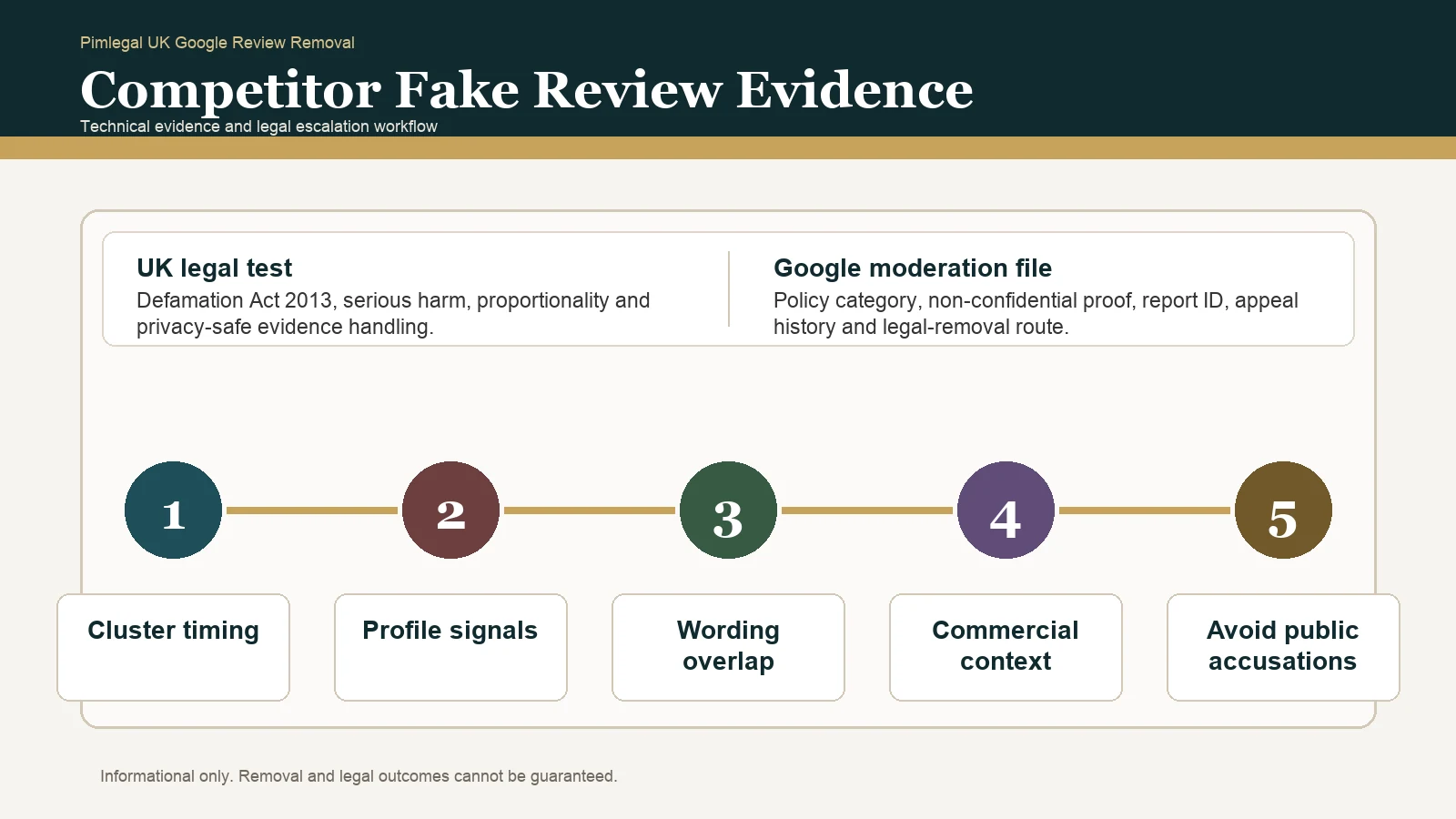
For a stronger file, pair this article with fake customer review evidence and platform policy and legal notice strategy.