
How to assess harmful factual allegations, proof and removal strategy in United Kingdom. In England and Wales, a damaging Google review is not automatically defamatory because it is harsh, unfair or commercially painful. The core question is whether the review conveys a false factual allegation, or a defamatory implication, that has caused or is likely to cause serious harm to the reputation of an identifiable business or professional.
Read this page with our guide on fake customer review evidence and the UK article on platform policy and legal notice strategy. Together, those resources explain how to move from preservation to Google reporting, and then to legal review only where the facts justify escalation.
Serious Harm Under The Defamation Act 2013
The starting point is section 1 of the Defamation Act 2013. A statement is not defamatory unless its publication has caused, or is likely to cause, serious harm to the claimant's reputation. For a body that trades for profit, serious harm is not enough by itself: the Act says the serious harm requirement is not satisfied unless the publication has caused, or is likely to cause, serious financial loss.
That threshold is important for online reviews. A one-star rating may irritate a business, but the legal file should explain why the words matter, who saw them, whether they were visible on a key profile, whether enquiries or bookings dropped, whether the allegation attacks professional integrity, safety, honesty or lawful trading, and whether the review remains indexed or prominent.
Lachaux And The Need For Evidence
The Supreme Court decision in Lachaux v Independent Print Ltd confirms that serious harm is a real evidential requirement, not a label to be asserted. A business should therefore avoid a bare accusation that a review is defamatory. It should preserve facts showing why the allegation is serious in context and why it is likely to affect reputation or trade.
For a Google review, practical evidence may include reduced enquiries after publication, cancellation messages referring to the review, screenshots showing the review near the top of the profile, analytics data, booking records, witness statements, and proof that the factual allegation is false. If the review says a clinic reused equipment, a restaurant sold unsafe food, a law firm stole client money or a contractor abandoned a job, the file should answer that allegation with records rather than outrage.
Fact, Opinion And Context
English law distinguishes factual assertions from opinion, but the distinction is contextual. A review saying 'terrible service' or 'I would not return' is normally an evaluative opinion. A review saying 'they charged me twice and refused a refund', 'the surgeon is not qualified', or 'the company uses fake certificates' is more factual. Mixed statements can be harder: an opinion may imply undisclosed facts, and that implication may be defamatory.
In Stocker v Stocker, the Supreme Court emphasised that meaning should be assessed in the context of how ordinary readers use social media, not by an over-technical analysis. That reasoning matters for Google reviews too. A legal assessment should consider the platform, star rating, heading, wording, profile context and what a reasonable reader would take from the whole review.
Defences: Truth, Honest Opinion And Public Interest
The main statutory defences under the Defamation Act 2013 include truth, honest opinion and publication on a matter of public interest. A business may believe a review is unfair, but if the sting of the allegation is substantially true, a defamation route is weak. If the wording is clearly opinion based on indicated facts, the honest opinion defence may become relevant. If the review raises a wider safety or public-interest issue, the analysis becomes more sensitive.
This is why a removal strategy should not simply declare that the customer is lying. It should identify the exact words complained of, the meaning the business says they convey, the facts showing falsity, the harm caused, and any reasons the review also violates Google policy. A narrow, evidence-led request is more credible than a broad legal threat.
Website Operators, Google And Platform Limits
Section 5 of the Defamation Act 2013 introduced a defence for operators of websites in respect of statements posted by third parties, subject to statutory conditions and regulations. That does not mean Google will remove every disputed review on request. It does mean that a business should distinguish between the author of the review, any person who organised it, and the platform hosting it.
The Court of Appeal decision in Tamiz v Google Inc, concerning comments on Blogger, illustrates why platform liability for user comments is different from liability of the original author. For review removal, the practical route is often a Google policy report first, legal notice to the responsible actor where known, and a formal legal removal route only where the facts fit.
Case Study: A False Safety Allegation
Imagine a private dental clinic in London receives a one-star review stating: 'They used unsterilised tools, injured me and refused to give medical records.' The clinic has no patient matching the name, no treatment on the date claimed, sterilisation logs for the relevant period and a CQC inspection record. The review is not merely rude; it alleges unsafe clinical practice and refusal to provide records. That is the type of allegation where reputation harm, regulatory sensitivity and evidence preservation all matter.
The clinic should not reply with patient details. It should preserve the review, check whether the reviewer can be identified, capture the profile URL, compare appointment records, collect sterilisation logs, classify the Google policy categories, and prepare a careful report. If escalation is needed, a solicitor can assess whether the serious harm and serious financial loss requirements are supportable, and whether a legal notice is proportionate.
Publications And Research Context
The UK Competition and Markets Authority has repeatedly treated online reviews as important to consumer choice, including through its work on fake reviews and its 2025 announcement of undertakings from Google. The Competition and Markets Authority, Citizens Advice and consumer-law commentary all treat review integrity as a market-trust issue, not merely a private reputation complaint.
For businesses, that research context is useful but not enough. A business still needs a case-specific file. A general statement that fake reviews harm consumers will not prove that one Google review is false, defamatory or removable. The removal request should connect the general policy concern to the exact review, the exact allegation and the exact evidence.
Key England And Wales References
- Defamation Act 2013: serious harm, truth, honest opinion, public interest and website-operator provisions.
- Defamation Act 2013 section 1: serious harm, including serious financial loss for bodies trading for profit.
- Civil Procedure Rules Part 53: media and communications claims, including defamation and misuse of private information.
- Pre-Action Protocol for Media and Communications Claims: expected detail before a defamation or privacy claim.
- Limitation Act 1980 section 4A: one-year limitation period for libel and slander claims.
- Digital Markets, Competition and Consumers Act 2024 and CMA guidance: consumer-review manipulation and fake-review enforcement context.
- Google Business Profile prohibited and restricted content policy: fake engagement, conflicts of interest, harassment, off-topic content and personal information.
- Google Legal Help Center: legal removal pathways where a policy report is not enough.
Practical Evidence Standard
A strong English review-removal file should not rely on screenshots alone. It should preserve the review URL, reviewer name, profile link, star rating, publication date, screenshots with the browser address bar visible, the Google Business Profile affected, internal booking or CRM searches, invoices, email records, staff notes, report IDs, appeal dates and any public reply that has already been posted. The aim is to make the chronology understandable to Google, to a solicitor and, if necessary, to a court.
The file should also separate private evidence from material that can safely be sent to a platform or reviewer. A business can say that no matching customer record exists without exposing customer lists. It can say that the site was closed on a date without publishing staff schedules. In England and Wales, privacy, data protection and proportionality are part of the strategy, not an afterthought.
How To Use These References In A Removal File
The references above should be used as a framework, not as decoration. For each disputed review, the business should identify the Google policy category, the factual allegation, the evidence contradicting it, the legal issue that may apply and the practical remedy requested. If the issue is fake engagement, the Google report should lead with the authenticity evidence. If the issue is a serious false allegation, the legal review should lead with meaning, falsity, serious harm and financial impact. If the issue is personal information, privacy and data-minimisation should shape both the platform report and the public reply.
A useful internal packet has three versions. The full evidence file is kept privately for solicitors and decision-makers. The platform version is shorter and focused on Google policy. The recipient-facing notice is precise, proportionate and limited to what the reviewer or responsible actor needs to understand the complaint. Keeping those versions separate helps the business challenge harmful content without publishing confidential information, overstating the law or weakening its position with an emotional response.
Visual Evidence Route

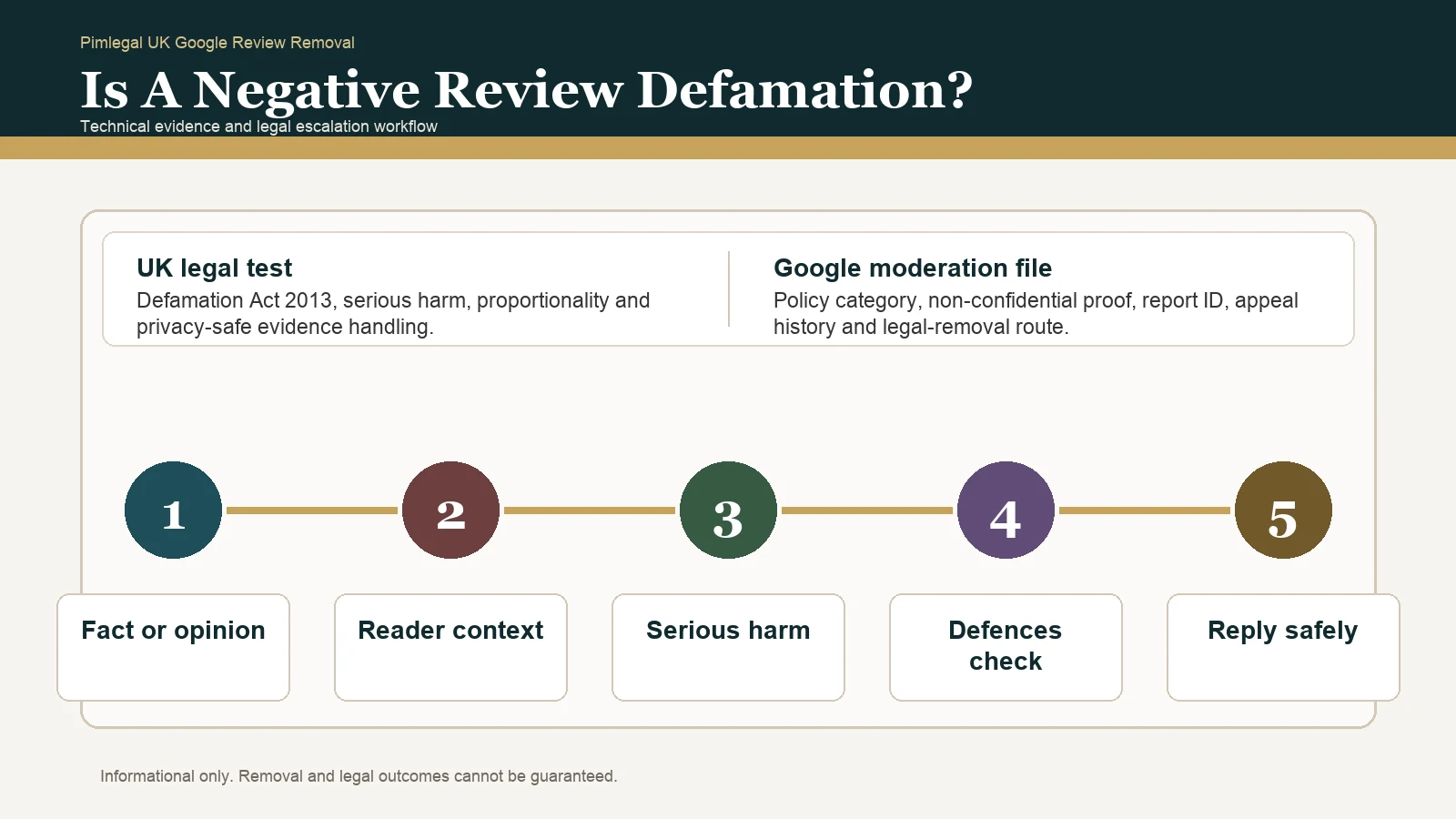
For a stronger file, pair this article with fake customer review evidence and platform policy and legal notice strategy.