
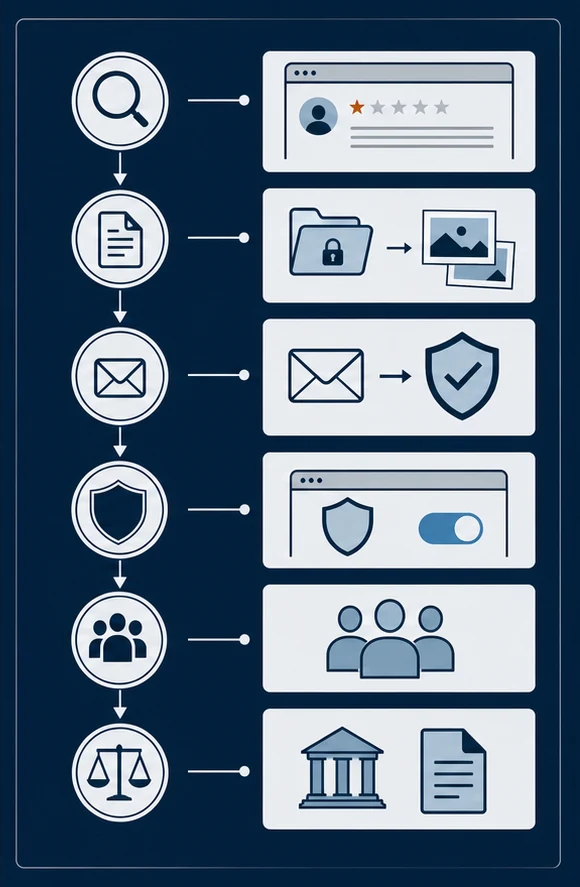
How to connect Google policy categories with proportionate legal action in United Kingdom. In the United Kingdom, a Google review removal file should start with classification, not a template legal threat. Some reviews are best handled through Google policy. Some need a careful public reply. Some justify a legal notice to a reviewer, competitor, former employee, contractor or review broker. A smaller number may require formal legal process.
This strategy should be read with the UK pages on defamatory Google reviews and responding to harmful Google reviews. Those pages explain how to identify legal risk and control public wording before escalation.
Track One: Google Business Profile Policy
Google policy is often the first route because it focuses on platform categories rather than full legal proof. Categories may include fake engagement, conflicts of interest, harassment, hate speech, personal information, off-topic content, misrepresentation and restricted content. A report should identify the exact category and explain the evidence in short, verifiable points.
A platform report is not a courtroom pleading. It should avoid long legal argument and focus on why the content violates Google rules. If the reviewer was not a customer, say what records were checked. If the review contains personal information, identify the private material without repeating it unnecessarily. If the review is part of a pattern, identify the pattern and list the related reviews.
Track Two: Legal Removal Routes
Google also maintains legal-removal pathways through its Legal Help Center. Legal routes may be relevant for court orders, copyright, trademark, privacy, personal information, defamation or other legal grounds. For a UK business, the legal route should be used only where the evidence and legal basis are clear.
A weak legal submission can slow the process. If the problem is fake engagement, the business may be better served by a strong policy report. If the review contains a specific false allegation causing serious harm, a legal notice and legal-removal assessment may be appropriate. If the review discloses private information, privacy and data protection issues may be more important than defamation.
Track Three: Notice To The Responsible Actor
A UK legal notice should identify the review, quote the words complained of, explain the meaning, state why the words are false or policy-violating, describe the evidence, request a defined remedy and preserve rights. It should not overstate the law, threaten criminal action without basis or demand silence about all criticism. The remedy may be removal, correction, preservation of evidence, cessation of repeated conduct or confirmation of identity.
The notice should also comply with the spirit of the Pre-Action Protocol for Media and Communications Claims where defamation or privacy is in view. That means enough detail for the recipient to understand the complaint and respond. A precise notice can support settlement. A vague or aggressive notice can make the dispute harder.
Defamation Act 2013 And Serious Harm
If the notice relies on defamation, it must address the Defamation Act 2013. Section 1 requires serious harm, and trading bodies must address serious financial loss or likely serious financial loss. The notice should therefore explain why the review is more than annoying: it attacks honesty, competence, safety, lawful trading or professional integrity, and it has a credible connection to reputational or commercial damage.
The notice should also anticipate possible defences: truth, honest opinion and public interest. Cases such as Lachaux and Stocker show that seriousness and meaning require careful analysis. A business should not threaten defamation proceedings merely because it dislikes criticism.
Fake Reviews And Consumer-Law Context
The Digital Markets, Competition and Consumers Act 2024 and CMA work on fake reviews provide useful context where a review appears fabricated, incentivised or competitor-driven. A legal notice to a competitor, agency or broker should request preservation of communications, instructions, payment records, account details and campaign materials. It should avoid asserting facts that the business cannot yet prove.
Consumer-law context is especially useful for organised conduct. A single unknown review may be a platform-policy issue. A repeated campaign connected to a commercial actor may raise competition, unfair trading, defamation and business-interference concerns. The evidence should decide the route.
Anonymous Or Pseudonymous Reviewers
If the reviewer is anonymous, formal disclosure may be considered only in serious cases. Authorities such as Totalise plc v Motley Fool Ltd and Sheffield Wednesday Football Club Ltd v Hargreaves show the role of disclosure in anonymous online publication disputes. The process is not automatic, and proportionality is central.
Before seeking identity, ask whether the review can be removed through Google policy, whether the harm justifies formal steps, whether the responsible actor is likely identifiable, whether the claim is strong enough, and whether private data requests are proportionate. A legal notice to Google is different from a policy report and should be used carefully.
Case Study: Competitor Review Campaign
A Bristol removal company receives five reviews alleging stolen property. None of the names match customer records. Two reviews mention a rival's slogan. A former employee now works for that rival. The business also sees similar accusations on another platform. The first step is not to sue the competitor. The first step is to preserve each review, compare wording, check records, document the rival signal and report policy violations to Google.
If the pattern continues and evidence strengthens, a legal notice may request preservation of documents and cessation of unlawful conduct. It may identify possible defamation, malicious falsehood, consumer-law and business-interference issues. It should avoid accusing the rival as a proven fact unless the evidence supports that conclusion.
Notice Packet Contents
- Review URL, profile link, screenshots, date, star rating and page context.
- A sentence-by-sentence chart of the statements complained of and why they are false or policy-violating.
- Internal records proving no matching customer, impossible dates, unsupported allegations or service mismatch.
- Google policy category analysis and report history.
- Evidence of serious harm, serious financial loss or likely commercial impact where defamation is alleged.
- A proportionate remedy request: removal, correction, preservation, cessation or private contact.
Practical Conclusion
A good UK removal strategy keeps platform policy, public response and legal notice aligned. The Google report should explain the rule. The public reply should protect trust and privacy. The legal notice should be precise, evidence-backed and proportionate. When those documents tell the same factual story, the business has a stronger chance of removal and a lower risk of creating a new legal problem.
Key England And Wales References
- Defamation Act 2013: serious harm, truth, honest opinion, public interest and website-operator provisions.
- Defamation Act 2013 section 1: serious harm, including serious financial loss for bodies trading for profit.
- Civil Procedure Rules Part 53: media and communications claims, including defamation and misuse of private information.
- Pre-Action Protocol for Media and Communications Claims: expected detail before a defamation or privacy claim.
- Limitation Act 1980 section 4A: one-year limitation period for libel and slander claims.
- Digital Markets, Competition and Consumers Act 2024 and CMA guidance: consumer-review manipulation and fake-review enforcement context.
- Google Business Profile prohibited and restricted content policy: fake engagement, conflicts of interest, harassment, off-topic content and personal information.
- Google Legal Help Center: legal removal pathways where a policy report is not enough.
Practical Evidence Standard
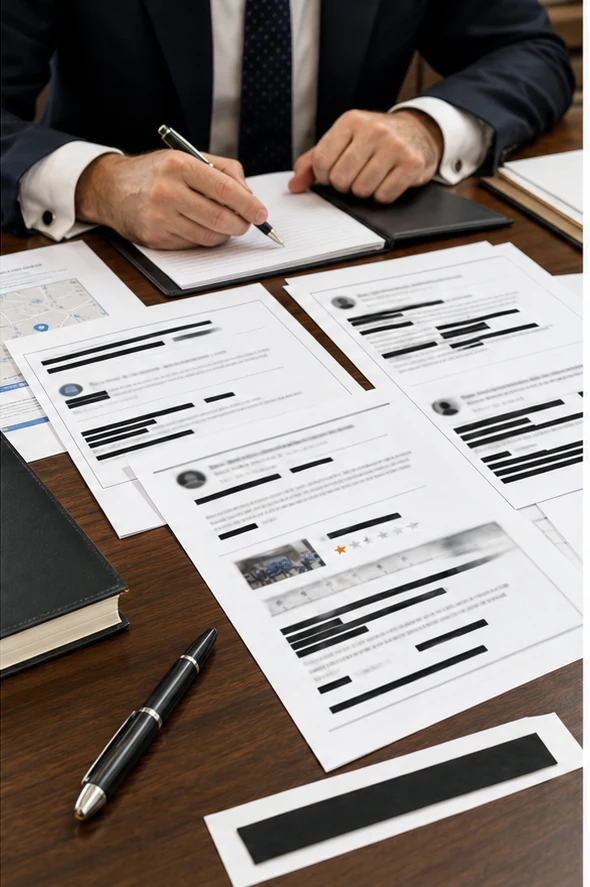
A strong English review-removal file should not rely on screenshots alone. It should preserve the review URL, reviewer name, profile link, star rating, publication date, screenshots with the browser address bar visible, the Google Business Profile affected, internal booking or CRM searches, invoices, email records, staff notes, report IDs, appeal dates and any public reply that has already been posted. The aim is to make the chronology understandable to Google, to a solicitor and, if necessary, to a court.
The file should also separate private evidence from material that can safely be sent to a platform or reviewer. A business can say that no matching customer record exists without exposing customer lists. It can say that the site was closed on a date without publishing staff schedules. In England and Wales, privacy, data protection and proportionality are part of the strategy, not an afterthought.
How To Use These References In A Removal File
The references above should be used as a framework, not as decoration. For each disputed review, the business should identify the Google policy category, the factual allegation, the evidence contradicting it, the legal issue that may apply and the practical remedy requested. If the issue is fake engagement, the Google report should lead with the authenticity evidence. If the issue is a serious false allegation, the legal review should lead with meaning, falsity, serious harm and financial impact. If the issue is personal information, privacy and data-minimisation should shape both the platform report and the public reply.
A useful internal packet has three versions. The full evidence file is kept privately for solicitors and decision-makers. The platform version is shorter and focused on Google policy. The recipient-facing notice is precise, proportionate and limited to what the reviewer or responsible actor needs to understand the complaint. Keeping those versions separate helps the business challenge harmful content without publishing confidential information, overstating the law or weakening its position with an emotional response.
Visual Evidence Route
For a stronger file, pair this article with civil and criminal defamation rules and fake customer review evidence.