
How local civil, criminal and procedural rules can shape an online review dispute in United Kingdom. In England and Wales, an online review dispute can involve civil defamation law, platform policy, privacy, harassment, malicious communications and, in unusual cases, criminal communications offences. A business should not assume that every harmful review is a criminal matter. The proper classification depends on the words used, the evidence of falsity, the harm caused and the conduct around the review.
Use this page alongside our UK guide on defamatory Google reviews and our article on how to respond to a harmful Google review. Those pages cover reputation assessment and public-response control; this page focuses on the civil and criminal rules that may shape escalation.
Civil Defamation: The Main Route
Most serious review disputes are civil matters. The business must identify the statement complained of, the meaning it says the words convey, why that meaning is defamatory, why the statement is false or defensible as a complaint, who published it, and how the serious harm threshold is met. For companies, serious financial loss or likely serious financial loss is central under section 1 of the Defamation Act 2013.
Civil defamation analysis is fact-sensitive. A review alleging that a restaurant is overpriced or staff were rude may be opinion. A review alleging food poisoning, fraud, unsafe equipment, forged qualifications or theft may communicate facts. A solicitor will usually assess natural and ordinary meaning, innuendo meaning where relevant, defences, limitation, proportionality and whether litigation is commercially sensible.
Defences And Why Threats Must Be Careful
The Defamation Act 2013 includes defences of truth, honest opinion and publication on a matter of public interest. A legal notice that ignores these defences can backfire. If the reviewer had a genuine experience and expresses dissatisfaction as opinion, a heavy legal threat may look disproportionate. If the review is fake or contains false factual allegations, the notice should identify the exact falsity and supporting records.
The pre-action stage matters. The Pre-Action Protocol for Media and Communications Claims expects detail, including the words complained of, the meaning attributed to them, factual inaccuracies, remedies sought and relevant chronology. A vague demand to delete a review 'because it is defamatory' is weaker than a notice that explains the legal and evidential basis precisely.
Procedure: CPR Part 53 And Limitation
CPR Part 53 governs media and communications claims, including defamation, misuse of private information and certain data protection claims. Review disputes can also involve interim relief, disclosure, jurisdiction and identification issues. A business should preserve evidence early because the limitation period for libel and slander is generally one year under section 4A of the Limitation Act 1980.
The one-year period does not mean a business should rush into litigation. It means the chronology should be recorded. When was the review first published? Was it edited? Was it repeated elsewhere? When did the business discover it? What reports were made to Google? What replies were posted? Those facts help solicitors evaluate limitation, evidence and proportionality.
Criminal Communications: A Narrower Path
A harmful review is rarely best framed first as a criminal defamation issue. England and Wales do not use a general modern criminal libel route for ordinary business complaints. However, abusive online conduct may engage other statutes in serious cases, including the Malicious Communications Act 1988 section 1, Communications Act 2003 section 127, harassment law or newer online-safety offences depending on the conduct and timing.
Those routes are controlled by public authorities, not by the business. A review containing threats, repeated abuse, doxxing, discriminatory abuse, extortion or menacing messages may justify preserving evidence and seeking police or specialist advice. A review that is merely false about a transaction is usually better assessed through Google policy, civil defamation, consumer-law context or legal notice strategy.
Online Safety Act And False Communications
The Online Safety Act 2023 introduced new communications offences, including false communications and threatening communications provisions. Businesses should be cautious before relying on criminal framing, because statutory elements, commencement and prosecutorial discretion matter. The practical first step remains preservation: capture the review, any direct messages, threats, payment demands and repeated conduct.
Where the conduct includes an extortion demand, threats of repeated fake reviews, harassment of staff or disclosure of private information, the matter is broader than defamation. The evidence pack should keep those elements distinct: one folder for the review itself, one for direct threats, one for customer records, one for Google reports and one for any staff-safety or privacy risk.
Case Law Reference Points
The Supreme Court decisions in Lachaux and Stocker are core references for serious harm and online meaning. Tamiz v Google Inc is useful when considering platform-hosted user comments. Monroe v Hopkins shows how online posts can produce real defamation liability even where the publication is short and digital.
These cases do not make every review actionable. They show the opposite: courts examine meaning, context, seriousness, publication, evidence and remedies. A business that wants removal should therefore build a disciplined file before escalating.
Case Study: Review Plus Threatening Messages
A Birmingham aesthetics clinic receives a review saying it used unsafe products and injured customers. On the same day, the clinic receives anonymous messages saying more reviews will follow unless money is paid. The review itself may raise defamation and Google policy issues. The messages may raise harassment, malicious communications or extortion concerns. The clinic should not merge everything into one emotional complaint.
The correct approach is to preserve the public review, preserve the private messages, avoid publishing patient information, check records, classify the Google policy categories, and seek legal advice on whether a civil notice, platform report, police report or injunction strategy is proportionate. The existence of threatening messages may change the risk assessment, but it does not remove the need to prove the review allegation is false.
Escalation Checklist
- Civil defamation: identify words, meaning, falsity, serious harm, serious financial loss and remedies.
- Google policy: classify fake engagement, conflict of interest, harassment, personal information or off-topic content.
- Criminal communications: preserve threats, menacing messages, extortion demands, doxxing and repeated abuse separately.
- Procedure: record dates, edits, Google reports, replies, appeal outcomes and limitation issues.
- Privacy: avoid disclosing customer, patient, employee or staff data in a public reply or platform submission.
Key England And Wales References
- Defamation Act 2013: serious harm, truth, honest opinion, public interest and website-operator provisions.
- Defamation Act 2013 section 1: serious harm, including serious financial loss for bodies trading for profit.
- Civil Procedure Rules Part 53: media and communications claims, including defamation and misuse of private information.
- Pre-Action Protocol for Media and Communications Claims: expected detail before a defamation or privacy claim.
- Limitation Act 1980 section 4A: one-year limitation period for libel and slander claims.
- Digital Markets, Competition and Consumers Act 2024 and CMA guidance: consumer-review manipulation and fake-review enforcement context.
- Google Business Profile prohibited and restricted content policy: fake engagement, conflicts of interest, harassment, off-topic content and personal information.
- Google Legal Help Center: legal removal pathways where a policy report is not enough.
Practical Evidence Standard
A strong English review-removal file should not rely on screenshots alone. It should preserve the review URL, reviewer name, profile link, star rating, publication date, screenshots with the browser address bar visible, the Google Business Profile affected, internal booking or CRM searches, invoices, email records, staff notes, report IDs, appeal dates and any public reply that has already been posted. The aim is to make the chronology understandable to Google, to a solicitor and, if necessary, to a court.
The file should also separate private evidence from material that can safely be sent to a platform or reviewer. A business can say that no matching customer record exists without exposing customer lists. It can say that the site was closed on a date without publishing staff schedules. In England and Wales, privacy, data protection and proportionality are part of the strategy, not an afterthought.
How To Use These References In A Removal File
The references above should be used as a framework, not as decoration. For each disputed review, the business should identify the Google policy category, the factual allegation, the evidence contradicting it, the legal issue that may apply and the practical remedy requested. If the issue is fake engagement, the Google report should lead with the authenticity evidence. If the issue is a serious false allegation, the legal review should lead with meaning, falsity, serious harm and financial impact. If the issue is personal information, privacy and data-minimisation should shape both the platform report and the public reply.
A useful internal packet has three versions. The full evidence file is kept privately for solicitors and decision-makers. The platform version is shorter and focused on Google policy. The recipient-facing notice is precise, proportionate and limited to what the reviewer or responsible actor needs to understand the complaint. Keeping those versions separate helps the business challenge harmful content without publishing confidential information, overstating the law or weakening its position with an emotional response.
Visual Evidence Route

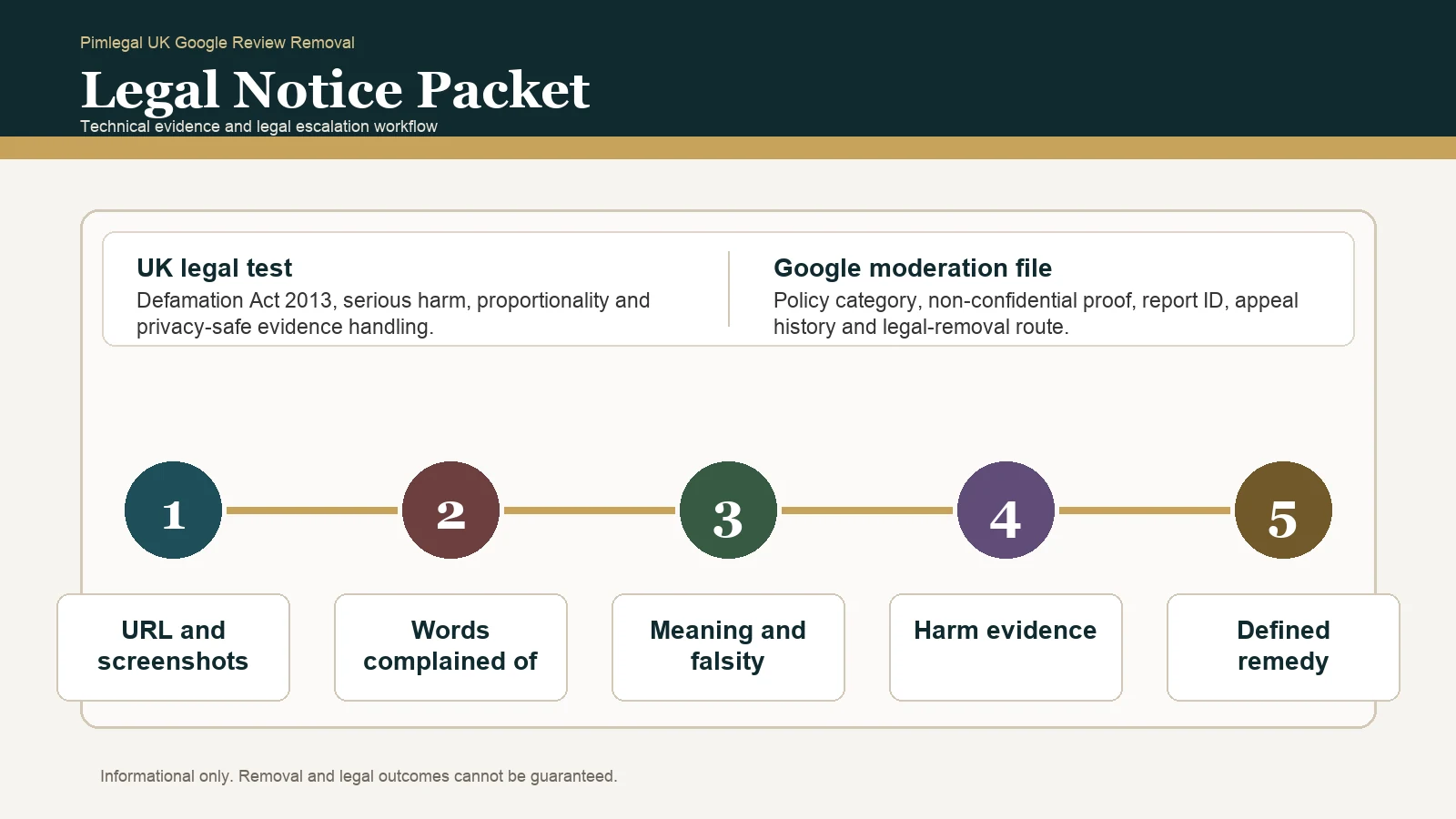
For a stronger file, pair this article with platform policy and legal notice strategy and harmful Google review response strategy.