
What businesses should document before reporting suspicious Google reviews in United Kingdom. In the United Kingdom, a fake customer review can raise several issues at once: Google policy, consumer protection, unfair trading, defamation, malicious communications, data protection and evidence preservation. The first task is not to prove a full court claim. The first task is to build a reliable file showing why the review probably does not reflect a genuine customer experience.
This guide should be read with our UK article on defamatory Google reviews and business reputation and the practical coordinated review attack case study. Those related pages explain how the evidence file supports both a Google report and any later legal escalation.
Fake Engagement Under Google Policy
Google Business Profile policy prohibits content that does not represent a genuine experience, including fake engagement and conflicts of interest. A UK business should not simply write "fake review" in the report box. It should show why the review appears fake: no matching customer record, impossible dates, services never offered, repeated wording, a newly created profile, a reviewer with no local connection, or a pattern linked to a competitor, former employee or contractor dispute.
The strongest Google submission is concise and factual. It may state that the reviewer name does not appear in booking, invoice, payment or enquiry records; that the service described is not offered in the United Kingdom location; that the business was closed on the date alleged; or that multiple reviews repeat unusual phrases within a short period. Each point should be tied to evidence the business can preserve.
Digital Markets, Competition And Consumers Act 2024
The Digital Markets, Competition and Consumers Act 2024 strengthens UK consumer-law enforcement and sits alongside CMA work on online reviews. The CMA has described fake reviews as a consumer-protection problem because they can mislead people choosing businesses, products or services. This regulatory context is especially relevant where a competitor, agency or review broker is suspected.
A local business normally does not enforce the DMCC Act directly in a Google review dispute. However, the Act and CMA guidance help frame the issue: review manipulation can distort consumer choice and competition. If there is evidence that an agency, competitor or organised actor procured false negative reviews, the file should preserve that pattern carefully rather than treating the dispute as a single unhappy-customer complaint.
Consumer Protection From Unfair Trading
The Consumer Protection from Unfair Trading Regulations 2008 remain relevant background for misleading commercial practices. A review campaign connected to a trader or competitor may create different issues from an ordinary customer complaint. The business should therefore ask who benefits from the review, whether the wording resembles marketing claims, whether reviewers overlap with competitor activity, and whether any payment, incentive or agency relationship can be inferred from evidence.
Care is needed. Similar wording does not prove a competitor attack by itself. Timing clusters and profile anomalies are indicators, not conclusions. A responsible UK evidence file records the indicators, avoids unsupported allegations, and leaves final legal characterisation to solicitors or regulators where escalation is justified.
Preserving Records Before A Reviewer Disappears
Google reviews can be edited, removed or hidden. Reviewer profiles can change. A business should capture the review as soon as it is found. Preserve the URL, star rating, profile name, profile link, date, screenshots, page position, photographs, likes, owner replies and the full Google Business Profile context. If several reviews arrive together, capture the order and timing before the pattern becomes harder to prove.
Internal records matter as much as public screenshots. Keep booking logs, CRM searches, invoices, payment records, refund records, call logs, emails, chat transcripts, staff rotas where relevant, CCTV availability notes, delivery records and service records. Do not publish private records in a public reply. Preserve them for a targeted platform report or legal review.
Anonymous Reviewers And Disclosure Strategy
Many fake review matters involve pseudonymous accounts. English procedure may allow disclosure routes in appropriate cases, including Norwich Pharmacal relief. Decisions such as Totalise plc v Motley Fool Ltd and Sheffield Wednesday Football Club Ltd v Hargreaves are commonly cited in discussions of identifying anonymous online publishers. Those cases do not mean a platform must disclose data on informal request; they show why legal process and proportionality matter.
Before seeking identification, the business should ask whether it is necessary. If a Google policy report can remove the content, formal disclosure may be excessive. If the review pattern is serious, repeated, defamatory or commercially targeted, solicitors may consider preservation letters, platform routes, disclosure options and whether the evidence justifies court involvement.
Case Study: A Former Contractor Pattern
Consider a Manchester home-services company that receives nine one-star reviews in two days. The reviewers describe work the company never performs, repeat a phrase used in a recent dispute with a dismissed contractor, and post from profiles with no other local review history. The company also receives a message demanding payment to 'make the reviews stop'. This is not just a customer-service problem; it is a preservation and classification problem.
The company should preserve the reviews, the message, the contractor dispute records, any matching phrases, dates, profile data and Google report IDs. It should not accuse the contractor publicly without proof. The first Google report should focus on fake engagement, conflict of interest, harassment or extortion indicators. A legal notice can be considered only after the responsible actor and evidence are assessed.
Evidence Checklist
- Review URL, reviewer profile link, star rating, date and screenshots with visible browser context.
- CRM, booking, invoice, payment and enquiry searches showing whether the reviewer was a customer.
- Service records showing whether the alleged product, date, branch or employee existed.
- Pattern evidence: timing clusters, repeated wording, profile age, geographic mismatch and cross-platform similarities.
- Google report IDs, appeal history, takedown outcomes and any owner replies already posted.
- Separate private evidence from public response wording to avoid privacy and data protection problems.
Publications And Studies
CMA publications on online reviews, enforcement announcements involving Google, and consumer research on review reliance all support the same practical point: review authenticity affects purchasing decisions. Academic and regulator literature on online reputation repeatedly shows that star ratings and recent reviews influence consumer trust, so a fake negative review can create real commercial consequences even before litigation is considered.
For removal purposes, the business should convert that general insight into concrete proof. Explain what customers see, why the review is prominent, why the described transaction is impossible or unsupported, and why the suspected pattern fits Google policy. The best file is not the longest file; it is the clearest file.
Key England And Wales References
- Defamation Act 2013: serious harm, truth, honest opinion, public interest and website-operator provisions.
- Defamation Act 2013 section 1: serious harm, including serious financial loss for bodies trading for profit.
- Civil Procedure Rules Part 53: media and communications claims, including defamation and misuse of private information.
- Pre-Action Protocol for Media and Communications Claims: expected detail before a defamation or privacy claim.
- Limitation Act 1980 section 4A: one-year limitation period for libel and slander claims.
- Digital Markets, Competition and Consumers Act 2024 and CMA guidance: consumer-review manipulation and fake-review enforcement context.
- Google Business Profile prohibited and restricted content policy: fake engagement, conflicts of interest, harassment, off-topic content and personal information.
- Google Legal Help Center: legal removal pathways where a policy report is not enough.
Practical Evidence Standard
A strong English review-removal file should not rely on screenshots alone. It should preserve the review URL, reviewer name, profile link, star rating, publication date, screenshots with the browser address bar visible, the Google Business Profile affected, internal booking or CRM searches, invoices, email records, staff notes, report IDs, appeal dates and any public reply that has already been posted. The aim is to make the chronology understandable to Google, to a solicitor and, if necessary, to a court.
The file should also separate private evidence from material that can safely be sent to a platform or reviewer. A business can say that no matching customer record exists without exposing customer lists. It can say that the site was closed on a date without publishing staff schedules. In England and Wales, privacy, data protection and proportionality are part of the strategy, not an afterthought.
How To Use These References In A Removal File
The references above should be used as a framework, not as decoration. For each disputed review, the business should identify the Google policy category, the factual allegation, the evidence contradicting it, the legal issue that may apply and the practical remedy requested. If the issue is fake engagement, the Google report should lead with the authenticity evidence. If the issue is a serious false allegation, the legal review should lead with meaning, falsity, serious harm and financial impact. If the issue is personal information, privacy and data-minimisation should shape both the platform report and the public reply.
A useful internal packet has three versions. The full evidence file is kept privately for solicitors and decision-makers. The platform version is shorter and focused on Google policy. The recipient-facing notice is precise, proportionate and limited to what the reviewer or responsible actor needs to understand the complaint. Keeping those versions separate helps the business challenge harmful content without publishing confidential information, overstating the law or weakening its position with an emotional response.
Visual Evidence Route

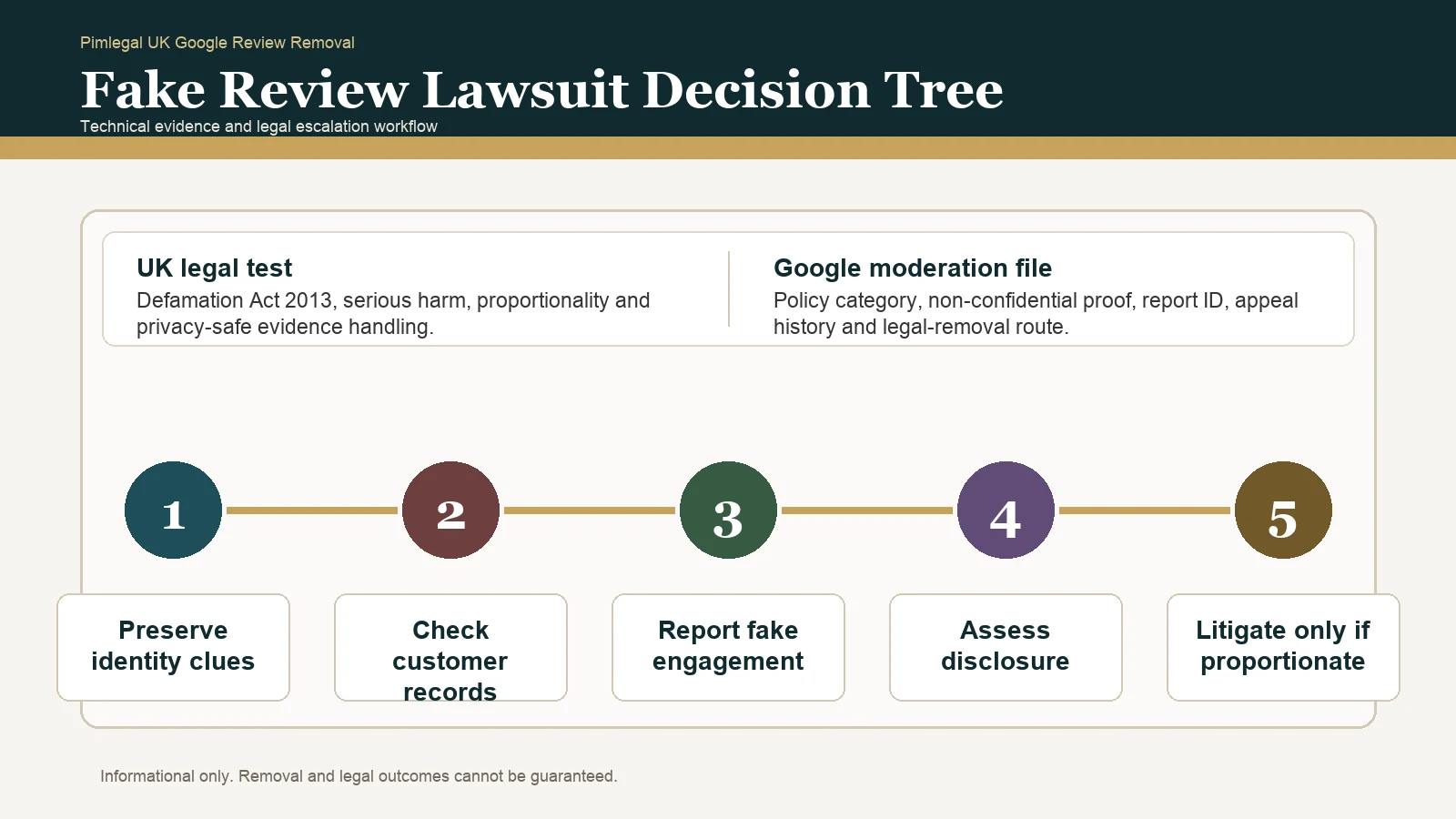
For a stronger file, pair this article with defamatory Google review analysis and coordinated review attack case study.