
A practical UK guide to deciding when a fake Google review justifies legal action, disclosure strategy, platform reporting or a more restrained response. The United Kingdom strategy should be precise, proportionate and evidence-led. Businesses often move too quickly from reputational anxiety to a demand for removal. A stronger file treats the review as a publication, a platform-policy event, a customer-record question and a legal-risk decision at the same time.
For deeper context, read fake customer review evidence in the United Kingdom and international online reputation strategy. Those two related Pimlegal pages help connect this article to the wider UK review-removal framework without turning a single review dispute into an overbroad legal threat.

Legal Issue Framing Under UK Defamation Law
For can you sue someone for a fake Google review in the United Kingdom, the first task is to classify the review precisely. The issue is whether litigation is proportionate compared with Google reporting, a privacy-safe response, a preservation notice or identity-focused legal process. A damaging review can be commercially painful and still be lawful opinion. A short post can also be legally serious if it accuses the business of dishonesty, unsafe practice, fraud, discrimination, criminal conduct, professional incompetence or another factual matter that readers are likely to treat as true.
The central statute is the Defamation Act 2013. Section 1 requires serious harm to reputation, and section 1(2) adds that a body trading for profit must show serious financial loss or likely serious financial loss. That standard should shape every UK Google review removal file. The business should not rely on adjectives such as unfair, malicious or defamatory unless the evidence explains why the exact words cross the legal threshold.
The Supreme Court decision in Lachaux v Independent Print Ltd confirms that serious harm is an evidential question, while Stocker v Stocker is important for online meaning because readers assess social and review-platform language in context. A UK review file should therefore record the words, star rating, surrounding profile, publication date, ranking position, screenshots and reader context before deciding whether the legal route is strong.
The business should then test likely defences. Truth may defeat a complaint if the sting of the review is substantially true. Honest opinion may matter where the wording is evaluative and based on indicated facts. Public interest may become relevant where the review discusses safety, compliance, consumer protection or professional conduct. A strong removal strategy anticipates these points instead of assuming that the reviewer's tone is enough.
Timing also matters. The Limitation Act 1980 section 4A normally gives one year for libel and slander claims. That does not mean a business should rush into litigation. It does mean the business should preserve evidence early, record when the review was first discovered and avoid losing the chronology while informal reporting is attempted.
In this article the focus is a suspected fake review where the author may be anonymous, pseudonymous or linked to a competitor, former employee or organised campaign. The best approach is not a generic takedown request. It is a controlled legal and platform assessment that asks: what does the review say, what does a reasonable UK reader understand, what evidence disproves it, what harm can be shown, what Google policy category fits, what public response is safe, and what remedy is proportionate.
Evidence Checklist Before Reporting Or Replying
The evidence standard for this issue is practical: the business should preserve URLs, profile pages, timestamps, no-match customer searches, payment logs, call logs, competitor indicators, threat messages and the exact sequence before seeking identity. The file should be understandable to a Google moderator, a solicitor, management and, if escalation is unavoidable, a court. It should not be a folder of unexplained screenshots.
- Capture the full review, star rating, reviewer name, profile URL, publication date, images, likes and visible Business Profile context.
- Take screenshots with the browser address bar visible and preserve the source URL separately in a dated note.
- Search booking, CRM, email, payment, refund, delivery, job, complaint and call records for the reviewer name and the facts alleged.
- Record who performed the search, when it was performed and which systems were checked.
- Preserve the public ranking position of the review and any evidence that prospects, customers, staff or partners saw it.
- Keep private customer, patient, employee and payment records out of public replies and out of unnecessary platform uploads.
- Create a short policy summary for Google and a fuller privileged or solicitor-ready evidence bundle for legal review.
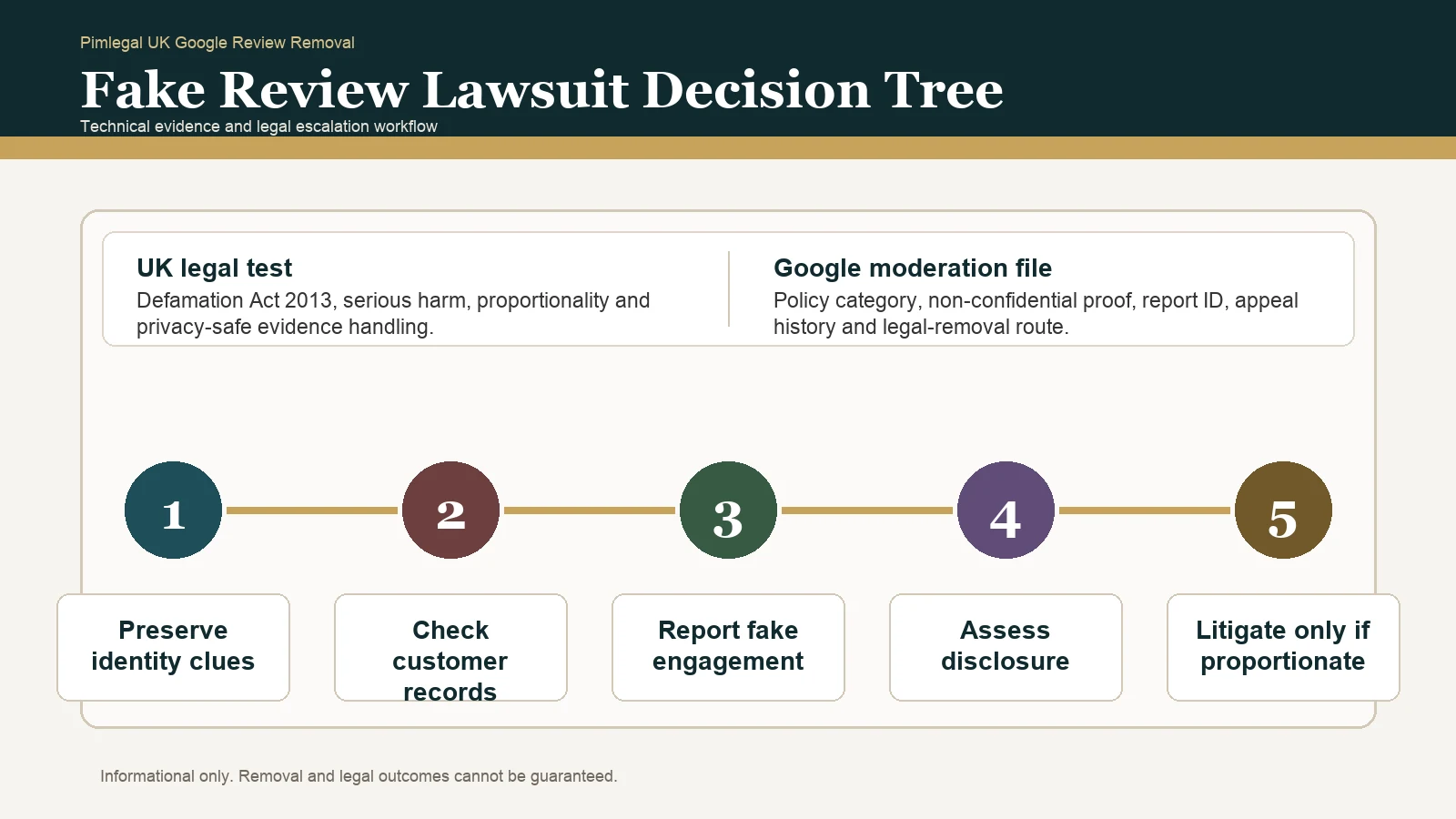
The chronology should be boring in the best possible way: review found, evidence captured, records checked, policy category selected, report submitted, report ID saved, public response reviewed, escalation considered. A business that can recreate each step is in a stronger position than a business that only asserts the review is harmful.
For businesses with several locations, each affected Google Business Profile should be documented separately. Do not assume that a review on one branch proves harm to another branch. Preserve location, branch name, address, profile URL, screenshots and any local customer records. Multi-location confusion is common in Google review disputes, and it can weaken otherwise strong reports.
Google Policy And Legal Removal Angle
Google review removal is not identical to a UK defamation claim. The Google Business Profile prohibited and restricted content policy focuses on platform rules such as fake engagement, impersonation, conflicts of interest, harassment, hate speech, off-topic content, personal information and restricted content. The Google report process is usually most effective when the submission is short, factual and tied to one or two strongest policy categories.
For this topic, the Google angle is: the strongest first route may be fake engagement, conflict of interest or extortion reporting rather than immediate court proceedings. The report should not read like a court pleading. It should identify the review, state the policy category, give objective indicators and avoid exposing unnecessary confidential material. If the review contains a serious legal allegation, a separate legal analysis can exist in the background.
Where the content is not adequately addressed by ordinary reporting, Google's Legal Help Center may be relevant. Legal removal routes should be used carefully. A weak legal submission can be slower and less persuasive than a strong policy report. A business should decide whether the problem is platform abuse, legal defamation, privacy, harassment, extortion, consumer-law misconduct or a mixture.
The UK consumer-protection context also matters. The Digital Markets, Competition and Consumers Act 2024 and CMA work on fake reviews show that review integrity is a market-trust issue, especially where reviews are fabricated, incentivised or commercially manipulated. The CMA's 2025 Google fake-review undertakings announcement is useful context, but a business still needs review-specific proof.
The strongest submissions are modular. The Google report translates the evidence into platform language. The public response protects trust and privacy. The legal notice, if needed, translates the same evidence into legal meaning, falsity, harm and remedy. These documents should not contradict one another.
Escalation Criteria For UK Businesses
Escalation is justified only when the evidence supports it. For this issue, formal legal action may be considered if the review is serious, repeated, identifiable or commercially targeted, and if disclosure or injunctive relief is proportionate. In practice, escalation may include a second Google report, a privacy-safe public response, a preservation letter, a solicitor's notice, a legal-removal submission, identity-focused process, interim relief analysis or a civil claim.
If a legal notice is contemplated, the Pre-Action Protocol for Media and Communications Claims and Civil Procedure Rules Part 53 are important references. The complaint should identify the words, publication location, meaning, factual inaccuracy, harm, remedy sought and documents preserved. A precise notice is more credible than a broad threat to sue everyone involved.
Platform liability and author liability should also be separated. Tamiz v Google Inc illustrates why platform-hosted user comments raise different questions from direct author publication. Where the author is anonymous, authorities such as Totalise plc v Motley Fool Ltd show why disclosure strategy requires legal process and proportionality rather than informal demands.
Risk cautions are central: a business should not sue merely because a review feels fake; evidence, proportionality and recoverability matter. Businesses should also avoid review suppression. They should not threaten honest customers, offer unlawful incentives for removal, ask staff to post counter-reviews, publish private data, fabricate evidence or claim that every negative opinion is defamatory.
Where threats, repeated targeting or abusive messages are present, separate statutes may need review, including the Malicious Communications Act 1988, the Protection from Harassment Act 1997 and the Online Safety Act 2023. These references should not be dropped into every review letter. They matter only where the facts fit.
Birmingham Case Study: Anonymous Reviewer And No Customer Record
A Birmingham service company receives three reviews from accounts with no matching customer record. One profile uses a false name, one repeats language from a competitor's website and one threatens to post more unless a refund is paid.
A disciplined response would begin with preservation, not accusation. Management should freeze screenshots, copy URLs, check internal records, identify who may safely review private evidence and decide whether the first route is Google policy, a public reply, a legal notice or no action beyond monitoring.
The case file should then be split into three versions. The internal version contains the complete chronology and private records. The Google version states the policy category and non-confidential proof points. The external notice version, if needed, quotes only what is necessary and requests a defined remedy. This separation helps the business act firmly without broadcasting sensitive information.
If the facts remain uncertain, the correct conclusion may be restraint. A business can preserve evidence and post a neutral public response while further checks continue. Not every harmful review should produce litigation, and not every policy report should contain legal threats. The route should follow the evidence.
Practical Conclusion
The practical answer to can you sue someone for a fake Google review in the United Kingdom is evidence-led. A UK business should preserve the review, classify the words, check records, map the strongest Google policy category, protect private data, assess serious harm and choose a proportionate remedy. That may be a Google report, a calm reply, a legal notice, a disclosure route or no immediate public action.
The business should also keep the site's legal-disclaimer posture in mind. This article is informational only. It does not promise removal, does not replace advice from a solicitor and does not mean that every negative Google review is unlawful. The value of a lawyer-grade process is that it helps the business challenge genuinely false or abusive content while respecting lawful criticism and avoiding a second reputational problem.
Key References
- Defamation Act 2013: serious harm, truth, honest opinion, public interest and website-operator provisions.
- Pre-Action Protocol for Media and Communications Claims: expected detail before defamation or privacy proceedings.
- Google Business Profile prohibited and restricted content policy: fake engagement, conflicts of interest, harassment, personal information and related policy categories.
- Google Legal Help Center: legal-removal pathways where policy reporting is not enough.
- Digital Markets, Competition and Consumers Act 2024: UK consumer-law context for review manipulation and fake-review enforcement.