
A practical United Kingdom guide to auditing review authenticity, preserving evidence, correcting risky practices and responding proportionately to platform or regulator scrutiny.
Why Fake Reviews Can Be More Than A Defamation Problem
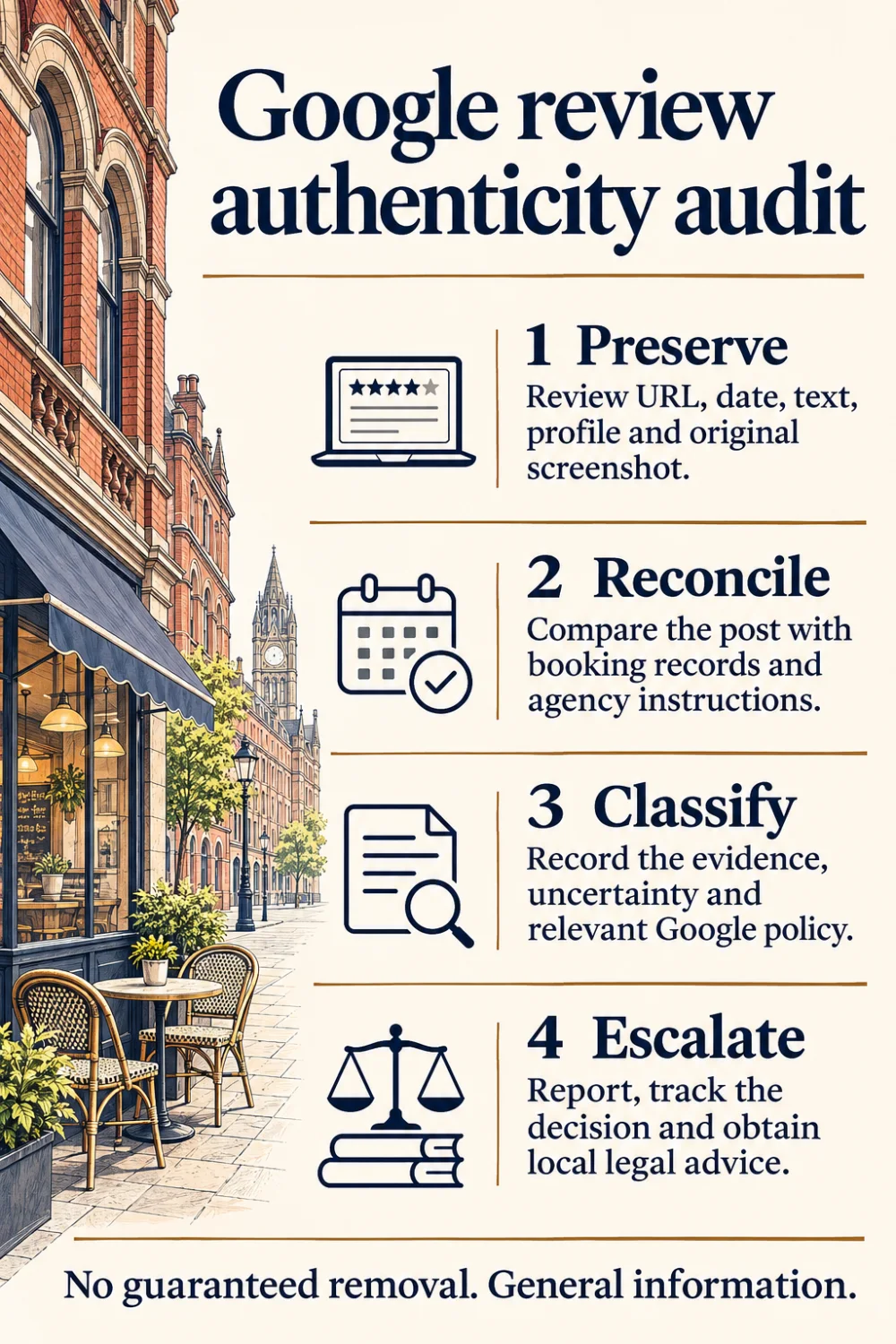
Start an authenticity audit with a question the records can answer. What did the agency agree to deliver, and which published posts resulted from that instruction? Collect the statement of work, campaign approval and any promise concerning stars or replacement reviews. Assign an audit owner who can ask staff for records without asking them to rewrite what happened. Define the locations and dates under review. The first output should be a list of known publications, uncertain matches and records still requested. This keeps an unresolved name or a sudden rating change from becoming an unsupported accusation.
Applying the audit in United Kingdom
The CMA's Feefo case page was updated on 28 September 2026 to record that its investigation remained ongoing. The case concerns whether certain one-star reviews were omitted from publication and ratings on Autotrader. The page says no finding of infringement had been made at that stage. For a UK agency audit, reconcile moderation decisions with the denominator used for the displayed average. Keep genuine negative feedback in the evidence pack. A report about fabricated reviews and a concern about selective suppression can require different proof. Check the current case record before describing its outcome, and do not infer that the investigation established a breach by Google.

Evidence Checklist Before You Call It Fake
Give every item a stable reference. Record the review URL, the text as seen, its rating and the date and time of capture. Keep the original file alongside a working copy used for redaction. Link each post to any agency delivery screenshot, invoice or instruction, and record the strength of that link. An invoice for ten posts does not identify ten live reviews. If an export contains seven links and one no longer resolves, the file has six visible matches, a historical link to investigate and three unidentified deliverables. Label this as an illustrative reconciliation, then apply the same discipline to the actual records.
Recent platform development — 20 October 2026
On 20 October 2026, Search Engine Land reported Google's announcement of extended processing times for review appeals. The report described a historical operational delay and supplied no deadline for a pending case. It supports keeping report receipts, evidence versions and appeal outcomes together. It does not establish that every report is delayed today. Google's current guidance provides a one-time appeal for eligible decisions and a tool for checking status.
Recent Development — Singapore Fake-Review Enforcement, 30 September 2026
On 30 September 2026, Singapore's Competition and Consumer Commission announced enforcement following an investigation into a fake-review provider and 47 client businesses. The regulator said 45 businesses admitted procuring fake reviews. Their undertakings included stopping the practice, identifying and removing fake reviews, reporting progress, strengthening compliance and publishing a prominent apology for six months. The release describes generated text, paid posters, review packages and dashboards used to make fabricated experiences look authentic.
For a business in United Kingdom, this is a documented international enforcement example, not a change to United Kingdom law and not proof that every unusual review is fake. Its practical relevance is the remediation sequence: preserve the external allegation and internal workflow, identify affected content, stop questionable solicitation or vendor activity, document correction, and keep public statements consistent with verified facts. Local regulator powers and remedies must be checked under UK Digital Markets, Competition and Consumers Act 2024.

Google Policy And The Consumer-Law Angle
Draft the platform report from the reconciliation table. Select the post and explain the documented conduct that fits a Google policy. Attach only the evidence needed to understand that connection. Save the submission receipt and the version sent. A rejected review report, a pending report and a restriction on the business profile represent different decisions. Read the notification before choosing an appeal route. When new evidence arrives, add it to the audit chronology and check whether the relevant process permits its submission. An internal assumption that a report succeeded should never close the case without checking the public post.
Public Response Strategy Without Overreaching
Prepare a response that the business can keep accurate as the audit develops. Designate who can approve it and who will monitor replies. Where an experience cannot be matched, offer a private way for the customer to supply a date or reference. Avoid placing receipts or sensitive service details in the reply. If the agency campaign has been paused, record when that occurred before referring to it publicly. Keep a copy of each published version. A correction to the business's own statement should be recorded with the same care as an edit to the disputed review.
When Escalation Becomes More Serious
Take unresolved legal questions to local counsel with a concise evidence pack. Identify the person or company whose conduct is questioned, the specific publication, the established connection to the campaign and the remedy being considered. Separate any request for disclosure of an author's identity from a request to remove content. If the agency refuses its records, preserve the refusal and the contract provision relied on. A regulator enquiry, a payment demand tied to removing reviews or a serious factual allegation may justify urgent advice. Have counsel assess authority, confidentiality and applicable procedures before sending a formal demand.
Related PimLegal Reading
For related reading, see our local guide to fake customer review evidence and the United Kingdom Google review removal page.
Selected Official References
- UK Digital Markets, Competition and Consumers Act 2024
- CCS enforcement release, 30 September 2026
- Google Maps user-generated content policy
- Google Business Profile restrictions for policy violations
- Google review reporting guidance
- 20 October 2026 — review appeal processing announcement
- CMA — Feefo investigation, timetable updated 28 September 2026
Practical Conclusion
Close the audit by distinguishing what has been confirmed, what has changed and what remains unresolved. Check each public review URL again after a platform decision and record the result by outlet. Review the next agency contract against the failure found in this file. Require an account of the work performed and the source of customer invitations. Specify how delivery records will be handed over. Assign a date for checking outstanding items so a campaign that has stopped generating invoices is still followed through to a documented result.
This article is general information only and not legal advice for a specific dispute in United Kingdom. Businesses should seek local advice before sending formal notices or accusing any person or company of review manipulation.