
Response strategy, escalation timing and legal risk control for businesses in United Kingdom. In England and Wales, a public reply to a harmful Google review is not just customer service. It can become evidence, affect defamation analysis, expose private data, strengthen or weaken a Google policy report, and influence whether a later legal notice appears proportionate. The safest reply is short, factual and controlled.
Before replying, read the UK guide on fake customer review evidence and the article on civil and criminal defamation rules. Those pages explain why preservation and legal classification should happen before a business posts a public answer.
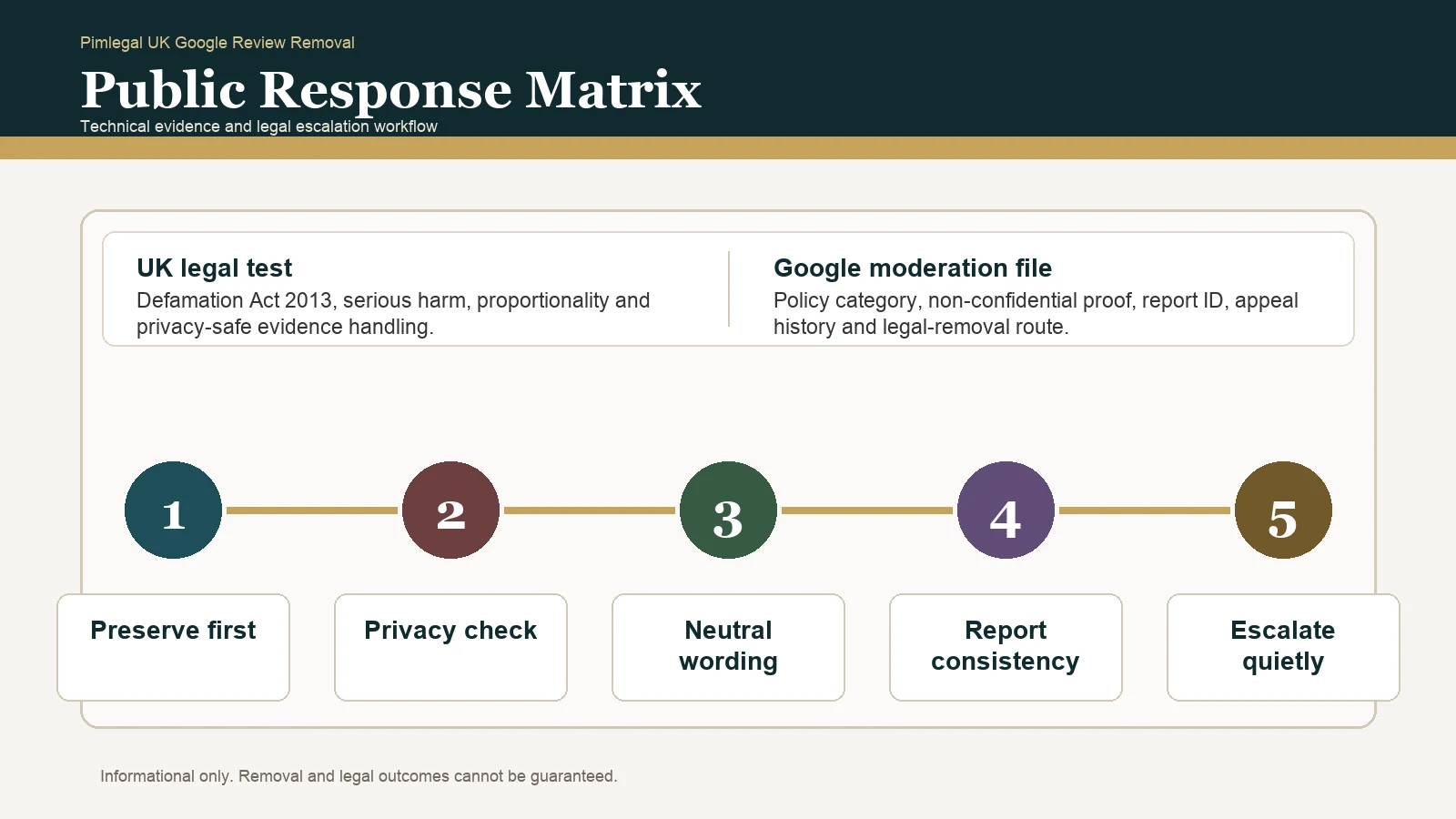
Preserve First, Reply Second
The first mistake is to reply while angry. Before any public response, preserve the review URL, profile link, star rating, text, date, screenshots, image attachments and surrounding profile context. Then check internal records. Was the reviewer a customer? Is the date possible? Was the service described offered? Are there private facts, threats, health information, staff allegations or litigation-related issues?
A reply that discloses private customer information can create a separate problem. In regulated sectors such as healthcare, legal services, finance, education or childcare, even confirming that someone is or is not a client can be sensitive. A public response should protect reader trust without publishing private records.
A Safe Reply Framework
A safe UK response usually has three parts. First, acknowledge that the business takes feedback seriously. Second, state that the account cannot be verified or that the matter is being reviewed, without disclosing private data. Third, invite the reviewer to contact a private channel. The reply should not threaten, insult, diagnose, reveal, speculate or accuse without evidence.
For example: 'We take this seriously, but we cannot verify the account from the information provided. Please contact our manager at [channel] so we can review the matter privately.' If the review appears fake, the reply can remain neutral while the evidence file and Google report say more. Future customers read the tone as much as the content.
When Not To Reply
Delay a public reply when the review contains threats, extortion demands, accusations of criminal conduct, medical or client facts, employee grievances, safeguarding issues, doxxing, discriminatory abuse or signs of a coordinated campaign. In those cases, preserve first and escalate internally. A reply may still be posted later, but only after privacy and legal risks have been checked.
If the review includes personal data, a legal claim, or information about another customer, a public answer can make the situation worse. The business should consider a Google policy report for personal information, harassment or off-topic content, and prepare a private evidence file for legal review if needed.
Defamation Risk In The Reply
A business can defame a reviewer too. Calling someone a fraudster, blackmailer, fake customer, competitor agent or liar without sufficient evidence may create risk. Even where the business strongly suspects a fake review, public wording should be careful. The evidence file can record suspicion; the public reply should be measured.
English cases such as Monroe v Hopkins show that short online publications can carry defamatory meaning and real consequences. The lesson for businesses is simple: do not create a second defamatory publication while trying to answer the first.
Google Policy And Report Consistency
The public reply should not contradict the Google report. If the report says the reviewer is not a customer, the reply should not say 'we remember your visit'. If the report says the review contains personal information, the reply should not repeat that information. If the report says the review is off-topic, the reply should not debate the off-topic allegation in detail.
Consistency matters because Google, the reviewer, a solicitor or a court may later see both documents. A controlled response supports credibility. An emotional response may make the business look defensive and reduce the chance that a platform or adviser treats the removal request as evidence-led.
Case Study: The False Refund Allegation
A Leeds training provider receives a review saying: 'They took my money, cancelled the course and refused to refund me.' Records show that the reviewer attended the course, requested a certificate reissue and was refunded a small duplicate payment. The accusation is misleading, but a public reply listing payment details would expose private financial information.
A safer reply would say that the provider cannot discuss individual accounts publicly and invites the reviewer to contact a named private channel. The evidence file can include payment records, attendance records and emails. A Google report or legal notice can then identify the false factual allegation without publishing private details on the Business Profile.
Regulatory And Consumer Trust Context
CMA work on online reviews and fake-review enforcement shows that review integrity matters to consumer choice. That does not mean every negative review should be removed. It means a business should respond in a way that protects legitimate criticism while challenging fake, misleading, abusive or unlawful content through the correct channel.
The public audience is often more important than the reviewer. A calm answer shows professionalism to future customers. A legal threat may frighten genuine reviewers, attract criticism or look like review suppression. The better approach is to preserve evidence, report policy violations and reply only where the message improves trust.
Reply Templates
- Unverified review: We cannot verify this account from the information provided, but we take concerns seriously. Please contact us privately so we can review it.
- Known customer, disputed facts: We are sorry you were disappointed. We cannot discuss account details publicly, but our manager is available to review this with you directly.
- Policy issue: We are reviewing this matter through the appropriate channel and cannot discuss private details publicly.
- Coordinated pattern: We take feedback seriously and are reviewing the matter. For privacy and safety reasons, we will respond through the appropriate process.
When To Escalate
Escalate beyond a public reply when the review contains a serious false factual allegation, a pattern of suspected fake engagement, threats, personal information, discriminatory abuse, competitor indicators, extortion demands or regulatory accusations. In those cases, the reply is only one part of the strategy. The business may need Google reporting, evidence preservation, a legal notice or specialist advice.
Key England And Wales References
- Defamation Act 2013: serious harm, truth, honest opinion, public interest and website-operator provisions.
- Defamation Act 2013 section 1: serious harm, including serious financial loss for bodies trading for profit.
- Civil Procedure Rules Part 53: media and communications claims, including defamation and misuse of private information.
- Pre-Action Protocol for Media and Communications Claims: expected detail before a defamation or privacy claim.
- Limitation Act 1980 section 4A: one-year limitation period for libel and slander claims.
- Digital Markets, Competition and Consumers Act 2024 and CMA guidance: consumer-review manipulation and fake-review enforcement context.
- Google Business Profile prohibited and restricted content policy: fake engagement, conflicts of interest, harassment, off-topic content and personal information.
- Google Legal Help Center: legal removal pathways where a policy report is not enough.
Practical Evidence Standard
A strong English review-removal file should not rely on screenshots alone. It should preserve the review URL, reviewer name, profile link, star rating, publication date, screenshots with the browser address bar visible, the Google Business Profile affected, internal booking or CRM searches, invoices, email records, staff notes, report IDs, appeal dates and any public reply that has already been posted. The aim is to make the chronology understandable to Google, to a solicitor and, if necessary, to a court.
The file should also separate private evidence from material that can safely be sent to a platform or reviewer. A business can say that no matching customer record exists without exposing customer lists. It can say that the site was closed on a date without publishing staff schedules. In England and Wales, privacy, data protection and proportionality are part of the strategy, not an afterthought.
How To Use These References In A Removal File
The references above should be used as a framework, not as decoration. For each disputed review, the business should identify the Google policy category, the factual allegation, the evidence contradicting it, the legal issue that may apply and the practical remedy requested. If the issue is fake engagement, the Google report should lead with the authenticity evidence. If the issue is a serious false allegation, the legal review should lead with meaning, falsity, serious harm and financial impact. If the issue is personal information, privacy and data-minimisation should shape both the platform report and the public reply.
A useful internal packet has three versions. The full evidence file is kept privately for solicitors and decision-makers. The platform version is shorter and focused on Google policy. The recipient-facing notice is precise, proportionate and limited to what the reviewer or responsible actor needs to understand the complaint. Keeping those versions separate helps the business challenge harmful content without publishing confidential information, overstating the law or weakening its position with an emotional response.
Visual Evidence Route

For a stronger file, pair this article with defamatory Google review analysis and platform policy and legal notice strategy.