
How U.S. businesses should preserve evidence, use Google's extortion reporting path, and assess subpoena or legal escalation after anonymous review threats. In the United States, anonymous Google review extortion should be treated as a combined evidence, platform-policy, reputation, and legal-risk problem. The business is often hit twice: first by a sudden cluster of harmful reviews or a single severe anonymous review, and then by a message demanding money, goods, services, refunds, or other concessions in exchange for deleting, editing, or stopping the attack.
The lawyer-grade question is not simply whether the messages feel abusive. The real question is how to preserve a file that can be understood by Google, by local U.S. counsel, by management, and, if necessary, by a court or law-enforcement contact. That requires separating the review text, the off-platform demand, the customer-record mismatch, the anonymity issue, the platform route, and the escalation threshold. When those categories are merged into one emotional complaint, the file usually becomes weaker.
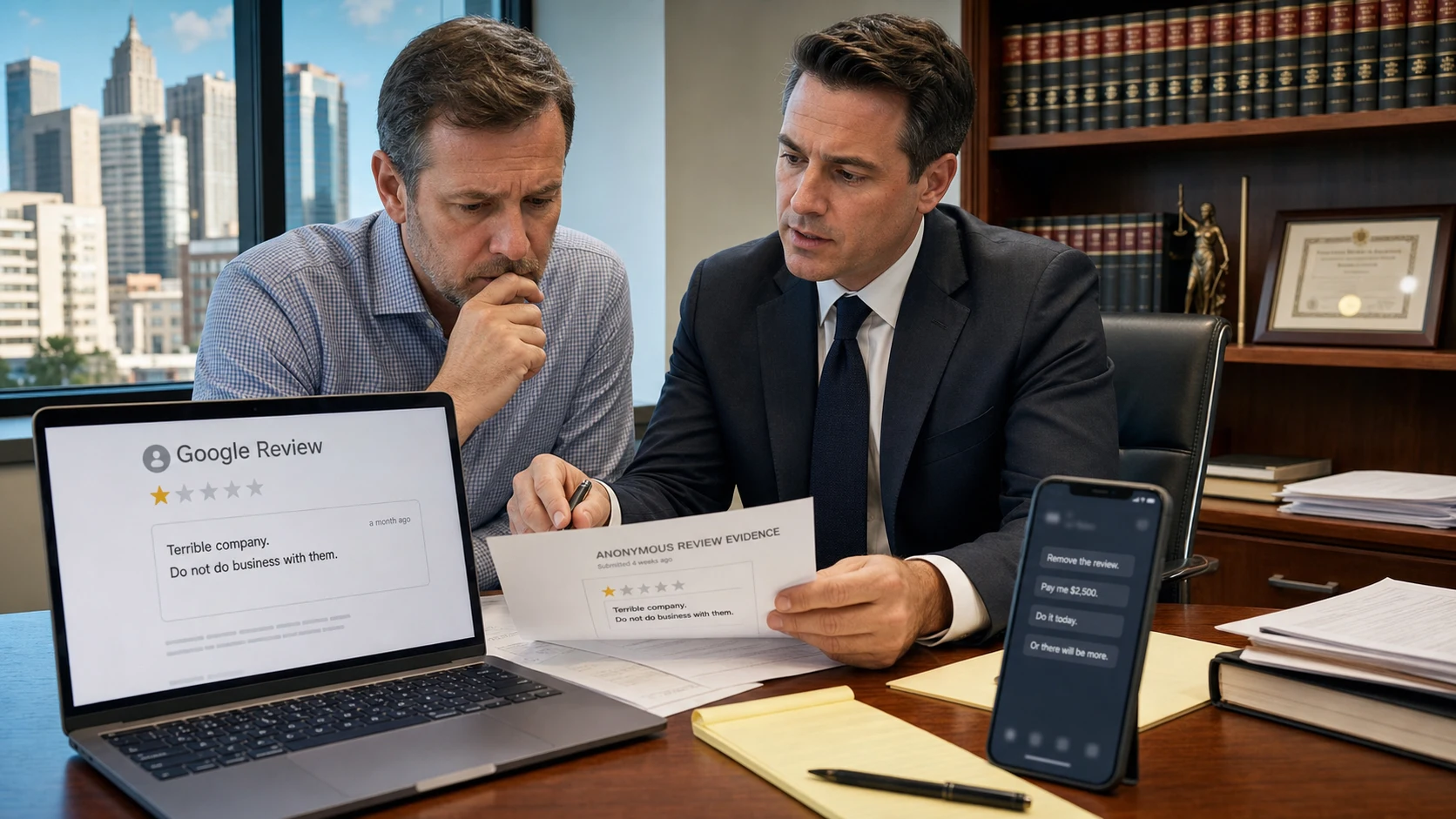
Legal Issue Framing: Anonymous Review Or Extortion Event
Google now has a dedicated official page for negative review extortion scams on Business Profiles. Google describes a recognizable pattern: a sudden increase in low-star reviews followed by someone demanding money, goods, or services in exchange for removing the reviews. Google also tells merchants not to engage, not to pay, to gather evidence immediately, and to report all relevant communications through the extortion channel. That platform guidance matters because many businesses still try to solve the problem privately and unintentionally damage the evidence file.
On the U.S. legal side, not every ugly message is criminal extortion, and not every fake review campaign automatically becomes a police matter. But 18 U.S.C. § 875 is a useful federal reference point because subsection (d) addresses interstate communications sent with intent to extort money or another thing of value by threatening to injure property or reputation or to accuse someone of a crime. For a business, the practical lesson is narrower than the statute itself: if the sender is threatening reputational harm unless the business pays or provides something of value, preserve the exact words, timestamps, sender details, and delivery channel before doing anything else.
This distinction matters because the business may need several routes at once. One route is platform moderation for the review itself. Another route is internal reputation management for the public profile. A third route is private legal assessment of the demand message, the identity issue, and whether formal preservation, subpoena planning, or referral to local U.S. counsel is justified. These routes should support one another, but they should not be confused.
This article should be read with our guide on fake customer review evidence and the broader United States Google review removal page. Those are the only internal links used here on purpose: one points to the evidence workflow, and the other points to the country-level removal framework that sits behind escalation decisions.
Evidence Checklist: Build The File Before You Reply
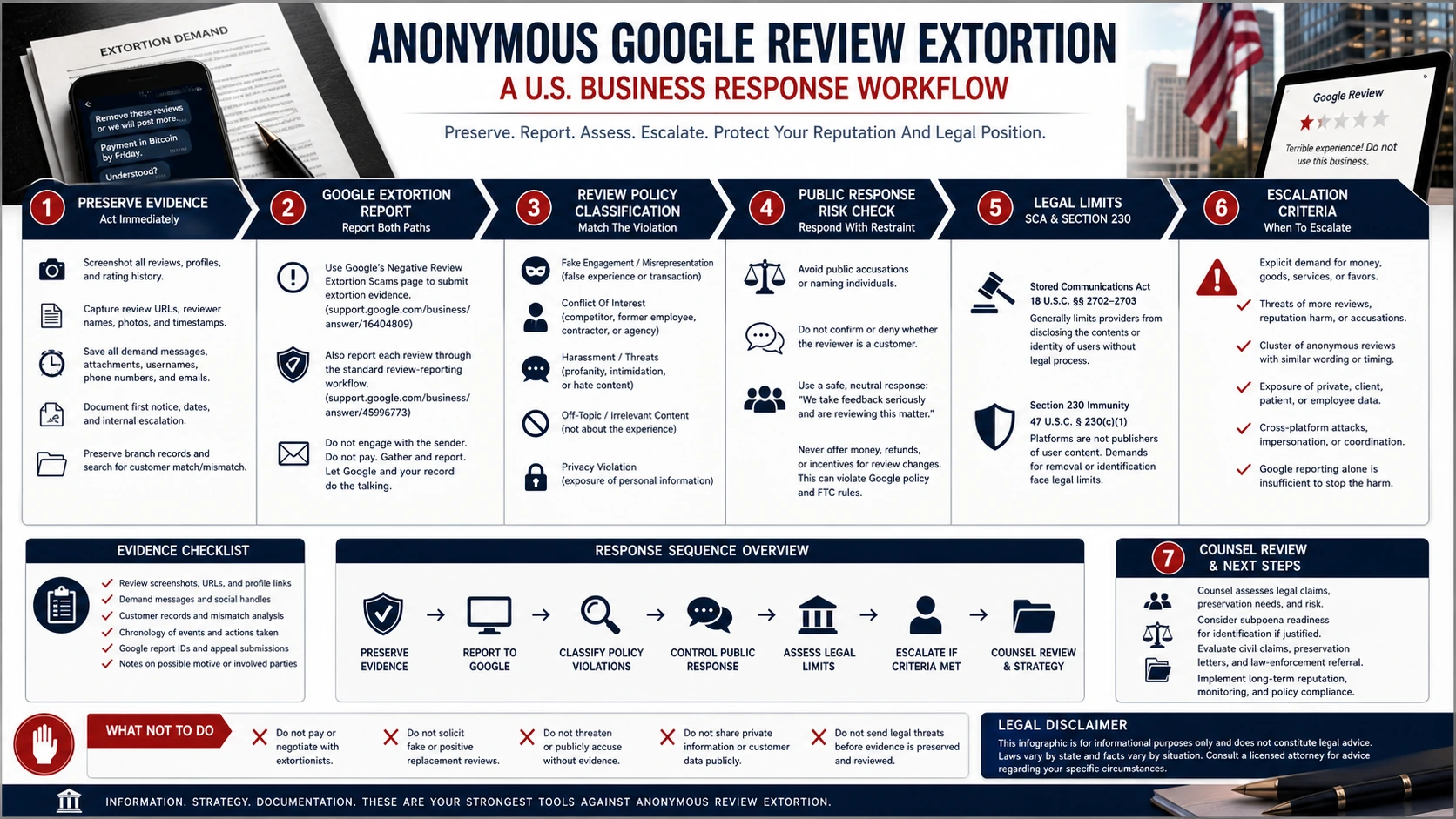
The first rule is speed without improvisation. Review clusters, reviewer profiles, and external messages can disappear or change. A solid file should preserve the full Google review pages, reviewer display names, profile links, star ratings, timestamps, screenshots showing page context, and the business rating before and after the attack. If several reviews appear at once, preserve their chronology as a separate exhibit. If the demand arrives by email, WhatsApp, Telegram, SMS, Instagram, or another channel, preserve the original message, headers where available, phone numbers or usernames, and the dates and times of every contact.
The second rule is to preserve negative results as carefully as positive ones. Search booking records, CRM entries, order logs, invoices, payment records, branch calendars, support tickets, and any other system that would show whether the reviewer was a real customer. If no match exists, document which systems were searched, who performed the search, the date of the search, and any uncertainty that remains. A business often says 'this person was never a customer,' but the stronger statement is a dated note showing exactly why the records do not support a genuine transaction.
The third rule is compartmentalization. Keep the review evidence, the extortion communications, the customer-record analysis, and any public-response drafts in separate folders or exhibits. If the matter later goes to counsel, the business will want a clean sequence: what was posted on Google, what was demanded privately, what the records show, what the business reported to Google, and what steps were taken afterward. This prevents later confusion about which facts support fake engagement, which facts support legal risk, and which facts are only internal working notes.
- Review URLs, screenshots, reviewer names, profile links, star ratings, visible edit history, and rating movement on the Business Profile.
- Direct links to each suspicious review and a screenshot log that includes date, time, browser context, and the branch or location affected.
- All demand messages, attachments, usernames, phone numbers, email addresses, and social handles connected to the extortion attempt.
- Customer-record checks showing whether the reviewer was real, whether the dates were possible, and whether the described transaction matches any internal file.
- A chronology of first notice, first demand, internal escalation, Google reports, any appeal submissions, and any follow-up contact from the extortionist.
- Any evidence of competitor, contractor, broker, former employee, or agency involvement, without making unsupported public accusations.

Platform-Policy Angle: Use Google's Extortion And Review Channels Correctly
Google's ordinary review-reporting workflow remains relevant because only reviews that violate Google's policies are eligible for removal, and Google says businesses should not report a review merely because they dislike it or disagree with it. In a true extortion file, that means the business usually has two parallel Google tasks: report the suspicious review itself under the best policy category, and separately submit the extortion evidence through Google's dedicated extortion form.
The policy categories still matter. Google's prohibited and restricted content policy addresses fake engagement, misrepresentation, conflict of interest, off-topic content, harassment, and personal information. When a demand message accompanies a suspicious review, the business should still ask which policy category best fits the review itself. A review that describes a non-existent transaction may fit fake engagement. A review tied to a contractor, former employee, or competitor may raise conflict-of-interest issues. A review that exposes private data or threatens staff may fit other policy categories. The extortion message does not replace that analysis; it strengthens the seriousness of the file.
Businesses also need to remember the reverse risk. Google's page on Business Profile restrictions for policy violations explains that businesses violating fake-engagement rules may face profile restrictions, including review blocking, review unpublishing, or warnings. That means a threatened business should not react by paying for counter-reviews, selectively soliciting only satisfied customers, offering incentives for review changes, or trying to negotiate off-platform rewards for removal. Those shortcuts can turn a harmed profile into a profile that itself violates Google's rules.
The same caution appears in federal consumer-protection guidance. The FTC's Consumer Reviews and Testimonials Rule Q&A explains that its rule, effective on October 21, 2024, addresses fake or false reviews, purchased reviews, and review suppression. A business responding to extortion should therefore avoid creating a second problem by using groundless threats or manipulative review practices of its own. If the business challenges a false or extortion-linked review, the challenge should be evidence-based and proportionate.
Anonymous Reviewer Identification: Subpoena Readiness And Disclosure Limits
Anonymous review cases often create an immediate instinct to demand that Google reveal the sender. That instinct needs to be checked against law and platform structure. 18 U.S.C. § 2702 generally restricts providers from knowingly divulging the contents of stored communications except in specified circumstances, and 18 U.S.C. § 2703 addresses compelled disclosure routes. The practical consequence is straightforward: a business should not assume that Google will simply hand over private account information because the review looks fake or because the business asks forcefully.
Section 230 adds a separate layer. Under 47 U.S.C. § 230(c)(1), an interactive computer service generally is not treated as the publisher or speaker of information provided by another information content provider. The California Supreme Court's Hassell v. Bird decision is a useful illustration of how platform-directed removal theories can run into Section 230 problems. That does not protect the person who wrote the review or the person who organized the extortion scheme. It does mean that the platform itself is not automatically the strongest first legal target.
Subpoena readiness is therefore an evidence discipline rather than a threat posture. Before any formal step is contemplated, the file should explain why identification is necessary, why ordinary policy reporting is insufficient, what false or extortionate conduct occurred, what harm is ongoing, and what less intrusive alternatives were tried first. Many businesses rush into a broad demand letter that asks for everything at once. A better file first proves that the attack is real, documents why the reviewer likely was not a genuine customer, preserves the extortion messages, and only then asks local U.S. counsel whether formal identification is proportionate.
Public Response Strategy: What Not To Say
A public response is often the most dangerous place to improvise. If the business posts 'this reviewer is a criminal extortionist' before counsel has reviewed the evidence, it may create fresh defamation or credibility problems. If the business confirms that the sender was or was not a specific customer using private information, it can create privacy issues. If the business offers money, discounts, services, or settlements in exchange for deleting the review, it may make both the platform and regulatory position worse.
Federal consumer-review law also supports restraint. The FTC's CRFA guidance at Consumer Review Fairness Act: What Businesses Need to Know and the statute at 15 U.S.C. § 45b protect honest consumer review rights and prohibit certain anti-review contract provisions. The broader message for an extortion file is that the business should target false, fake, or extortion-linked content with precision rather than trying to suppress all criticism. Where the review may be partly genuine, the file should isolate the extortion and the false factual components rather than overclaiming.
The safest public language is usually narrow. The business can say it is reviewing suspicious activity affecting the profile, that it takes genuine customer feedback seriously, and that it invites direct contact through the official channel. It should not disclose evidence details, accuse named people without support, or litigate the entire matter in the review thread. In some cases, the best immediate public response is no response until screenshots, report IDs, and counsel review are complete.
Escalation Criteria: When The File Needs Counsel Or Formal Process
Not every anonymous negative review justifies lawyer involvement. Escalation becomes more serious when there is an actual demand for money, goods, or favors; repeated threats to post additional reviews; threats to injure reputation or accuse the business of crime; personal-data exposure; signs of coordinated activity across accounts or platforms; or a regulated-industry privacy risk. A one-off angry review from an identifiable customer may still be handled through platform reporting and a restrained response. A profile-wide anonymous extortion attempt is a different category.
The baseline U.S. unfair-practices reference point is 15 U.S.C. § 45, Section 5 of the FTC Act, which declares unfair or deceptive acts or practices unlawful. That does not mean every extortion-linked review becomes an FTC case. It does mean that the business should understand the broader consumer-protection logic behind fake-review enforcement: manipulated reviews distort market trust, mislead consumers, and harm honest competitors. Counsel can use that framework to calibrate the seriousness of the file without promising any particular regulator outcome.
- Escalate promptly if the sender demands money, services, products, refunds, or other value in exchange for deletion or non-publication.
- Escalate if several anonymous reviews appear in a cluster and share wording, timing, impossible facts, or clear branch-record mismatches.
- Escalate if private client, patient, employee, or financial information appears in the review or in the extortion messages.
- Escalate if the review thread is paired with off-platform threats, impersonation, or signs of contractor, broker, or competitor involvement.
- Escalate if Google policy reporting alone will not resolve the risk and the business needs advice on preservation letters, subpoena readiness, or court-order strategy.
Risk Cautions: Do Not Create A Second Problem
The biggest strategic mistake in anonymous review extortion cases is overreaction. Paying the sender can encourage more demands and does not guarantee removal. Publicly accusing the wrong person can create a second dispute. Incentivizing replacement reviews can trigger platform restrictions. Sending a legal threat before the evidence is preserved can weaken later escalation. The business should assume that every message it sends may later be attached to a platform appeal, a lawyer file, or a court exhibit.
Another common error is treating the whole event as purely criminal or purely SEO-driven. In reality, these files sit at the intersection of platform policy, commercial reputation, privacy, customer records, anonymous-speech limits, and sometimes criminal-law considerations. That is why the article uses a staged approach: preserve, classify, report properly, control the public response, and escalate only with a record that can withstand scrutiny.
Practical Conclusion
An anonymous Google review extortion event in the United States should begin with documentation, not with negotiation. Preserve the reviews, preserve the off-platform demand, preserve the no-match customer checks, and use Google's dedicated extortion channel alongside the normal review-reporting path. Treat reviewer identification as a proportional later-stage question rather than an immediate demand for platform disclosure.
Pimlegal's role at the preliminary stage is to help businesses organize the file, frame the strongest Google-policy submission, keep the public response within safe boundaries, identify when Stored Communications Act or Section 230 issues limit expectations, and decide when the matter should move to local U.S. counsel for subpoena readiness or broader legal escalation. The objective is informational and strategic only: preserve leverage, avoid avoidable mistakes, and build the strongest documented path toward review removal or broader response.