
How local civil, criminal and procedural rules can shape an online review dispute in United States. U.S. defamation law is not a single national code. It is a combination of state civil law, constitutional limits, platform-immunity rules, consumer-protection concepts and, in a smaller number of states, criminal defamation statutes. For a harmful Google review, the first question is not whether the review is unpleasant. The first question is whether it states or implies a false fact capable of legal proof.
This article should be read together with our guide on defamatory Google reviews and business reputation and our article on fake customer review evidence. Those pages explain the reputation and evidence side of the analysis. This page focuses on the civil and criminal legal framework that may apply in the United States.
Civil Defamation Is Mostly State Law
Civil defamation claims are usually created by state law, not federal law. Most states require a false statement of fact concerning the plaintiff, publication to someone other than the plaintiff, fault by the speaker and resulting harm. Businesses may also encounter related claims such as trade libel, business disparagement, tortious interference or unfair competition when the review attacks products, services, professional integrity or commercial relationships.
The difference between fact and opinion is central. A statement such as “I would never use this company again” is normally opinion. A statement such as “this clinic reused contaminated equipment” or “this contractor stole my deposit and never performed any work” is more factual and may be verifiable. The U.S. Supreme Court in Milkovich v. Lorain Journal Co. rejected a broad immunity for anything labeled opinion; if a statement implies an assertion of objective fact, it can still be actionable.
Constitutional Limits: Sullivan, Gertz And Fault
U.S. defamation law is heavily shaped by the First Amendment. New York Times Co. v. Sullivan established the actual-malice rule for public officials: they must prove that the defendant knew the statement was false or acted with reckless disregard for truth. Gertz v. Robert Welch, Inc. gave states more flexibility for private plaintiffs, but it rejected strict liability and limited presumed or punitive damages unless the higher constitutional fault standard is met.
For many local businesses, the plaintiff is a private figure. That can make the legal standard less demanding than a public-figure case. But a review about a public controversy, a public-facing professional, a regulated industry or a matter of community concern can complicate the analysis. The safer approach is to build evidence as if fault and material falsity will be contested.
Examples Of State Civil Statutes
State statutes are useful reference points. California Civil Code § 44 separates defamation into libel and slander. California Civil Code § 45 defines libel as a false and unprivileged fixed publication that exposes a person to hatred, contempt, ridicule or tends to injure occupation. California Civil Code § 46 addresses slander, including statements that tend directly to injure someone in office, profession, trade or business.
Texas Civil Practice and Remedies Code Chapter 73 contains Texas libel provisions, including § 73.001. New York does not use one single modern defamation statute for all ordinary claims, but New York Civil Rights Law §§ 70-a and 76-a are important in actions involving public petition and participation. In covered New York cases, the plaintiff may face a clear-and-convincing actual-malice standard and potential fee or damages consequences if the case lacks a substantial basis.
Anti-SLAPP Risk
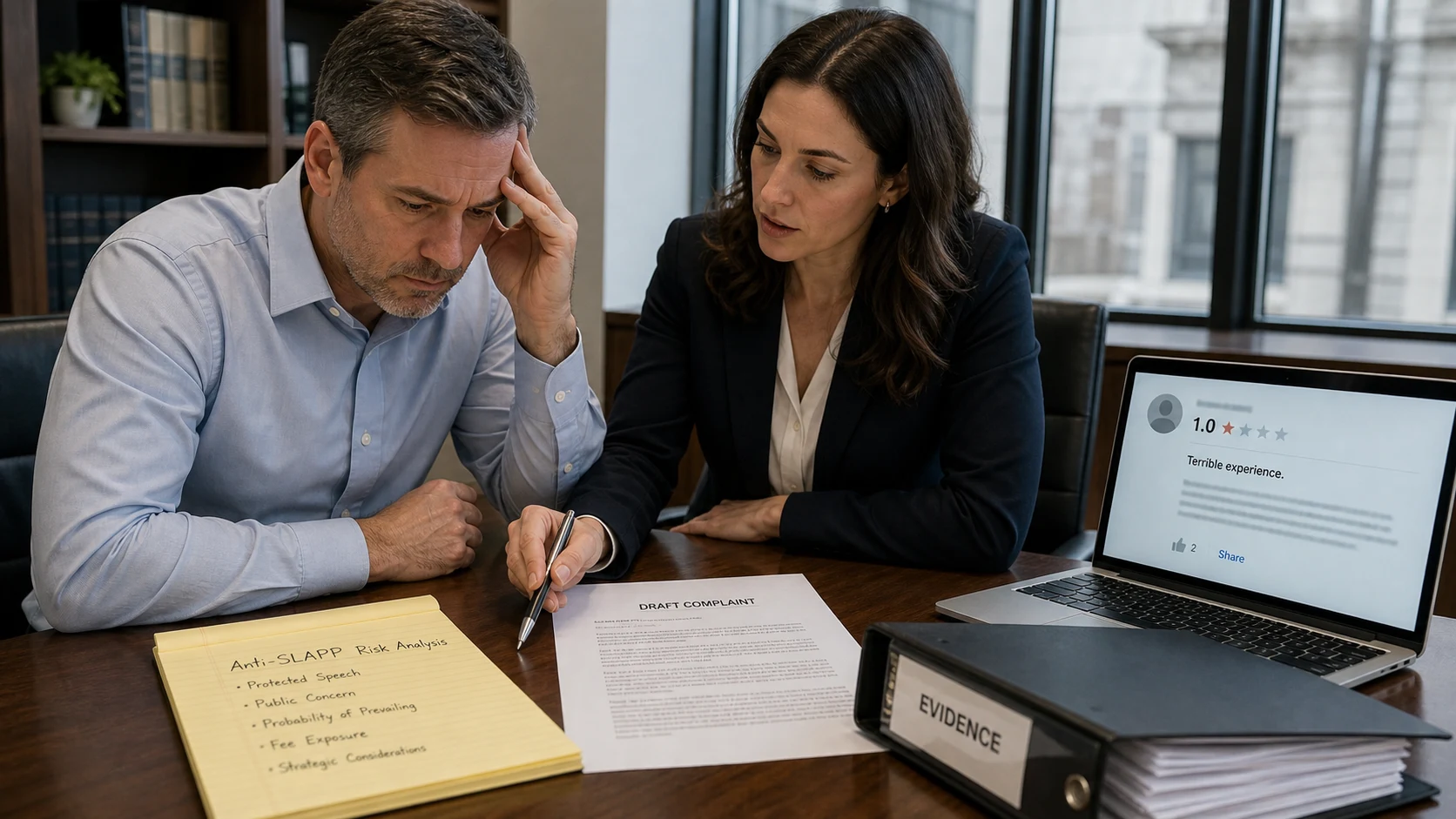
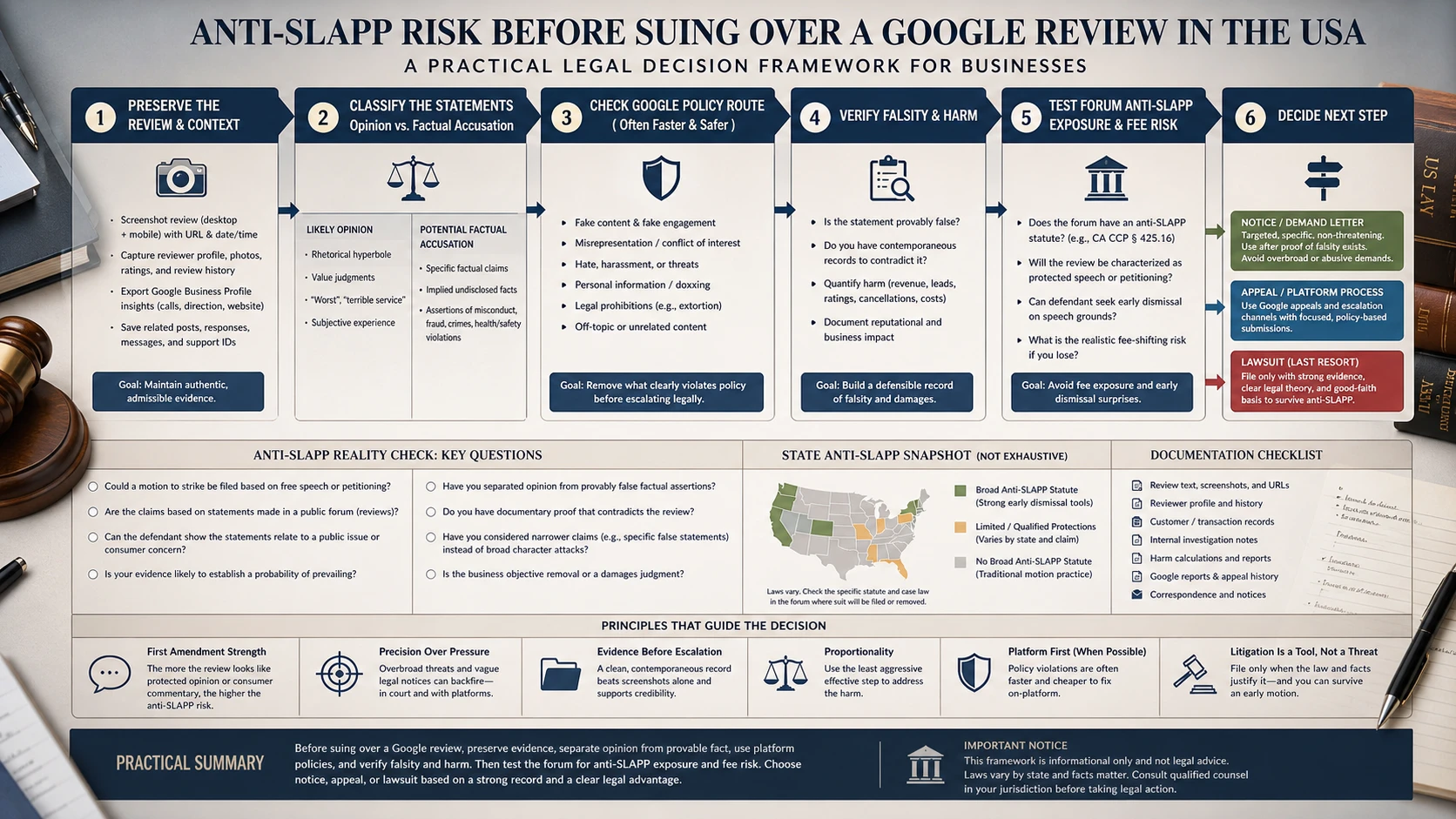
Anti-SLAPP laws are one of the biggest practical risks for businesses considering litigation over reviews. California Code of Civil Procedure § 425.16 allows early challenges to claims arising from protected petition or speech activity. If the defendant succeeds, fee-shifting may follow. New York’s public participation statutes can create similar strategic pressure in covered disputes. Other states also have anti-SLAPP statutes, but their scope varies widely.
This is why a Google review complaint should be evidence-led. A business should not sue simply because a review is harmful. The stronger route is to preserve the review, classify the allegations and compare the facts with platform policy and local law. The United States resources page links related guides that support this staged approach.
Criminal Defamation In The United States
Criminal defamation is more limited and more constitutionally sensitive than civil defamation. There is no general federal criminal defamation statute for ordinary business reviews. Some states still have criminal libel or criminal defamation provisions, but enforcement is uncommon and must respect First Amendment limits. Businesses should be very careful before framing a review dispute as a criminal matter.
Garrison v. Louisiana is the key U.S. Supreme Court case on criminal defamation of public officials. The Court held that criminal libel laws cannot punish truthful criticism and that, at least for statements about official conduct, liability requires knowledge of falsity or reckless disregard for truth. Ashton v. Kentucky also rejected a vague common-law criminal libel approach. These cases show why criminal defamation must be narrowly handled.
Some state statutes still exist. Minnesota Statutes § 609.765 is one example of a criminal defamation provision. New Hampshire RSA § 644:11 is another. The existence of such statutes does not mean a business should threaten criminal action in an ordinary Google review dispute. Criminal processes are controlled by public authorities, and improper threats can create separate legal and reputational risk.
Section 230 And Claims Against Platforms
A civil or criminal theory against the reviewer is different from a theory against Google. 47 U.S.C. § 230(c)(1) generally prevents an interactive computer service from being treated as the publisher or speaker of third-party user content. For review disputes, this means the original reviewer, competitor or review broker may be a stronger legal target than the platform hosting the content.
Section 230 does not prevent a business from reporting a review to Google under platform policies. Nor does it protect the person who authored a false review. It does, however, make direct platform-liability theories difficult when the claim is based on user-generated review text. The removal strategy should therefore combine platform-policy reporting with evidence preservation and jurisdiction-specific legal assessment.
False Advertising And Business Disparagement
Some review disputes are not classic defamation claims. If a competitor creates or coordinates false reviews to divert customers, the Lanham Act may become relevant. 15 U.S.C. § 1125(a) addresses false or misleading commercial representations. Not every consumer review is commercial advertising, but competitor-originated review campaigns may also raise unfair competition, business disparagement or tortious interference issues under state law.
Civil claims of this kind require careful factual proof. The business must connect the review pattern to the competitor or commercial actor, show falsity or misleading conduct, and explain commercial harm. Screenshots alone are usually not enough. Transaction records, IP or account evidence, witness statements, internal communications, review timing and comparison across platforms may all matter.
Evidence, Damages And Litigation Strategy
A review case can fail if the business cannot show what was false, who said it, why the speaker was at fault and how harm resulted. Evidence should include the review URL, screenshots, profile details, publication date, rating history, customer records, invoices, booking logs, messages and documentation showing the reviewer was not a customer or that the accusation is materially false.
Damages also matter. Some statements may qualify as defamation per se under state law, such as accusations that injure a person in trade or profession. Even then, constitutional limits and state rules may affect presumed damages, punitive damages and proof. Where the objective is removal rather than damages, a targeted Google report or evidence-backed legal notice may be more proportionate than immediate litigation.
Key U.S. Reference Points
- New York Times Co. v. Sullivan, 376 U.S. 254: actual malice for public officials.
- Gertz v. Robert Welch, Inc., 418 U.S. 323: private-plaintiff fault and damages limits.
- Milkovich v. Lorain Journal Co., 497 U.S. 1: opinion labels do not automatically protect factual assertions.
- Garrison v. Louisiana, 379 U.S. 64: constitutional limits on criminal libel.
- 47 U.S.C. § 230(c)(1): platform immunity for third-party content.
- 15 U.S.C. § 1125(a): false or misleading commercial representations.
- California Civil Code §§ 44-46, California Code of Civil Procedure § 425.16, Texas Civil Practice and Remedies Code Chapter 73, New York Civil Rights Law §§ 70-a and 76-a.
- Minnesota Statutes § 609.765 and New Hampshire RSA § 644:11 as examples of state criminal defamation provisions.
Practical Conclusion For A U.S. Google Review Dispute
The safest U.S. strategy is not to choose between civil law, criminal law and platform policy too early. Start with the evidence. Then identify whether the review is false factual content, opinion, fake customer activity, competitor manipulation, harassment, privacy exposure or ordinary criticism. Each category points to a different route.
Pimlegal’s preliminary review focuses on that classification. Where the file supports action, the next step may be a Google report, evidence-backed correspondence, referral to U.S. counsel, or a more formal jurisdiction-specific legal process. The objective is to reduce reputational harm while avoiding overbroad claims, weak threats and procedural mistakes.
Visual Evidence Route
For a stronger file, pair this article with platform policy and legal notice strategy and harmful Google review response strategy.