
How to connect Google policy categories with proportionate legal action in United States. In the United States, a Google review removal file should not begin with a generic legal threat. It should begin with classification. Some reviews are best handled through Google Business Profile policy. Some require a careful public response. Some justify a legal notice to the reviewer, competitor, broker or other responsible actor. A smaller number may require formal legal process, local counsel, subpoena strategy or litigation.
The practical challenge is that platform policy and U.S. law do not ask exactly the same question. Google may remove a review because it is fake engagement, harassment, personal information, off-topic content or a conflict of interest. U.S. defamation law asks whether a statement is false, factual, concerning the business, published to a third party, made with the required fault and capable of causing harm. Consumer-protection law asks whether the conduct misleads consumers or distorts competition. A strong removal strategy connects these layers without pretending they are identical.
This article should be read with our guide on fake customer review evidence and our article on how to respond to a harmful Google review. The evidence page explains what to preserve before escalation. The response page explains how to protect the public record while the policy and legal tracks are being assessed.
Start With A Three-Track Strategy
A U.S. business should usually separate the matter into three tracks. Track one is platform moderation: does the review violate Google policy? Track two is reputation response: should the business post a short public reply, contact the reviewer privately, or avoid replying while evidence is preserved? Track three is legal escalation: is there enough evidence for a legal notice, subpoena strategy, defamation review, unfair-competition analysis or referral to U.S. counsel?
Separating the tracks prevents two common mistakes. The first is treating every harmful review as defamation, even when the stronger route is fake engagement or conflict of interest under platform policy. The second is sending an aggressive legal notice before the business has preserved the review, checked customer records, identified the strongest legal theory and assessed anti-SLAPP or review-suppression risk.
Track One: Google Business Profile Policy
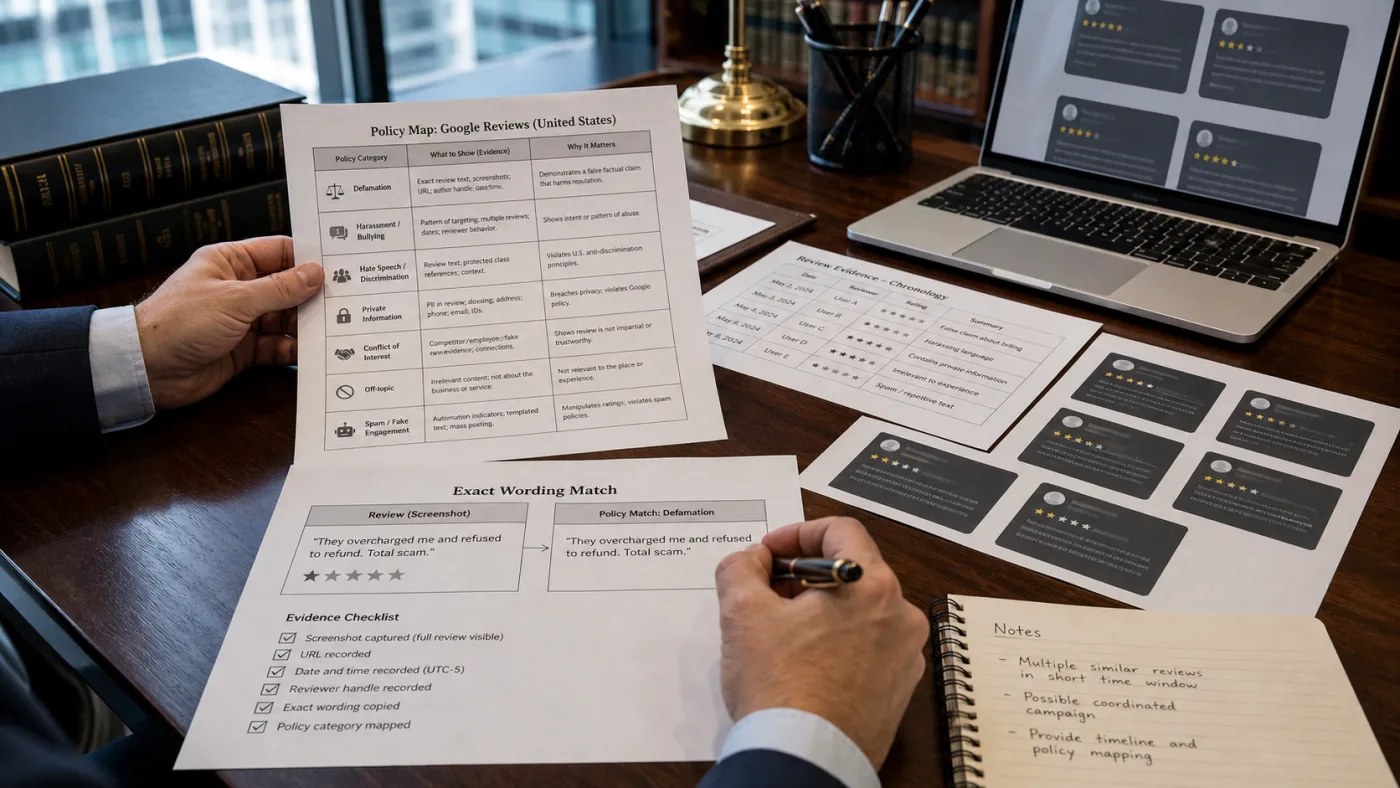
Google’s prohibited and restricted content policy is the first reference point. It states that contributions should reflect a genuine experience and addresses categories such as fake engagement, misrepresentation, harassment, hate speech, personal information, off-topic content, restricted content and conflicts of interest. A removal request should identify the category and support it with evidence.
For fake engagement, the business should show why the review likely does not reflect a real customer experience. Useful facts include no matching customer record, impossible dates, services never offered, repeated wording, newly created profiles, timing clusters, reviewer profiles with no local connection, or links to a known competitor, former employee or contractor dispute. The submission should be concise. Google reviewers need a clear policy reason, not a long courtroom brief.
Google also maintains documentation on Business Profile restrictions for policy violations. That matters because review manipulation can affect both harmful negative reviews and improper positive-review campaigns. Businesses should preserve their own review-request practices, incentives and agency instructions so they can prove they are challenging abuse without violating Google’s fake-engagement rules themselves.
Track Two: Legal Removal Requests To Google
A Google policy report is different from a legal removal request. Google’s Legal Help Center is used for certain legal content-removal requests, including categories such as court orders, copyright, trademark and other legal grounds. Google Search also has a content removal form for certain personal-content or legal-removal pathways.
For a business review dispute, the legal-removal route is not a shortcut around weak evidence. If the issue is simply that a review is unfair, rude or commercially damaging, the legal channel may not fit. If the issue is a false factual allegation, personal data exposure, impersonation, intellectual property issue, court order, doxxing or other legally actionable content, the legal channel may become relevant. The submission should explain the legal basis and attach the minimum necessary supporting material.
Track Three: Notice To The Reviewer Or Responsible Actor
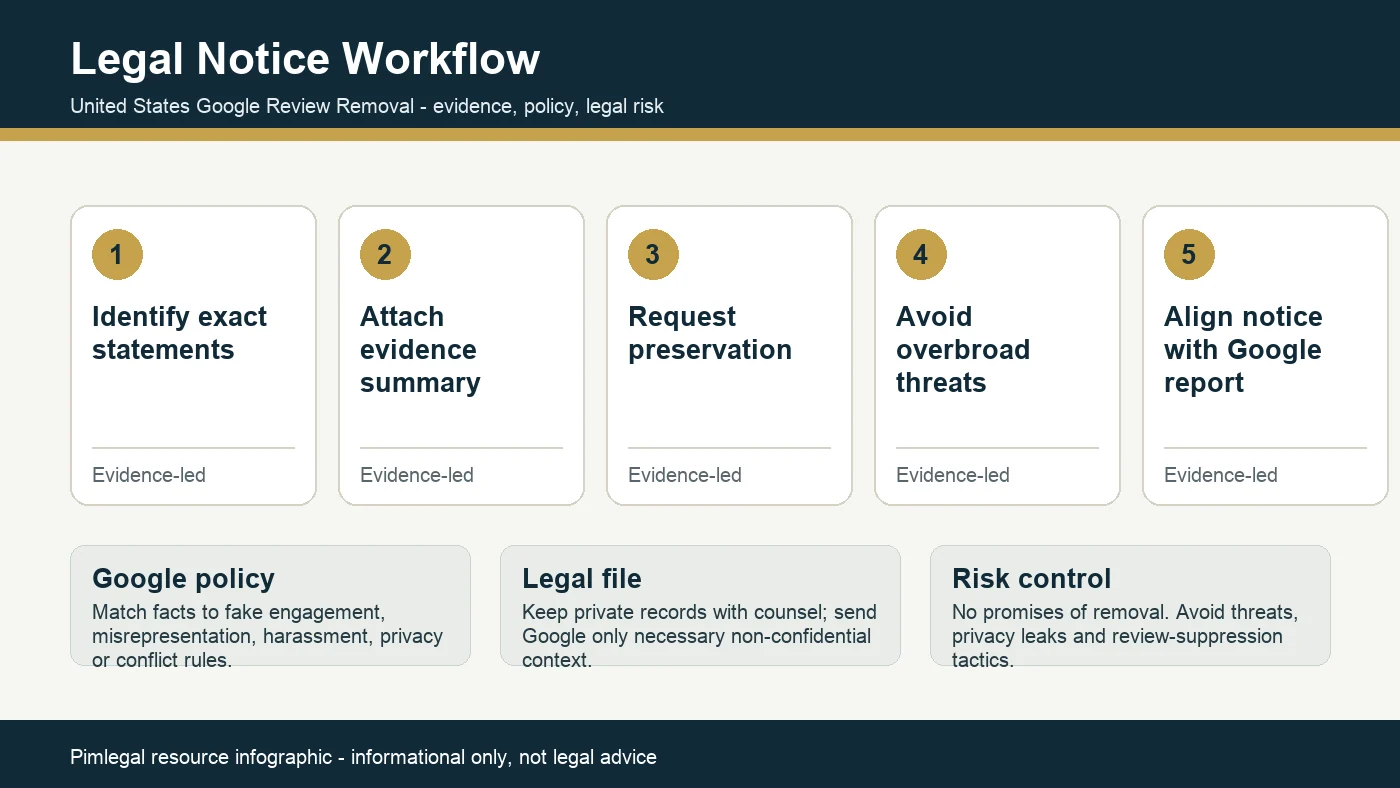
A legal notice to the reviewer, competitor, former employee, contractor or broker should be more precise than a platform report. It should identify the review, preserve evidence, list the false or policy-violating statements, explain the records contradicting them, request a defined remedy, and avoid unsupported accusations. A notice may ask for removal, correction, preservation of evidence, confirmation of identity, cessation of coordinated conduct or disclosure of who procured the review.
The tone matters. A notice that overstates the law or threatens criminal action without basis may create legal and reputational risk. A notice that calmly identifies specific false statements, attaches records, and preserves all rights is more credible. In many cases, the best first notice is not a demand letter to the platform but an evidence-backed communication to the person or entity that created or organized the content.
FTC Rules On Fake Reviews And Suppression
The FTC Consumer Reviews and Testimonials Rule Q&A is central to U.S. review strategy. The rule addresses fake or false consumer reviews, buying positive or negative reviews, insider reviews, company-controlled review websites, review suppression and fake social media indicators. The FTC announced the final rule in 2024, and it became effective on October 21, 2024.
The text of 16 C.F.R. Part 465 is important for both sides of a removal file. 16 C.F.R. § 465.2 addresses fake or false consumer reviews. 16 C.F.R. § 465.4 addresses buying positive or negative reviews. 16 C.F.R. § 465.7 addresses review suppression, including certain groundless legal threats, intimidation or false accusations used to prevent or remove negative reviews.
That last point is crucial. A business can challenge fake or defamatory content, but it should not use an unfounded legal threat to silence legitimate criticism. The notice must be anchored in facts. If the business reasonably believes the review is fake, the file should show why. If the review is genuine but false in part, the notice should target the false factual statements rather than the reviewer’s right to express dissatisfaction.
Consumer Review Fairness Act Limits
The Consumer Review Fairness Act, codified at 15 U.S.C. § 45b, restricts form-contract provisions that prohibit or penalize honest consumer reviews or transfer review-related intellectual property rights to the business. It does not protect fake, defamatory, confidential, harassing or unlawful content, but it does protect the broader right to share honest opinions.
For legal notices, this means the business should not rely on a boilerplate non-disparagement clause in a consumer contract unless counsel has specifically reviewed it. The stronger route is a fact-specific notice: identify what is false, why the review violates policy or law, what evidence contradicts it, and what remedy is requested. A notice that tries to suppress all criticism can become the problem.
Defamation, Anti-SLAPP And State Law
Defamation in the United States is mostly state law, filtered through First Amendment limits. New York Times Co. v. Sullivan, Gertz v. Robert Welch, Inc. and Milkovich v. Lorain Journal Co. remain core reference points. The business must separate false factual statements from opinion, rhetorical criticism and subjective dissatisfaction.
State anti-SLAPP statutes can be a major risk if litigation is filed too broadly. California Code of Civil Procedure § 425.16 and New York Civil Rights Law §§ 70-a and 76-a are examples of public-participation protections that can create early dismissal and fee-shifting exposure in covered cases. Other states vary. This is why a legal notice should be evidence-led and proportionate, and why litigation should be assessed by local U.S. counsel.
Section 230 And Why The Platform Is Different
A legal notice to Google is not the same as a claim against the reviewer. 47 U.S.C. § 230(c)(1), Section 230, generally prevents an interactive computer service from being treated as the publisher or speaker of third-party user content. The California Supreme Court’s Hassell v. Bird decision involving Yelp illustrates how removal orders directed at platforms can raise Section 230 problems.
Section 230 does not immunize the original reviewer from their own false statements. It does not protect a competitor that organizes fake reviews or a broker that sells them. It does, however, make direct publisher-liability theories against a platform difficult. The practical strategy is to use Google policy where the content violates platform rules, use legal notices against responsible actors where evidence supports it, and reserve formal platform-directed legal requests for cases that fit recognized legal-removal categories.
Competitors, Brokers And The Lanham Act
If a competitor, marketing agency or review broker is involved, the Lanham Act may be relevant. 15 U.S.C. § 1125(a) addresses false or misleading commercial representations. A single consumer review will not always qualify as commercial advertising or promotion, but an organized competitor campaign can raise unfair competition, business disparagement, tortious interference or false advertising issues depending on the facts.
A notice in that context should request preservation of communications, review instructions, payment records, account details, agency contracts and campaign materials. The business should not assume that similar wording proves competitor involvement. It should collect evidence and let the theory follow the facts.
Anonymous Reviewers And Stored Communications
Many harmful reviews are pseudonymous. The federal Stored Communications Act, including 18 U.S.C. § 2702 and 18 U.S.C. § 2703, affects when electronic service providers may disclose account records or communications. A business should not expect a platform to disclose private reviewer information merely because the business requests it.
If identification is necessary, counsel may need to evaluate subpoena options, anonymous-speech protections, jurisdiction, preservation requests and proportionality. A pre-litigation file should already explain why the reviewer identity matters, what statements are false, what harm occurred and why a less intrusive platform report is insufficient.
Evidence And Authentication
The strongest notice packet includes more than screenshots. It should include review URLs, timestamps, profile links, screenshots with surrounding page context, CRM searches, booking logs, invoices, payment records, email or phone records, staff statements, closure dates, policy categories, a sentence-by-sentence falsity chart and a chronology of reports submitted to Google. If litigation becomes possible, counsel may also consider authentication under evidence rules and business-record issues.
The notice should avoid attaching unnecessary private data. It can say that records show no matching customer visit without exposing confidential customer lists. It can state that the business was closed on a date without publishing staff schedules. The file should be detailed, but the public and recipient-facing version should disclose only what is needed.
Recommended Escalation Sequence
- Preserve the review, profile, URL, rating, date, screenshots and internal records before replying or reporting.
- Classify the content under Google policy: fake engagement, conflict of interest, harassment, privacy, off-topic content, misrepresentation or other category.
- Decide whether a short public response is useful, privacy-safe and consistent with the evidence file.
- Submit a targeted Google report for each review and log report IDs, dates, outcomes and appeal steps.
- Prepare a legal notice only after identifying the responsible actor, false statements, supporting records and proportionate remedy.
- Assess FTC, CRFA, defamation, anti-SLAPP, Section 230, Lanham Act and privacy issues before making threats.
- Refer to local U.S. counsel for subpoenas, litigation, court orders or state-specific defamation strategy.
Key U.S. References
- Google Business Profile prohibited and restricted content policy: fake engagement, conflicts of interest, harassment, privacy and other categories.
- Google Legal Help Center and Google content removal form: legal-removal pathways for certain content.
- FTC Consumer Reviews and Testimonials Rule Q&A and 16 C.F.R. Part 465: fake reviews, review buying and review suppression.
- FTC Consumer Review Fairness Act guidance and 15 U.S.C. § 45b: consumer-review anti-gag-clause rules.
- 47 U.S.C. § 230(c)(1): platform-immunity reference point for third-party user content.
- 15 U.S.C. § 1125(a): Lanham Act false or misleading commercial representations.
- 18 U.S.C. § 2702 and 18 U.S.C. § 2703: Stored Communications Act disclosure framework.
- Hassell v. Bird: Section 230 issues around platform-directed removal obligations.
Practical Conclusion
A platform-policy report, a public reply and a legal notice should support each other, not contradict each other. The policy report should identify the Google rule. The public reply should protect reader trust without disclosing private facts or overclaiming. The legal notice should be specific, evidence-backed and proportionate. If any of those documents is emotional or unsupported, the whole strategy becomes weaker.
Pimlegal’s role is to help businesses build the file before escalation: preserve the evidence, select the correct Google policy category, draft a careful public response where useful, identify the strongest U.S. legal reference points, and decide when the matter should move from platform moderation to local legal counsel or formal process.
Visual Evidence Route
For a stronger file, pair this article with civil and criminal defamation rules and fake customer review evidence.