
What businesses should document before reporting suspicious Google reviews in United States. In the United States, fake customer reviews are not only a reputation problem. They can raise consumer protection, unfair competition, platform-policy, evidence and defamation issues at the same time. The legal route depends on who created the review, whether the reviewer was a real customer, whether a competitor or broker was involved, and whether the business can prove the review is false or misleading.
A fake review may be positive or negative. For a harmed business, the most urgent case is often a negative Google review from a person who never purchased, never booked, never attended an appointment, or describes events that could not have happened. The legal strategy should not begin with emotion. It should begin with a structured evidence file capable of showing why the review is not a genuine customer experience.
FTC Rules On Fake Or False Reviews
The strongest federal reference point is the FTC’s Rule on the Use of Consumer Reviews and Testimonials, 16 C.F.R. Part 465. Section 465.2 targets fake or false consumer reviews and testimonials. It addresses reviews that materially misrepresent that the reviewer exists, that the reviewer used or otherwise had experience with the product, service or business, or that misrepresent the reviewer’s experience.
For businesses, this framework is useful even when the immediate goal is Google removal rather than an FTC complaint. It gives a practical checklist: does the reviewer exist, did the reviewer use the service, and is the described experience materially accurate? If the answer is no, the review may fit both platform-policy categories and a broader consumer-protection analysis.
16 C.F.R. § 465.4 separately deals with buying positive or negative consumer reviews. It treats compensation or other incentives conditioned on a particular review sentiment as an unfair or deceptive practice. That matters where a competitor, vendor, former employee, marketing agency or review broker appears to be coordinating negative reviews or manipulating ratings.
Section 5 Of The FTC Act
The broader statutory foundation is Section 5 of the Federal Trade Commission Act, 15 U.S.C. § 45, which prohibits unfair or deceptive acts or practices in or affecting commerce. Fake reviews can mislead consumers, divert customers and distort competition. In the enforcement context, the FTC has treated review manipulation as deceptive when businesses or agents create fake endorsements, conceal their identity, or use fabricated consumer experiences to influence purchasing decisions.
The Sunday Riley matter is a useful enforcement example. The FTC alleged that company personnel posted fake reviews of the company’s products using fake accounts. The case ended in a consent order, not a litigated liability judgment, but it remains a practical warning that employee-written or company-directed fake reviews can create federal regulatory exposure.
Roomster And Fake Review Brokers
The FTC’s Roomster action is another important example. The FTC and several states alleged that Roomster used fake reviews and misleading listings, and that a separate operator supplied fabricated reviews. For local businesses, the lesson is that the actor behind the review may matter as much as the text itself.
Coordination signals can include repeated language, timing clusters, reviewers with no local connection, newly created profiles, similar accusations across platforms or links to a known competitor dispute. These signals do not prove fraud by themselves, but they can support a platform report and guide legal assessment.
Lanham Act And Competitor Attacks
If a competitor is involved, the federal Lanham Act may also be relevant. 15 U.S.C. § 1125(a) addresses false or misleading commercial representations. Not every Google review is commercial advertising or promotion, but a competitor-run fake review campaign may raise false advertising, unfair competition or business disparagement issues depending on the facts.
This is why businesses should not describe every bad review as defamation. A fake review dispute may be a defamation matter, a deceptive-review matter, a competitor misconduct matter, or simply a Google policy matter. The evidence file should identify which route is strongest rather than forcing every issue into one legal category.
Section 230 And The Platform Question
Businesses often ask whether Google can be sued because it hosts the review. 47 U.S.C. § 230(c)(1) generally protects providers and users of interactive computer services from being treated as the publisher or speaker of third-party content. That does not protect the original fake reviewer, the competitor who procured the review, or a broker selling fake reviews. It does, however, make direct claims against a platform more difficult when the claim is based on user-generated content.
Hassell v. Bird, a California Supreme Court decision involving Yelp, illustrates the platform-removal problem. The court treated Section 230 as a significant barrier to imposing publisher-type obligations on the platform. The case is California authority, not a nationwide Supreme Court rule, but it is useful when deciding whether the stronger target is the reviewer, a broker, a competitor or a platform-policy channel.
Identifying Anonymous Reviewers
Fake review cases often involve anonymous or pseudonymous accounts. The federal Stored Communications Act, including 18 U.S.C. §§ 2702 and 2703, affects how electronic service providers may disclose account records or communication content. In practice, identifying a reviewer may require a subpoena, court order or other lawful process, and the available information may be limited. Businesses should assume that Google will not simply provide private account data on request.
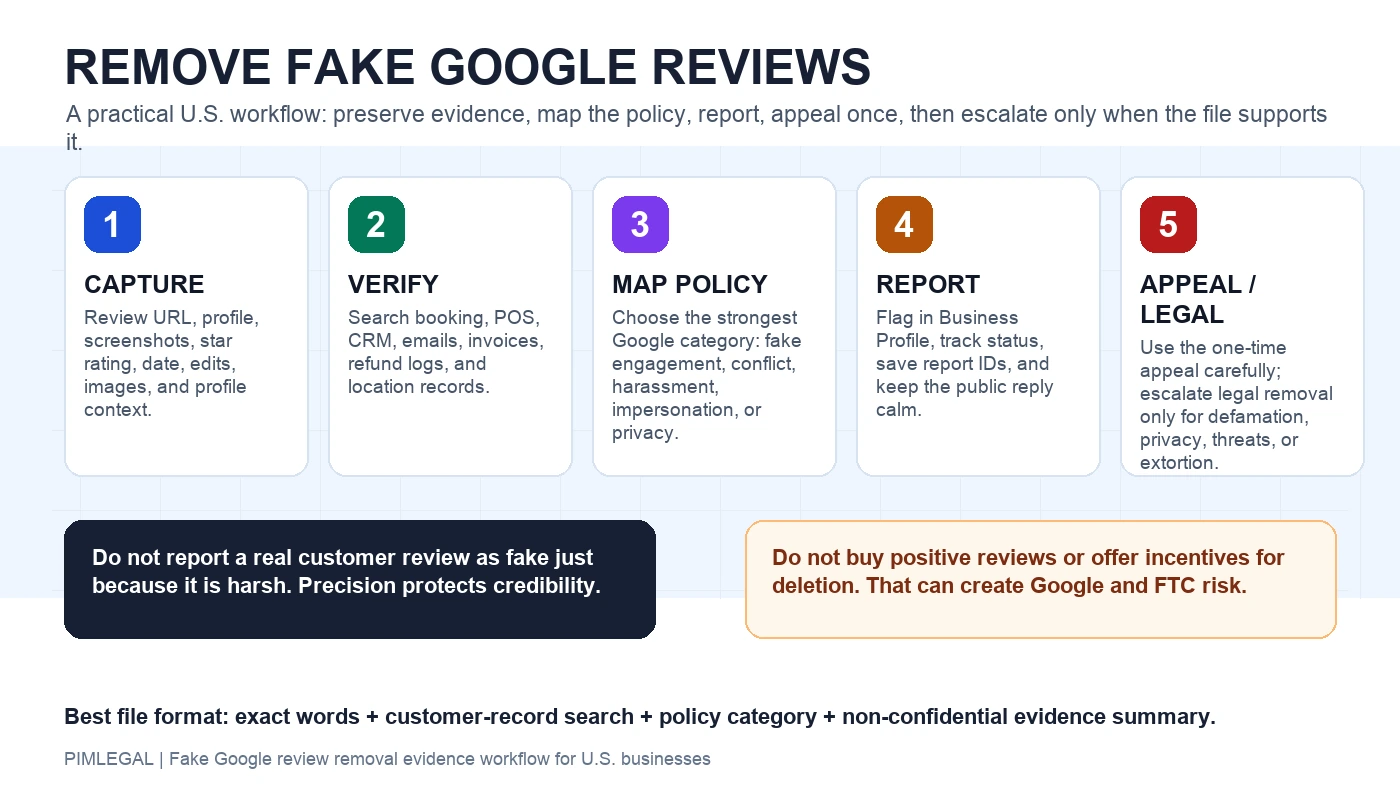
That makes early preservation essential. The business should save the review URL, reviewer display name, profile link, star rating, publication date, screenshots, booking logs, invoices, CRM search results and message history. If legal process is later needed, the file should already show why identification is proportionate and relevant.
Evidence Rules: Screenshots, Records And Authentication
Evidence quality matters. Federal Rule of Evidence 901 requires evidence sufficient to support a finding that an item is what the proponent claims it is. For online reviews, that means screenshots should be captured with visible URLs, dates, profile details and surrounding context. A screenshot without metadata may still be useful internally, but a stronger file records when, where and how the capture was made.
Federal Rule of Evidence 803(6), the business-records exception, can matter when CRM entries, booking records, invoices or support logs show that a claimed transaction did not occur. Rule 902 may help with self-authentication of certain certified records. The goal is to preserve material in a way a lawyer can later authenticate if needed.
Review Suppression Risk
Businesses also need to avoid overcorrecting. 16 C.F.R. § 465.7 addresses review suppression, including certain unfounded legal threats or intimidation. A business can challenge fake, defamatory or clearly false content, but it should not use groundless threats to silence genuine criticism.
Key U.S. Legal Reference Points
- 15 U.S.C. § 45: Section 5 of the FTC Act, prohibiting unfair or deceptive acts or practices in commerce.
- 16 C.F.R. § 465.2: FTC rule on fake or false consumer reviews and testimonials.
- 16 C.F.R. § 465.4: FTC rule on buying positive or negative consumer reviews.
- 16 C.F.R. § 465.7: FTC rule on review suppression and certain improper threats.
- 15 U.S.C. § 1125(a): Lanham Act false advertising and misleading commercial representations.
- 47 U.S.C. § 230(c)(1): platform immunity principle for third-party content.
- 18 U.S.C. §§ 2702-2703: Stored Communications Act provisions relevant to disclosure of account records or communications.
- Federal Rules of Evidence 901, 902 and 803(6): authentication, self-authentication and business-record issues.
Practical Strategy For A U.S. Business
A strong fake-review response has three stages. First, preserve the evidence before the profile changes or the review is edited. Second, classify the problem: fake customer, conflict of interest, competitor attack, defamatory statement, privacy issue, harassment or irrelevant content. Third, choose the proportional route: Google report, public response, private correspondence, legal notice, subpoena strategy or referral to U.S. counsel.
Pimlegal’s role at the preliminary stage is to help businesses avoid weak or overbroad claims. The best case is not always the loudest accusation. It is the file that cleanly shows the reviewer probably had no customer experience, that the content misleads consumers, that the harm is ongoing, and that the requested action is targeted, documented and proportionate.
Visual Evidence Route

For a stronger file, pair this article with defamatory Google review analysis and coordinated review attack case study.