
How to assess harmful factual allegations, proof and removal strategy in United States. In the United States, a negative Google review is not automatically unlawful just because it is harsh, damaging or unfair. The legal question is narrower: does the review communicate a false statement of fact about an identifiable business or professional, and can the business prove that the statement caused reputational or commercial harm?
This distinction matters because American defamation law strongly protects opinion, consumer criticism and speech on matters of public concern. A review saying that service was slow, that staff were rude, or that a customer would not return is usually framed as personal experience or opinion. A review claiming that a company committed fraud, used unsafe materials, stole money, falsified qualifications, discriminated against customers or exposed private information may be different if the statement is presented as fact and is false.
Core U.S. Defamation Elements For Google Reviews
Defamation is mainly governed by state law, so the exact test changes from state to state. Still, most U.S. claims require a plaintiff to identify a false and defamatory statement concerning the plaintiff, publication to a third party, fault by the speaker, and damage. For a business, the analysis usually starts with whether the review can reasonably be read as making factual allegations about the company, its owner, employees, products or professional services.
The statement must be capable of being proven true or false. A vague insult may be damaging but not actionable. A specific accusation is more serious. For example, “they charged me twice and refused to refund me” can be checked against payment records; “the clinic reused needles” can be checked against records, witnesses and compliance documents; “this lawyer lost my case because he is corrupt” raises both factual and opinion issues and needs careful analysis before escalation.
Identification is also important. On Google Business Profiles, this is often straightforward because the review appears directly under the company listing. The harder question is proof: the business needs records showing that the transaction described did not happen, that the accusation is materially false, or that the reviewer omitted context in a way that makes the statement misleading.
Federal Constitutional Limits
Two U.S. Supreme Court decisions shape almost every American defamation analysis. In New York Times Co. v. Sullivan, public officials must prove “actual malice,” meaning knowledge of falsity or reckless disregard for truth, when suing over statements about official conduct. Later cases extended similar protections to public figures. In Gertz v. Robert Welch, Inc., the Court allowed states more room to set liability standards for private plaintiffs, but not strict liability, and limited presumed or punitive damages unless the higher knowledge-or-recklessness standard is met.
For most local businesses, the plaintiff will be a private figure rather than a public official or public figure. That can make the standard less demanding than actual malice, depending on state law. However, if the business owner is a public figure, if the review concerns a public controversy, or if the claim is filed in a state with strong public-participation protections, the evidentiary burden may increase significantly.
Section 230 And Why Google Is Different From The Reviewer
A common mistake is to treat Google as the legal publisher of every user review. 47 U.S.C. § 230(c)(1), often called Section 230 of the Communications Decency Act, generally prevents an interactive computer service from being treated as the publisher or speaker of information provided by another content provider. In practical terms, this usually makes a direct defamation claim against Google difficult when the harmful content was written by a user.
That does not mean a business has no route. The strategy often separates three tracks: platform-policy reporting to Google, evidence preservation against the reviewer or coordinated group, and legal assessment of claims against the person or entity responsible for the content. Section 230 does not normally protect the original author of a false review, a competitor who organized fake reviews, or a person who created misleading content.
State Law Examples And Anti-SLAPP Risk
State law is where many practical differences appear. California Civil Code § 45 defines libel in terms of a false and unprivileged fixed publication that exposes a person to hatred, contempt, ridicule or tends to injure occupation. California also has a strong anti-SLAPP procedure in Code of Civil Procedure § 425.16, which can allow early dismissal of lawsuits targeting speech in connection with a public issue and may expose the plaintiff to attorney-fee risk.
New York’s Civil Rights Law § 76-a applies to actions involving public petition and participation and requires clear and convincing proof of knowledge of falsity or reckless disregard for falsity in covered cases. New York Civil Rights Law § 70-a can also create fee and damages consequences when a covered action is brought without a substantial basis. These statutes matter because a poorly framed defamation complaint can become more dangerous than the review itself.
Other states have their own definitions, retraction rules, damages rules, limitation periods and anti-SLAPP statutes. A national Google review strategy therefore cannot rely on one universal U.S. template. The state connected to the business, the reviewer, the publication and the harm may all matter.
Business Reviews, Competitors And False Advertising
Some malicious review disputes are not ordinary defamation cases. If a competitor posts or coordinates false reviews to divert customers, the analysis may include unfair competition, business disparagement, tortious interference or false advertising. The federal Lanham Act, 15 U.S.C. § 1125(a), can be relevant where commercial advertising or promotion misrepresents the nature, characteristics or qualities of goods or services. It will not apply to every consumer review, but it may matter where the review campaign is commercial, organized and connected to a competitor.
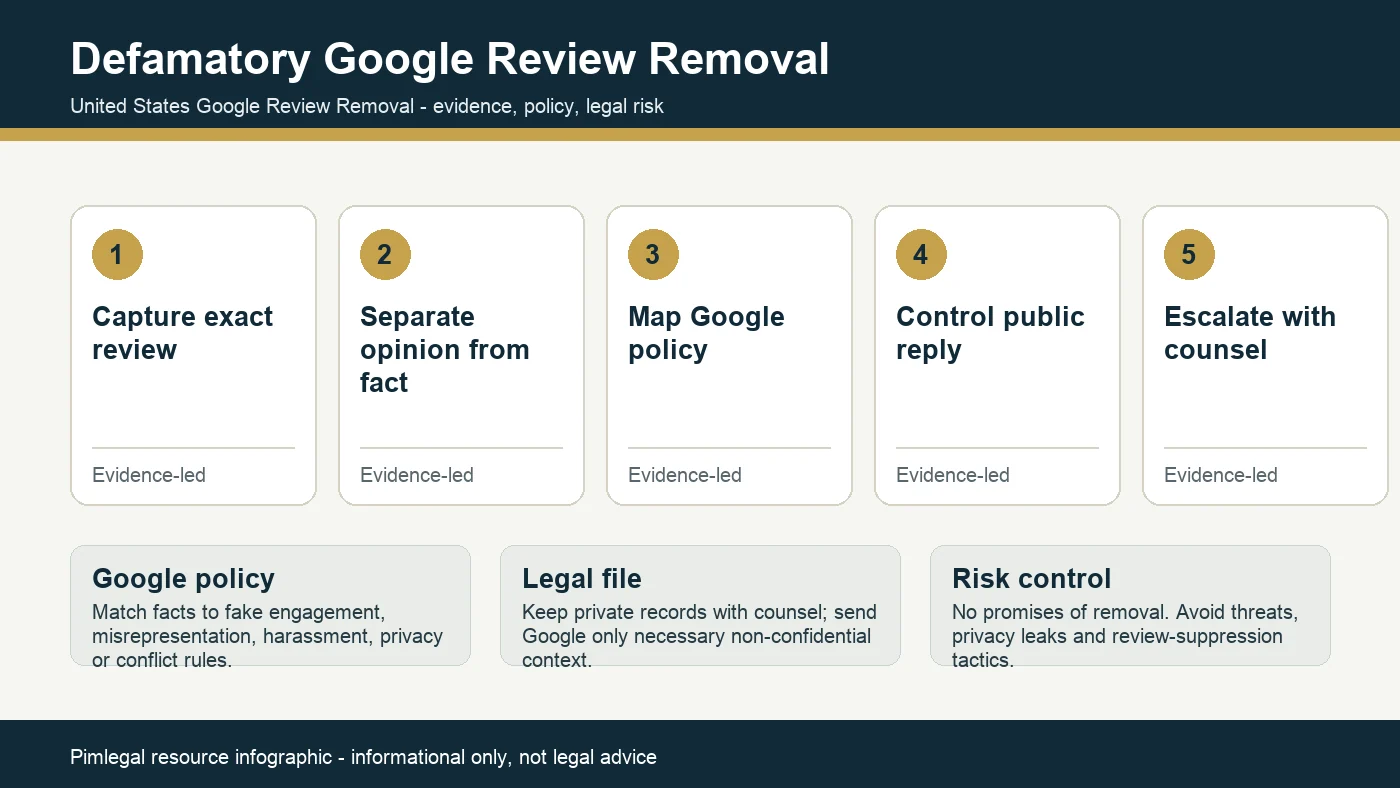
Evidence is the dividing line between suspicion and action. A business should preserve the review URL, screenshots, reviewer profile, publication date, rating history, transaction records, CRM checks, booking logs, invoices, messages and any pattern suggesting coordinated activity. If the reviewer never purchased, never attended, used a fake name or described impossible facts, that evidence can support a Google report and may also support legal correspondence.
Practical Evidence File Before Escalation
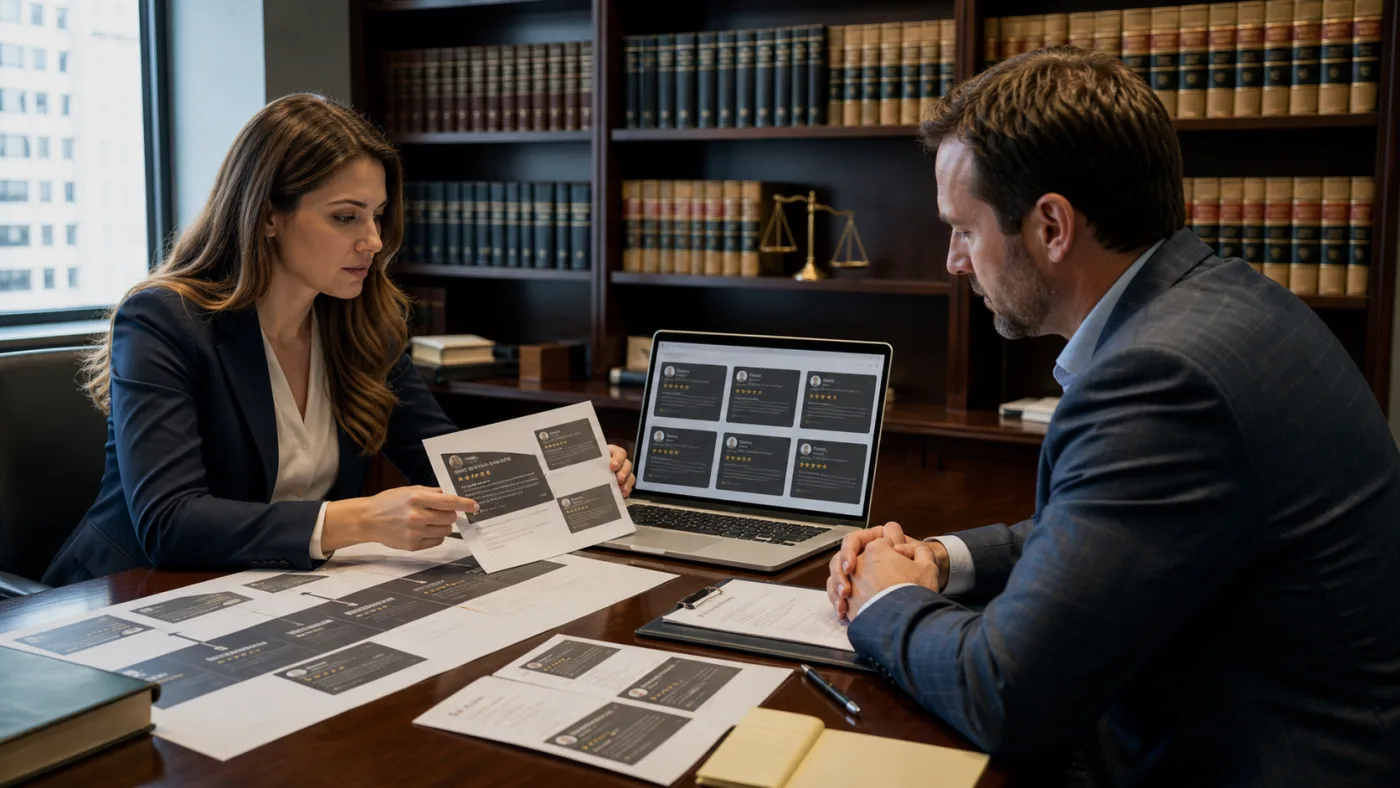
Before asking for removal, the business should map the review sentence by sentence. Each assertion should be classified as fact, opinion, mixed opinion, insult, privacy issue, conflict of interest, fake engagement or irrelevant content. This method avoids overclaiming and helps focus on the parts of the review that are most likely to breach Google policy or create legal risk.
Public responses should be handled carefully. A short, factual reply may reassure customers, but it can also create admissions or disclose private information. The safer sequence is to preserve evidence first, evaluate policy and legal routes second, then decide whether a public response, Google report, legal notice or court action is proportionate.
Key U.S. Legal Reference Points
- 47 U.S.C. § 230(c)(1): platform immunity principle for third-party user content, subject to important exceptions and limits.
- 15 U.S.C. § 1125(a): false or misleading commercial representations, relevant in some competitor or false advertising scenarios.
- 28 U.S.C. §§ 4101-4102: federal SPEECH Act provisions defining defamation for foreign-judgment purposes and limiting recognition of foreign defamation judgments.
- California Civil Code § 45: statutory libel definition used as one example of state-level defamation law.
- California Code of Civil Procedure § 425.16: California anti-SLAPP procedure for claims arising from protected petition or speech activity.
- New York Civil Rights Law §§ 70-a and 76-a: public participation protections, actual-malice standard in covered cases, and potential fee/damages consequences.
How Pimlegal Reviews A U.S. Google Review Dispute
For U.S. Google review matters, Pimlegal’s first step is not to promise removal. The first step is to build a clean evidence file, identify the governing jurisdiction, separate platform-policy issues from legal issues, and assess whether the review is false, defamatory, abusive, conflicted or simply negative opinion. That distinction protects the business from unnecessary escalation and gives any removal request a stronger foundation.
Where the review appears fake or defamatory, the preferred route may combine Google policy reporting, evidence-backed correspondence, reputation strategy and referral for local U.S. counsel where formal action is needed. The objective is practical: reduce ongoing harm, avoid avoidable legal risk, and decide whether the matter belongs in platform moderation, private resolution or a jurisdiction-specific legal process.
Visual Evidence Route
For a stronger file, pair this article with fake customer review evidence and platform policy and legal notice strategy.