
A practical scenario showing how evidence, conflict indicators and platform rules fit together in United States. A coordinated review attack is different from an ordinary unhappy-customer review. The core problem is not one person describing a bad experience; it is a pattern of reviews that may be organized, incentivized, fake, conflicted, or designed to distort a business profile at scale. In the United States, the response has to combine evidence preservation, Google Business Profile policy analysis, consumer-protection law, defamation principles, platform-immunity limits and, where a competitor is involved, unfair-competition or false-advertising assessment.
This case study uses a practical scenario: a medical clinic in the United States receives fourteen one-star Google reviews over a weekend. Several reviewers use newly created profiles, repeat similar phrases, mention services the clinic does not offer, and claim events on dates when the clinic was closed. The clinic recently refused a demand from a former marketing contractor, and a nearby competitor has launched a campaign using similar wording. The question is not simply whether the reviews are unfair. The question is how to prove the pattern, classify it correctly, and choose a proportionate removal or legal route.
For background on the defamation side, read our guide to defamatory Google reviews and business reputation. For the evidence workflow, this article should be paired with our page on fake customer review evidence. Those two internal guides support the practical steps below: isolate the factual statements, preserve the digital material, and avoid public replies that create unnecessary legal risk.
Step 1: Freeze The Evidence Before The Pattern Changes
The first operational step is preservation. Review attacks are fluid: reviews may be edited, removed, hidden by filters, answered by staff, or replaced by new accounts. The clinic should capture the full Google Business Profile page, every review URL if available, the reviewer display names, profile links, star ratings, publication dates, screenshots showing the URL and timestamp, and any visible review history. If the reviews mention specific appointments, products, procedures, staff members or invoices, those claims should be cross-checked against booking logs, CRM records, payment records, phone logs and closure dates.
The evidence file should separate platform evidence from business evidence. Platform evidence includes review text, profiles, dates, language similarities, profile behavior and rating clusters. Business evidence includes calendars, customer lists, invoices, emails, call records, visitor logs, internal incident reports and any documents showing that the alleged transaction never happened. This distinction helps later because Google policy teams, lawyers, courts and consumer-protection authorities do not all ask the same question.
Step 2: Classify The Attack Under Google Policy
Google Business Profile policy is the fastest removal route when the facts fit. Google says contributions should reflect a genuine experience and that fake engagement is not allowed. Its policy examples include content not based on a real experience, incentivized reviews, content posted from multiple accounts to manipulate a rating, misrepresentation, and content based on a conflict of interest such as current or former employment or other professional affiliations.
In the clinic scenario, the strongest Google-policy signals are not the low star ratings by themselves. They are the cluster timing, repeated language, impossible dates, services the clinic never offered, possible contractor conflict, and reviewer profiles with no credible customer connection. A removal request should not merely say, 'these are fake.' It should state the policy category, list the pattern, attach evidence, and explain why each review probably does not represent a genuine customer experience.
Step 3: Apply The FTC Consumer Review Rule
The key federal regulatory reference is the FTC Consumer Reviews and Testimonials Rule, which went into effect on October 21, 2024. The rule does not create a private right of action for the clinic, but it is highly relevant to risk analysis because it targets deceptive and unfair review conduct by businesses, review brokers, reputation agencies and other commercial actors.
Under 16 C.F.R. § 465.2, fake or false consumer reviews are addressed where a review materially misrepresents that the reviewer exists, used or had experience with the product or service, or accurately reflects the reviewer experience. 16 C.F.R. § 465.4 addresses buying positive or negative consumer reviews when compensation or incentives are conditioned on sentiment. 16 C.F.R. § 465.7 addresses review suppression, including certain unfounded threats or intimidation used to prevent or remove negative reviews.
For the clinic, the FTC rule changes the framing. If the former contractor, competitor or review broker created or sold negative reviews from people who did not use the clinic, the matter may be more than defamation. It may be deceptive review conduct affecting commerce. That does not mean the clinic can personally enforce the FTC rule in court, but it gives a reliable federal benchmark for why fake, purchased or coordinated negative reviews harm consumers and honest businesses.
Step 4: Separate Defamation From Fake Engagement
A coordinated review attack may include defamation, but not every fake review is defamatory. U.S. defamation law is mostly state law and generally requires a false statement of fact concerning the plaintiff, publication, fault and harm. Opinion, insult and rhetorical exaggeration receive substantial First Amendment protection. Cases such as New York Times Co. v. Sullivan, Gertz v. Robert Welch, Inc. and Milkovich v. Lorain Journal Co. shape that analysis.
In the scenario, a review saying 'terrible service' is probably opinion. A review saying 'the clinic reused contaminated needles on March 3' is a factual allegation that can be checked. A review saying 'they stole my deposit' may be factual if payment records prove no such transaction occurred. The legal review should mark each sentence as fact, opinion, mixed opinion, harassment, privacy issue, fake customer signal, conflict of interest or irrelevant content. This prevents the business from overclaiming and helps focus the removal request on provable points.
Step 5: Consider Competitor Misconduct And False Advertising
If a competitor organized the campaign, the analysis may include unfair competition, business disparagement, tortious interference and the Lanham Act. 15 U.S.C. § 1125(a) addresses false or misleading commercial representations in connection with goods or services. It will not apply to every consumer review because ordinary reviews are not always commercial advertising or promotion. But a competitor-run campaign designed to divert patients or customers can move the dispute beyond a simple user-review complaint.
The evidence burden is higher for that route. Similar wording is useful, but not conclusive. The clinic would need facts connecting the pattern to the competitor or commercial actor: messages, witnesses, invoice trails, agency records, shared profiles, timing linked to a dispute, or admissions. The legal theory should follow the evidence, not the other way around.
Step 6: Account For Section 230 And Platform Limits
Businesses often ask why Google cannot simply be sued for hosting harmful reviews. 47 U.S.C. § 230(c)(1), known as Section 230, generally prevents an interactive computer service from being treated as the publisher or speaker of third-party content. That protection usually makes direct publisher-liability theories against a platform difficult when the review was written by a user.
The California Supreme Court decision in Hassell v. Bird, involving Yelp, illustrates why removal orders directed at platforms can raise Section 230 issues. The better first targets are often the review author, the organizer, the broker, the competitor or the platform-policy process. Section 230 does not protect the original author of a false review from their own content, nor does it immunize a competitor that procures fake reviews.
Step 7: Learn From FTC Enforcement Cases
FTC enforcement history provides useful case studies. In Fashion Nova, the FTC alleged the company suppressed lower-star reviews and the matter resulted in a $4.2 million settlement. In Roomster, the FTC and several states alleged fake reviews and misleading listings, including allegations that a separate operator supplied tens of thousands of fake reviews. In Sitejabber, the FTC challenged review representations made before consumers had received or experienced products. In Rytr, the FTC approved a final order involving an AI testimonial and review service alleged to generate false and deceptive review content.
These cases are not identical to a local Google review attack, but they show the same regulatory logic: reviews influence consumer decisions, fake reviews distort competition, and commercial actors who create, buy, sell, suppress or manipulate reviews can face serious consequences. For a harmed business, those cases also help explain why a coordinated negative campaign should be documented as market manipulation, not merely as hurt feelings.
Step 8: Use Research To Explain Harm And Pattern Evidence
Academic and policy publications help show why review integrity matters. Michael Luca and Georgios Zervas, in Fake It Till You Make It: Reputation, Competition, and Yelp Review Fraud, studied review fraud in relation to reputation and competition. Dina Mayzlin, Yaniv Dover and Judith Chevalier, in Promotional Reviews: An Empirical Investigation of Online Review Manipulation, examined promotional review manipulation. The OECD report Understanding online consumer ratings and reviews also treats fake and misleading review practices as a consumer-policy problem.
For a business file, these studies do not prove that any particular reviewer is fake. They do support a broader point: review systems affect purchasing decisions and can be manipulated by actors with commercial incentives. That matters when explaining why a sudden one-star cluster can create measurable harm, why pattern evidence matters, and why platforms and regulators should take coordinated activity seriously.
Step 9: Choose The Proportionate Response
The clinic should not publish an emotional response accusing every reviewer of fraud. A public reply can preserve customer confidence, but it should be short, factual and privacy-safe. A suitable response may say that the business cannot match the account to a genuine customer record and invites the person to contact a dedicated channel. It should not disclose medical, financial or private data, and it should not threaten legal action unless counsel has reviewed the file.
The private route is more detailed: submit individual Google reports, then prepare an escalation packet grouping the reviews by timing, language, false facts, profile signals, conflict indicators and business records. If there is evidence of a broker, contractor or competitor, preserve communications and consider a legal hold letter or counsel-led correspondence. Where identification is necessary, U.S. counsel can assess subpoena options, privacy constraints and jurisdiction.
Evidence Checklist For A Coordinated Review Attack
- Full screenshots of each review with URL, date, rating, reviewer name and surrounding page context.
- Reviewer profile links, visible review histories, repeated wording, timing clusters and account-age indicators.
- Booking, invoice, CRM, payment, phone and email records showing whether the reviewer was a real customer.
- A sentence-by-sentence classification of factual claims, opinions, privacy issues, harassment, fake engagement and conflict indicators.
- Evidence of external coordination, such as contractor disputes, competitor communications, broker solicitations or similar attacks across platforms.
- A log of all Google reports, appeal IDs, responses, removals, refusals and dates.
Key U.S. References
- Google Business Profile prohibited and restricted content policy: fake engagement, misrepresentation and conflict-of-interest categories.
- FTC Consumer Reviews and Testimonials Rule Q&A: practical guidance on the 2024 rule.
- 16 C.F.R. Part 465: federal rule on consumer reviews and testimonials.
- 15 U.S.C. § 45: FTC Act Section 5, unfair or deceptive acts or practices.
- 15 U.S.C. § 1125(a): Lanham Act false or misleading commercial representations.
- 47 U.S.C. § 230(c)(1): platform-immunity reference point for third-party content.
- Hassell v. Bird: state high-court case illustrating Section 230 problems around platform removal orders.
- FTC v. Fashion Nova matter, FTC Roomster action, FTC Sitejabber matter and FTC Rytr order: enforcement examples involving review suppression, fake reviews, premature review collection or AI-generated review content.
Practical Conclusion
A coordinated Google review attack in the United States should be handled as an evidence project before it becomes a legal dispute. The business needs to show what happened, why the pattern is not ordinary criticism, which Google policy categories apply, whether FTC review-manipulation principles are relevant, and whether defamation, unfair competition or false advertising theories have enough support to justify escalation.
Pimlegal’s preliminary role is to organize that file, reduce avoidable mistakes, and identify the most credible route: platform report, escalation packet, evidence-backed correspondence, referral to U.S. counsel, or broader reputation strategy. The stronger file is not the angriest one. It is the one that connects reviews, records, law, policy and proportional remedies in a way that a platform, lawyer or authority can actually act on.
Visual Evidence Route

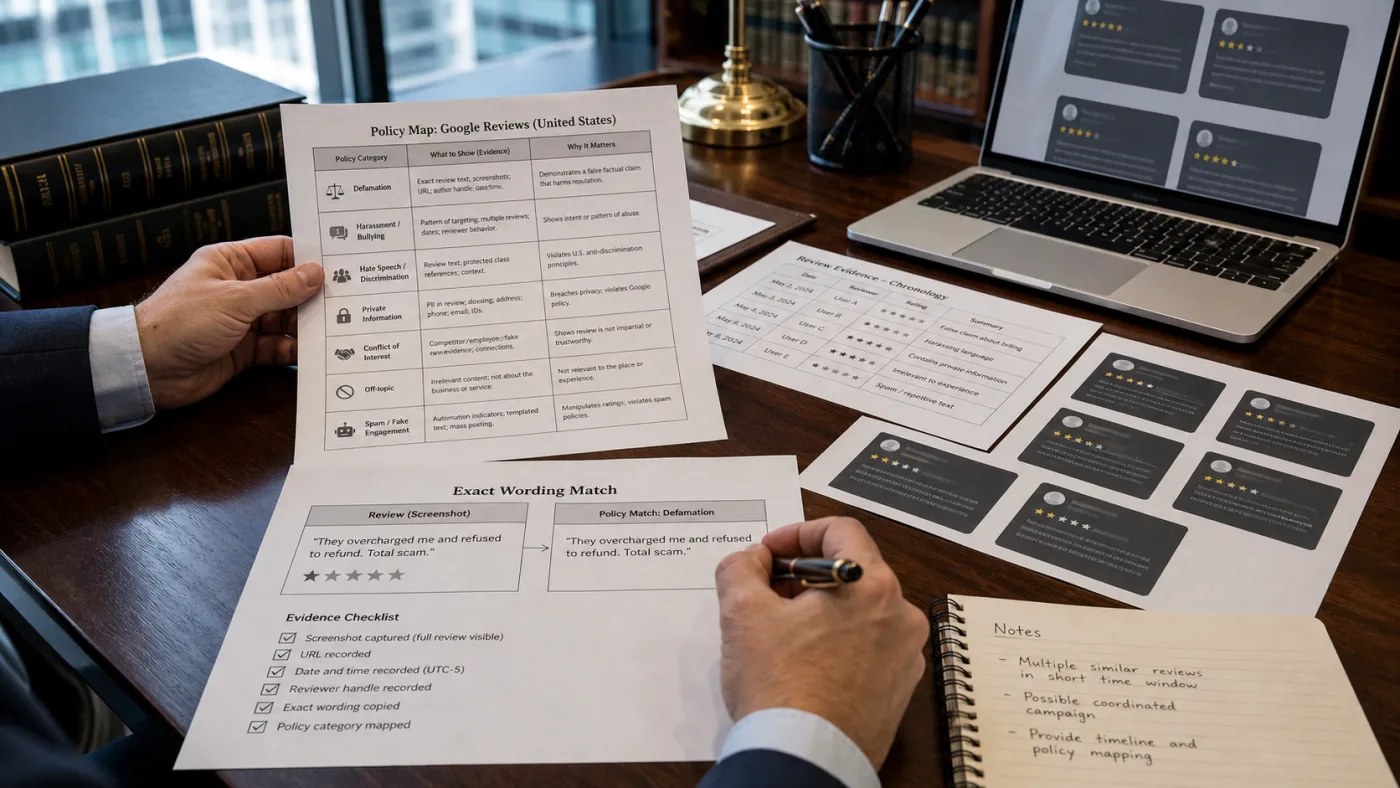
For a stronger file, pair this article with fake customer review evidence and platform policy and legal notice strategy.