
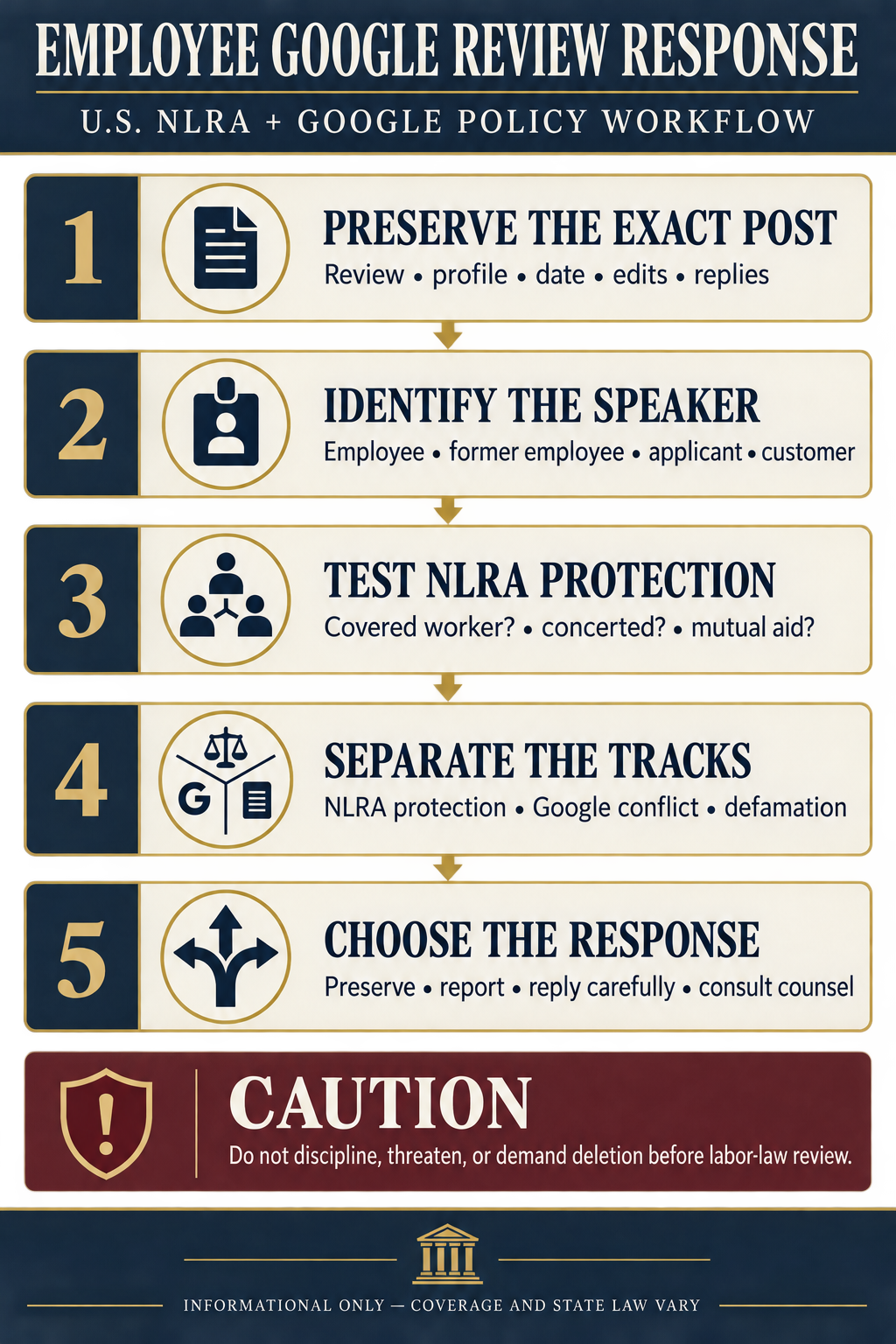
A U.S. legal guide to employee Google reviews, NLRA protection, Google conflict policy, evidence, retaliation risk, and careful response. This United States guide addresses how a U.S. business should respond when a current or former employee posts a negative Google review, because a platform conflict-of-interest report, a labor-law retaliation analysis, and any defamation claim are separate tracks with different facts and decision makers from a lawyer-grade evidence and platform perspective. The goal is not to promise deletion. The goal is to help a business preserve a useful file, avoid avoidable public-response mistakes, and decide whether Google reporting, a legal notice, subpoena-readiness review, or local counsel escalation is proportionate.
The working scenario is this: a current employee posts a one-star review accusing the company of unsafe staffing, unpaid time, and dishonest management after discussing schedules and pay with coworkers. Management identifies the account, wants HR to demand deletion, plans to report the post to Google as a current-employment conflict, and considers termination. Some allegations are disputed, several coworkers reacted to the same concerns, and the review also criticizes customer service. The team assumes that Google's policy violation automatically makes discipline lawful. A rushed reaction usually weakens the case. A business may reply publicly before it has searched records, accuse the wrong person, submit private documents to Google, or threaten litigation over language that is closer to opinion than fact. A stronger approach slows the dispute down just enough to classify the words, preserve the proof, and select the narrowest route that fits the evidence.

Legal Issue Framing
In U.S. review disputes, Section 7 of the National Labor Relations Act protects covered employees who act together for collective bargaining or other mutual aid or protection, and Section 8(a)(1) makes employer interference, restraint, or coercion unlawful. The NLRB states that social media can be protected concerted activity when it relates to group action or brings a group complaint to management, while purely individual griping is not necessarily concerted. Coverage, concert, purpose, loss of protection, causation, and remedy are fact-specific. A Google policy violation does not decide those labor-law questions, and possible NLRA protection does not decide Google's moderation rules or every state-law defamation element. Defamation law is mainly state law, so exact elements, privileges, damages rules, limitation periods, and anti-SLAPP exposure can vary. Still, a practical national screen is useful. Ask whether the review was published to third parties, whether it identifies the business or a person connected to it, whether the challenged words imply a fact capable of being proved true or false, whether that fact is false or materially misleading, and whether the publication caused reputational harm.
The Supreme Court references are important but should be used carefully. Milkovich is useful because a statement labeled as opinion can still imply an assertion of objective fact. New York Times v. Sullivan matters where public-official or public-figure standards are implicated, but many ordinary business review disputes involve private figures under state-law rules. The business should not overstate the constitutional point in a Google report. Google is not deciding a trial; it is deciding whether content violates platform policy.
Pair the labor-law screen with the USA guide to former-employee Google reviews, while the United States Google review removal page explains the broader country-specific platform and service strategy.
Evidence Checklist
The evidence file should begin before anyone contacts the reviewer. Preserve the review URL, profile URL, display name, star rating, full text, photos, visible edit history, publication date, Google Business Profile context, local-search position if relevant, and screenshots from desktop and mobile where possible. Then compare the allegations with the exact review and profile, publication and edit dates, coworker comments or prior group discussions, wage, schedule, staffing, safety, discipline, complaint, and investigation records, the reviewer's employment classification and supervisory authority, applicable handbooks and social-media rules, Google reports and appeal IDs, manager and HR communications, decision-maker knowledge, contemplated and final employment actions, comparator treatment, customer records if the reviewer also claims a customer experience, and a chronology that separates platform moderation from personnel decisions. A no-match conclusion should identify which systems were searched, who searched them, when, and what limitations remain.
The strongest file is a sentence-by-sentence table. One column quotes the exact words. One column states what an ordinary reader may understand. One column classifies the phrase as opinion, hyperbole, insult, factual accusation, private information, threat, fake-engagement signal, or off-topic content. Other columns identify proof for and against, non-confidential evidence that can be shown to Google, private evidence reserved for counsel, response risk, and potential harm.
- Save the review, profile, URL, screenshots, star rating, images, publication date, edit evidence, and Business Profile context.
- Compare the challenged statements with the exact review and profile, publication and edit dates, coworker comments or prior group discussions, wage, schedule, staffing, safety, discipline, complaint, and investigation records, the reviewer's employment classification and supervisory authority, applicable handbooks and social-media rules, Google reports and appeal IDs, manager and HR communications, decision-maker knowledge, contemplated and final employment actions, comparator treatment, customer records if the reviewer also claims a customer experience, and a chronology that separates platform moderation from personnel decisions.
- Preserve negative checks: no booking found, no invoice found, no matching visit, no branch record, or a partial match with inaccurate allegations.
- Keep confidential records separate from the Google submission; summarize sensitive facts instead of uploading private customer, staff, payment, health, student, legal, or HR data.
- Document harm with contemporaneous proof such as prospect questions, canceled bookings, rating movement, sales impact, staff concern, partner concern, and report or appeal outcomes.
- Create one chronology that tracks first discovery, preservation, internal review, Google reports, appeals, notices, public responses, and any off-platform messages.

Platform-Policy Angle
Google's own review-reporting workflow should be used with a moderator-readable file. The submission should identify the exact review, the policy category, the non-confidential facts that support the category, and the requested action. For this topic, the likely policy angle may involve fake or misleading engagement, rating manipulation, and conflict of interest because Google's current policy identifies current or former employment as an example of a conflict. Other supported categories may include misrepresentation, harassment, personal information, or content unrelated to a genuine customer experience. The Google report should not assert that labor-law protection disappears merely because Maps policy may prohibit the contribution. The important point is precision: a review may be legally troubling but still require a policy explanation before Google can act.
Google's prohibited and restricted content policy is the operational map. It covers categories such as fake engagement, misrepresentation, harassment, personal information, off-topic content, and conflicts of interest. A business should not ask Google to decide every state-law issue. It should explain why the review fails Google's own rules and support that explanation with a concise chronology. If the problem includes review extortion, use Google's dedicated extortion route as well as the ordinary review-reporting route where the facts fit.
The business must also avoid becoming the policy problem. The FTC Consumer Reviews and Testimonials Rule Q&A states that the federal rule went into effect on October 21, 2024 and addresses deceptive or unfair conduct involving consumer reviews and testimonials. A harmed business should not buy counter-reviews, pressure customers to edit truthful criticism, create insider reviews without proper controls, review-gate only happy customers, or make groundless public accusations to suppress a lawful review.
One Review Creates Three Separate Decision Tracks
The first track is employment law: may the employer investigate, direct removal, discipline, discharge, or sue without interfering with protected activity? The second is platform policy: does the contribution violate Google's rules because it is based on current or former employment, another conflict, or non-genuine engagement? The third is defamation and related state law: does the review communicate a false factual assertion, with the required fault and harm, without privilege or another defense? The same screenshot belongs in all three files, but one answer does not control the others.
A business can report a conflict to Google while pausing personnel action. It can preserve possible defamation evidence while concluding that a lawsuit is disproportionate. Google can remove a review under product rules without finding the author lied, and an NLRB inquiry can focus on the employer's conduct even if the post later disappears. Write each proposed action, legal basis, evidence owner, decision maker, deadline, and uncertainty on a separate line. That simple separation reduces the risk that a moderator decision is misused as an employment-law conclusion.
Start With Coverage, Not With The Star Rating
Section 7, codified at 29 U.S.C. Section 157, gives employees the right to engage in concerted activities for collective bargaining or other mutual aid or protection. Section 8(a)(1), in 29 U.S.C. Section 158, makes it an unfair labor practice for an employer to interfere with, restrain, or coerce employees in exercising those rights. These rules can apply in nonunion workplaces. The legal screen therefore begins with the speaker's statutory status and the employer's coverage, not whether the review is one star or commercially embarrassing.
Coverage is not universal. The NLRB's current coverage guidance identifies excluded categories including public-sector employees, agricultural and domestic workers, independent contractors, certain family-employed workers, air and rail employees covered by the Railway Labor Act, and supervisors, subject to limited qualifications. The Act text also defines employee and employer for NLRA purposes. Job titles are not enough. Preserve actual authority, duties, reporting lines, economic facts, and separation status before classifying a manager, contractor, applicant, former worker, franchise worker, or staffing-agency worker.
Concerted Activity Is More Than A Personal Complaint
The NLRB's current social-media guidance states that using social media can be protected concerted activity when employees address work issues or share information about pay, benefits, and working conditions. It also draws an important limit: an individual complaint is not automatically concerted. The communication must relate to group action, seek to initiate or prepare for group action, or bring a group complaint to management. A public Google review can therefore require context that is not visible on the review page.
Look backward from publication. Did coworkers discuss the same schedule, pay, staffing, safety, workload, discipline, discrimination, or policy concern? Did anyone ask the reviewer to speak for the group? Did coworkers comment, react, share proof, or plan a complaint? Was the reviewer trying to enlist employee or public support for a workplace issue? Conversely, was the post an isolated attack over a personal dispute with no connection to group concerns? Preserve evidence on both sides. Do not instruct managers to create affidavits or rewrite meeting notes after the review appears.
Mutual Aid Or Protection Requires A Workplace Nexus
Concert is only one part of the inquiry. The purpose must involve mutual aid or protection, commonly an effort to improve terms or conditions of employment. Complaints about shared wages, schedules, safety, staffing, benefits, discipline, discrimination, or an overbroad workplace rule may fit more readily than a consumer-style statement that the company's product is bad. Mixed posts require statement-by-statement analysis. A review can combine a protected workplace complaint, a personal insult, a claim about customer service, and an allegedly false accusation in one paragraph.
Do not solve a mixed post by labeling the whole thing protected or unprotected. Quote each proposition, identify its workplace purpose, record the audience and coworker context, and mark any separable product disparagement, threat, private information, or factual accusation. The employer should also record whether the same concern was raised internally and whether the reviewer was seeking group support. This matrix helps employment counsel, Google moderators, and defamation counsel evaluate different questions without changing the underlying evidence.
Protection Has Limits, But Employers Should Not Declare Them Alone
The NLRB's social-media page says activity is not protected when statements are egregiously offensive or knowingly and deliberately false, or when an employee publicly disparages products or services without relating the criticism to a labor controversy. That language does not create a safe shortcut for management. A disputed, exaggerated, harsh, or mistaken statement is not necessarily a knowingly deliberate falsehood. Investigators should preserve the speaker's sources, management records, contemporaneous coworker knowledge, corrections, and evidence of intent before reaching a conclusion.
Labor-dispute defamation also has a specialized federal overlay. In Linn v. United Plant Guard Workers, the Supreme Court allowed a state libel remedy for statements circulated during a labor dispute where the complainant could prove malice and injury, while emphasizing the latitude traditionally afforded heated labor speech. The case is not a universal rule for every employee review. It is a warning that labor preemption, statutory protection, state defamation elements, actual-malice analysis, and proof of injury may need to be addressed together before a demand or complaint is filed.
Retaliation Risk Attaches To The Employer's Response
The key employment-law event may be a manager's message, HR interview, schedule change, warning, suspension, discharge, benefit decision, reference, or lawsuit—not the review itself. Preserve who first identified the author, what each decision maker knew about coworker activity, when the business considered action, what reason was recorded, whether the same rule was applied to comparable conduct, and whether a neutral investigation had already begun. Keep original messages and drafts; do not move the discussion to disappearing chats.
- Pause any deletion ultimatum, discipline, discharge, reduced hours, reassignment, bonus decision, or adverse reference tied to the post until the protected-activity screen is documented.
- Identify legitimate operational concerns separately, including confidentiality, threats, data exposure, attendance, performance, or customer harm, and preserve when those concerns arose.
- Compare treatment of similar online conduct by employees who did and did not raise group workplace issues.
- Preserve policy versions, acknowledgments, prior enforcement, manager training, investigation notes, and the exact stated reason for action.
- Limit access to personnel records and legal analysis; the Google moderation packet should not become a substitute HR file.
Former Employees, Applicants, And Supervisors Need Separate Analysis
The phrase former employee in Google's conflict rule does not answer NLRA status. Timing and statutory definitions matter. Record the last day worked, separation reason, whether a labor dispute or alleged unfair practice was ongoing, whether substantially equivalent employment was obtained where relevant, and whether the speaker acted with current coworkers. Applicants, supervisors, managers, independent contractors, public employees, and workers covered by another labor regime can present different rights and remedies. Do not state in a report, reply, or demand that every former worker has no legal protection.
The opposite overstatement is also unsafe. Prior employment does not immunize fabricated customer stories, impersonation, threats, doxxing, or knowingly false factual attacks. It does mean the business should preserve the relationship accurately and send the facts to counsel before converting a Google conflict report into a personnel threat. If the reviewer also had a genuine customer transaction, separate the employment-based statements from the consumer experience rather than asserting that the entire account is impossible.
Google's Conflict Rule Is Strong—And Narrow
Google's current prohibited and restricted content policy says Maps contributions should reflect genuine and unbiased experiences and identifies current or former employment as an example of a conflict of interest. That is the clearest platform path for a review based on workplace experience. A report should quote the employment-centered language, identify the relationship and dates in a privacy-safe way, provide the direct review and profile URLs, and explain why the contribution is not an independent customer review. The business should avoid attaching tax forms, medical records, disciplinary details, government identifiers, or a full personnel file.
The Business Profile reporting guidance says only policy-violating reviews are eligible for removal and provides a one-time appeal after a no-violation decision. Use the first submission and appeal carefully: exact URL, conflict category, concise chronology, minimal verification, and no claim that Google must decide NLRA coverage. A Google rejection does not make discipline lawful. A removal does not prove the employee lied or waive possible labor rights. The platform and employer remain different actors applying different rules.
Build A Two-Packet Evidence System
The counsel packet can contain the complete workplace file: preserved post, coworker context, coverage facts, employment records, source documents, investigation material, policies, decision chronology, allegedly false statements, harm evidence, and privileged analysis. The Google packet should be much smaller: review and profile URLs, screenshots, dates, a neutral statement of the employment or other conflict, and only the non-confidential material needed to verify the category. Keep a manifest showing what was shared, when, with whom, and for which purpose.
Hashing or otherwise recording stable copies can help show that later edits were not silently folded into the original. Capture the Business Profile, owner replies, reviewer profile, contribution history visible at the time, and Google report status. For workplace evidence, preserve native messages, recipients, timestamps, attachments, schedule versions, pay records, complaint channels, investigation notes, and decision drafts according to lawful retention rules. Do not ask employees to surrender personal accounts or credentials without a specific lawful basis and counsel review.
A Privacy-Safe Public Reply
The safest public reply is usually brief and does not confirm employment, separation, discipline, pay, health, leave, immigration, performance, or complaint details. It can say that the business takes workplace and service concerns seriously, uses appropriate internal channels, and cannot discuss confidential matters publicly. If the review also claims a customer transaction, invite private contact through an official channel without saying no such customer exists until records have been checked. A response should be written for future readers and regulators, not as an argument with the speaker.
Avoid calling the reviewer a disgruntled ex-employee, liar, extortionist, thief, or criminal. Avoid announcing termination, disclosing the investigation, quoting private coworker messages, or stating that counsel will ruin the author unless the post is removed. Even an accurate response can create unnecessary privacy, retaliation, defamation, or witness issues. If a temporary no-response position is selected, document the reason and continue monitoring edits, replies, republication, and measurable harm without orchestrating counter-reviews.
When Employment Counsel Should Take Over
Escalate promptly to employment counsel when managers propose discipline or a deletion demand; coworkers participated; the post concerns pay, hours, staffing, safety, discrimination, benefits, or a workplace rule; the author filed or threatened an agency charge; coverage is uncertain; or the business wants to sue. Section 10(b), codified at 29 U.S.C. Section 160, generally bars an NLRB complaint based on an unfair labor practice occurring more than six months before filing and service, subject to the statutory exception. That federal timing rule does not replace any shorter internal, contract, state, defamation, preservation, or insurance deadline.
- Escalate when the reviewer acted with coworkers or referred to a shared workplace complaint.
- Escalate before any adverse action when the decision maker knew about organizing, complaints, agency contact, or other protected activity.
- Escalate when the review contains serious false factual accusations, personal information, threats, or repeated publication across profiles and platforms.
- Escalate when Google rejects a well-supported conflict report and management wants to intensify pressure on the author.
- Escalate when supervisors, contractors, franchise relationships, staffing agencies, public employment, or multistate facts make coverage or governing law uncertain.
- Escalate when litigation, a regulator, an insurer, a preservation duty, or material economic harm changes the proportionality analysis.
A Practical Decision Memorandum
Before action, prepare a short memorandum with five conclusions and confidence levels: who the speaker is; whether the NLRA and employer jurisdiction appear to apply; whether the communication is concerted and for mutual aid or protection; whether any separable conduct may fall outside protection; and which Google policy category is supported. Add the defamation screen, privacy limits, available internal evidence, decision-maker chronology, deadlines, alternatives, and unknown facts. The memorandum should expressly state which questions remain for employment or state-law counsel.
The proportionate route may be a Google conflict report with no personnel action, an internal correction of genuine workplace problems, a confidential investigation, a neutral public reply, a preservation hold, a counsel-led communication, or—on strong facts—a separate legal claim. More than one route can proceed, but they should not be collapsed. The objective is a defensible record and a lawful response, not punishment for public criticism or a promise that the review will disappear.
Public Response Strategy
The public response should be written for future readers, Google, and a later evidence file. It should usually be short, factual, and privacy-safe. The business can state that it takes the matter seriously, that available records are being reviewed, and that the reviewer can contact an official private channel. The response should not disclose the evidence package. The main risk here is directing HR or a manager to threaten discipline, termination, litigation, or lost benefits unless the review is removed; asking coworkers to pressure the reviewer; retroactively creating a policy basis; publicly confirming employment facts or personnel issues; calling disputed wage or safety complaints lies without an investigation; uploading private personnel records to Google; or treating a successful Google removal as proof that retaliation, defamation, or other legal claims are resolved.
A public reply can become a screenshot in a later platform appeal, regulator complaint, media post, or lawsuit. Avoid calling the reviewer a criminal, extortionist, competitor, ex-employee, fake customer, or liar unless counsel has reviewed the evidence and the business accepts the risk. If the review contains private data, staff names, customer identifiers, health information, payment details, student information, legal-client facts, or HR allegations, the public response should be screened before publication.
Escalation Criteria
Escalation is not a single move. It may mean a stronger Google appeal, a legal-preservation letter, a narrow demand letter, private outreach, subpoena-readiness review, local counsel referral, law-enforcement consultation for true extortion facts, or a state-law defamation assessment. Escalation is most defensible when the accusation is specific, factual, serious, contradicted by objective records, causing measurable harm, and not adequately addressed by ordinary platform reporting.
Expectations about the platform should remain realistic. 47 U.S.C. Section 230 generally limits attempts to treat an interactive computer service as the publisher or speaker of third-party content. That does not protect the person who wrote a false review, and it does not stop the business from using Google's policy channels. It does mean that a legal strategy aimed directly at the platform needs careful analysis and usually should not be the first assumption.
- Escalate when the review makes a serious factual accusation such as fraud, theft, unsafe conduct, falsified records, discrimination, or professional misconduct.
- Escalate when the reviewer appears to be a non-customer, competitor, former staff member, supplier, transaction opponent, or part of a coordinated pattern.
- Escalate when there are threats, demands for value, personal information, images, harassment, or repeated publication across platforms.
- Escalate when Google rejects a first report because the submission lacked policy framing, chronology, or non-confidential evidence.
- Escalate when a public response would create privacy, employment, consumer-protection, confidentiality, or retaliation risk.
Risk Cautions
The Consumer Review Fairness Act, codified at 15 U.S.C. Section 45b, restricts certain form-contract provisions that prohibit, penalize, or transfer rights in honest consumer reviews. It does not protect fake, defamatory, harassing, confidential, or unlawful content, but it does warn businesses against overbroad anti-review tactics. A removal strategy should target false or policy-violating statements, not silence ordinary criticism.
The second caution is evidentiary discipline. Do not delete internal notes, alter customer records, post confidential documents, offer payment for deletion, send a template threat without reviewing state law, or submit a long emotional narrative to Google. A business should keep one clean file and separate what can be shown publicly, what can be summarized to Google, and what should remain with counsel.
Sources Consulted
- Google Business Profile Help: report inappropriate reviews.
- Google prohibited and restricted content policy.
- Milkovich v. Lorain Journal Co., 497 U.S. 1 (1990).
- New York Times v. Sullivan, actual-malice framework.
- 47 U.S.C. Section 230.
- FTC Consumer Reviews and Testimonials Rule Q&A.
- 15 U.S.C. Section 45b, Consumer Review Fairness Act.
- 29 U.S.C. Section 157, employee rights to concerted activity.
- 29 U.S.C. Section 158, unfair labor practices.
- 29 U.S.C. Section 160, NLRB enforcement and six-month charge period.
- NLRB guidance on social media and protected concerted activity.
- NLRB protected concerted activity guidance and examples.
- NLRB guidance on workers excluded from NLRA coverage.
- National Labor Relations Act text and definitions.
- Linn v. United Plant Guard Workers, 383 U.S. 53 (1966).
- Google Maps user-generated content policy.
- Google Legal Help: Defamation Overview.
- Google Legal Help: report content for legal reasons.
Practical Conclusion
An employee-authored Google review requires three files, not one conclusion. Preserve the exact post and workplace chronology; test NLRA coverage, concert, purpose, and protection before any personnel action; make a separate privacy-safe Google conflict-of-interest submission; and analyze any false factual statement under the governing defamation law. Management should pause discipline and deletion demands until employment counsel has reviewed the evidence. Google may remove a policy-violating review, but neither removal nor continued publication determines labor-law liability or guarantees a legal outcome.
Pimlegal's preliminary role is to organize the review evidence, frame the platform policy route, keep the public response proportionate, and identify when the matter should move to U.S. counsel for jurisdiction-specific legal advice. This article is general information only. It does not guarantee review removal, identify a final legal remedy, or replace state-specific counsel review.