
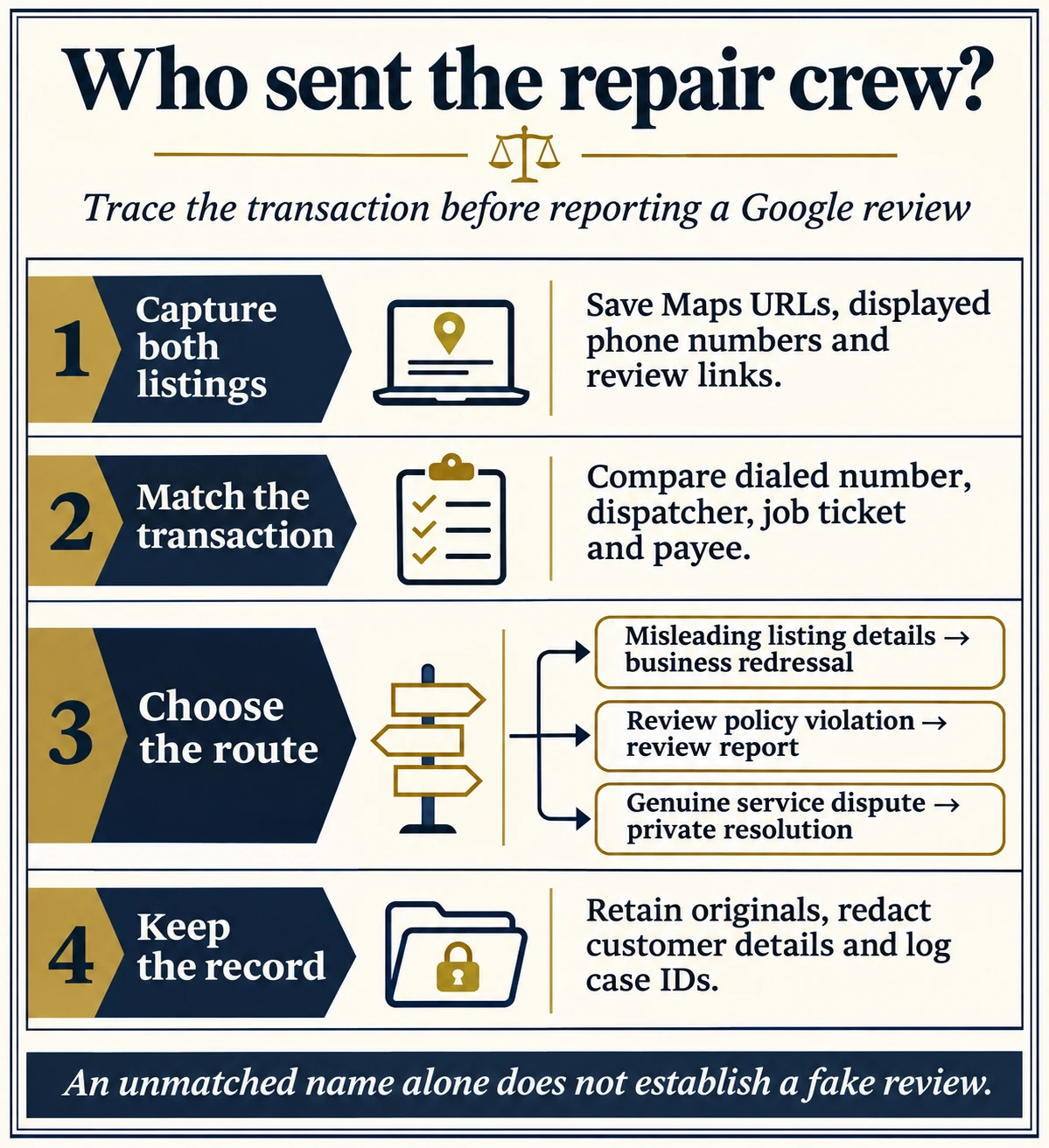
A homeowner writes, “Your technician took our deposit and never came back.” Your dispatcher cannot find the job. Before anyone calls the reviewer a liar, find out which number the homeowner dialed, who accepted the deposit, and which Google Maps listing now carries the complaint. Those three answers can point to different businesses. They determine whether to report a listing, challenge an individual review, or make good on a service your company promised.

Recent development
On October 19, 2026, the Federal Trade Commission reported to Congress on its work protecting older consumers. Its enforcement appendix describes a federal case in the Northern District of Illinois against B.E.S.T. GDR, LLC, doing business as Premium Home Service, and Yosef Bernath. The entry says the plaintiffs alleged that fictitious local repair listings attracted customers and fabricated reviews raised ratings and diluted negative feedback. The FTC recorded the litigation as ongoing. October 19 is the report date. The United States and Illinois filed their civil complaint on May 11. The report gives businesses a documented example of how reviews and listing details can work together to misidentify a service provider. It records allegations and establishes no new Google removal rule. FTC report to Congress, enforcement appendix.
Consider the Texas customer described in paragraph 47 of the filed complaint. According to the plaintiffs, he arranged a same-day electrical appointment through a well-rated Google profile, paid a membership fee and waited for a technician who never came. When he visited the advertised address to pursue a refund, he found a doughnut shop. He could have personal knowledge of the call, payment and missed appointment even though he had never met an electrician. A merchant investigating that account would need the listing and payment trail to identify who made the promise. The complaint does not say he reviewed the doughnut shop.
Identify the statement your business can actually dispute
Read the entire post, including the stars, photographs, edits and any response already visible. In the opening example, a customer could accurately describe paying a deposit and still be mistaken about who collected it. Write the attribution as a separate proposition: “Our business dispatched the technician or accepted the deposit.” Then identify which record could confirm or contradict it. Calling an invoice expensive expresses a different complaint from saying that your technician charged a card twice. A customer may also have dealt with your office by phone without ever receiving an invoice.
Ask whether the reviewer posted on your genuine profile, whether someone changed contact details on your genuine profile, or whether a second profile uses a confusing name. Record both URLs if two places exist. If the complaint sits on a different business’s profile and mentions neither your business nor your staff, explain internally how customers are being confused before seeking any action on the review. A similar trading name in a neighboring town, by itself, establishes little.
Evidence checklist for a misdirected repair review
- Capture the whole review and the profile where it appears. Save the review link, Maps share link, visible business name, service area, website, displayed number, date and time of capture. Keep the original before marking up a copy.
- Capture the second listing independently. Note which details match yours and which differ. Save a dated copy of your business website or other records showing the number you published at the time the customer booked. A change made today cannot establish what the caller saw last month.
- With the customer’s cooperation, compare the number actually dialed, booking confirmation, invoice issuer and payment descriptor. A redacted receipt or the last few digits of the dialed number may answer the question. Offer a private contact channel and avoid asking for a bank statement or a full card number.
- Check job records across dates, branch offices, warranty dispatch, franchise scheduling and subcontractors. Search by service address or job reference with appropriate internal access. Record who checked, which period they searched and which systems were unavailable.
- Make a dated chronology of the first call, promised visit, attendance, invoice, review and profile changes. Distinguish what the customer recalls from what a document shows. Preserve any record connecting your business to the job, including material that undermines your initial position.
Test an innocent explanation before reporting impersonation
Suppose the dialed number belongs to an answering service. If that service forwarded the call to your on-call technician and your office later took payment, the customer has a connection to your business even if the receipt shows a different legal name. Ask your dispatcher for the assignment and check the answering-service agreement in force that weekend. A family member may have booked the visit, a landlord may have paid, or the customer may describe an estimate that never became a job. Each leaves a different record.
Now change one fact. The homeowner supplies a booking confirmation from a company your office has never engaged. Its callback number matches a second listing that uses your shop name. Your provider confirms that it never assigned that number to you, and the customer’s receipt names the same other company. Those facts support a focused report about misleading contact information. They do not identify who created the second listing or establish that the homeowner deliberately posted on the wrong page. Keep those questions open.
When to report the listing, the review, or both
If the business name, phone number or website on Maps is being used misleadingly, Google directs users to its business redressal complaint form. Include the exact listing, the disputed field, what the customer saw and a document supporting the correction. For a place that never existed or is ineligible, Google also describes the signed-in “Suggest an edit” route. A home-service contractor may serve customers at their addresses. The absence of a walk-in shop alone is a poor basis for claiming that a business does not exist. Check the listing you selected before submitting an edit. Google’s Business Profile reporting guidance.
For a specific review on your profile, identify the exact policy issue. Google requires a genuine experience and disallows contributions that misrepresent the location or product. A reasoned submission might say that the reviewer’s own confirmation identifies a different dispatch company and that the number dialed matches that company’s listing. Explain how you checked for an agency or subcontracting relationship. Leave placeholders for private facts out of the public reply. If only the workmanship or reasonableness of a bill is disputed, Google says it does not referee ordinary customer disagreements. Google Maps contribution policy.
If both objects are affected, make each request intelligible on its own. A listing investigator needs the incorrect field and the source of the correct information. A review moderator needs the individual post and the reason it violates policy. Save both case references. Use the Reviews Management Tool to check the review decision. Google provides a one-time appeal after an eligible rejection. Use it to address the actual reason for reporting and add the strongest missing evidence. Google’s review reporting and appeal instructions.
What the FTC rule covers
Section 465.2(a) addresses a business writing, creating or selling a review that materially misrepresents the reviewer’s existence, experience with the business, or what that experience was. Subsection (b) addresses purchasing reviews or disseminating testimonials where the business knew or should have known of the material misrepresentation. Subsection (c) deals with procuring materially false reviews from specified insiders or their immediate relatives under a knowledge standard. The regulation also distinguishes generalized requests to purchasers and mere review hosting in subsection (d). 16 C.F.R. § 465.2.
Those distinctions matter when a marketing vendor offers to repair the shop’s rating. Ask where its reviewers come from and whether anyone can connect them to actual experiences. Decline offers to supply ready-written customer accounts. If your agency has already arranged suspicious posts, retain the agreement, messages and invoices and investigate your own exposure. A homeowner’s honest mistake about the name on a van raises a different issue. Citing the federal rule in a message to that homeowner supplies no evidence about who took the call.
A public reply that helps the next caller
A short response can address immediate confusion while the records are being checked. For example: “We’d like to trace the visit you describe. Please use the service contact on our official website and send the booking date and the company name on your confirmation. Please keep your address and payment details private.” Assign a staff member to receive that message. If a refund is due, handle it through the ordinary complaint process without conditioning payment on deleting or changing a review.
If the customer confirms they chose the wrong Maps entry, let them decide whether to correct their account. Keep their confirmation private and update your own public response if you previously misstated the facts. For a straightforward mix-up between two established shops, the U.S. guide to reviews for the wrong business or location explains how to document that narrower issue.
When the evidence warrants legal escalation
Seek advice promptly if several independent customers report paying someone using your identity, your verified number keeps changing, a customer reports an immediate safety concern, or a specific false statement is causing documented cancellations. Give counsel the exact wording, publication dates, jurisdictions involved, job records, platform decisions and evidence of harm. A canceled contract accompanied by a customer email explaining why is easier to evaluate than a fall in call volume during a quiet week. Retain records of other possible explanations for lost work.
Ask counsel to identify the responsible speaker or listing operator, the provably false factual statement about your business and any applicable defenses before sending a demand. State rules concerning deadlines, fault, damages and early dismissal can change the economics of a claim. A broad threat to a customer can draw attention to the very allegation you are investigating. Where several callers appear to have been diverted, a consumer-protection complaint may address conduct that removing a single post would leave in place. The PimLegal United States Google review removal page describes the country-specific service for businesses considering an assessment.
Practical conclusion
Trace one job from the number dialed to the payee. If the records point to your crew, address the service failure. If they point to a misleading listing, document the disputed field. If a particular review attributes another company’s work to yours, report that attribution with the evidence that supports it. Preserve unresolved gaps and revisit the public pages after any decision. This guide provides general information. An attorney can advise on the facts and law in a particular matter. Neither reporting nor legal action guarantees removal or any other outcome.