
A practical U.S. guide to what a Google negative review removal service can do, what it should never promise, and how businesses can use monitoring, evidence, compliant responses, appeals, and legal escalation without creating new Google or FTC risk. The phrase sounds simple, but the safe workflow is not. A negative Google review removal service cannot press a hidden delete button, cannot guarantee that Google will remove truthful criticism, and cannot lawfully buy positive reviews to bury a problem. What a serious service can do is organize evidence, monitor risk, identify policy violations, prepare a cleaner report, control public replies, support the one-time appeal, and recognize when a legal route needs counsel instead of another dashboard ticket.
This article is inspired by Snapbad's page about stressful bad reviews, technology-assisted reputation monitoring, automated review replies, and negative review removal. The useful idea is that a business benefits from a repeatable system rather than a panic response to one angry post. The Pimlegal angle is more cautious: review technology is helpful only when it is tied to evidence, Google policy, FTC review-suppression rules, privacy discipline, and a realistic understanding of what Google will and will not remove.
What A Negative Review Removal Service Can Actually Do
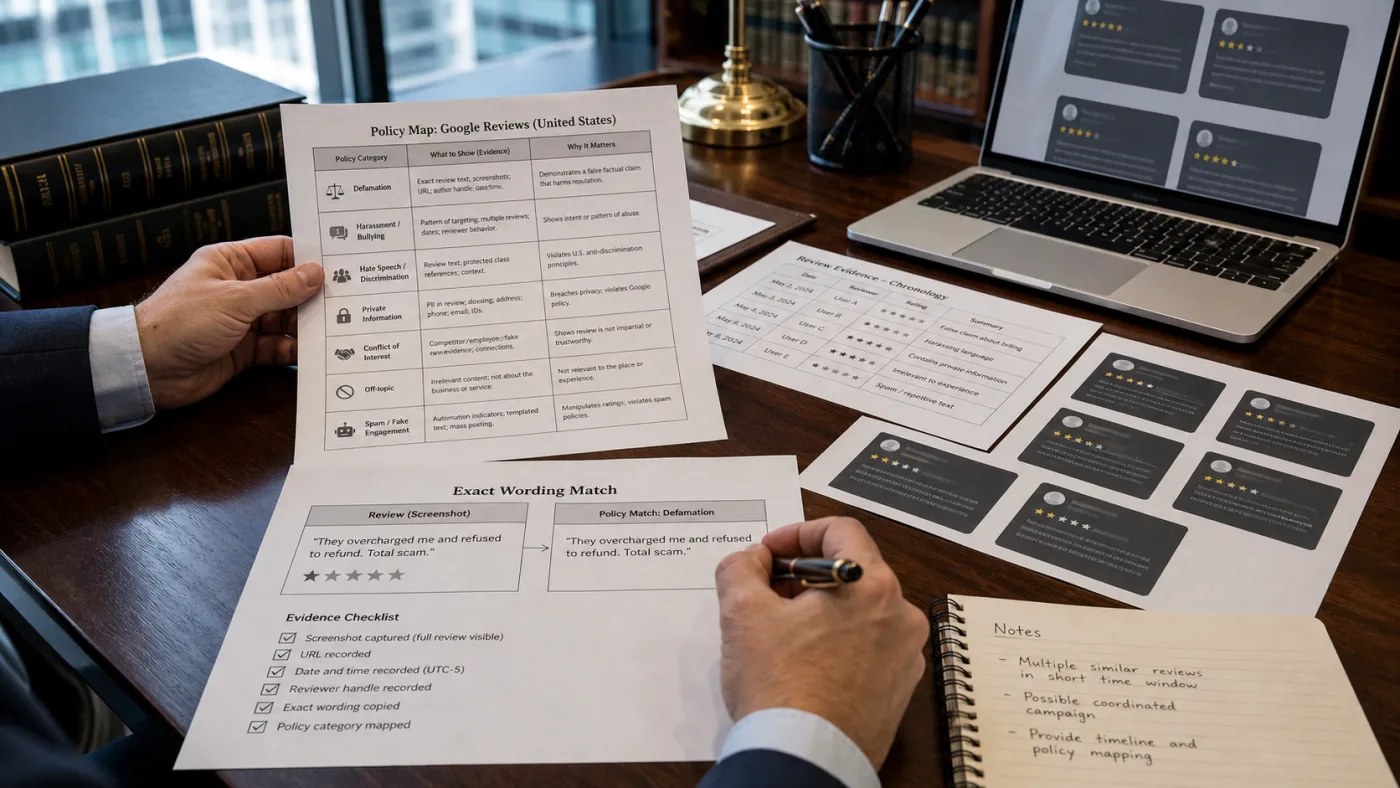
A good service starts by slowing the dispute down. The intake should capture the review URL, reviewer display name, reviewer profile, star rating, full text, images, visible date, edit history, owner replies, Business Profile context, and any off-platform messages. It should then ask what the business knows: customer record, transaction date, invoice, booking, refund, staff schedule, location, branch, service provided, previous complaint, or pattern of similar reviews. This is the difference between a professional removal file and a generic complaint that says the review is unfair.
Google's Business Profile review-reporting guidance makes the limit clear: businesses can report reviews, but only reviews that violate Google policy are eligible for removal. Google's prohibited and restricted content policy then supplies the working categories. A service should therefore translate the review into a policy file: fake engagement, rating manipulation, conflict of interest, impersonation, harassment, personal information, off-topic content, restricted content, misrepresentation, or another recognized category. If the review is merely negative but genuine, the service should say that honestly.
The strongest services also separate four lanes. The first lane is platform moderation: report a policy-violating review to Google. The second lane is public response: answer genuine criticism without disclosing private facts. The third lane is reputation rebuilding: ask real customers for honest reviews in a compliant way. The fourth lane is legal escalation: preserve and assess serious false factual accusations, threats, extortion, impersonation, privacy issues, copyright issues, or court-order routes. A vendor that puts every situation into one lane is taking shortcuts.
Read this with the USA Google review removal evidence guide and the United States Google review removal page. Those are the two contextual internal links used in this article: one evidence workflow and one country-service page.
What A Service Should Never Promise
The warning sign is a guarantee. No outside service controls Google's final moderation decision. A service can improve the file and submit a clearer report, but it cannot promise deletion of every bad review. It should not say that all one-star reviews are removable, that it has a special relationship with Google, that truthful criticism can be erased, or that enough mass-flagging will force removal. Promises like that create legal, ethical, and practical risk for the business that hires the service.
The second warning sign is suppression language. A service should not offer to pay reviewers for deletion, trade refunds for review changes, buy positive reviews, create fake customer praise, route only happy customers to Google, threaten ordinary consumers with form letters, or report truthful reviews as fake. These shortcuts can violate Google policy, attract FTC attention, and make the business look worse if screenshots of the tactic reach customers or regulators.
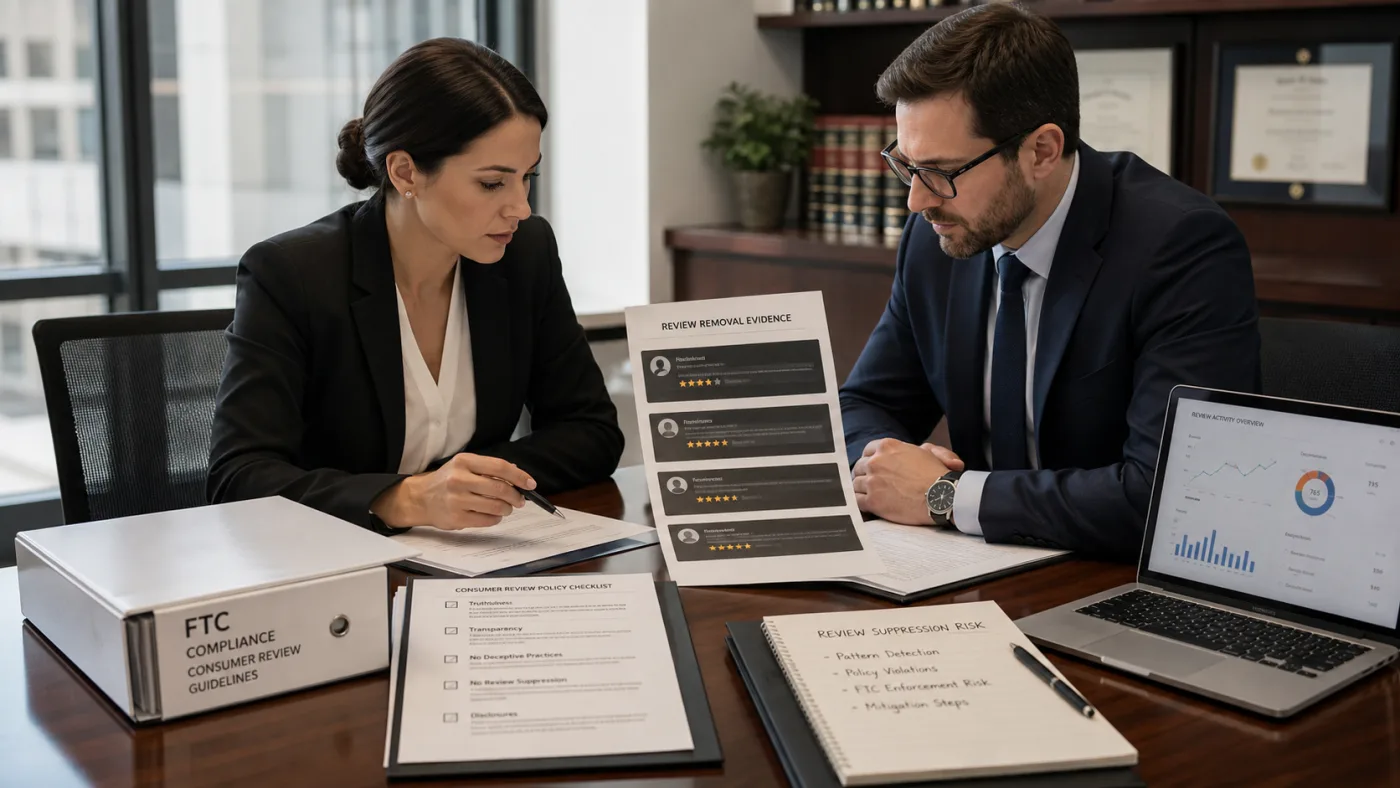
Google's policy is direct on this point. It does not allow reviews that are paid for directly or in kind, and it also prohibits incentives in exchange for posting, revising, or removing a negative review. It warns merchants not to discourage or prohibit negative reviews and not to selectively solicit positive reviews. The FTC's Consumer Reviews and Testimonials Rule Q&A adds a federal consumer-protection layer for deceptive or unfair review practices. A removal service should help the business avoid those traps, not operationalize them.
Monitoring Is Useful Only If It Creates Evidence
Technology can help. Multi-location businesses, restaurants, dental groups, hotels, home-service companies, legal practices, and clinics may receive reviews across many profiles and platforms. A monitoring tool can alert management when a review uses high-risk language, names staff, alleges crime, includes personal information, threatens harm, mentions discrimination, demands money, or appears in a sudden cluster. The value is speed and consistency. But monitoring by itself does not remove anything. It becomes useful when it produces a clean evidence trail.
The service should preserve status history: when the review was found, who reviewed it, which systems were checked, which policy category was selected, when the report was submitted, what Google decided, whether appeal was available, what public response was posted, and whether the reviewer edited the text. For a multi-location company, the file should identify the exact branch and staff involved without exposing confidential records publicly. For regulated businesses, the monitoring workflow should also flag privacy, health, employment, student, financial, or client-confidentiality risks before anyone replies.
- Monitor all Google Business Profiles and alert reviews with legal, privacy, safety, or policy language.
- Preserve URLs, screenshots, reviewer profiles, timestamps, images, owner replies, and visible edit history.
- Search customer records before saying the reviewer is fake, conflicted, or unknown.
- Map exact review wording to one Google policy category and one non-confidential evidence summary.
- Track Google status, appeal eligibility, public replies, reviewer edits, and follow-up decisions.
Automated Replies Need Human Guardrails
Automated review replies can help a busy business avoid silence. They can produce fast, polite first drafts, enforce consistent tone, and remind teams to move sensitive details into private channels. That is useful. But an automated reply can also create new exposure if it confirms a customer relationship, repeats private information, accuses the reviewer of fraud, contradicts the removal file, or promises a remedy the business has not approved. The more sensitive the review, the more human review is needed before publication.
Google's manage customer reviews guidance matters because owner replies are public and appear as the business. A service should therefore treat reply templates as legal-risk documents, not just marketing copy. A safe template thanks the reviewer, states that the business takes the matter seriously, avoids debating facts publicly, and invites private follow-up. A risky template says the reviewer is lying, reveals transaction details, threatens legal action, or discloses records to win the argument in public.
A good service should also align the reply with the report. If the business reports the review as non-genuine, the public reply should not describe the visit as remembered. If the report says the review exposes personal information, the reply should not repeat the information. If the review alleges discrimination, medical harm, fraud, theft, or criminal conduct, the reply should be screened carefully before it becomes a public company statement.
Appeals And Legal Escalation Require Better Facts
If Google rejects the first report, the service should not simply resubmit the same complaint. Google describes a status path that can include decision pending, no policy violation, and a one-time appeal. That appeal should be treated as a structured memo. It should identify the exact review, quote the exact policy-relevant text, explain the business-record search, add any new evidence, remove unsupported labels, and state why the policy category fits. A wasted appeal can close the most useful platform route.
Some negative reviews need legal review rather than another moderation attempt. Milkovich is useful because U.S. law recognizes that statements framed as opinion can still imply provably false facts, but not every harsh review is defamatory. 47 U.S.C. Section 230 also shapes expectations about platform-directed claims. It does not protect a reviewer who wrote a false statement, and it does not prevent Google from considering policy or legal-removal requests, but it limits attempts to treat the platform as the publisher of third-party content.
When a review includes serious false factual accusations, personal information, threats, extortion, impersonation, copyrighted material, or court-order issues, the Google Legal Help Center may become relevant. If the review is paired with a demand for money, goods, services, refunds, or silence, Google's negative review extortion guidance should also be considered. The service should preserve the evidence and escalate to counsel where appropriate instead of improvising legal threats inside the review thread.
How To Choose A Safer Review Removal Provider
Before hiring a provider, ask what happens before the first report is filed. A credible answer should mention evidence capture, policy classification, customer-record review, public-response control, appeal strategy, and compliance limits. Ask whether the provider guarantees removal. Ask whether it pays reviewers, buys reviews, asks staff to post praise, or uses review-gating. Ask who reviews sensitive replies before publication. Ask how confidential records are handled. Ask what happens if Google refuses removal. The provider's process matters more than its confidence.
For multi-location businesses, also ask how the provider handles scale. A central dashboard is helpful only if it protects local facts. A restaurant group, healthcare group, hotel portfolio, dental group, or home-service franchise may have different evidence at each branch. The service should not use a single generic response or report for every location. It should keep location-specific records, staff context, customer search history, and Google status separate enough that a later appeal, legal review, or regulator inquiry can understand what happened.
- Does the provider guarantee deletion, or does it describe evidence-based probability and limits?
- Does the intake require URLs, screenshots, profile data, business records, and policy mapping?
- Does the provider avoid incentives, fake positives, review-gating, and mass-flagging real criticism?
- Does a human review sensitive replies before publication?
- Does the provider preserve a file that counsel can use if the matter becomes legal?
Build The Profile While The Removal File Runs
A removal service should not make the business passive while Google reviews a report. The company should keep serving customers, answering legitimate feedback, fixing repeated operational issues, and asking real customers for honest reviews through a neutral process. A business with a thin review profile is fragile: one unfair review can dominate the impression. A business with steady, recent, authentic feedback is more resilient, and future readers can judge a single negative review in context.
The Consumer Review Fairness Act at 15 U.S.C. Section 45b is part of that discipline because it warns against contract terms that punish or restrict covered consumer reviews. A business can challenge fake, defamatory, unlawful, confidential, threatening, or policy-violating content. It should not use reputation management as a way to silence ordinary criticism. The safer approach is two-sided: challenge what is truly removable, and make the genuine customer experience strong enough that truthful reviews improve over time.

Sources Consulted
- Snapbad Google negative review removal service page.
- Google Business Profile Help: report inappropriate reviews.
- Google prohibited and restricted content policy.
- Google Business Profile Help: manage customer reviews.
- Google negative review extortion scam reporting guidance.
- FTC Consumer Reviews and Testimonials Rule Q&A.
- 15 U.S.C. Section 45b, Consumer Review Fairness Act.
- Milkovich v. Lorain Journal Co., 497 U.S. 1 (1990).
- 47 U.S.C. Section 230.
- Google Legal Help Center.
Practical Conclusion
A Google negative review removal service is valuable when it gives the business discipline: monitoring, preservation, policy classification, precise reporting, careful appeals, safe public replies, compliant review generation, and legal escalation where the facts justify it. It is risky when it sells certainty, uses suppression tactics, or treats all criticism as fake. For U.S. businesses, the safest question is not 'who can delete this review?' It is 'what evidence supports which route, and what should we avoid doing while the route runs?'
Pimlegal's approach is to structure the file before pressure takes over. The objective is to protect trust, avoid FTC and Google policy problems, preserve leverage, and decide whether the next step is a platform report, one-time appeal, public response, service recovery, legal notice, Google legal request, or local counsel referral. A serious removal service should make those choices clearer, not hide them behind a deletion promise.