
A lawyer-grade U.S. guide for businesses when a Google review targets staff, contains threats, doxxing, or intimidation, and requires a tighter evidence, policy, and public-response strategy. This United States guide addresses Google reviews in the USA that target staff, contain threats, doxxing, or intimidation from a lawyer-grade evidence and platform perspective. The goal is not to promise deletion. The goal is to help a business preserve a useful file, avoid avoidable public-response mistakes, and decide whether Google reporting, a legal notice, subpoena-readiness review, or local counsel escalation is proportionate.
The working scenario is this: a local business receives a one-star Google review naming a receptionist, posting part of a phone number, warning that 'people should show up and teach them a lesson,' and repeating pressure in off-platform messages after a refund dispute. A rushed reaction usually weakens the case. A business may reply publicly before it has searched records, accuse the wrong person, submit private documents to Google, or threaten litigation over language that is closer to opinion than fact. A stronger approach slows the dispute down just enough to classify the words, preserve the proof, and select the narrowest route that fits the evidence.
Legal Issue Framing
In U.S. review disputes, the business needs to distinguish offensive criticism and hyperbole from statements that may be false factual accusations, personal-information violations, targeted harassment, extortion pressure, or potentially actionable threats. Defamation law is mainly state law, so exact elements, privileges, damages rules, limitation periods, and anti-SLAPP exposure can vary. Still, a practical national screen is useful. Ask whether the review was published to third parties, whether it identifies the business or a person connected to it, whether the challenged words imply a fact capable of being proved true or false, whether that fact is false or materially misleading, and whether the publication caused reputational harm.
The Supreme Court references are important but should be used carefully. Milkovich is useful because a statement labeled as opinion can still imply an assertion of objective fact. New York Times v. Sullivan matters where public-official or public-figure standards are implicated, but many ordinary business review disputes involve private figures under state-law rules. The business should not overstate the constitutional point in a Google report. Google is not deciding a trial; it is deciding whether content violates platform policy.
Read this with the USA guide to Google reviews posting personal information and the United States Google review removal page. Those are the two contextual internal links used in this article: one related USA resource and one country-service page.
Evidence Checklist
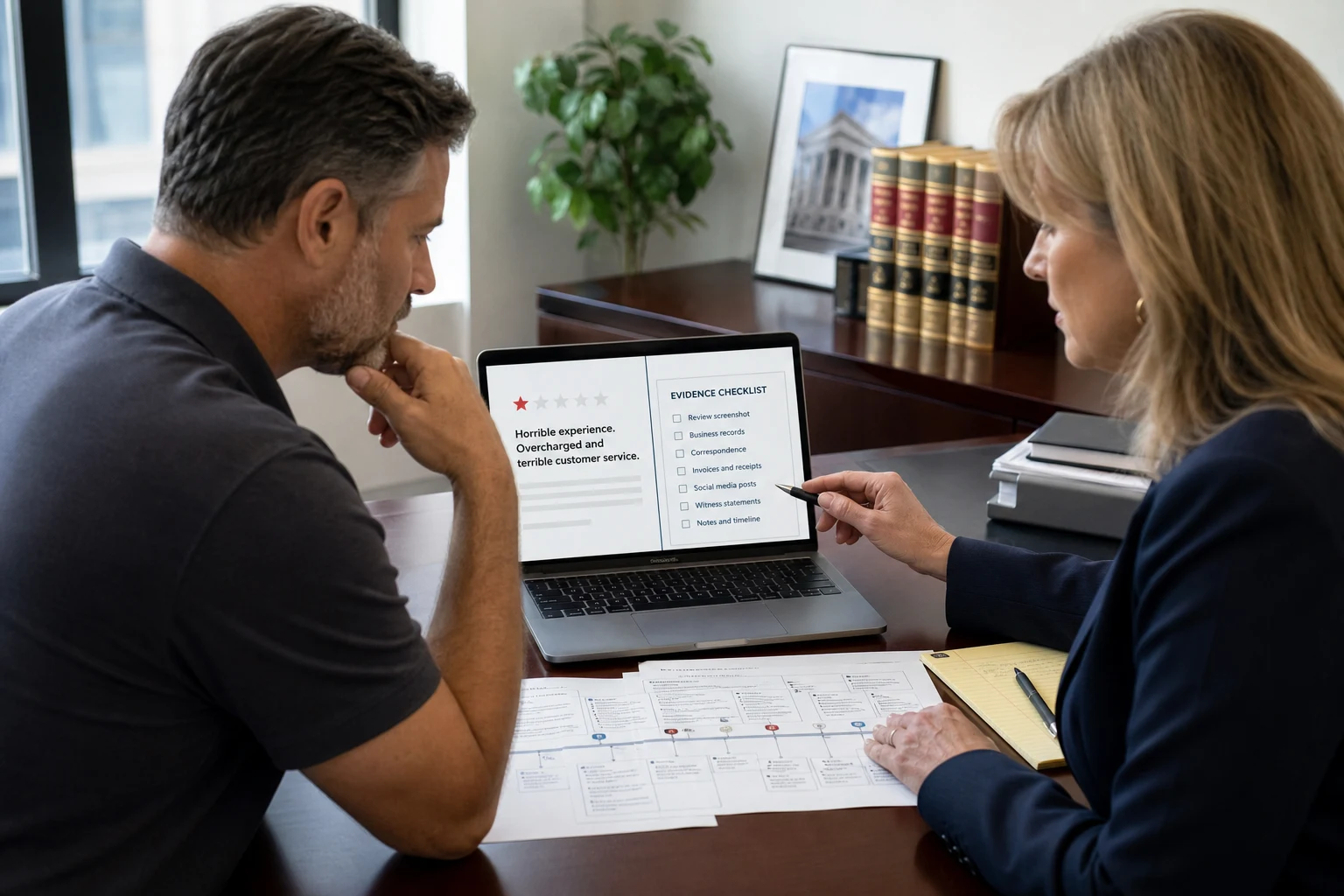
The evidence file should begin before anyone contacts the reviewer. Preserve the review URL, profile URL, display name, star rating, full text, photos, visible edit history, publication date, Google Business Profile context, local-search position if relevant, and screenshots from desktop and mobile where possible. Then compare the allegations with the exact review text, every visible edit, reviewer-profile captures, screenshots from desktop and mobile, booking or transaction records, staff incident notes, any off-platform emails or messages, internal safety reports, a timing chronology, and proof of reputational or operational harm. A no-match conclusion should identify which systems were searched, who searched them, when, and what limitations remain.
The strongest file is a sentence-by-sentence table. One column quotes the exact words. One column states what an ordinary reader may understand. One column classifies the phrase as opinion, hyperbole, insult, factual accusation, private information, threat, fake-engagement signal, or off-topic content. Other columns identify proof for and against, non-confidential evidence that can be shown to Google, private evidence reserved for counsel, response risk, and potential harm.
- Save the review, profile, URL, screenshots, star rating, images, publication date, edit evidence, and Business Profile context.
- Compare the challenged statements with the exact review text, every visible edit, reviewer-profile captures, screenshots from desktop and mobile, booking or transaction records, staff incident notes, any off-platform emails or messages, internal safety reports, a timing chronology, and proof of reputational or operational harm.
- Preserve negative checks: no booking found, no invoice found, no matching visit, no branch record, or a partial match with inaccurate allegations.
- Keep confidential records separate from the Google submission; summarize sensitive facts instead of uploading private customer, staff, payment, health, student, legal, or HR data.
- Document harm with contemporaneous proof such as prospect questions, canceled bookings, rating movement, sales impact, staff concern, partner concern, and report or appeal outcomes.
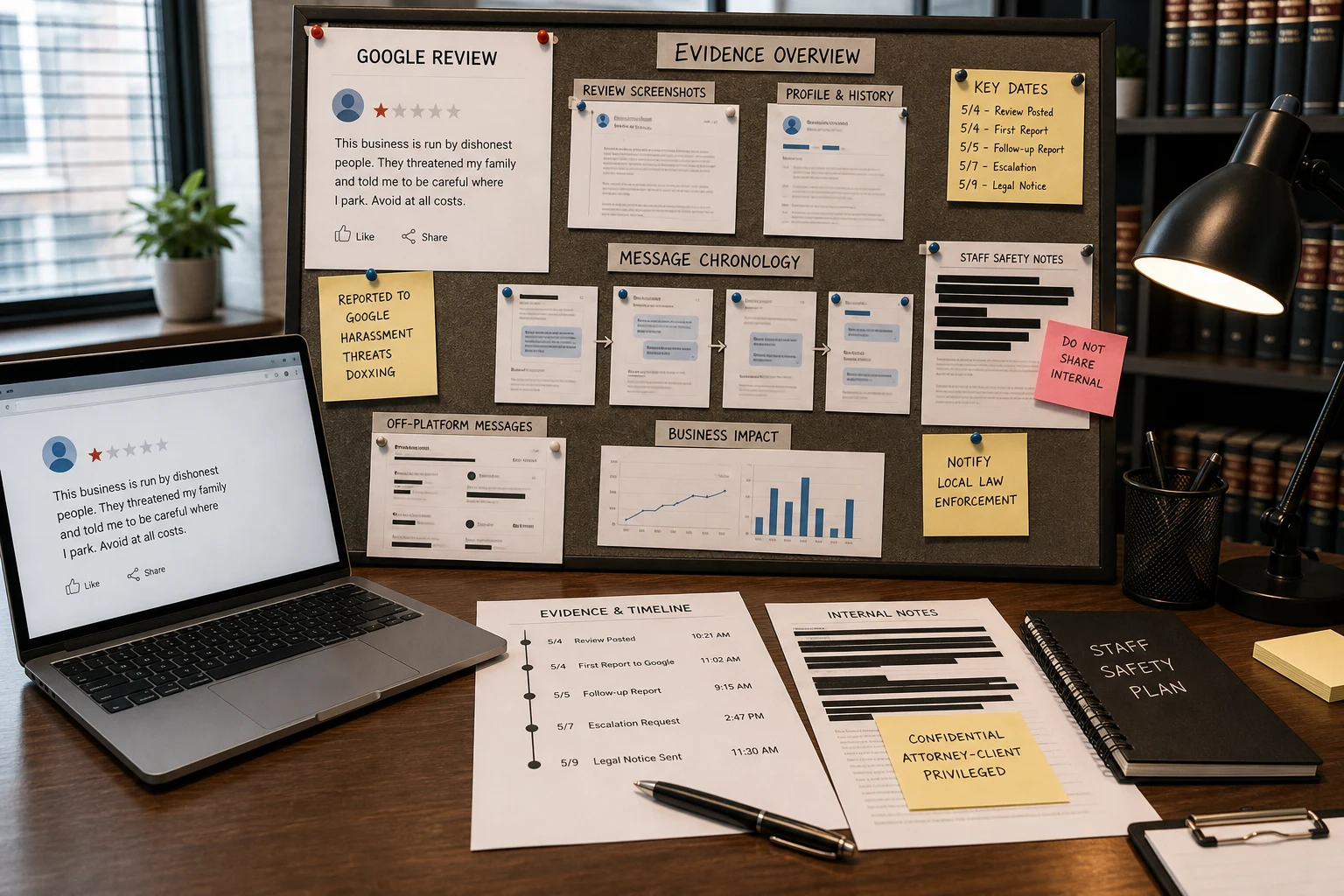
- Create one chronology that tracks first discovery, preservation, internal review, Google reports, appeals, notices, public responses, and any off-platform messages.
Platform-Policy Angle
Google's own review-reporting workflow should be used with a moderator-readable file. The submission should identify the exact review, the policy category, the non-confidential facts that support the category, and the requested action. For this topic, the likely policy angle may involve harassment, specific threats of harm, personal information, doxxing, fake engagement, and where money or concessions are demanded, Google's extortion reporting route. The important point is precision: a review may be legally troubling but still require a policy explanation before Google can act.
Google's prohibited and restricted content policy is the operational map. It covers categories such as fake engagement, misrepresentation, harassment, personal information, off-topic content, and conflicts of interest. A business should not ask Google to decide every state-law issue. It should explain why the review fails Google's own rules and support that explanation with a concise chronology. If the problem includes review extortion, use Google's dedicated extortion route as well as the ordinary review-reporting route where the facts fit.
The business must also avoid becoming the policy problem. The FTC Consumer Reviews and Testimonials Rule Q&A states that the federal rule went into effect on October 21, 2024 and addresses deceptive or unfair conduct involving consumer reviews and testimonials. A harmed business should not buy counter-reviews, pressure customers to edit truthful criticism, create insider reviews without proper controls, review-gate only happy customers, or make groundless public accusations to suppress a lawful review.
Threats, Harassment, And The First Amendment Line
Google's current prohibited and restricted content policy is unusually useful for this topic because it expressly addresses harassment, specific threats of harm, doxxing, and personal information. That means the first platform question is not whether management can already prove a complete defamation case. The first platform question is whether the review text itself, or the combination of review text and related conduct, fits one or more moderation categories Google already recognizes. A report framed only as defamation may be slower or less legible to a moderator than a report that isolates the threat language, the staff-targeting language, the personal-information issue, and the chronology.
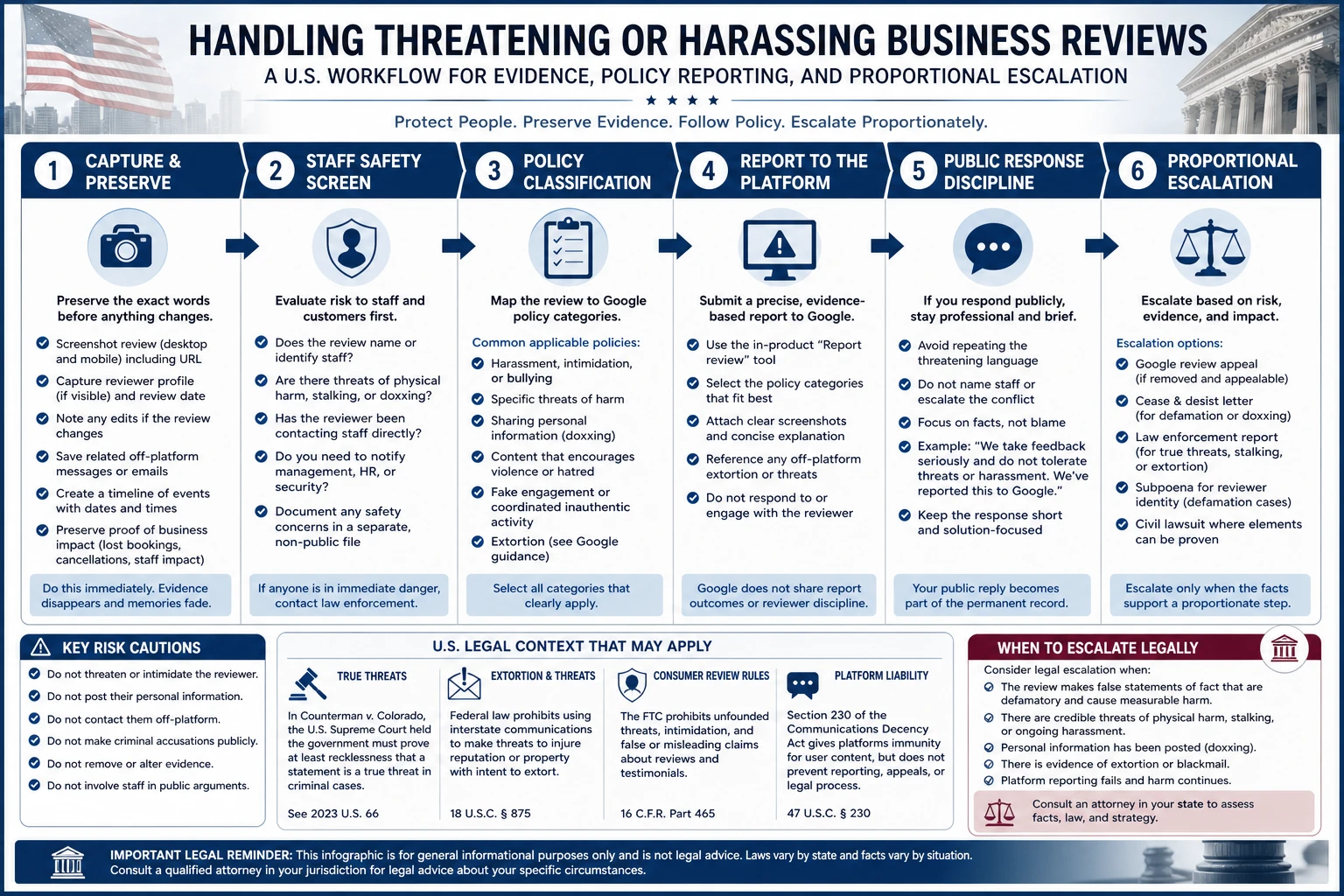
On the legal side, businesses should stay precise. In Counterman v. Colorado, the Supreme Court said that, for criminal true-threat prosecutions, the State must prove at least recklessness with respect to whether the communication would be viewed as threatening violence. That does not mean every frightening Google review is a criminal case, and it does not mean Google waits for a court before acting on threatening content. It does mean a business should preserve the exact words, screenshots, edits, and surrounding messages before calling the post a crime. Counsel may later decide the matter is abusive or policy-violating without meeting any criminal threshold at all.
If the threatening review is paired with demands for money, refunds, discounts, services, or silence, preserve that separate lane too. Google's current negative review extortion reporting guidance tells businesses not to engage, not to pay, and to report all relevant communications promptly. 18 U.S.C. Section 875 is also a useful U.S. reference because it addresses interstate communications containing threats to injure property or reputation, or threats to accuse someone of a crime, when sent with intent to extort money or another thing of value. The practical point is narrower than the statute: capture the message trail cleanly before anyone improvises a response.
Threats Against Staff Change The Response File
Threat-focused files also need a different internal discipline. A business should decide quickly who is responsible for preserving evidence, who screens the public response, who checks whether personal information should be redacted from internal circulation, and who documents any staff-safety concern. The FTC's current rule at 16 C.F.R. Part 465 is relevant here for a second reason: it prohibits unfounded legal threats, physical threats, intimidation, or knowingly false accusations used to suppress consumer reviews, while also recognizing that businesses may act where they reasonably believe content is harassing, abusive, clearly false, fake, or privacy-invasive. The clean lesson is to stay evidence-led. A business should challenge a threatening review firmly, but it should not answer abusive conduct with overbroad or unsupported counter-threats.
Public Response Strategy
The public response should be written for future readers, Google, and a later evidence file. It should usually be short, factual, and privacy-safe. The business can state that it takes the matter seriously, that available records are being reviewed, and that the reviewer can contact an official private channel. The response should not disclose the evidence package. The main risk here is repeating the threatening language publicly, naming staff again, accusing the reviewer of crimes too early, or disclosing internal safety steps in the owner response.
A public reply can become a screenshot in a later platform appeal, regulator complaint, media post, or lawsuit. Avoid calling the reviewer a criminal, extortionist, competitor, ex-employee, fake customer, or liar unless counsel has reviewed the evidence and the business accepts the risk. If the review contains private data, staff names, customer identifiers, health information, payment details, student information, legal-client facts, or HR allegations, the public response should be screened before publication.
Escalation Criteria
Escalation is not a single move. It may mean a stronger Google appeal, a legal-preservation letter, a narrow demand letter, private outreach, subpoena-readiness review, local counsel referral, law-enforcement consultation for true extortion facts, or a state-law defamation assessment. Escalation is most defensible when the accusation is specific, factual, serious, contradicted by objective records, causing measurable harm, and not adequately addressed by ordinary platform reporting.
Expectations about the platform should remain realistic. 47 U.S.C. Section 230 generally limits attempts to treat an interactive computer service as the publisher or speaker of third-party content. That does not protect the person who wrote a false review, and it does not stop the business from using Google's policy channels. It does mean that a legal strategy aimed directly at the platform needs careful analysis and usually should not be the first assumption.
- Escalate when the review makes a serious factual accusation such as fraud, theft, unsafe conduct, falsified records, discrimination, or professional misconduct.
- Escalate when the reviewer appears to be a non-customer, competitor, former staff member, supplier, transaction opponent, or part of a coordinated pattern.
- Escalate when there are threats, demands for value, personal information, images, harassment, or repeated publication across platforms.
- Escalate when Google rejects a first report because the submission lacked policy framing, chronology, or non-confidential evidence.
- Escalate when a public response would create privacy, employment, consumer-protection, confidentiality, or retaliation risk.
Risk Cautions
The Consumer Review Fairness Act, codified at 15 U.S.C. Section 45b, restricts certain form-contract provisions that prohibit, penalize, or transfer rights in honest consumer reviews. It does not protect fake, defamatory, harassing, confidential, or unlawful content, but it does warn businesses against overbroad anti-review tactics. A removal strategy should target false or policy-violating statements, not silence ordinary criticism.
The second caution is evidentiary discipline. Do not delete internal notes, alter customer records, post confidential documents, offer payment for deletion, send a template threat without reviewing state law, or submit a long emotional narrative to Google. A business should keep one clean file and separate what can be shown publicly, what can be summarized to Google, and what should remain with counsel.
Sources Consulted
- Google Business Profile Help: report inappropriate reviews.
- Google prohibited and restricted content policy.
- Counterman v. Colorado, true-threats decision.
- Milkovich v. Lorain Journal Co., 497 U.S. 1 (1990).
- New York Times v. Sullivan, actual-malice framework.
- 47 U.S.C. Section 230.
- FTC Consumer Reviews and Testimonials Rule Q&A.
- 15 U.S.C. Section 45b, Consumer Review Fairness Act.
- Google negative review extortion scam reporting guidance.
- 18 U.S.C. Section 875.
- 16 C.F.R. Part 465, FTC consumer reviews and testimonials rule.
Practical Conclusion
A threatening or harassing Google review in the United States is handled best by preserving the exact words early, separating staff-safety issues from the public thread, reporting the strongest Google policy categories precisely, and escalating only when the evidence supports a proportionate legal path.
Pimlegal's preliminary role is to organize the review evidence, frame the platform policy route, keep the public response proportionate, and identify when the matter should move to U.S. counsel for jurisdiction-specific legal advice. This article is general information only. It does not guarantee review removal, identify a final legal remedy, or replace state-specific counsel review.