
A U.S. legal guide to owner replies as evidence, admissions, settlement limits, preservation, Google policy, FTC risk, and safe drafting. This United States guide addresses whether a public Google Business Profile owner response can later be authenticated, attributed to the business, and used in a U.S. lawsuit, regulator file, platform appeal, employment dispute, insurance claim, or other evidentiary record from a lawyer-grade evidence and platform perspective. The goal is not to promise deletion. The goal is to help a business preserve a useful file, avoid avoidable public-response mistakes, and decide whether Google reporting, a legal notice, subpoena-readiness review, or local counsel escalation is proportionate.
The working scenario is this: a customer posts a one-star review accusing a business of overcharging, unsafe work, and falsified records. A branch manager replies from the verified Business Profile that the team 'made a billing mistake,' says the employee involved was disciplined, offers a refund if the review is removed, and calls the reviewer dishonest. Headquarters later learns that the investigation was incomplete, the reply was not approved, the reviewer edited the post after being notified, and screenshots of the exchange are circulating. A rushed reaction usually weakens the case. A business may reply publicly before it has searched records, accuse the wrong person, submit private documents to Google, or threaten litigation over language that is closer to opinion than fact. A stronger approach slows the dispute down just enough to classify the words, preserve the proof, and select the narrowest route that fits the evidence.

Legal Issue Framing
In U.S. review disputes, a public reply is not automatically conclusive proof, but it can be a written statement with evidentiary consequences. Federal Rule of Evidence 801(d)(2) addresses statements made, adopted, authorized, or made by an employee or agent within the scope of the relationship and offered against an opposing party. Authentication, authority, context, relevance, state evidence law, privileges, and the purpose for which the reply is offered still matter. Calling a public comment 'without prejudice' does not automatically turn it into protected settlement negotiations. Defamation law is mainly state law, so exact elements, privileges, damages rules, limitation periods, and anti-SLAPP exposure can vary. Still, a practical national screen is useful. Ask whether the review was published to third parties, whether it identifies the business or a person connected to it, whether the challenged words imply a fact capable of being proved true or false, whether that fact is false or materially misleading, and whether the publication caused reputational harm.
The Supreme Court references are important but should be used carefully. Milkovich is useful because a statement labeled as opinion can still imply an assertion of objective fact. New York Times v. Sullivan matters where public-official or public-figure standards are implicated, but many ordinary business review disputes involve private figures under state-law rules. The business should not overstate the constitutional point in a Google report. Google is not deciding a trial; it is deciding whether content violates platform policy.
Use this evidence analysis with the USA guide to public responses to negative Google reviews, while the United States Google review removal page explains the broader country-specific service and platform strategy.
Evidence Checklist
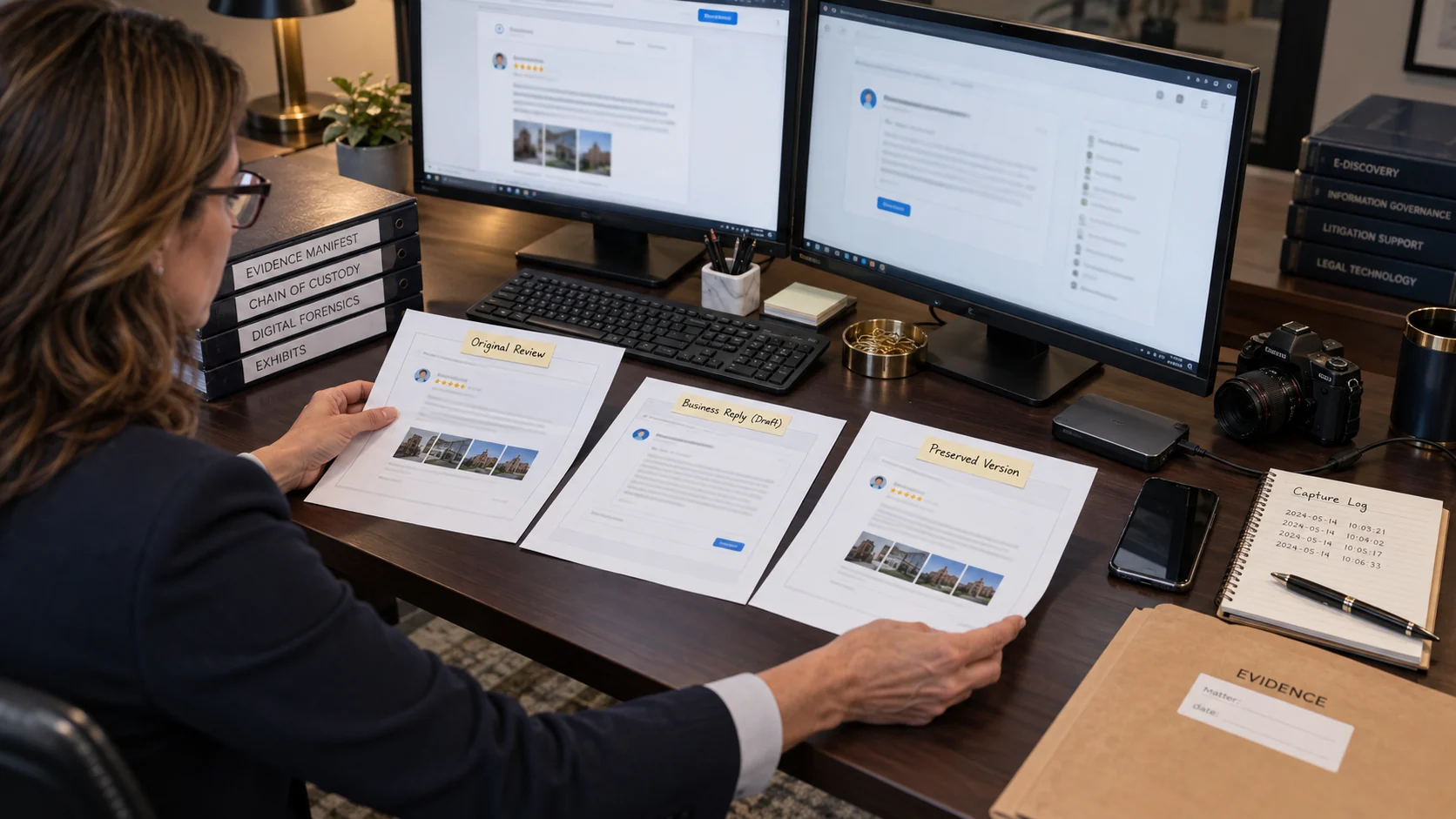
The evidence file should begin before anyone contacts the reviewer. Preserve the review URL, profile URL, display name, star rating, full text, photos, visible edit history, publication date, Google Business Profile context, local-search position if relevant, and screenshots from desktop and mobile where possible. Then compare the allegations with the original review and every visible version, the owner reply and every draft, publication and edit timestamps, direct review and profile URLs, Business Profile access and role records, approval policies, who typed and approved the response, internal messages, customer and incident records, refund or settlement communications, Google notifications, report and appeal IDs, preserved screenshots or exports, subsequent corrections, and a chronology separating public publication from private negotiation. A no-match conclusion should identify which systems were searched, who searched them, when, and what limitations remain.
The strongest file is a sentence-by-sentence table. One column quotes the exact words. One column states what an ordinary reader may understand. One column classifies the phrase as opinion, hyperbole, insult, factual accusation, private information, threat, fake-engagement signal, or off-topic content. Other columns identify proof for and against, non-confidential evidence that can be shown to Google, private evidence reserved for counsel, response risk, and potential harm.
- Save the review, profile, URL, screenshots, star rating, images, publication date, edit evidence, and Business Profile context.
- Compare the challenged statements with the original review and every visible version, the owner reply and every draft, publication and edit timestamps, direct review and profile URLs, Business Profile access and role records, approval policies, who typed and approved the response, internal messages, customer and incident records, refund or settlement communications, Google notifications, report and appeal IDs, preserved screenshots or exports, subsequent corrections, and a chronology separating public publication from private negotiation.
- Preserve negative checks: no booking found, no invoice found, no matching visit, no branch record, or a partial match with inaccurate allegations.
- Keep confidential records separate from the Google submission; summarize sensitive facts instead of uploading private customer, staff, payment, health, student, legal, or HR data.
- Document harm with contemporaneous proof such as prospect questions, canceled bookings, rating movement, sales impact, staff concern, partner concern, and report or appeal outcomes.
- Create one chronology that tracks first discovery, preservation, internal review, Google reports, appeals, notices, public responses, and any off-platform messages.
Platform-Policy Angle
Google's own review-reporting workflow should be used with a moderator-readable file. The submission should identify the exact review, the policy category, the non-confidential facts that support the category, and the requested action. For this topic, the likely policy angle may involve the policy status of the underlying review, the public nature of the owner reply, privacy and personal-information limits, harassment or false-accusation risk, misrepresentation, fake engagement, and a separate evidence-led report or appeal. The reply should not try to litigate facts that belong in the platform package or counsel file. The important point is precision: a review may be legally troubling but still require a policy explanation before Google can act.
Google's prohibited and restricted content policy is the operational map. It covers categories such as fake engagement, misrepresentation, harassment, personal information, off-topic content, and conflicts of interest. A business should not ask Google to decide every state-law issue. It should explain why the review fails Google's own rules and support that explanation with a concise chronology. If the problem includes review extortion, use Google's dedicated extortion route as well as the ordinary review-reporting route where the facts fit.
The business must also avoid becoming the policy problem. The FTC Consumer Reviews and Testimonials Rule Q&A states that the federal rule went into effect on October 21, 2024 and addresses deceptive or unfair conduct involving consumer reviews and testimonials. A harmed business should not buy counter-reviews, pressure customers to edit truthful criticism, create insider reviews without proper controls, review-gate only happy customers, or make groundless public accusations to suppress a lawful review.
A Public Owner Reply Can Become An Opposing-Party Statement
The federal starting point is Federal Rule of Evidence 801(d)(2). When a statement is offered against an opposing party, the rule identifies several routes that can take it outside the hearsay definition: a statement made by the party in an individual or representative capacity, one the party adopted or believed true, one made by a person authorized to speak on the subject, or one made by an employee or agent on a matter within the scope of that relationship while it existed. A verified Business Profile reply can therefore matter even though it was written quickly, outside court, and without an affidavit.
That does not mean every owner reply is automatically admissible, accurate, binding for every purpose, or a formal judicial admission. The proponent still may need to authenticate the page, connect the reply to the account and speaker, show relevance, overcome other objections, and explain the purpose for which the statement is offered. The business may contest authorship, authority, completeness, interpretation, or whether the reply was based on incomplete information. Those are reasons to control the publication process before posting, not reasons to assume the comment disappears from the evidence landscape.
The practical risk is broader than a defamation lawsuit. A customer may attach the reply to a regulator complaint, chargeback, discrimination claim, professional-board filing, insurance notice, wage dispute, accessibility complaint, media inquiry, or Google appeal. A statement that seems harmless in a marketing review queue can become the company's clearest timestamped account of what it believed, who it blamed, what remedy it offered, and whether management had investigated.
Identify The Speaker, Authority, And Approval Path
A business should know exactly who can reply from each location and what that person is authorized to say. Business Profile access is not the same as legal authority to admit a billing error, promise a refund, describe discipline, waive a defense, acknowledge a safety defect, or accuse a reviewer of misconduct. Build a role matrix for owners, managers, agencies, reception teams, franchisees, contractors, and corporate communications. The matrix should state who can draft, who must verify facts, who approves sensitive categories, and who can press publish.
Rule 801(d)(2) makes this operationally important because attribution can turn on adoption, authorization, and the scope of an employment or agency relationship. The rule also says that a statement alone does not establish the speaker's authority or the existence or scope of the relationship. Preserve corroborating account records, job responsibilities, agency agreements, approval messages, and audit logs. Do not create a misleading after-the-fact story that a manager was unauthorized if the business routinely allowed that manager to speak for the profile.
- Record the legal entity, brand, branch, franchise, and Business Profile associated with the reply.
- Export or screenshot profile-user roles and access history where available, then preserve the business policy in force on the publication date.
- Retain the draft, factual source notes, approvals, edits, publisher identity, publication time, and any later correction request.
- Separate customer-service authority from authority to make legal, employment, safety, privacy, settlement, or insurance statements.
- Require counsel or designated leadership review when the draft admits serious conduct, identifies a person, threatens action, or offers value connected to removal.
A Public Reply Is Not Automatically A Protected Settlement Communication
Federal Rule of Evidence 408 excludes specified compromise offers and statements made during compromise negotiations when offered to prove or disprove the validity or amount of a disputed claim or to impeach by contradiction. The rule requires a real disputed claim and has purpose-based limits and exceptions. An ordinary public response written for prospective customers is not automatically a compromise negotiation merely because it apologizes, offers contact, mentions a refund, or includes the words 'without prejudice.' A label is not a substitute for the rule's conditions.
Keep public communications and private resolution communications in different channels. The public reply should serve readers: acknowledge concern without confirming confidential facts, invite contact through an official channel, and avoid bargaining in public. If a genuine disputed claim moves into settlement discussion, management should use a controlled private process and counsel should evaluate the governing federal or state rule. Combining a refund offer, deletion demand, factual admission, and public accusation in one owner reply creates ambiguity that a disclaimer will not reliably cure.
Rule 408 is also not a secrecy rule. It does not guarantee that the communication can never be discovered, mentioned, or used for another permissible purpose. State evidence rules and substantive laws may differ. The safe operational lesson is not to write more aggressively behind a settlement heading. It is to state only verified and necessary facts, preserve the file, and obtain forum-specific advice when a real claim is disputed.
Corrections And Remedial Measures Need Preservation, Not Paralysis
Businesses sometimes leave an inaccurate reply online because they fear that correction will look like an admission. Federal Rule of Evidence 407 limits the use of subsequent remedial measures to prove negligence, culpable conduct, a product defect, or a need for a warning or instruction, but it permits use for other purposes in appropriate circumstances. Its fit to an edited owner response depends on the claim and purpose. The rule is not a universal shield for apologies, policy changes, refunds, deletions, or rewritten online statements.
Do not let evidence anxiety prevent a necessary safety, privacy, or accuracy correction. First preserve the original reply, surrounding review, timestamps, reason for change, approving person, and corrected text. Then make the narrow correction the situation requires. Do not silently rewrite a material admission and later claim the first version never existed. A candid version record is usually more defensible than a gap suggesting that the company altered a public account after learning of a dispute.
Relevance does not end the admissibility analysis. Rule 403 permits exclusion when probative value is substantially outweighed by dangers such as unfair prejudice, confusion, misleading the jury, delay, or needless cumulative proof. That balancing is for a court, not a social-media manager. The business should preserve clean context so counsel can argue fairly about what the reply proves and what it does not.
Preserve The Whole Thread, Not A Convenient Screenshot
A cropped screenshot can omit the reviewer identity, star rating, publication date, edit marker, location, prior language, owner attribution, or later reply. Federal Rule of Evidence 106 allows an adverse party to require another part of a writing or recorded statement that fairness requires to be considered at the same time. A business should therefore preserve the full exchange and every material version rather than planning to rely on one favorable sentence.
Authentication is a separate foundation issue. Under Rule 901, the proponent needs evidence sufficient to support a finding that the item is what the proponent claims. Useful foundations can include testimony from a knowledgeable collector, distinctive characteristics, and evidence about an accurate process or system. Rule 1001 recognizes sight-readable outputs that accurately reflect electronically stored information, while Rule 1003 generally permits a duplicate unless authenticity is genuinely disputed or admission would be unfair. None of these rules makes an unexplained crop self-proving.
- Capture the direct review URL, reviewer profile URL, full review, rating, images, location, owner reply, edit labels, and page context before posting or changing anything.
- Record collector, date, time, time zone, device, browser, sign-in state, filename, byte size, and a cryptographic hash for each preserved original.
- Keep the original capture read-only; create separately labeled working, redacted, annotated, and platform-upload copies.
- Preserve Google notifications showing that the reviewer was notified, plus any later review or response changes and the dates they appeared.
- Retain Business Profile access evidence and internal approval records capable of connecting the visible reply to the business and speaker.
- Document limitations honestly: a screenshot can show visible content without proving who controlled an account, why a statement was made, or whether it was true.
Use Three Separate Files Before Publishing
The public-response file is the smallest. It contains the approved text, factual verifier, privacy review, authority check, publication record, and monitoring plan. The Google-policy file contains the exact challenged review, direct URLs, best-fitting policy category, concise chronology, report IDs, appeal status, and non-confidential exhibits. The counsel file contains the full evidence set, contradictory records, sensitive documents, harm analysis, speaker attribution, legal deadlines, preservation questions, and weaknesses. Mixing these files is how private facts reach a public reply or a platform submission becomes an argumentative legal brief.
The three files should remain consistent without being identical. If the public reply says there is no record of any interaction, the counsel file should show which systems were searched and their limits. If the Google appeal says the review is from a non-customer, the business should not privately possess an obvious transaction match and ignore it. If facts remain uncertain, use conditional, neutral language instead of manufacturing certainty.
Google's current manage customer reviews guidance says owner replies are publicly posted after review, the reviewer is notified, and the reviewer can change the review after reading the response. That makes pre-publication preservation and post-publication monitoring part of one workflow. A reply can improve confidence for future readers, but it can also prompt a new version that changes the evidence and platform analysis.
FTC Review-Suppression Risk Applies To What The Business Says
The FTC's current Consumer Reviews and Testimonials Rule Q&A explains that a business may respond publicly to a negative review but should watch what it says. Under the review-suppression provision in 16 C.F.R. Section 465.7, a public false accusation made in response to a consumer review, with knowledge of falsity or reckless disregard, can create risk when used to prevent or remove the review. Unfounded or groundless legal threats, physical threats, and intimidation are separately addressed. Calling a customer a liar, extortionist, criminal, competitor, or fake profile is not a safe pressure tactic simply because the accusation appears in the owner's side of the thread.
A legitimate public correction remains possible. The business can state a verified policy, explain that it is reviewing the concern, invite private contact, or say that available records have not yet confirmed the described interaction. The key is evidentiary support and proportionality. Management should not turn uncertainty into a categorical accusation, condition ordinary remedies on deletion, or recruit employees and customers to counterattack the reviewer.
The platform report should also remain evidence-led. Google policy addresses non-genuine experiences, fake engagement, conflicts, harassment, personal information, and misleading content, among other categories. A calm owner reply does not waive the right to report policy-violating content, and a strong policy report does not justify an aggressive public accusation. Run the tracks in parallel with consistent facts and different disclosure levels.
A Lawyer-Style Pre-Publication Checklist
- Preservation: Have the original review, profile, URL, rating, media, timestamps, edit status, and pre-reply page been captured?
- Identity: Do records support who the reviewer is, or is the business only inferring identity from a display name or disputed facts?
- Verification: Has a named person checked every factual sentence against the relevant transaction, safety, billing, HR, privacy, or service records?
- Authority: Is the publisher authorized to speak for the correct entity and location on this subject, and is required approval documented?
- Admissions: Does the draft unnecessarily concede fault, knowledge, causation, agency, discipline, damages, a refund obligation, or another contested fact?
- Privacy: Does it reveal or confirm customer, patient, client, student, employee, payment, health, disability, legal, or security information?
- Pressure: Does it threaten, shame, bargain for deletion, offer value for removal, or make an accusation the business cannot substantiate?
- Consistency: Does it conflict with the Google report, internal investigation, insurer notice, regulator response, demand letter, or prior public statement?
- Tone and length: Can future readers understand the response without seeing confidential proof, and can the draft be shortened without losing accuracy?
- Monitoring: Who will preserve publication, watch for edits, record notifications, and escalate new allegations or threats?
Escalation Criteria For High-Risk Replies
Escalate before publication when the review alleges fraud, crime, discrimination, unsafe conduct, professional misconduct, privacy violations, wage theft, unlicensed practice, falsified records, or another serious fact; when the draft would admit or deny those facts categorically; when litigation, a regulator filing, an insurance claim, or a preservation duty is reasonably foreseeable; or when management wants to name, threaten, or accuse the reviewer. The reply should also pause when the only rebuttal depends on confidential records that cannot safely be summarized in public.
Counsel review is particularly useful when branch and parent entities may have different roles, a franchisee or agency controls the profile, the responder's authority is uncertain, an earlier reply needs correction, a refund is being negotiated, or the company must coordinate with employment, health, education, financial, or professional-licensing rules. The objective is not to turn every negative review into litigation. It is to prevent a short public comment from becoming the avoidable second dispute.
Public Response Strategy
The public response should be written for future readers, Google, and a later evidence file. It should usually be short, factual, and privacy-safe. The business can state that it takes the matter seriously, that available records are being reviewed, and that the reviewer can contact an official private channel. The response should not disclose the evidence package. The main risk here is publishing an unnecessary admission, adopting a manager's unsupported account, identifying a customer or employee, threatening a reviewer, making a knowingly false or reckless public accusation, conditioning a refund on deletion, editing or deleting the reply without preserving the original, or assuming that a disclaimer, apology label, or 'without prejudice' phrase prevents later use.
A public reply can become a screenshot in a later platform appeal, regulator complaint, media post, or lawsuit. Avoid calling the reviewer a criminal, extortionist, competitor, ex-employee, fake customer, or liar unless counsel has reviewed the evidence and the business accepts the risk. If the review contains private data, staff names, customer identifiers, health information, payment details, student information, legal-client facts, or HR allegations, the public response should be screened before publication.
Escalation Criteria
Escalation is not a single move. It may mean a stronger Google appeal, a legal-preservation letter, a narrow demand letter, private outreach, subpoena-readiness review, local counsel referral, law-enforcement consultation for true extortion facts, or a state-law defamation assessment. Escalation is most defensible when the accusation is specific, factual, serious, contradicted by objective records, causing measurable harm, and not adequately addressed by ordinary platform reporting.
Expectations about the platform should remain realistic. 47 U.S.C. Section 230 generally limits attempts to treat an interactive computer service as the publisher or speaker of third-party content. That does not protect the person who wrote a false review, and it does not stop the business from using Google's policy channels. It does mean that a legal strategy aimed directly at the platform needs careful analysis and usually should not be the first assumption.
- Escalate when the review makes a serious factual accusation such as fraud, theft, unsafe conduct, falsified records, discrimination, or professional misconduct.
- Escalate when the reviewer appears to be a non-customer, competitor, former staff member, supplier, transaction opponent, or part of a coordinated pattern.
- Escalate when there are threats, demands for value, personal information, images, harassment, or repeated publication across platforms.
- Escalate when Google rejects a first report because the submission lacked policy framing, chronology, or non-confidential evidence.
- Escalate when a public response would create privacy, employment, consumer-protection, confidentiality, or retaliation risk.
Risk Cautions
The Consumer Review Fairness Act, codified at 15 U.S.C. Section 45b, restricts certain form-contract provisions that prohibit, penalize, or transfer rights in honest consumer reviews. It does not protect fake, defamatory, harassing, confidential, or unlawful content, but it does warn businesses against overbroad anti-review tactics. A removal strategy should target false or policy-violating statements, not silence ordinary criticism.
The second caution is evidentiary discipline. Do not delete internal notes, alter customer records, post confidential documents, offer payment for deletion, send a template threat without reviewing state law, or submit a long emotional narrative to Google. A business should keep one clean file and separate what can be shown publicly, what can be summarized to Google, and what should remain with counsel.
Sources Consulted
- Google Business Profile Help: report inappropriate reviews.
- Google prohibited and restricted content policy.
- Milkovich v. Lorain Journal Co., 497 U.S. 1 (1990).
- New York Times v. Sullivan, actual-malice framework.
- 47 U.S.C. Section 230.
- FTC Consumer Reviews and Testimonials Rule Q&A.
- 15 U.S.C. Section 45b, Consumer Review Fairness Act.
- United States Courts: current Federal Rules of Evidence.
- Federal Rule of Evidence 801, including opposing-party statements.
- Federal Rule of Evidence 408, compromise offers and negotiations.
- Federal Rule of Evidence 407, subsequent remedial measures.
- Federal Rule of Evidence 106, completing a writing or recorded statement.
- Federal Rule of Evidence 403, prejudice, confusion, and cumulative evidence.
- Federal Rule of Evidence 901, authentication and identification.
- Federal Rule of Evidence 1001, writings, recordings, photographs, originals, and duplicates.
- Federal Rule of Evidence 1003, admissibility of duplicates.
- Google Business Profile Help: manage and reply to customer reviews.
- Google Legal Help: report content for legal reasons.
- 16 C.F.R. Section 465.7, review suppression.
Practical Conclusion
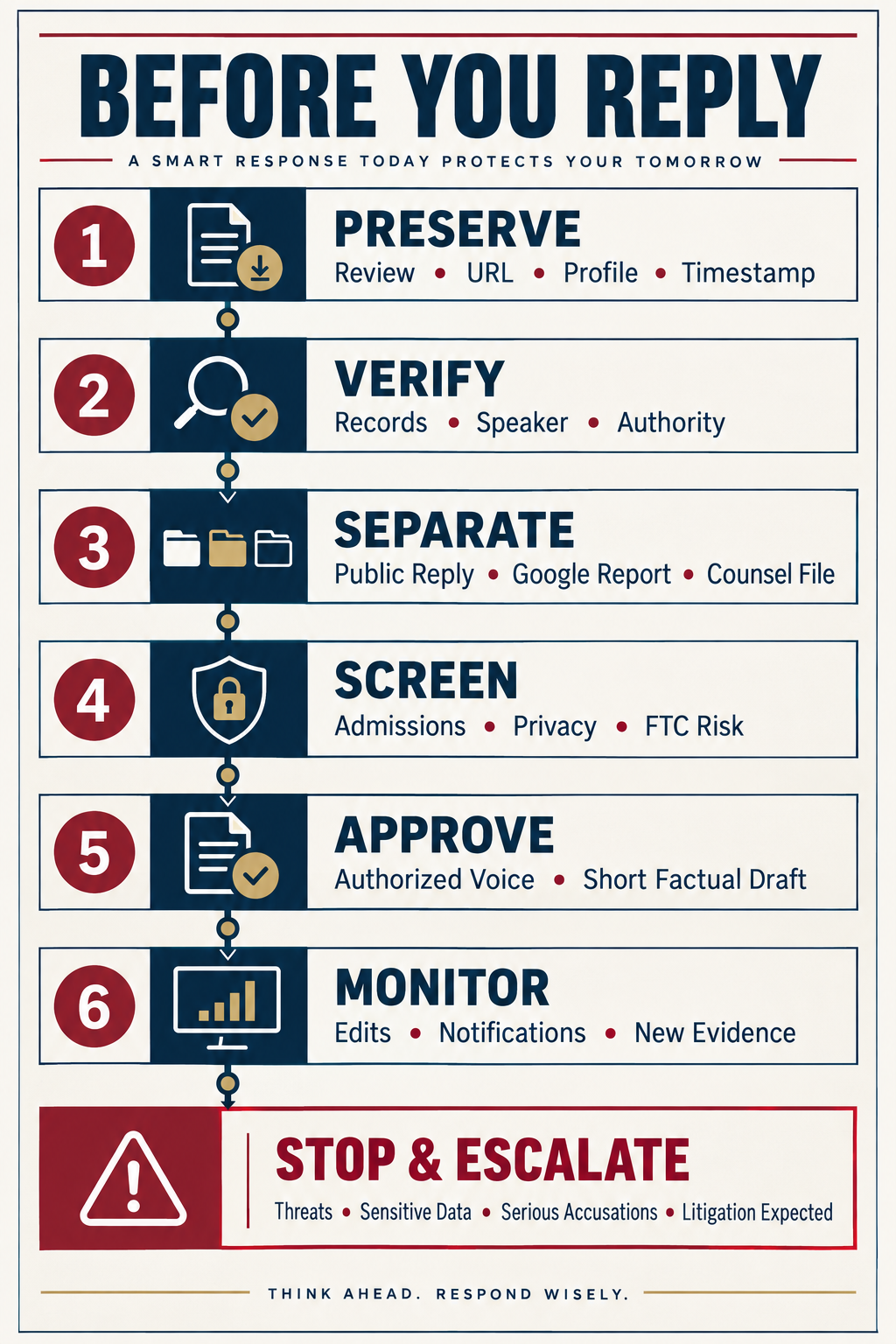
A U.S. business should treat every Google owner reply as a durable public statement, not an informal customer-service note. Preserve the review and draft first, verify facts and speaker authority, separate the public response from the Google report and any settlement communication, screen for admissions, privacy and FTC risk, approve a short factual version, and preserve later edits. The reply may be useful evidence, but admissibility and legal effect depend on the forum, purpose, foundation, and governing law; no drafting formula guarantees removal or litigation protection.
Pimlegal's preliminary role is to organize the review evidence, frame the platform policy route, keep the public response proportionate, and identify when the matter should move to U.S. counsel for jurisdiction-specific legal advice. This article is general information only. It does not guarantee review removal, identify a final legal remedy, or replace state-specific counsel review.