
A customer says your business took a deposit and disappeared. Your staff cannot find the order. Then the customer sends an advertisement carrying your name, linked to a website you do not operate. The customer may have suffered a real loss while attributing it to the wrong business. Treating that person as a dishonest reviewer can make the dispute worse and destroy an opportunity to identify the impersonator.
For a United States business, this problem calls for an identity investigation before a defamation demand. Trace the advertisement, the destination, the contact and the recipient of the payment. Use that record to explain what the Google review gets wrong, while dealing separately with the advertisement that created the confusion. The practical workflow below is an investigation framework, not a promise that Google or a court will remove content.

Recent development: the FTC's November 2026 imposter-ad alert
On November 2, 2026, the Federal Trade Commission published an alert about online imposter advertisements, inviting public input on possible measures addressing digital platforms. It identified advertisements impersonating businesses and government agencies across social feeds, search results and shopping platforms. The stated comment deadline is November 30, 2026.
The underlying October 1 Federal Register notice, 91 FR 62347, is an advance notice of proposed rulemaking, not a final rule. It asks whether platform practices that further impersonation scams warrant regulation. Advertiser screening, complaint handling and action against confirmed scam advertisements are among the possibilities under consideration. The notice does not establish a new Google-review removal deadline or decide that a particular platform is liable.
The connection to reputation management is practical: a misleading advertisement can generate a transaction complaint against the business whose identity was borrowed. That connection is our application of the development to review disputes; the alert is not a finding about any particular Google review. As of this article's November 29 research cutoff, the reviewed materials describe consultation rather than an adopted platform obligation. Businesses should document actual confusion now, without describing possible future rules as existing remedies.
Frame the issue: what happened, and who actually did it?
Separate three questions in the initial incident record. Did someone use the business's identity without authorization? Did the reviewer transact with that person or with your business? What does the review say that a reader would understand as being about your business? Each question needs its own evidence. An unauthorized advertisement does not prove that every later complaint is unrelated to your operations.
Start with your own sales channels. Check trading names, franchise locations, authorized booking agents, affiliate campaigns and outsourced call handling. A different domain or merchant descriptor may belong to an authorized intermediary. Ask the marketing team to reconcile the advertisement against active campaigns and agency instructions. Ask finance to check payment processors and trading entities, rather than searching only the customer's display name.
Record confidence explicitly. “No matching order located in the systems checked” is a defensible investigation result. “This person has never dealt with us” requires much more. A spouse may have ordered, a customer may use a nickname, or an appointment inquiry may have failed before any purchase. Keep a separate column for unresolved explanations so that a tentative internal conclusion does not become an inaccurate public accusation.
Existing U.S. law: impersonation and defamation are distinct
16 C.F.R. § 461.3 prohibits materially and falsely posing as a business or its officer, and materially misrepresenting affiliation, endorsement or sponsorship, in or affecting commerce. That existing impersonation rule addresses deceptive identity claims. Its presence does not turn an FTC report into a private removal order or make every mention of a business name unlawful.
A separate review may raise a state-law defamation issue. The core inquiry generally concerns a false factual statement, publication, the required fault and legally cognizable harm; state rules and constitutional protections affect the analysis. An honestly mistaken customer is not automatically immune, but a business still needs the applicable elements rather than simply proof that its rating fell. See Cornell's explanation of defamation and its jurisdictional limits.
Consider the difference between “I paid this company and it stole my deposit” and “I followed an ad using this name and lost my deposit; I cannot establish who received it.” Their attribution is different. Preserve the complete review, including photographs, later edits and the business's reply. Counsel should assess what the actual words communicate in context, rather than treating the label “scam” alone as decisive.
Where an advertiser uses a business identity commercially, counsel may also examine false affiliation or origin under 15 U.S.C. § 1125(a). That is a fact-specific commercial claim, not a shortcut for suppressing criticism. Rights, confusion, causation, standing and available relief require analysis. Keep the advertiser's conduct separate from the consumer's later account of being misled.
Evidence checklist: preserve the route from ad to review
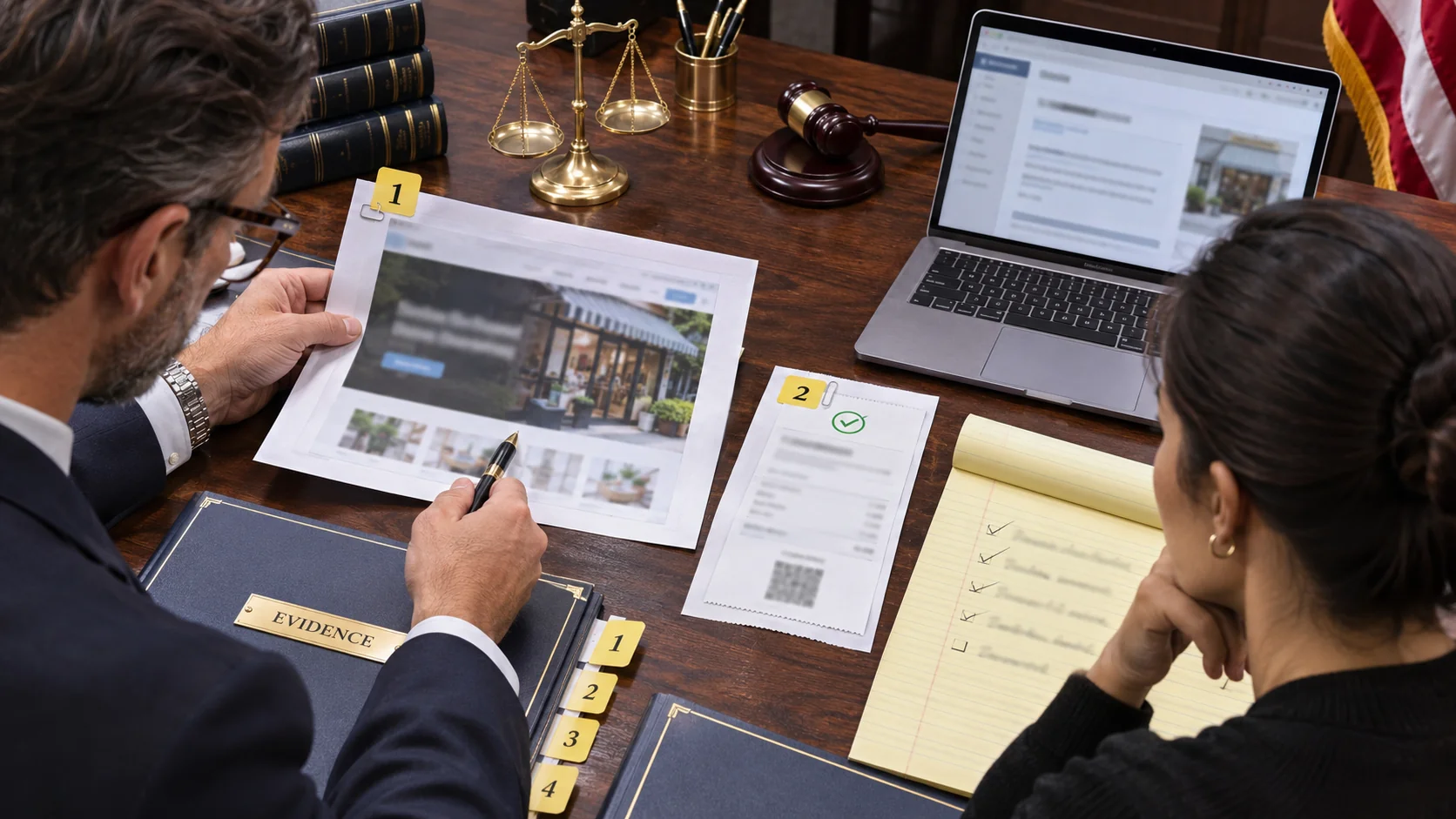
Build one chronological incident folder with originals and working copies. Give every item a capture date, source and collector. These are recommended investigation controls; they do not certify admissibility. If litigation is reasonably anticipated, ask counsel which records and routine deletion processes must be preserved. The USA guide to preserving Google-review evidence explains that broader preservation task.
- Advertisement: retain the full visible ad, its platform, advertiser information if shown, display URL, actual destination and any ad identifier. Include the surrounding result so a cropped screenshot does not obscure that it was paid advertising.
- Landing page: preserve the address, relevant branding, claimed affiliation, phone number, contact details and transaction instructions. Record redirects you can observe safely. Do not enter credentials, download suspicious files or make a payment to test the site.
- Customer contact: request the original confirmation message, date of contact, number called and order reference through a private channel. Ask for redacted documents; never request a password or full card details.
- Payment trail: identify the named recipient and merchant descriptor, transaction date and relevant receipt. Distinguish a customer's recollection from a document actually supplied. A descriptor alone may not identify the ultimate operator.
- Business records: retain authorized domains, trading names, agency contracts, campaign records and the scope of the customer-record search. Preserve evidence that cuts against the impersonation hypothesis too.
- Review and harm: save the review URL, text, rating, profile link, visible date and subsequent changes. Retain actual cancellation messages or inquiries connecting the accusation to business loss, rather than assuming every lost sale followed from it.
Build a short attribution table before reporting
Use four columns: what the customer saw, what your business actually uses, the supporting document, and what remains unresolved. For example, a customer called a number displayed in a sponsored result. Your authorized campaign uses another number, but your agency sometimes uses tracking numbers. The next step is obtaining the agency's number allocation, not asserting fraud from the mismatch.
Once the agency confirms the disputed number was never assigned to your campaign, combine that confirmation with the captured advertisement and the customer's receipt. State the finding narrowly: the identified advertisement and payment route were not authorized by this business. If you still cannot identify the operator, say so. Do not name a competitor because the design resembles its website or because two advertisements appeared together.
This table also helps identify genuine operational failures. If the payment went to your authorized booking partner, investigate the partner's service and your own representations. A misleading partner journey may require customer redress and corrective advertising. Attempting to remove the review before that investigation may leave both the underlying problem and the reputational harm unresolved.
Google's platform-policy angle
Google Maps' prohibited-content policies require contributions to reflect genuine experiences and prohibit content that misrepresents the relevant business or location. They also prohibit impersonation. Match the report to the conduct: a scammer's profile pretending to be your business and a customer's review mistakenly assigned to your listing are different complaints.
Do not describe a documented fraud victim as a fake account merely because the payment went elsewhere. Explain why the transaction described is not attributable to the business being reviewed. Attach the smallest sufficient set of redacted evidence, identify the exact review and specify the relevant policy. Google may still conclude that the post reflects an experience with your business; an unusual payment route does not settle that question.
The official review-reporting instructions explain the Reviews Management Tool and a one-time appeal for an eligible rejected report. Save the submitted explanation, attachments, case information and decision. If an appeal is available, address the reason the first submission failed and add relevant evidence. Repeating an unsupported allegation does not improve the record.
Run separate reports for separate objects
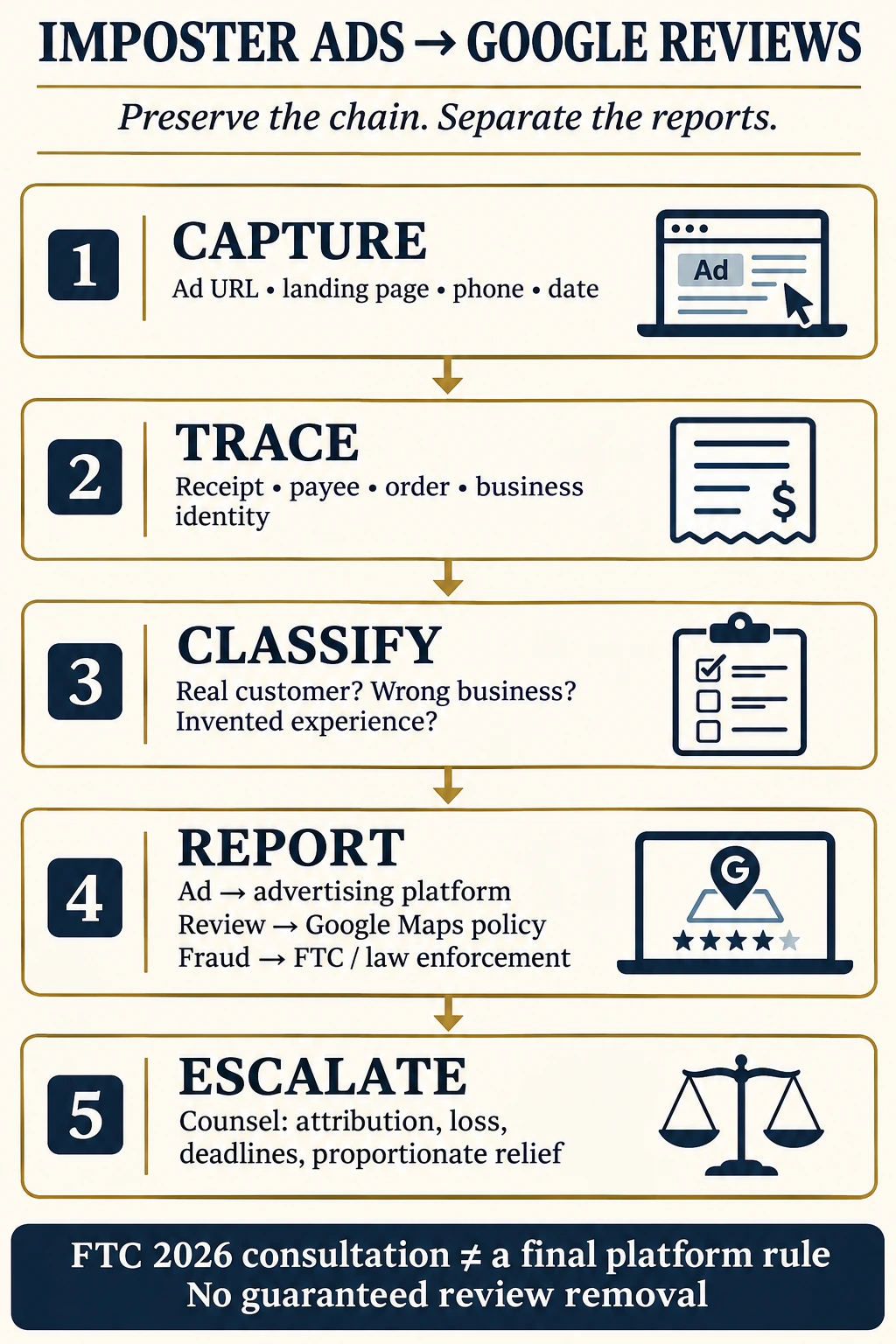
The advertising platform needs the advertisement and destination. The review team needs the review and its connection to the listed business. A fraud report needs the identity claims, transaction and loss. Organize these as separate submissions drawn from one evidence folder. A reference number for an ad report does not show that the review has been assessed, and removal of the ad does not establish what Google decided about a customer's post.
If the advertisement is still directing customers to an impersonator, designate a staff member to track that exposure as well as the review. Record each platform's response and the next follow-up date. A review can disappear while a replacement advertisement continues the same deception. Conversely, a platform can stop an advertisement while a historical review remains. Measure those outcomes independently.
An FTC consultation comment serves a different purpose again. It supplies information for a potential regulatory process; it is not an individual takedown application. The notice explains that comments enter a public record. Do not place customer receipts, account details or confidential business evidence in a public comment merely because those documents belong in a private incident file.
A public response that invites evidence without blaming the customer
If the facts remain uncertain, a suitable starting point is: “We are concerned by what you describe and would like to investigate. Please contact our business through the contact details on our official website with your booking reference and the website used. Please do not post payment details here.” Adapt this language to the business and the information it can safely receive.
Once the evidence supports impersonation, a more specific response could say: “The website shown in the documents you shared is not operated or authorized by our business. We have reported it to the relevant platform and can help clarify our official booking channels privately.” Use the sentence about reporting only after a report has actually been submitted. Do not claim that Google, the police or the FTC has confirmed your conclusion unless you possess a decision saying so.
Public responses should not expose the receipt, customer's contact details or disputed operator's personal information. Keep any broader consumer warning factual and based on verified identifiers. A legitimate apology for the confusion does not require admitting that your business received the payment. Have one authorized person approve replies so that staff do not publish inconsistent explanations while the investigation develops.
Escalation criteria and risk cautions
Seek U.S. counsel promptly when impersonation is ongoing, several independently documented customers are affected, sensitive data may be involved, losses are material, or the operator's identity cannot be established without legal process. Provide the attribution table, original records and a timeline. Ask counsel to identify jurisdiction, limitation periods, preservation needs, likely defendants and a proportionate remedy before sending threats.
For any proposed claim against the reviewer, ask specifically about truth, opinion, privileges, the required fault and applicable anti-SLAPP procedures or fee exposure. For a proposed claim against a platform, ask which conduct is alleged and which defenses apply. The FTC's regulatory position is not a court judgment resolving your dispute. A support rejection does not establish liability, and a regulator's acknowledgment does not establish that a prosecution or civil action will follow.
Avoid paying for review deletion, arranging replacement positive reviews or offering a benefit conditioned on editing a review. Google's policy prohibits incentives for reviews and their revision or removal. Deal with any genuine refund or service obligation on its merits. Do not disguise a review bargain as compensation for inconvenience.
Keep your own conduct credible. Preserve the original advertisement before seeking its removal, maintain the customer's original account alongside later corrections, and distinguish documented losses from estimates. Do not imply that an unknown advertiser is connected to a known competitor without evidence. The strongest incident file is one a reviewer, platform analyst or lawyer can understand without accepting your assumptions.
Practical conclusion
When an imposter advertisement leads to a Google complaint, start with attribution. Establish what the customer encountered, where the money went and whether the route was authorized. Then make precise, separate reports, respond without blaming a possible fraud victim and obtain legal advice when the evidence justifies escalation. PimLegal's United States Google review removal service page provides the country-level framework for assessing a potential review-removal request.
This article provides general information, not legal advice or an attorney-client relationship. U.S. law varies by jurisdiction and facts. Platform decisions and legal outcomes are not guaranteed. The photographs are AI-generated illustrative scenes, not images of an actual incident or client.