
A U.S. guide to incentivized Google reviews, FTC disclosure and sentiment rules, Google fake-engagement policy, evidence, reporting, and legal risk. This United States guide addresses how U.S. businesses should distinguish federal review-law exposure from Google's stricter ban on incentivized Maps reviews, while preserving proof and choosing a credible reporting or compliance route from a lawyer-grade evidence and platform perspective. The goal is not to promise deletion. The goal is to help a business preserve a useful file, avoid avoidable public-response mistakes, and decide whether Google reporting, a legal notice, subpoena-readiness review, or local counsel escalation is proportionate.
The working scenario is this: a business discovers that a competitor, agency, former contractor, or review broker may have offered cash, discounts, free services, loyalty points, contest entries, or another benefit tied to Google reviews. In a second common scenario, the business itself is accused of buying favorable reviews after a promotion, referral campaign, or customer-recovery offer. Management needs to know what the FTC rule actually prohibits, what disclosure can and cannot cure, why Google policy is stricter, and how to respond without destroying evidence or creating a new compliance problem. A rushed reaction usually weakens the case. A business may reply publicly before it has searched records, accuse the wrong person, submit private documents to Google, or threaten litigation over language that is closer to opinion than fact. A stronger approach slows the dispute down just enough to classify the words, preserve the proof, and select the narrowest route that fits the evidence.
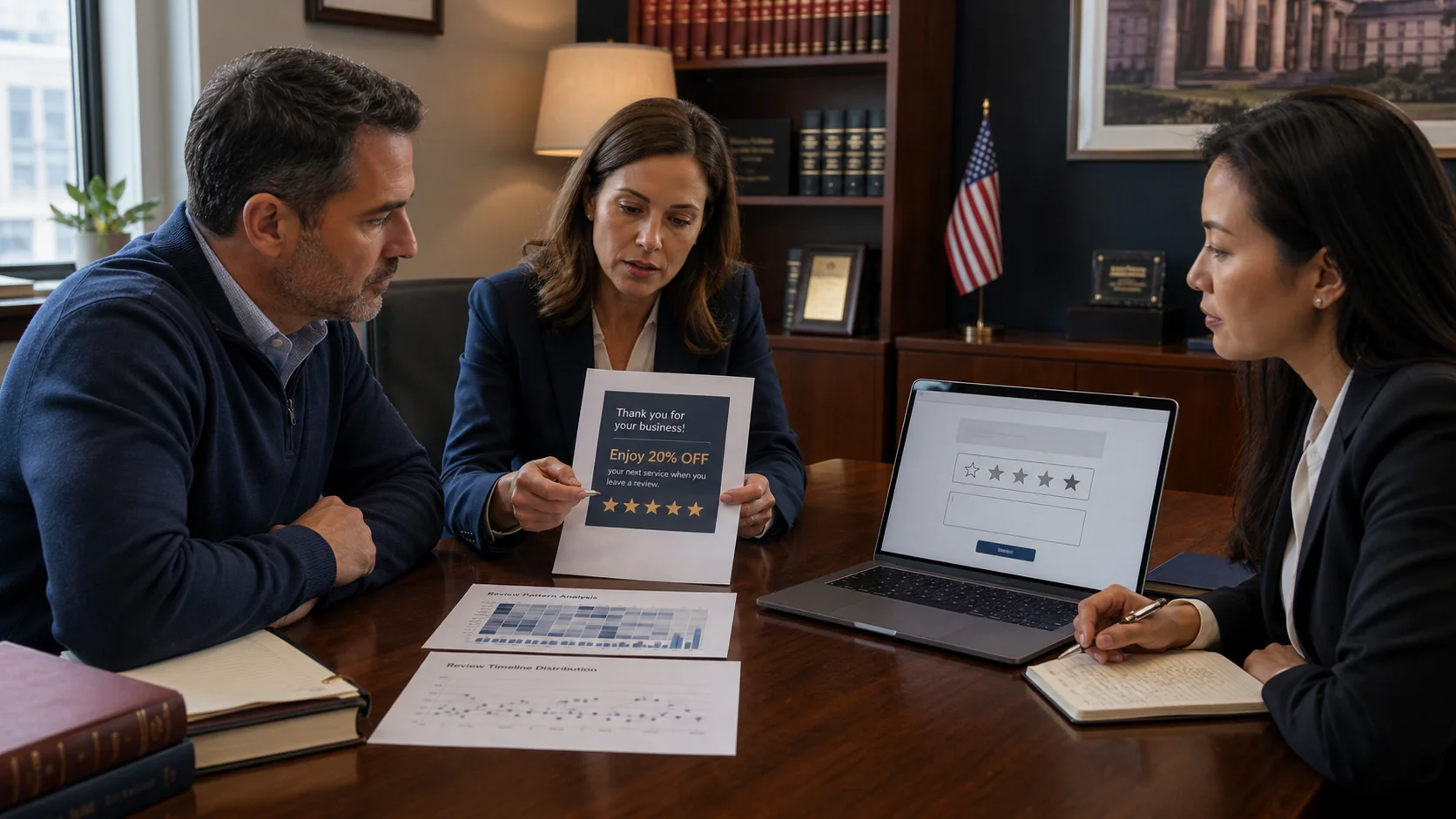
Legal Issue Framing
In U.S. review disputes, 16 C.F.R. Section 465.4 prohibits a business from providing compensation or another incentive in exchange for, or expressly or impliedly conditioned on, a consumer review expressing a particular positive or negative sentiment. A genuinely neutral incentive is not categorically prohibited by that section, but undisclosed material connections can still be deceptive under the FTC Act and the Endorsement Guides, and disclosure does not cure a sentiment-conditioned offer. Google separately prohibits incentivized or biased Maps reviews and may remove them or restrict a Business Profile. Federal law, state law, contracts, platform rules, defamation, tortious interference, and agency liability may overlap, but the facts and jurisdiction determine the available claim or remedy. Defamation law is mainly state law, so exact elements, privileges, damages rules, limitation periods, and anti-SLAPP exposure can vary. Still, a practical national screen is useful. Ask whether the review was published to third parties, whether it identifies the business or a person connected to it, whether the challenged words imply a fact capable of being proved true or false, whether that fact is false or materially misleading, and whether the publication caused reputational harm.
The Supreme Court references are important but should be used carefully. Milkovich is useful because a statement labeled as opinion can still imply an assertion of objective fact. New York Times v. Sullivan matters where public-official or public-figure standards are implicated, but many ordinary business review disputes involve private figures under state-law rules. The business should not overstate the constitutional point in a Google report. Google is not deciding a trial; it is deciding whether content violates platform policy.
Read this with the USA guide to accusations of buying fake Google reviews and the United States Google review removal page. Those are the two contextual internal links used in this article: one related USA resource and one country-service page.
Evidence Checklist
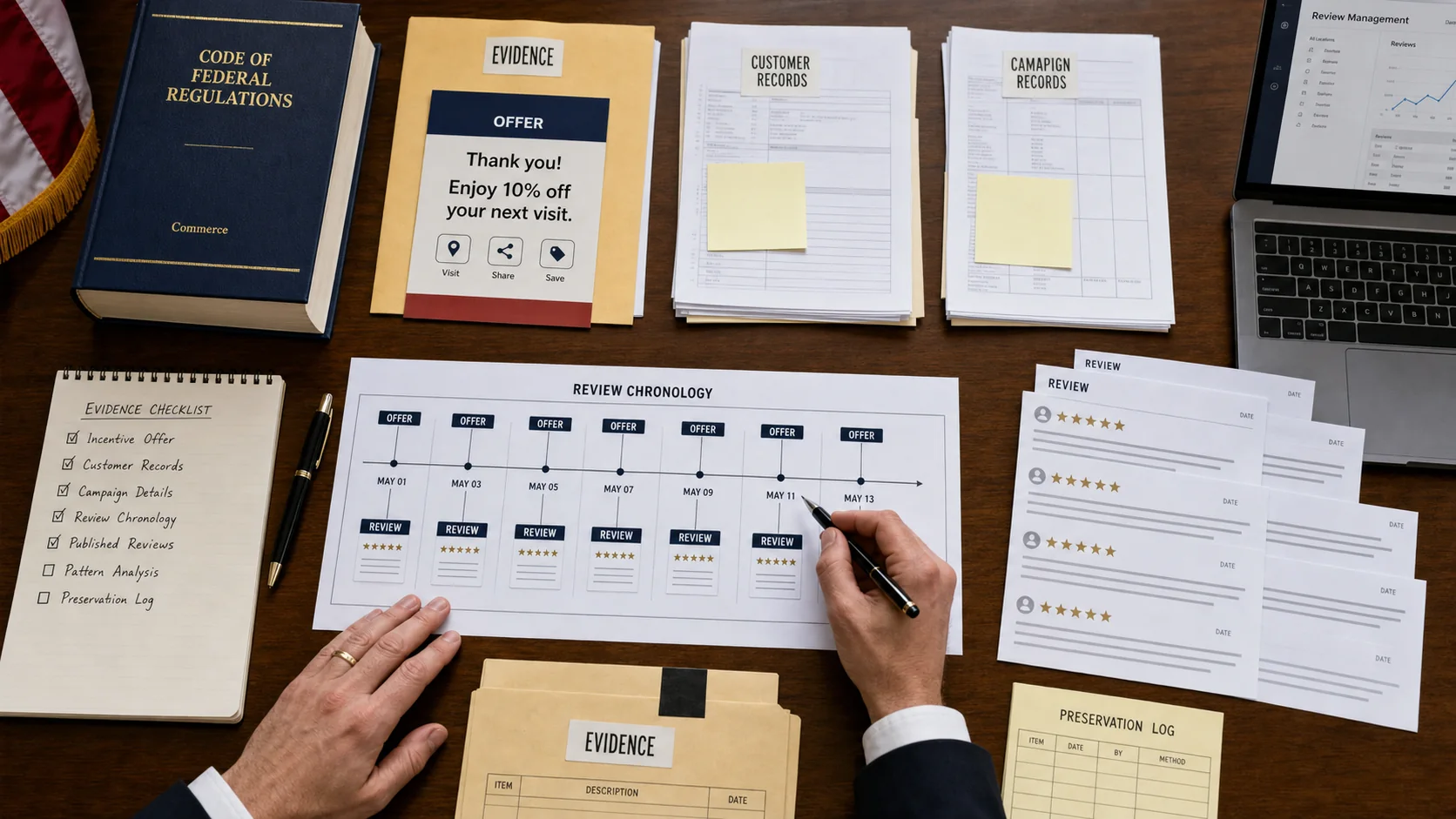
The evidence file should begin before anyone contacts the reviewer. Preserve the review URL, profile URL, display name, star rating, full text, photos, visible edit history, publication date, Google Business Profile context, local-search position if relevant, and screenshots from desktop and mobile where possible. Then compare the allegations with the exact incentive language, screenshots and source URLs, offer dates, eligibility terms, coupon or gift records, customer and reviewer identities where lawfully available, campaign and agency instructions, employee scripts, vendor contracts, invoices, payment trails, loyalty and referral logs, contest rules, review URLs, reviewer profiles, publication and edit dates, star-rating changes, repeated wording, account patterns, communications about deletion or revision, Business Profile notices, report and appeal confirmations, and a chronology linking each benefit to each challenged review without assuming causation. A no-match conclusion should identify which systems were searched, who searched them, when, and what limitations remain.
The strongest file is a sentence-by-sentence table. One column quotes the exact words. One column states what an ordinary reader may understand. One column classifies the phrase as opinion, hyperbole, insult, factual accusation, private information, threat, fake-engagement signal, or off-topic content. Other columns identify proof for and against, non-confidential evidence that can be shown to Google, private evidence reserved for counsel, response risk, and potential harm.
- Save the review, profile, URL, screenshots, star rating, images, publication date, edit evidence, and Business Profile context.
- Compare the challenged statements with the exact incentive language, screenshots and source URLs, offer dates, eligibility terms, coupon or gift records, customer and reviewer identities where lawfully available, campaign and agency instructions, employee scripts, vendor contracts, invoices, payment trails, loyalty and referral logs, contest rules, review URLs, reviewer profiles, publication and edit dates, star-rating changes, repeated wording, account patterns, communications about deletion or revision, Business Profile notices, report and appeal confirmations, and a chronology linking each benefit to each challenged review without assuming causation.
- Preserve negative checks: no booking found, no invoice found, no matching visit, no branch record, or a partial match with inaccurate allegations.
- Keep confidential records separate from the Google submission; summarize sensitive facts instead of uploading private customer, staff, payment, health, student, legal, or HR data.
- Document harm with contemporaneous proof such as prospect questions, canceled bookings, rating movement, sales impact, staff concern, partner concern, and report or appeal outcomes.
- Create one chronology that tracks first discovery, preservation, internal review, Google reports, appeals, notices, public responses, and any off-platform messages.
Platform-Policy Angle
Google's own review-reporting workflow should be used with a moderator-readable file. The submission should identify the exact review, the policy category, the non-confidential facts that support the category, and the requested action. For this topic, the likely policy angle may involve fake engagement and rating manipulation because Google prohibits reviews influenced by payment, discounts, free goods or services, or another benefit, including incentives offered for posting any review or for revising or removing a negative review. Conflict of interest, repeated account behavior, non-genuine experience, competitor conduct, misrepresentation, review suppression, or profile-level abuse may provide additional categories when independently supported. The important point is precision: a review may be legally troubling but still require a policy explanation before Google can act.
Google's prohibited and restricted content policy is the operational map. It covers categories such as fake engagement, misrepresentation, harassment, personal information, off-topic content, and conflicts of interest. A business should not ask Google to decide every state-law issue. It should explain why the review fails Google's own rules and support that explanation with a concise chronology. If the problem includes review extortion, use Google's dedicated extortion route as well as the ordinary review-reporting route where the facts fit.
The business must also avoid becoming the policy problem. The FTC Consumer Reviews and Testimonials Rule Q&A states that the federal rule went into effect on October 21, 2024 and addresses deceptive or unfair conduct involving consumer reviews and testimonials. A harmed business should not buy counter-reviews, pressure customers to edit truthful criticism, create insider reviews without proper controls, review-gate only happy customers, or make groundless public accusations to suppress a lawful review.
The Core Legal Split: FTC Law And Google Policy Are Not The Same Test
The starting point is the FTC's 16 C.F.R. Section 465.4. It treats it as an unfair or deceptive act or practice for a business to provide compensation or another incentive in exchange for, or conditioned expressly or by implication on, a consumer review expressing a particular sentiment. The provision reaches both positive and negative sentiment. A restaurant promising a coupon only for a five-star review and a competitor paying for one-star reviews can therefore raise the same conditioning issue from opposite directions.
The FTC's current Consumer Reviews and Testimonials Rule Q&A adds an important limit. The rule does not prohibit every incentive for an honest review when the business neither expressly nor implicitly requires a positive or negative sentiment. But that is not a blanket approval. The FTC explains that undisclosed incentives may still violate the FTC Act, and the Endorsement Guides can require a clear and conspicuous disclosure. It also warns that language such as asking customers to describe how much they loved a visit in exchange for a benefit can imply that positivity is required even if the offer never says 'five stars.'
Google applies a stricter product rule. Its dedicated Incentivized or Biased Reviews policy defines incentivized reviews as reviews influenced by payment, discounts, free goods or services, or another benefit, and says they are not allowed. Google's broader prohibited and restricted content policy states that merchants may not offer incentives in exchange for posting any review or for revising or removing a negative review. A promotion can therefore avoid the precise sentiment-conditioning prohibition in Section 465.4 and still violate Google Maps policy.
That difference should control the investigation. The legal file asks whether the offer was sentiment-conditioned, whether a material connection was disclosed, whether the campaign or resulting presentation was deceptive, who authorized it, and which federal or state rules apply. The Google file asks the narrower product question: did an incentive influence the review, rating, revision, or removal? Mixing those tests can make both submissions weaker. Saying 'the FTC permits this' does not answer Google's policy, and saying 'Google prohibits this' does not by itself establish a federal cause of action.
Identify The Benefit Before Debating The Review
An incentive is not limited to cash. It can be a discount, free item, upgraded service, loyalty credit, refund, gift card, contest entry, referral reward, charitable donation triggered by posting, early access, waiver of a fee, promise of future work, or another benefit that could influence the review. A business should preserve the economic reality, not merely the label. Calling a benefit a thank-you, ambassador perk, customer-appreciation reward, or service-recovery gesture does not answer whether it was linked to a public review.
Timing is critical. An offer made before publication can support a direct incentive theory. A benefit delivered shortly after a review can be evidence of a prior arrangement, but timing alone does not prove it. A refund or remediation provided because a real service failed may be ordinary customer care; it becomes a different problem if the benefit is conditioned on posting, improving, or deleting a review. Preserve the complete conversation so the condition is not inferred from an isolated screenshot.
- Record the benefit's type, value, provider, recipient, date, eligibility terms, redemption method, and any limits.
- Preserve the exact solicitation words, including headings, buttons, scripts, QR-code landing pages, follow-up messages, and verbal instructions documented by witnesses.
- Determine whether everyone qualified or only customers expected to be satisfied, whether a rating threshold was stated, and whether staff were measured on positive-review volume.
- Separate a benefit for completing a private survey from a benefit for posting on Google, and preserve any step that routed only favorable responses to the public platform.
- Check whether an agency, franchisee, reseller, employee, contractor, reputation vendor, or review broker designed or administered the offer.
Sentiment Conditioning Can Be Express Or Implied
Under Section 465.4, the words of the offer and the surrounding process both matter. 'Leave us a five-star review and receive $10' is express. 'Tell everyone how much you loved us and receive $10' can be an implied positive condition. So can a workflow that shows the public-review link only after a high private rating, tells staff to offer the reward only to happy customers, or threatens to withhold the benefit if criticism remains. Counsel should examine the complete funnel rather than treating one neutral-looking sentence as dispositive.
The same logic applies to negative campaigns. A competitor does not avoid scrutiny by paying a broker for reputation work without directing the precise words of each one-star review. The file should ask what result was purchased, how the broker was compensated, whether negative sentiment was expected, what accounts were used, and whether the reviewers had genuine experiences. At the same time, similarity and timing are indicators, not proof. Public accusations should wait until the relationship is documented.
The FTC states that its rule authorizes courts to impose civil penalties for knowing violations. That makes knowledge evidence important: campaign approvals, compliance warnings, vendor representations, repeated complaints, internal messages, and instructions issued after problems were identified. It does not mean every questionable review campaign will produce an enforcement action. A business should document the facts, correct its own practices, and obtain advice rather than use the prospect of FTC enforcement as a threat in a public review response.
Disclosure Is A Separate Analysis, Not A Universal Cure
The material-connection rule in 16 C.F.R. Section 255.5 asks whether a connection between the endorser and seller could materially affect the weight or credibility of the endorsement and is not reasonably expected by the audience. Payments, free or discounted products, family or business relationships, prize opportunities, and other benefits can qualify. Where disclosure is required, it must communicate the nature of the connection clearly and conspicuously enough for consumers to evaluate its significance.
Disclosure does not rescue a review that had to be positive or negative to earn the benefit. The FTC Q&A expressly says a business cannot pay for five-star reviews merely by asking reviewers to disclose the payment. Conversely, a neutral incentive with no sentiment condition still requires analysis of disclosure, presentation, and whether the practice distorts what consumers understand. An average star rating materially lifted by incentivized reviews can create a presentation issue even if each individual review contains some disclosure.
Google's rule remains separate and stricter. A reviewer writing 'I received a free service for this honest review' may improve transparency for FTC purposes, but the disclosed benefit still supplies evidence that the review was incentivized under Maps policy. For removal strategy, the disclosure can be useful proof. For the business that ran the campaign, it can also be proof of a policy breach. Preserve it before asking anyone to edit the review.
Build An Offer-To-Review Evidence Matrix
A useful matrix uses one row per challenged review. Record the review URL, profile URL, display name, rating, text, images, publication and edit dates, the alleged benefit, offer date, redemption date, exact condition, source of the offer, evidence of a genuine customer experience, disclosure language, repeated wording, related accounts, and confidence level. Add columns for the Google policy category, FTC issue, state-law question, confidentiality, and the next fact needed.
Keep proof and inference separate. A coupon ledger can prove that a benefit was issued. A review screenshot can prove what was published. Matching email addresses or order numbers can connect the recipient and reviewer when lawfully obtained. A close sequence can support an inference. Similar phrasing across profiles can show a pattern. None of those items alone necessarily proves who directed the review, whether sentiment was conditioned, or whether the reviewer lacked a genuine experience. The matrix should show those gaps rather than conceal them.
- Capture the live review and profile from desktop and mobile, including direct URLs, dates, rating, text, images, and visible edits.
- Preserve offer pages as screenshots and files, and retain campaign exports, terms, scripts, emails, texts, invoices, redemptions, and vendor records.
- Create a dated chronology linking offer, redemption, review publication, revision, deletion request, Google report, appeal, and any account restriction.
- Hash or otherwise integrity-check important original files where proportionate, record the collector and source, and keep an untouched copy.
- Use a separate moderator package that omits unnecessary customer, payment, health, employee, or other sensitive information.
- Document contrary facts, including genuine transactions, neutral campaign language, proper disclosure, and reviewers who posted criticism despite receiving the same benefit.
Google Reporting: Prove The Pattern In Moderator-Readable Form
Google's Business Profile review-reporting guidance says only policy-violating reviews are eligible for removal and describes a one-time appeal after a no-violation decision. For an incentivized-review report, lead with the product rule and a short evidence chain: the exact offer, the reviewer connection, the review URL, the timing, and the relevant policy language. If the evidence supports multiple reviews, include a compact table rather than a long narrative. Do not ask the moderator to infer a federal violation from a star pattern alone.
Report profile-level conduct separately when the evidence shows broader abuse. Google's profile-reporting guidance permits reports about profiles contributing false information or taking other policy-violating actions. Its Business Profile restrictions guidance also warns that a business violating fake-engagement policy may face restrictions in addition to review removal. That is why a company auditing its own campaign should stop the practice, preserve the record, notify appropriate decision-makers, and obtain compliance advice before launching an aggressive removal campaign against the resulting reviewers.
The one-time appeal should add evidence or correct the first report's framing. It should not simply repeat that the reviews are unfair. Identify how the offer influenced publication, why the account-review link is reliable, and what facts remain uncertain. If the first report used 'spam' but the stronger category is rating manipulation through an incentive, say so. Keep the requested action precise and avoid attaching an entire internal investigation when a concise non-confidential extract will do.
When Your Business Is Accused Of Buying Or Rewarding Reviews
A public accusation that a business buys reviews can itself cause serious reputation harm. The first step is an internal audit, not an automatic defamation threat. Identify every active and recent review request, customer-recovery offer, referral program, loyalty campaign, employee script, agency arrangement, franchise practice, and vendor promise. Determine whether the accusation is true, partly true, mistaken, or based on a program that was described internally as neutral but operated differently in practice.
If the accusation is materially false, preserve the exact statement and proof of the actual program. Under U.S. defamation law, the business would still need state-specific analysis of factual meaning, falsity, fault, harm, privilege, defenses, anti-SLAPP exposure, and procedure. A reviewer may be describing an observed promotion, expressing an opinion, or repeating a claim from another source. Do not assume that proving the company had a compliant written policy resolves what happened in practice.
If the audit confirms a problem, corrective action should be real. Suspend the offer, preserve rather than sanitize the records, stop vendor activity, notify relevant leadership, correct scripts and landing pages, review existing disclosures, and assess whether affected reviews should be removed or otherwise addressed. Do not ask reviewers to delete posts in exchange for keeping a benefit. Do not flood the profile with supportive reviews. Those moves can enlarge both the platform and regulatory problem.
Public Response Strategy
The public reply should be written for future customers and should disclose no private evidence. If the business is investigating suspected incentivized negative reviews, it may say that it takes feedback seriously, is reviewing whether the post complies with platform rules, and invites anyone with a genuine service issue to use an official private channel. It should not name a suspected competitor, broker, employee, or reviewer unless counsel has approved the evidence and the risk.
If the business is accused of buying reviews and the audit is not complete, avoid an absolute denial. A measured response can say that the company has a policy against paying for Google reviews, is reviewing the specific allegation, and welcomes evidence through a private compliance channel. If a mistake is confirmed, a truthful correction and program change may protect credibility better than a combative thread. Never repeat discount codes, customer identities, payment records, or internal disciplinary facts publicly.
Escalation Criteria And Risk Cautions
- Escalate when the offer expressly or impliedly requires positive or negative sentiment, especially when the conduct is repeated or brokered at scale.
- Escalate when payment, coupon, redemption, agency, account, and timing records reliably connect benefits to specific reviews or a coordinated pattern.
- Escalate when the conduct includes impersonation, non-genuine experiences, competitor attacks, threats, demands for value, review revision or deletion payments, or repeated profiles.
- Escalate internally when the business, franchisee, employee, or vendor may have created the incentive program, even if the reviews were honest or disclosed.
- Escalate to state-specific counsel when a false accusation of buying reviews is causing material harm, or when defamation, interference, contract, consumer-protection, subpoena, or anti-SLAPP issues may affect strategy.
- De-escalate unsupported accusations when the evidence shows only a normal discount, genuine customer transaction, neutral private survey, or temporal coincidence with no review condition.
Do not promise that Google will remove a review because an incentive existed, that the FTC will investigate, or that a private lawsuit will succeed. Do not threaten a regulator referral merely to pressure deletion. Do not submit altered screenshots, omit campaign language that favors the other side, or characterize every undisclosed benefit as a Section 465.4 violation. Do not delete records after a dispute becomes reasonably foreseeable. The strongest file is complete enough to show both the concern and the limits of the available proof.
Public Response Strategy
The public response should be written for future readers, Google, and a later evidence file. It should usually be short, factual, and privacy-safe. The business can state that it takes the matter seriously, that available records are being reviewed, and that the reviewer can contact an official private channel. The response should not disclose the evidence package. The main risk here is publicly accusing a competitor or reviewer without a documented link, treating every disclosed promotion as an FTC violation, assuming disclosure makes a sentiment-conditioned review lawful, offering value for deletion, asking loyal customers to flood the profile, deleting campaign records, uploading customer or payment data to Google, or promising that an FTC citation will compel removal.
A public reply can become a screenshot in a later platform appeal, regulator complaint, media post, or lawsuit. Avoid calling the reviewer a criminal, extortionist, competitor, ex-employee, fake customer, or liar unless counsel has reviewed the evidence and the business accepts the risk. If the review contains private data, staff names, customer identifiers, health information, payment details, student information, legal-client facts, or HR allegations, the public response should be screened before publication.
Escalation Criteria
Escalation is not a single move. It may mean a stronger Google appeal, a legal-preservation letter, a narrow demand letter, private outreach, subpoena-readiness review, local counsel referral, law-enforcement consultation for true extortion facts, or a state-law defamation assessment. Escalation is most defensible when the accusation is specific, factual, serious, contradicted by objective records, causing measurable harm, and not adequately addressed by ordinary platform reporting.
Expectations about the platform should remain realistic. 47 U.S.C. Section 230 generally limits attempts to treat an interactive computer service as the publisher or speaker of third-party content. That does not protect the person who wrote a false review, and it does not stop the business from using Google's policy channels. It does mean that a legal strategy aimed directly at the platform needs careful analysis and usually should not be the first assumption.
- Escalate when the review makes a serious factual accusation such as fraud, theft, unsafe conduct, falsified records, discrimination, or professional misconduct.
- Escalate when the reviewer appears to be a non-customer, competitor, former staff member, supplier, transaction opponent, or part of a coordinated pattern.
- Escalate when there are threats, demands for value, personal information, images, harassment, or repeated publication across platforms.
- Escalate when Google rejects a first report because the submission lacked policy framing, chronology, or non-confidential evidence.
- Escalate when a public response would create privacy, employment, consumer-protection, confidentiality, or retaliation risk.
Risk Cautions
The Consumer Review Fairness Act, codified at 15 U.S.C. Section 45b, restricts certain form-contract provisions that prohibit, penalize, or transfer rights in honest consumer reviews. It does not protect fake, defamatory, harassing, confidential, or unlawful content, but it does warn businesses against overbroad anti-review tactics. A removal strategy should target false or policy-violating statements, not silence ordinary criticism.
The second caution is evidentiary discipline. Do not delete internal notes, alter customer records, post confidential documents, offer payment for deletion, send a template threat without reviewing state law, or submit a long emotional narrative to Google. A business should keep one clean file and separate what can be shown publicly, what can be summarized to Google, and what should remain with counsel.
Sources Consulted
- Google Business Profile Help: report inappropriate reviews.
- Google prohibited and restricted content policy.
- Milkovich v. Lorain Journal Co., 497 U.S. 1 (1990).
- New York Times v. Sullivan, actual-malice framework.
- 47 U.S.C. Section 230.
- FTC Consumer Reviews and Testimonials Rule Q&A.
- 15 U.S.C. Section 45b, Consumer Review Fairness Act.
- Google Maps policy: Incentivized or Biased Reviews.
- Google Business Profile restrictions for policy violations.
- 16 C.F.R. Section 465.4, buying positive or negative consumer reviews.
- 16 C.F.R. Section 255.5, disclosure of material connections.
- FTC final-rule announcement on fake reviews and testimonials.
- Google guidance for reporting policy-violating user profiles.
Practical Conclusion
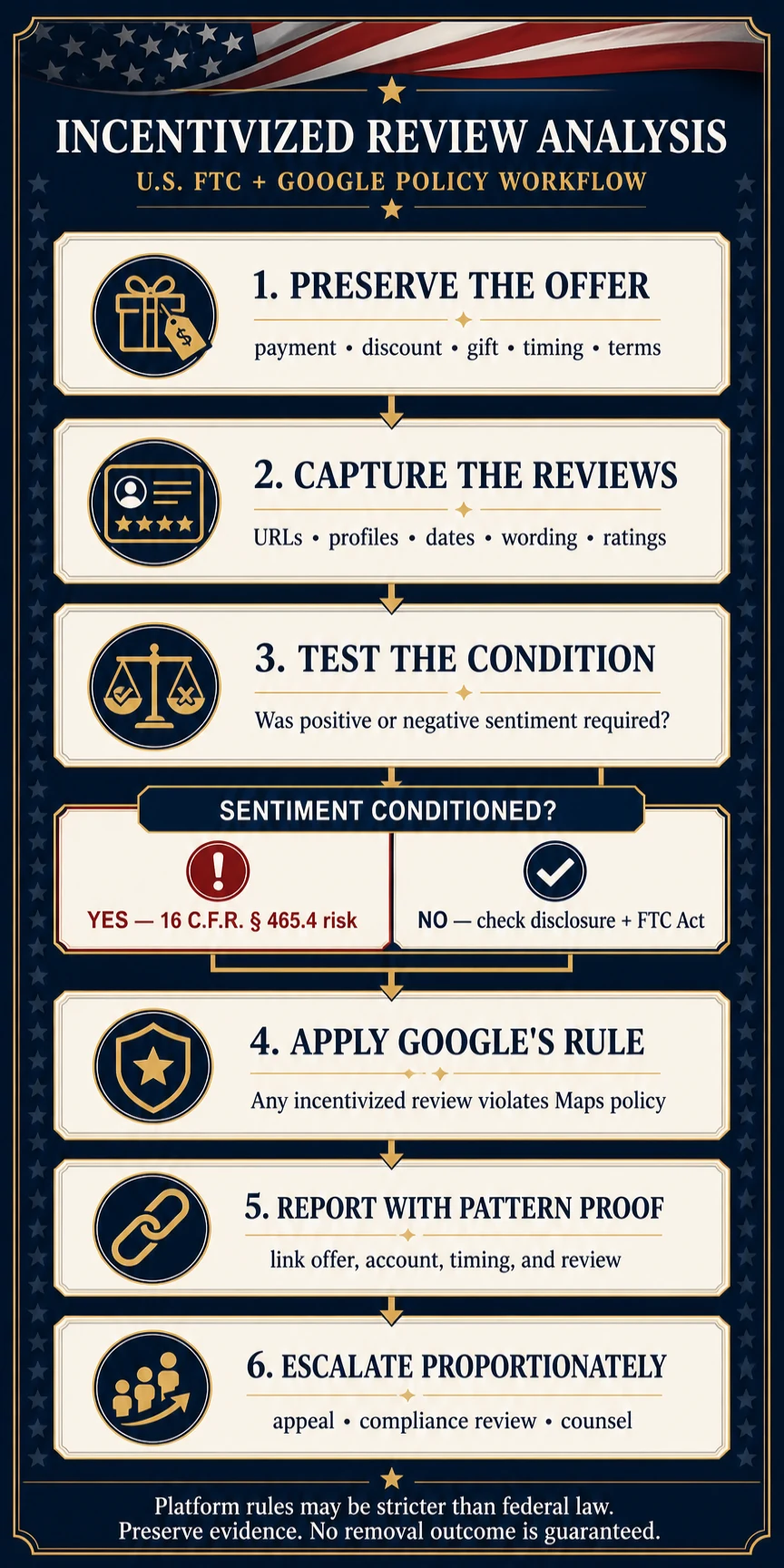
A U.S. incentivized-review file should begin with the offer, not the star rating. Preserve the benefit, the condition, the reviewer, the publication, and the timing; determine whether sentiment was required; analyze disclosure and the FTC Act separately; then apply Google's stricter no-incentive rule. Use a concise evidence chain for Google, keep sensitive and legal material in a counsel file, correct any internal program promptly, and escalate only when the documented facts justify it. This approach can strengthen reporting and compliance decisions, but it cannot guarantee removal, regulator action, or a legal outcome.
Pimlegal's preliminary role is to organize the review evidence, frame the platform policy route, keep the public response proportionate, and identify when the matter should move to U.S. counsel for jurisdiction-specific legal advice. This article is general information only. It does not guarantee review removal, identify a final legal remedy, or replace state-specific counsel review.