
A photographer gives your business one star and says you never paid for the shoot. Your project manager says the final photographs were never delivered. Both accounts could be accurate. Before replying on Google, ask accounts payable what actually reached the photographer, ask the project manager which files arrived and read the words a potential customer can see. The answers determine whether you have an overdue bill, a dispute over the contract, a misleading public statement, or some combination of the three.

Recent development
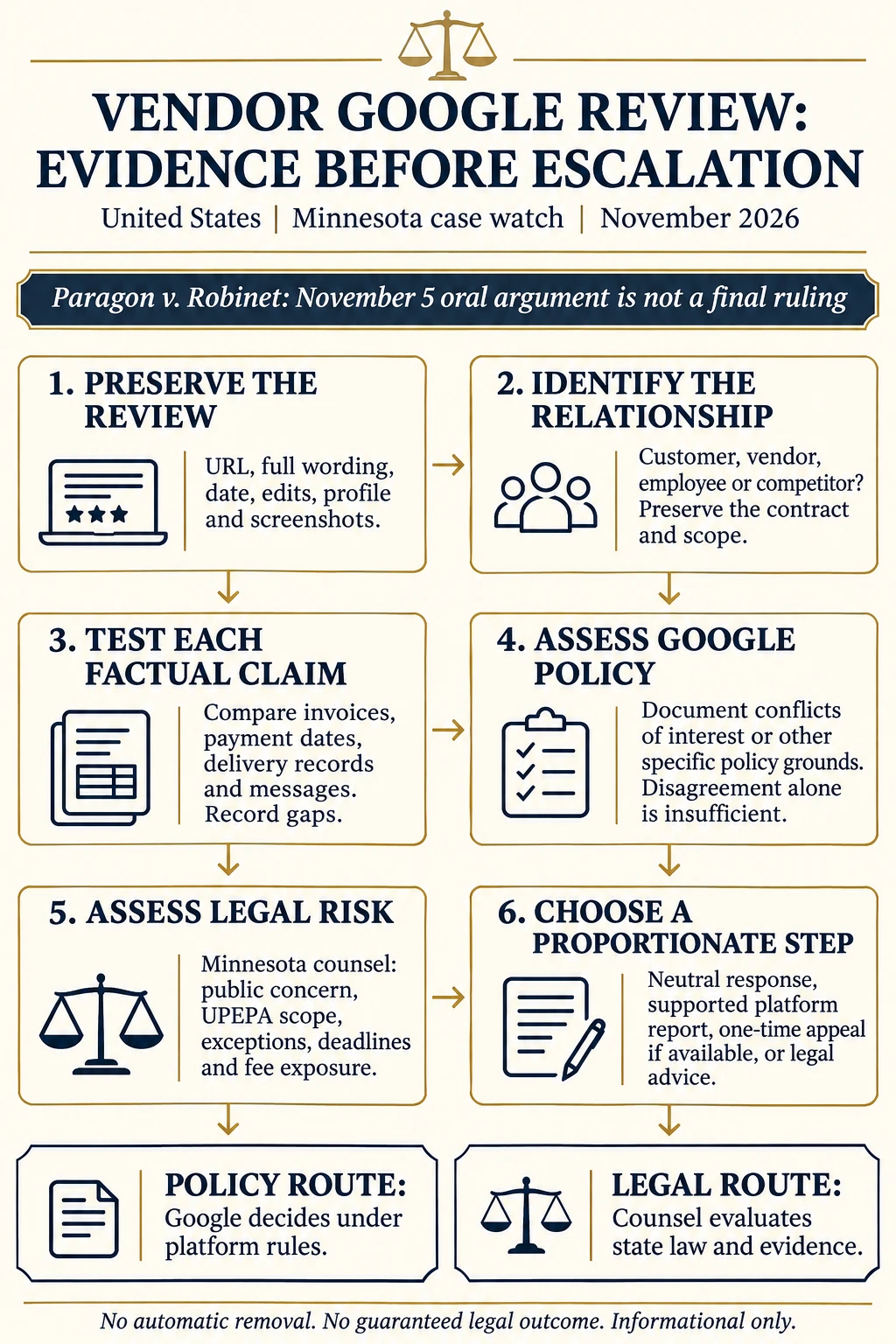
On November 5, 2026, the Minnesota Supreme Court heard Paragon Restorations, LLC v. Robinet Productions, LLC, No. A25-0826. A photography and video vendor posted a one-star Google review about its dealings with a restoration company. The state supreme court heard argument about access to Minnesota’s expedited procedure for lawsuits targeting protected expression. The issue matters even after a defamation claim has failed because the procedure can determine who pays motion-related legal fees. The court’s published materials reviewed through November 22 record oral argument. They identify no Minnesota Supreme Court decision resolving the appeal. Minnesota Supreme Court oral-argument archive.
The parties contracted in September 2024. After a disagreement, Jonn Robinet described an unhappy working relationship, said he had been denied payment and warned other contractors or business owners against working with Paragon. In January 2025 Paragon sued. The district court dismissed the defamation claim in the ordinary way. In its view, the challenged statements were true, substantially true or expressions of opinion. It separately denied Robinet’s special motion under Minnesota’s Uniform Public Expression Protection Act (UPEPA). The Minnesota Court of Appeals affirmed the denial on December 29, 2025. That sequence explains why the reviewer pursued an appeal despite having defeated the defamation claim. The reported appeal concerns that motion. It does not settle the parties’ contract accounts. Minnesota Court of Appeals opinion, pp. 2–4.
Why the vendor’s audience matters
Minnesota’s statute expressly mentions business reviews and ratings. It also requires speech on a matter of public concern for the free-speech route raised here. The appellate judges read those provisions together. They concluded that the business-review language can bring certain excluded claims back within the statute’s reach, while the reviewer must still satisfy the basic coverage requirement. The state supreme court took up both the relationship between those provisions and whether the constitutional test used in earlier Minnesota defamation cases governs the meaning of public concern here. Supreme Court summary of the questions presented, November 5.
Consider who could read the post, what the author said and what was happening around it. The appellate court treated the choice of a public review site as a point in the reviewer’s favor. It also recognized the warning to other businesses. What carried more weight was the account of a single commercial relationship and the absence in the record of a connection to a wider public discussion. A public audience and a subject of public concern answered different questions for those judges.
The court expressly left open a point that matters to anyone tempted to report a supplier as a fake customer. Paragon argued that the vendor supplied services to Paragon and therefore was outside the business-review provision. It also raised a statutory definition concerning artistic work. The appellate court had already resolved the motion on other grounds and declined to decide either argument. A business relying on this case should describe what the vendor actually did. Calling the reviewer a supplier establishes a relationship. It does not settle the scope of the Minnesota statute.
Read the allegation as of the day it appeared
Take a hypothetical post that says, “I sent the final files in August. As of Friday I still hadn’t received payment. I wouldn’t take another job from them.” The first sentence identifies a delivery that can be checked. The second identifies the date by which funds allegedly had not reached the vendor. The last tells readers what the writer would do in the future. A single bank confirmation is unlikely to answer all three. Print the post as it appeared, keep the original link and give the person investigating a copy with the disputed words underlined.
Suppose your bank released funds on Monday, three days after the Friday in the post. That supports an accurate update about payment on Monday. It also supports the vendor’s chronology if nothing had arrived by Friday. Now suppose payment settled before Friday but went to the photographer’s former agency. Find the instructions that authorized payment to that agency and check whether the agency forwarded it. Your ledger may accurately record money leaving your business while the reviewer accurately describes the balance in their own account.
A change of tense or scope can change what you need to prove. Someone who says a final installment remains outstanding may have received a deposit. Someone who says your business has a practice of withholding every freelancer’s pay makes a broader assertion. Save any earlier wording and identify what a reasonable reader could understand each version to mean. A record disproving a broad generalization may do little to resolve an unpaid final installment. Ask the person closest to the job to identify the strongest evidence that supports the reviewer’s version.
Evidence checklist for an unpaid-invoice review
- Capture the post in context. Keep the review and profile URLs, visible account name, rating, dates as displayed, attached images, public business reply and capture time. If the platform later shows an edit, preserve each version with the date you observed it. Record which person captured it.
- Locate the agreement in force for the job. Match the contracting entities, purchase order, milestone, due date, acceptance conditions and any revised scope. A proposal in an email may differ from the signed order. Keep both, along with messages approving rush work or a change in delivery format.
- Trace each deliverable. Preserve dated transfer receipts, file versions, access logs if available, revision requests and the client’s approval or rejection. A sent link shows transmission. It may say little about whether the link worked, which file it opened or whether the client accepted the work.
- Reconcile the money. Identify the invoice, payee, due date, amount disputed, amount released, settlement date and any returned transfer. Ask finance to reconcile the processor record against the bank and vendor ledger. An approval to pay, a printed check and a cleared payment can reflect three different dates.
- Document the consequences. If another supplier requires a deposit after reading the review, retain their original message and the terms previously offered. If a bid was lost, preserve the buyer’s own explanation. Record other plausible reasons for the change and any costs you avoided. Mark an estimate as an estimate.

Keep confidential originals where the project and finance teams ordinarily control access. Make redacted working copies for any outside submission. A vendor’s bank account, a client’s unpublished launch photographs and private pricing for other customers rarely help a moderator identify the reviewer’s role. If a claim is reasonably in prospect, ask counsel which systems and custodians to preserve before routine deletions occur. The U.S. guide to preserving Google review evidence for litigation addresses that next step.
When Google’s conflict-of-interest policy fits
Google expects Maps contributions to reflect genuine experience. Its policy also identifies conflicts of interest, with contractual or consulting relationships among the examples. A vendor can have firsthand knowledge of a transaction and a professional connection relevant to moderation. Identify the account, explain which business hired which and quote the part of the review that describes the work. If the person was both a supplier and a customer, say so and identify which relationship the post addresses. Google evaluates the circumstances under its own policy. Google Maps prohibited and restricted content policy.
For example, a studio owner may buy a frame from your shop in March and photograph your showroom for a fee in June. A review describing defective glass in the purchased frame calls for the March order and the customer-service file. A post about unpaid photography calls for the June agreement. If it mentions both, identify each passage. Searching the retail customer system alone could lead your staff to deny a relationship that either the retail receipt or the studio’s own invoice confirms.
Use the Business Profile reporting flow to select the reason that fits the actual post. Where the interface allows supporting information, a short explanation of the contract and a redacted record identifying the parties may suffice. Save the submission and use the Reviews Management Tool to check its status. Google provides a one-time appeal for an eligible review after an adverse decision. Use that opportunity to address a missing fact, such as a trade name linking the reviewer to the supplier. Google directs businesses to reserve reports for policy violations. It does not adjudicate the invoice dispute. Google’s reporting and appeal instructions.
Respond publicly without publishing the accounts file
Put one person in charge of the public reply and give someone with authority over the invoice responsibility for the private follow-up. While the balance is being checked, a suitable reply might read, “We take questions about payment seriously. Please send your invoice reference to our accounts team through the contact on our website so we can confirm the project and respond directly.” Make sure the contact works and someone is expecting the message. Avoid inviting the reviewer to publish an invoice number, payment instructions or a client’s name on Maps.
If the investigation finds an overdue amount, follow the normal payment process and tell the vendor privately what to expect. If the amount is contested, identify the particular installment or deliverable and give the vendor an opportunity to provide the missing record. Keep payment obligations independent of any request to alter the post. Google prohibits offering incentives in exchange for changing or removing a negative review. A message coupling a check to deletion can become more consequential for the business than the text it hoped to remove.
What a Minnesota lawsuit could cost
The available procedure can change the economics before either side has taken a deposition. Section 554.09 generally gives the party served with a qualifying pleading 60 days after service to file the special motion, subject to a later filing for good cause. Filing ordinarily pauses other proceedings between the parties, including discovery. A court can permit limited discovery on a specific showing that necessary information is otherwise unavailable. A business expecting to learn the facts only after filing should discuss that constraint with Minnesota counsel. Minnesota Statutes, chapter 554, sections 554.09–.13.
The fee rules are asymmetric. A party who prevails on its special motion receives the reasonable motion-related fees and expenses and court costs specified by the statute. A party who defeats the motion receives those amounts only if the court also finds that the motion was frivolous or filed solely to cause delay. Voluntarily dropping a claim after the motion is filed also carries consequences that depend on whether the dismissal is with or without prejudice. Ask counsel about the cost of resolving the motion even if the business later decides to withdraw the claim. Section 554.13 and section 554.16.
When to take the file to counsel
Prompt legal review makes sense when a specific, material accusation conflicts with reliable contemporaneous records and someone is acting on it. A supplier who cancels a signed agreement and cites the post gives counsel a clearer starting point than a general fall in profile traffic. Escalate promptly as well if you have been served, a deadline may be running or the post identifies private financial information. Give counsel the original communications, the proposed reply, the unfavorable evidence and the location of each party. An engagement that crossed state lines requires an assessment of the applicable law and forum.
Before authorizing a demand letter, say in one sentence what you want corrected. “The September invoice was for a different client” can be tested against specific documents. “Our business is professional” leaves both parties arguing about a judgment. Consider whether a factual clarification, a private accounting correction or a narrowly documented platform request would address the immediate problem. The PimLegal U.S. Google review removal service describes the assessment available for businesses pursuing a platform remedy. A posted hearing date or another company’s favorable court order supplies no basis for promising how Google will decide your report.
Practical conclusion
Read the review against the ledger as it stood on the date of publication. Verify what was delivered, who had to pay whom and when the money arrived. If a vendor’s professional relationship supports a Google report, explain it accurately. If the post exposes an unpaid bill, put the right person in charge of resolving it. The Minnesota case shows why a reviewer can defeat a defamation claim and still have a dispute about fees. This guide provides general information. A qualified attorney can advise on a particular review, jurisdiction and deadline. Outcomes depend on the facts and the decision-maker.