
How Missouri's 2026 UPEPA changes Google-review lawsuit risk, evidence, platform reporting, public response, deadlines, and fee exposure.
A Missouri business considering a defamation claim over a Google review now faces a materially different procedural landscape. The state's new Uniform Public Expression Protection Act, commonly called UPEPA, creates an early special motion, stays much of the case while that motion is pending, provides an immediate appeal from a denial, and requires fee-shifting in defined circumstances. Those features do not make false factual reviews lawful, immunize every reviewer, or decide whether a particular customer post concerns a matter of public concern. They do make it more expensive to confuse business frustration with a legally supportable claim.
The practical consequence is a front-loaded review of wording, context, claimant identity, evidence, forum, deadlines, defenses, Google policy, and public-response risk. Before sending a demand or filing suit, a business should be able to identify the exact provably false statement, explain why it concerns the claimant, preserve admissible evidence, account for substantial truth and opinion, and assess whether Missouri's special procedure may apply. Platform reporting remains a separate route: Google moderates under its own policies and legal processes, not under a business's preferred characterization of a review as defamatory.

Recent Development: Missouri UPEPA Took Effect August 28, 2026
Missouri Governor Mike Kehoe signed Senate Bill 1067 on July 13, 2026, as confirmed by the official Senate action history and the governor legislative-actions page. The final enacted bill text repealed former section 537.528 and enacted section 537.529, the Uniform Public Expression Protection Act. Subsection 15 states that the new procedure applies to civil actions filed, or causes of action asserted in a civil action, on or after August 28, 2026.
The law covers, subject to stated exceptions, claims based on communications in government proceedings, communications about issues under government consideration, or an exercise of federal or Missouri constitutional rights of speech, press, assembly, petition, or association on a matter of public concern. The statutory text permits a special motion within sixty days after service, absent good cause for later filing; stays covered proceedings and discovery; sets hearing and ruling periods; authorizes a twenty-one-day appeal as of right from a denial; and directs courts to award motion-related costs, reasonable attorney fees, and litigation expenses to a prevailing movant. A responding party receives fees only if it prevails and the court finds the motion frivolous or filed solely to delay.
Material uncertainty remains. The statute is new, and this article does not identify a reported Missouri appellate decision applying it to an ordinary Google customer review. Whether a particular post is on a matter of public concern, whether an exception applies, which causes of action are based on protected activity, and how the burdens operate will depend on the pleadings, evidence, forum, and later judicial interpretation. The statute is procedural protection, not a merits ruling and not an order to Google.
Why The New Law Matters For Google Review Disputes
Google reviews often mix protected evaluation with factual allegations. A one-star rating, 'terrible service,' or 'I would never return' may read as personal judgment. A statement that the business forged a signature, billed for work never performed, employed an unlicensed professional, or sold a counterfeit product can be more readily tested as fact. The legal analysis still turns on the entire post, disclosed facts, ordinary reader understanding, state law, falsity, fault, privilege, harm, and constitutional limits. UPEPA changes the early litigation process; it does not replace those elements.
The new procedure increases the cost of an imprecise complaint because the defendant may seek an early dismissal before ordinary discovery proceeds. If the business cannot establish a prima facie case for each essential element, or if the defendant establishes a pleading or summary-judgment ground, the court must dismiss the covered claim with prejudice under the statutory standard. A business that files mainly to force deletion or impose expense may therefore expose itself to a stay, early merits testing, appeal delay, mandatory defense fees, and more publicity for the original review.
PimLegal's United States anti-SLAPP guide for Google review lawsuits provides broader multistate context. The United States Google review removal page explains the separate platform-reporting, appeal, legal-notice, and evidence-intake routes. These are the only two internal links in this article.
Legal Issue Framing: Procedure Does Not Prove Or Disprove Defamation
Defamation remains a state-law cause of action with constitutional boundaries. Cornell's defamation overview identifies the familiar core: a false statement purporting to be fact, publication to a third person, fault, and reputational harm, subject to local variations. Milkovich v. Lorain Journal Co. rejects a wholesale exemption for anything labeled opinion, but the question remains whether the language can reasonably be understood to convey a provably false factual assertion. Loose rhetoric and disclosed personal evaluation can fall on the other side of that line.
Claimant and subject also matter. New York Times Co. v. Sullivan supplies the actual-malice rule for public officials, and Gertz v. Robert Welch, Inc. addresses constitutional limits for private figures. Philadelphia Newspapers v. Hepps and Dun & Bradstreet v. Greenmoss Builders illustrate that public-concern classification can alter burdens and damages rules. 'Actual malice' means knowledge of falsity or reckless disregard for truth; it does not mean that the reviewer sounded angry or wanted to harm the business.
A complaint should separate each challenged statement. Some phrases may be actionable fact, others protected opinion, and others substantially true or privileged. The claimant must also be identifiable: a statement about one employee, contractor, branch, franchisee, product, or predecessor may not automatically concern the profile-owning entity. UPEPA's early motion makes that statement-by-statement and claimant-by-claimant discipline more important at the beginning, not after months of discovery.
Scope Questions: Public Concern And The Seller Exception
Missouri's statute expressly reaches protected expression on a matter of public concern. A review alleging public safety, professional licensing, discrimination, fraud affecting consumers, dangerous products, or misconduct by a public-facing regulated business may present a stronger public-concern argument than a purely private disagreement over a late appointment or a small billing adjustment. That distinction is not automatic. The court must evaluate the actual words, context, audience, and claim rather than treating every online review as categorically public or private.
The final text also excludes a cause of action against a person primarily engaged in selling or leasing goods or services when the cause arises from a communication related to that person's sale or lease of those goods or services, while excluding specified expressive works from the statutory meaning of goods or services. This commercial-speech exception is not a universal exclusion for customer reviews. Its wording focuses on the speaker's own sale or lease, and its application to a business, reviewer, competitor, vendor, or reputation agency needs fact-specific analysis.
Do not assume the exception resolves a case merely because a commercial transaction appears somewhere in the story. A customer describing a purchase, a competing business promoting its own service, an employee discussing working conditions, and a contractor disputing performance involve different speaker roles and communications. Counsel should map the claim to the statutory coverage language and exceptions before predicting whether the special motion is available.
The Early Motion, Stay, Burdens, Appeal, And Fees
A covered defendant ordinarily has sixty days from service of the relevant pleading to file the special motion, with later filing possible for good cause. Filing generally stays other proceedings between the moving and responding parties, including discovery and pending hearings or motions. The court may permit limited discovery when specific information is necessary to meet a statutory burden and is not reasonably available without discovery. The hearing ordinarily occurs within sixty days after filing, and the court ordinarily rules within sixty days after the hearing, subject to the statutory qualifications.
At the merits stage, the moving party first establishes that the statute applies. The responding party may establish that an exception removes the claim. If the statute applies, the court dismisses with prejudice when the claimant fails to make a prima facie showing on every essential element, or when the movant establishes a failure to state a claim or entitlement to judgment as a matter of law with no genuine material-fact issue. A voluntary dismissal does not necessarily eliminate the fee question, which is another reason not to file first and investigate later.
The right to appeal a denial within twenty-one days can extend the procedural life of a dispute even while the underlying review remains visible. Mandatory fees for a prevailing movant make exposure harder to treat as a discretionary afterthought. A business should estimate not only its own legal budget and potential damages but also the possibility of paying motion-related defense costs, losing control of timing, and creating a public decision that repeats the review's allegations.
Evidence Checklist: Preserve The Review Before Contact Or Reporting
Preservation should occur before a public reply, private demand, report, appeal, or lawsuit. Save the direct review URL, complete text, star rating, reviewer name as displayed, profile link, attachments, dates, visible edits, owner responses, and the Business Profile context. Use full-page captures as well as focused screenshots. Record who collected each item, when, with what device or browser, and how the original file is stored. Later changes should become new versions, not overwrite the first capture.
- Preserve the review in Search and Maps when available, including the profile name, location, review count, rating, text, photos, replies, and visible edit status.
- Save Google report confirmations, Reviews Management Tool status, appeal decisions, support emails, case identifiers, and legal-removal correspondence.
- Preserve direct messages, refund requests, demands, threats, invoices, booking records, call logs, and other off-platform evidence in original form where lawful.
- Capture republication on social media, other review sites, or copied profiles without assuming that the same person controls every account.
- Create a neutral chronology that separates observed facts, source documents, disputed inferences, legal conclusions, and unresolved questions.

Evidence Checklist: Test Falsity, Fault, Harm, And Defenses
Match the review to the correct transaction without relying only on the display name. Reviewers may use a family account, nickname, marketplace booking, corporate card, companion's profile, former surname, or a different branch. Search reasonable date ranges and systems, and document the limits. The absence of a matching name in one database is evidence of a search result, not conclusive proof that no genuine experience occurred.
For each concrete accusation, identify the record that would prove or disprove it: signed agreements, orders, schedules, messages, refunds, inspection logs, license status, access records, photographs, policies, quality checks, and witness accounts. Preserve unfavorable facts too. Substantial truth, disclosed facts, consent, privilege, opinion, lack of fault, and failure to prove harm can defeat or narrow a claim. A lawyer cannot assess those issues honestly if the business supplies only documents that support its preferred narrative.
Harm evidence should be specific and dated. Preserve lost bookings, cancelled orders, customer inquiries mentioning the review, lender or insurer communications, ranking or conversion data, and mitigation costs without attributing every decline to one post. Correlation is not causation. If the business relies on a per se category or presumed damages, counsel should still evaluate constitutional restrictions, state-specific doctrine, and whether the statement actually fits that category.
Platform-Policy Angle: A Google Report Is Not An Anti-SLAPP Motion
Google's prohibited and restricted content policy requires contributions to reflect genuine experiences and prohibits defined categories including fake engagement, misrepresentation, harassment, personal information, and conflicts of interest. The Business Profile reporting guidance directs businesses to report policy violations rather than reviews they merely dislike or dispute. A useful report therefore identifies the exact content, the closest policy category, and concise non-confidential facts supporting that category.
Do not paste a litigation threat into the ordinary reporting tool or describe UPEPA as a removal rule. Google is not deciding the special motion, allocating fees, or adjudicating every element of Missouri defamation law when it moderates a review. Conversely, a platform decision to leave content online does not establish that the review is true or immune from a valid claim. Keep the private moderation process and the court process in separate files, even when some evidence overlaps.
When the complaint is genuinely legal rather than only policy-based, Google's legal-reporting guidance and defamation overview require a jurisdiction-specific explanation. A legal submission should identify the exact URL, exact wording, claimant, relevant law, factual basis, and procedural status. If there is no judgment or order, do not imply that a court has decided falsity or directed removal.
Public Response Strategy During A Potential Dispute
Write the public response for future customers, a Google moderator, and a possible court exhibit. A short reply can acknowledge the concern, state that the business is reviewing available records, correct one neutral public fact if safe, and invite private contact through an official channel. It should not disclose the evidence file, customer identity, employee discipline, payment data, health information, legal-client material, student records, or other protected details.
Avoid calling the reviewer a liar, criminal, extortionist, competitor, fake customer, or former employee unless the evidence and legal risk have been reviewed. An aggressive response may create a new defamation claim, supply evidence of retaliation or fault, provoke republication, or undermine the business's credibility. Do not threaten 'automatic fees' under UPEPA: coverage and prevailing-party status remain for the court, and a frivolous special motion can itself trigger an award to the responding party.
FTC And Consumer-Review Fairness Cautions
The FTC's Consumer Reviews and Testimonials Rule materials and 16 C.F.R. Part 465 address fake or false reviews, sentiment-conditioned incentives, undisclosed insider reviews, company-controlled review sites presented as independent, review suppression, and fake social indicators. A business facing a disputed post should not manufacture favorable reviews, condition a refund on positive sentiment, use baseless threats to suppress criticism, or ask staff and family to overwhelm the listing.
The Consumer Review Fairness Act, discussed in the FTC's official guidance and codified at 15 U.S.C. Section 45b, restricts certain form-contract terms that prohibit or penalize honest reviews or transfer review-related rights. It does not protect defamatory, harassing, confidential, or unlawful content. The safe lesson is to target a supported false factual statement or a defined policy violation, not the customer's general right to express an unfavorable experience.
Escalation Criteria
Counsel-led escalation becomes more defensible when the review contains a specific, verifiably false accusation of crime, fraud, dangerous conduct, license violations, discrimination, falsified records, counterfeit goods, or serious professional misconduct; objective records contradict it; the correct claimant is identifiable; and measurable harm is occurring. Urgency also rises with coordinated posting, extortion demands, doxxing, repeated republication, fabricated media, regulator attention, or a short limitation or pre-suit deadline.
Before a Missouri filing, counsel should assess UPEPA scope and exceptions, choice of law, personal jurisdiction, venue, federal-versus-state forum, limitation periods, required notices, privileges, public-figure or public-concern issues, and the fee budget. State anti-SLAPP procedures do not necessarily operate identically in federal court; Erie and circuit precedent can affect whether particular state procedural features apply. A business should not select a forum or defendant solely because it appears more favorable in a short online summary.
A strategy aimed directly at Google requires separate analysis. 47 U.S.C. Section 230 generally limits claims that seek to treat an interactive computer service as the publisher or speaker of third-party content, subject to the precise claim and statutory limits. The reviewer remains responsible for their own speech, and Google's voluntary policy and legal channels remain available. But naming the platform is not a shortcut around proof, jurisdiction, or the review author's defenses.
Risk Cautions Before A Demand Or Lawsuit
- Do not sue merely to obtain reviewer identity, force deletion, or impose cost without first testing the underlying elements and UPEPA exposure.
- Do not describe an allegation, platform decision, demand letter, police report, or filed complaint as an adjudicated fact.
- Do not destroy notes, edit records, backfill policies, overwrite captures, or contact witnesses in a way that compromises preservation or credibility.
- Do not publicly disclose confidential records to win an online argument; separate public, platform, counsel, and litigation versions of the file.
- Do not assume a one-star review is actionable, that a removed review was defamatory, or that a rejected report proves the review was lawful.
- Do not promise removal, damages, an injunction, reviewer unmasking, or fee recovery; each outcome depends on evidence, procedure, law, and judicial or platform decisions.
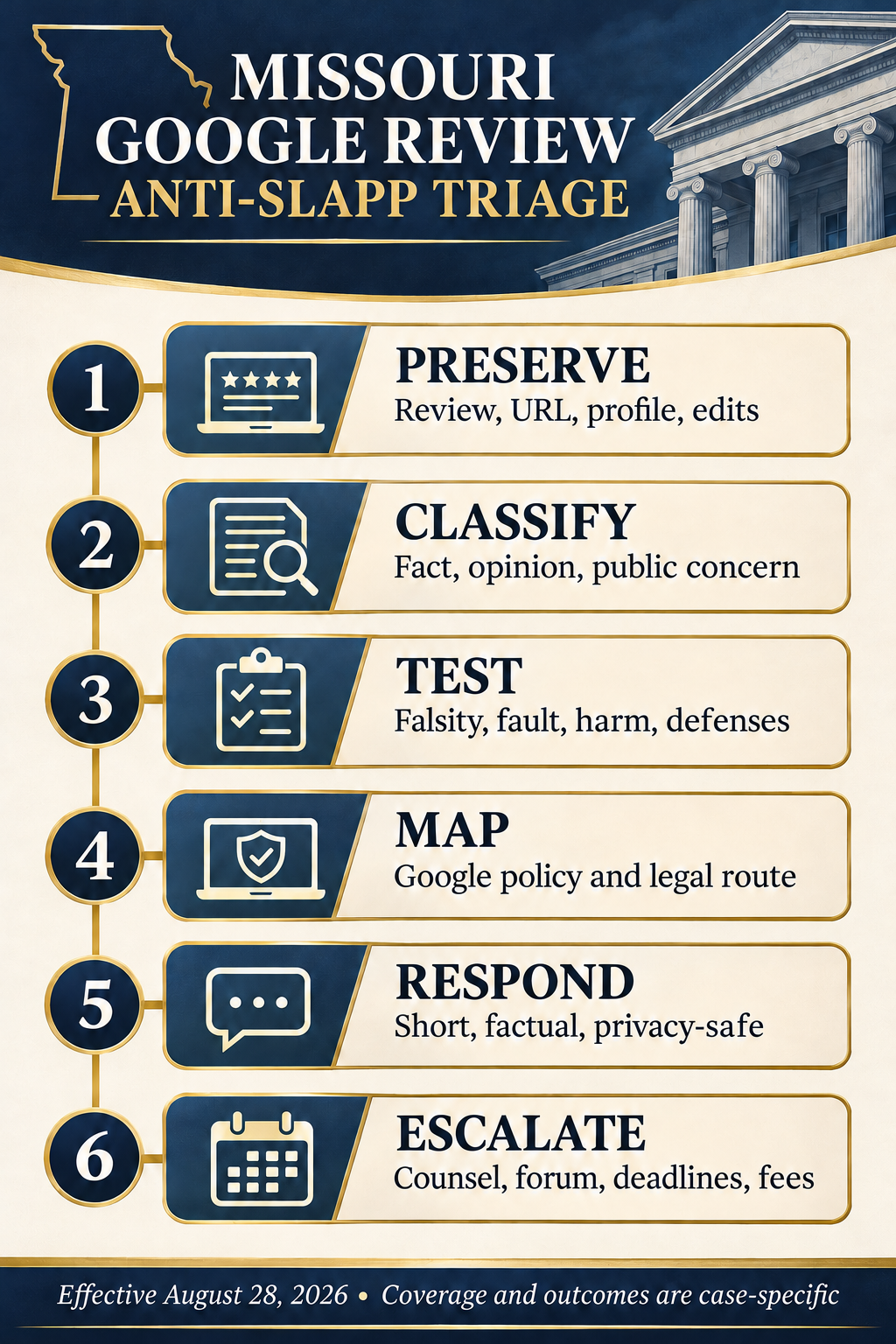
A Practical Missouri Decision Sequence
Sources Consulted
- Missouri Senate Bill 1067, truly agreed to and finally passed text (2026).
- Missouri Senate official legislative action history for SB 1067.
- Missouri governor legislative actions confirming approval of SB 1067.
- Cornell Legal Information Institute defamation overview.
- Milkovich v. Lorain Journal Co. and New York Times Co. v. Sullivan.
- Gertz v. Robert Welch, Inc. and Dun & Bradstreet v. Greenmoss Builders.
- Philadelphia Newspapers v. Hepps.
- Google Maps prohibited and restricted content policy.
- Google Maps user-generated content policy overview.
- Google Business Profile review-reporting guidance and Reviews Management Tool.
- Google legal-reporting guidance and Google defamation overview.
- FTC Consumer Reviews and Testimonials Rule materials and 16 C.F.R. Part 465.
- FTC Consumer Review Fairness Act guidance and 15 U.S.C. Section 45b.
- 47 U.S.C. Section 230.
Practical Conclusion
Missouri's UPEPA is a significant recent change because it expands early procedural protection for covered public expression and makes timing, stays, burdens, appeals, and fee exposure central to review-related litigation strategy. It does not establish that every Google review is protected, that every business claim is a SLAPP, or that false factual allegations lack a remedy. Its immediate lesson is disciplined triage: preserve first, separate fact from opinion, test the complete merits, map platform policy independently, and evaluate procedural risk before escalating.
Some harmful reviews belong in an ordinary Google report. Some call for operational correction or a restrained public reply. A narrower group may support a jurisdiction-specific legal notice or claim after counsel reviews the evidence and UPEPA exposure. No route guarantees removal, damages, fees, identity disclosure, or any legal outcome. This resource provides general information only and is not legal advice for a particular review, business, speaker, claim, or forum.