
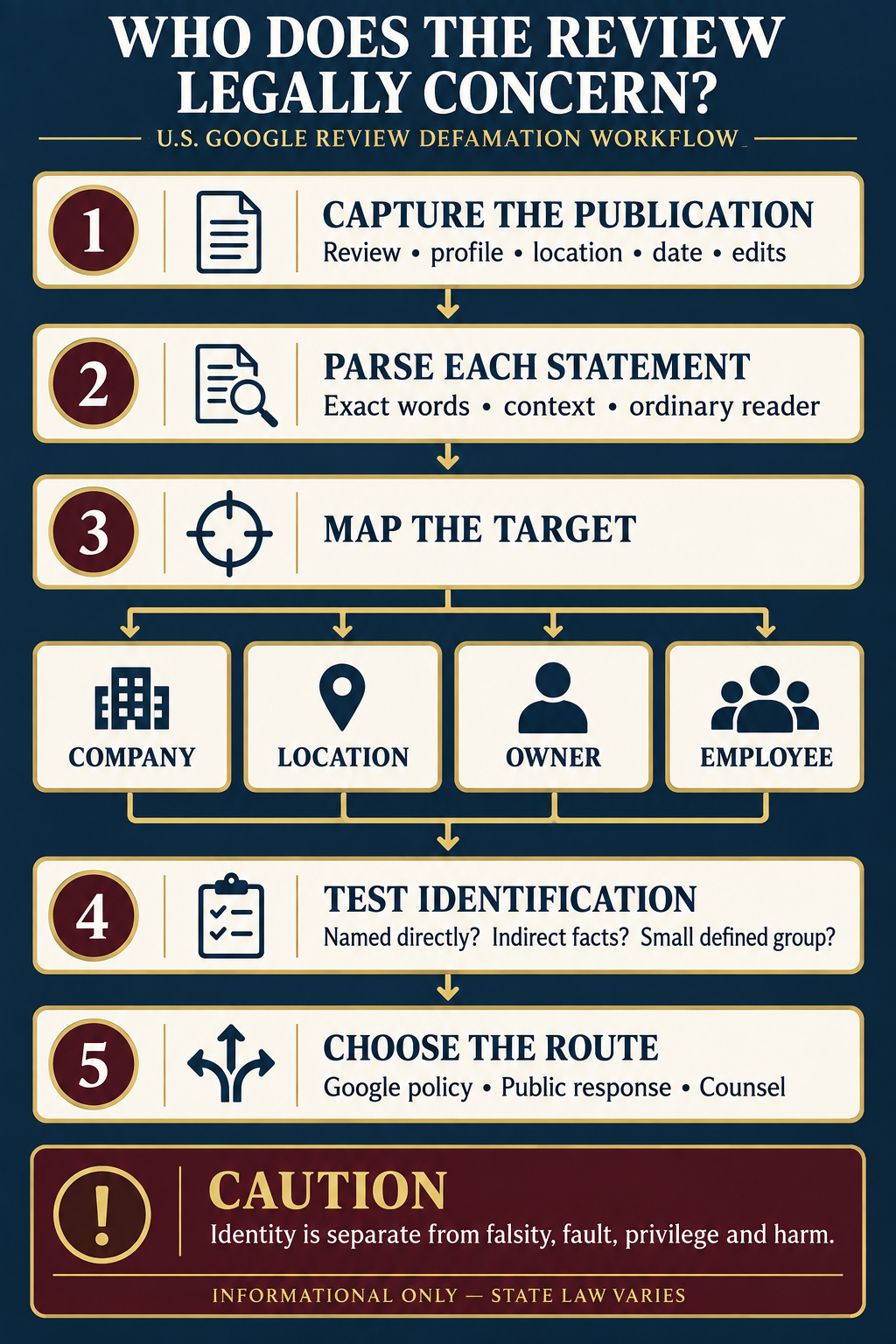
A U.S. legal guide to whether a harmful Google review concerns the company, location, owner, or employee, with evidence and removal strategy. This United States guide addresses the identity element of U.S. defamation law—often called the 'of and concerning' requirement—when one Google review may appear to target a legal entity, a trading name, one branch, an owner, a public-facing professional, an employee, or a defined group from a lawyer-grade evidence and platform perspective. The goal is not to promise deletion. The goal is to help a business preserve a useful file, avoid avoidable public-response mistakes, and decide whether Google reporting, a legal notice, subpoena-readiness review, or local counsel escalation is proportionate.
The working scenario is this: a one-star review posted on a multi-location company's Business Profile says that 'the owners and everyone at this office falsify records.' The profile carries a consumer-facing brand, the receipt names a separate LLC, the local branch has its own manager, and the reviewer later names one employee in a reply. Management assumes that the parent company, founder, local entity, manager, and employee can all rely on the same accusation and the same evidence file. A rushed reaction usually weakens the case. A business may reply publicly before it has searched records, accuse the wrong person, submit private documents to Google, or threaten litigation over language that is closer to opinion than fact. A stronger approach slows the dispute down just enough to classify the words, preserve the proof, and select the narrowest route that fits the evidence.

Legal Issue Framing
In U.S. review disputes, harmful words are not actionable by every person connected with the criticized business. Each proposed plaintiff must show that the challenged publication would reasonably be understood as referring to that plaintiff under the governing state's law. A direct name can help but is not always required; indirect identification may depend on the Business Profile, location, surrounding text, images, audience knowledge, and admissible extrinsic facts. Ownership, employment, or reputational concern alone does not automatically make an entity-level statement personal, or an individual-level statement corporate. Defamation law is mainly state law, so exact elements, privileges, damages rules, limitation periods, and anti-SLAPP exposure can vary. Still, a practical national screen is useful. Ask whether the review was published to third parties, whether it identifies the business or a person connected to it, whether the challenged words imply a fact capable of being proved true or false, whether that fact is false or materially misleading, and whether the publication caused reputational harm.
The Supreme Court references are important but should be used carefully. Milkovich is useful because a statement labeled as opinion can still imply an assertion of objective fact. New York Times v. Sullivan matters where public-official or public-figure standards are implicated, but many ordinary business review disputes involve private figures under state-law rules. The business should not overstate the constitutional point in a Google report. Google is not deciding a trial; it is deciding whether content violates platform policy.
Read this with the USA guide to Google reviews naming employees or directors and the United States Google review removal page. Those are the two contextual internal links used in this article: one related USA resource and one country-service page.
Evidence Checklist
The evidence file should begin before anyone contacts the reviewer. Preserve the review URL, profile URL, display name, star rating, full text, photos, visible edit history, publication date, Google Business Profile context, local-search position if relevant, and screenshots from desktop and mobile where possible. Then compare the allegations with the exact legal names of every potentially affected entity, assumed names and DBA filings, Business Profile name and category, branch ownership and operating agreements, franchise or license structure, receipts and contracts showing the customer-facing counterparty, website and directory naming at publication time, employee titles and public-facing roles, organization charts, who was pictured or named, who controlled the relevant transaction, reader or customer communications showing whom they understood the review to identify, and a plaintiff-by-statement matrix that keeps company, location, owner, and employee evidence separate. A no-match conclusion should identify which systems were searched, who searched them, when, and what limitations remain.
The strongest file is a sentence-by-sentence table. One column quotes the exact words. One column states what an ordinary reader may understand. One column classifies the phrase as opinion, hyperbole, insult, factual accusation, private information, threat, fake-engagement signal, or off-topic content. Other columns identify proof for and against, non-confidential evidence that can be shown to Google, private evidence reserved for counsel, response risk, and potential harm.
- Save the review, profile, URL, screenshots, star rating, images, publication date, edit evidence, and Business Profile context.
- Compare the challenged statements with the exact legal names of every potentially affected entity, assumed names and DBA filings, Business Profile name and category, branch ownership and operating agreements, franchise or license structure, receipts and contracts showing the customer-facing counterparty, website and directory naming at publication time, employee titles and public-facing roles, organization charts, who was pictured or named, who controlled the relevant transaction, reader or customer communications showing whom they understood the review to identify, and a plaintiff-by-statement matrix that keeps company, location, owner, and employee evidence separate.
- Preserve negative checks: no booking found, no invoice found, no matching visit, no branch record, or a partial match with inaccurate allegations.
- Keep confidential records separate from the Google submission; summarize sensitive facts instead of uploading private customer, staff, payment, health, student, legal, or HR data.
- Document harm with contemporaneous proof such as prospect questions, canceled bookings, rating movement, sales impact, staff concern, partner concern, and report or appeal outcomes.
- Create one chronology that tracks first discovery, preservation, internal review, Google reports, appeals, notices, public responses, and any off-platform messages.

Platform-Policy Angle
Google's own review-reporting workflow should be used with a moderator-readable file. The submission should identify the exact review, the policy category, the non-confidential facts that support the category, and the requested action. For this topic, the likely policy angle may involve fake engagement, a review tied to the wrong location or wrong product, impersonation, misrepresentation, harassment, personal information, conflict of interest, or an unsubstantiated allegation of unethical behavior or criminal wrongdoing. The identity of a possible defamation plaintiff is not itself a Google moderation category, and Google may permit the name of a publicly known executive or public-facing professional in business-related content. The important point is precision: a review may be legally troubling but still require a policy explanation before Google can act.
Google's prohibited and restricted content policy is the operational map. It covers categories such as fake engagement, misrepresentation, harassment, personal information, off-topic content, and conflicts of interest. A business should not ask Google to decide every state-law issue. It should explain why the review fails Google's own rules and support that explanation with a concise chronology. If the problem includes review extortion, use Google's dedicated extortion route as well as the ordinary review-reporting route where the facts fit.
The business must also avoid becoming the policy problem. The FTC Consumer Reviews and Testimonials Rule Q&A states that the federal rule went into effect on October 21, 2024 and addresses deceptive or unfair conduct involving consumer reviews and testimonials. A harmed business should not buy counter-reviews, pressure customers to edit truthful criticism, create insider reviews without proper controls, review-gate only happy customers, or make groundless public accusations to suppress a lawful review.
Identification Is A Separate Merits Question
Teams often use the word standing as shorthand for this problem, but the useful pleading question is more exact: does the challenged publication concern this proposed plaintiff? A business may have suffered a rating drop while the review's factual accusation was aimed only at a named employee. An owner may feel the commercial loss while ordinary readers understand the post to criticize only the company. Conversely, a review may name the brand but use words and context that a defined audience understands as accusing a particular public-facing professional. Identity must be tested before the merits file treats every affected person as a claimant.
New York Times Co. v. Sullivan is a foundational warning against automatic identification. The advertisement challenged there criticized police conduct and did not name the commissioner, who argued that criticism of his subordinates reflected on him. The Supreme Court concluded that the proof could not constitutionally support the judgment in the public-official setting before it. The point for a private Google review dispute is narrower: supervisory authority, ownership, or organizational responsibility does not by itself answer whether readers understood a statement to refer to the person who wants to sue.
The Business Profile Is Part Of The Publication
Do not analyze copied review text in isolation. Preserve the Business Profile name, exact location, category, address, photographs, linked website, owner reply, reviewer profile, star rating, and any service or product references. A review saying 'they falsified my invoice' can point differently when it appears on the parent company's national profile, a separately owned franchise location, a physician's name-based practice, or a storefront operated under a DBA. The page context may help identify the target, but it cannot be rewritten after the fact to manufacture a better claim.
Company, DBA, Brand And Location Are Not Interchangeable
Map the consumer-facing name to the actual operating structure. Record the parent corporation, subsidiary, LLC, professional entity, franchisee, assumed name, licensed brand, and individual location that handled the transaction. A profile label may not be the legal plaintiff's name. A branch may be only a place, not a separate legal person. A DBA may identify a real entity indirectly, but the file should show the link through public filings, contracts, receipts, website terms, and the way customers encountered the business when the review was published.
This is not merely a caption problem. The correct entity may own the contract, employ the relevant staff, control the profile, hold the professional license, or bear the reputational loss, and those roles may be split. Create a one-page entity map before drafting a legal notice. If counsel later chooses a different claimant, preserve the reason and do not simply substitute names in a template while leaving the factual theory unchanged.
Owner And Company Claims Need Separate Analysis
State law governs the result, and examples must remain jurisdiction-specific. In Three Amigos SJL Restaurant, Inc. v. CBS News Inc., New York's highest court explained that a plaintiff need not always be named, but must show that readers reasonably could understand the statement as referring to that plaintiff. The court also rejected the individual claims before it where a report about a club did not sufficiently identify unnamed people associated with its operations. That decision is useful precisely because it resists a universal owner-equals-company shortcut.
At the other edge, Murdaugh Volkswagen, Inc. v. First National Bank of South Carolina upheld a context-specific route under the law applied there where the corporation and individual could be treated as synonymous on the facts, including control, responsibility, financial ties, and the speaker's understanding. It is an illustration, not a national rule for closely held businesses. Sole ownership, founder visibility, or a shared surname may be relevant evidence, but counsel must still apply the governing state's identity test to the actual publication and audience.
Named Employees And Public-Facing Professionals
When the review names an employee, practitioner, manager, or director, isolate the statement that concerns that person from statements about the entity. A sentence accusing a named manager of altering a receipt may concern that manager; a separate sentence saying the company has deceptive pricing may concern the entity. They may require different falsity proof, privileges, fault analysis, damages records, insurance notice, and litigation decisions. Do not assume that one successful Google report resolves every potential claim.
Google's prohibited and restricted content policy creates a distinct moderation question. Its personal-information section may allow a person's name when it forms part of the commonly known business name or when a public-facing professional or publicly known executive conducts business under that name. Therefore, 'the review names our CEO' is not automatically a removal category. A stronger report identifies a separate supported rule: doxxing or harmful personal data, harassment, impersonation, non-genuine experience, conflict of interest, misrepresentation, or an unsubstantiated allegation of unethical behavior or criminal wrongdoing.
Group Accusations Require More Than Membership
Reviews sometimes accuse 'all the staff,' 'the owners,' 'management,' or 'everyone at this branch.' Rosenblatt v. Baer shows why group-reference analysis needs care. The Supreme Court rejected an instruction broad enough to permit an impersonal criticism of government operations to become personal without sufficient evidence that the implication was specifically directed at the plaintiff. The decision did not say that a statement can never concern more than one person. It shows that group size, definition, publication context, responsibility, and reader understanding matter, and that mere membership in a criticized organization is not enough by itself.
For a group accusation, record the number of people in the described group at publication time, their roles, whether the group was objectively defined, whether the review narrowed it by shift, date, service, location, image, or name, and whether readers familiar with the business identified a particular person. Do not solicit scripted declarations saying that everyone knew who the review meant. Preserve spontaneous customer, vendor, regulator, or staff communications and let counsel assess their admissibility and weight.
Indirect Identification And Audience Evidence
A plaintiff need not always be named. Indirect identification may rest on facts known to readers who were acquainted with the parties and subject, but those facts must have existed when the publication was read. Useful records can include the review's description of a unique transaction, the only professional serving a specialty at that location, a photograph, a title, a quoted email, a date and shift, or a distinctive service. The file should document how the connection arose without publishing private information or expanding the accusation beyond what readers saw.
- Preserve unsolicited messages asking whether the review refers to a particular company, branch, owner, or employee.
- Record the sender, date, original message, business relationship, and what publication context the reader actually saw.
- Separate readers who already knew the relevant facts from people who learned the connection only after management explained it.
- Do not coach employees, customers, or vendors to use legal conclusions such as defamed, libel, or of and concerning.
- Preserve contrary evidence, including readers who understood the accusation to target a different entity or no identifiable person.
Build A Plaintiff-By-Statement Matrix
The most useful work product is a matrix, not one global label for the review. Put every exact factual proposition in a separate row. Add columns for the profile context, proposed plaintiff, direct naming, indirect identifiers, audience evidence, governing law, falsity proof, fault evidence, privilege, public-concern issues, damages, Google policy category, and safer alternative route. Include an uncertainty column. A matrix that honestly shows one strong claimant and three weak ones is more valuable than a demand that treats them all as identical.
The matrix should also identify who owns each record and who can authenticate it. Corporate registration documents prove legal existence but do not prove what readers understood. A receipt may prove which entity contracted with the customer but not who was accused. A customer message may support reader understanding but not falsity. A rating chart may show profile-level harm while leaving individual reputational harm unproved. Use each exhibit only for the proposition it actually supports.
Identity, Falsity, Fault And Harm Must Not Collapse Into One
Even if the publication clearly concerns the proposed plaintiff, the business must separately assess whether the challenged words state or imply provable facts. Milkovich v. Lorain Journal Co. explains why merely calling language opinion does not end the inquiry, but ordinary criticism, disclosed opinion, rhetoric, and hyperbole remain relevant. Identification does not prove falsity. Falsity does not prove the required fault. Fault does not establish privilege or damages. Keep separate evidence columns so one persuasive fact is not made to do the work of every element.
Harm evidence must also match the claimant. A canceled booking may support injury to the operating company or location. A professional referral lost after the review may support individual harm if the evidence ties the reaction to the named professional. Emotional concern by an owner does not establish entity loss, and a company rating decline does not automatically establish an employee's personal damages. State law may affect available remedies, but careful claimant-specific proof is useful in every forum.
Google Policy And Legal Reporting Are Parallel Routes
Google's Business Profile review-reporting guidance says only policy-violating reviews are eligible for removal and that disagreement or dislike is insufficient. The identity analysis can still sharpen a report: the review may be attached to the wrong location, concern no genuine experience with the listed entity, impersonate someone, disclose harmful personal information, or misrepresent the goods or services. But do not ask a moderator to decide which LLC has a state-law claim. Lead with the exact Google rule and concise non-confidential evidence.
If a defined legal theory remains, Google's legal-reporting guidance asks for the correct product, specific content URL, precise identification of the allegedly violative material, and sufficient background for evaluation. The notice should name the claimant accurately and quote only the challenged content. A rejected policy report does not prove that every potential plaintiff lacks a claim; a removal does not establish that the review legally concerned every person listed in the notice.
Legal Notice And Filing Cautions
Before sending a demand, fix the claimant, forum, governing law, exact publication, exact statements, identity theory, falsity evidence, fault theory, privilege issues, limitation date, retraction or notice requirements, anti-SLAPP exposure, damages support, and requested remedy. If the review concerns several targets, explain them separately. Do not threaten claims for a parent company, affiliate, owner, or employee simply to increase pressure. Overclaiming can invite an early dismissal, fee exposure, credibility loss, or a wider public dispute.
The preservation letter and public response should be equally narrow. Do not reveal ownership structures, payroll facts, medical information, personnel records, customer identifiers, or protected communications to prove who was implicated. Do not publish a new statement that names an individual the original review left ambiguous. Where the identity theory depends on confidential facts, counsel should decide how and when those facts can be used without creating a second privacy, employment, or retaliation problem.
Public Response Strategy
The public response should be written for future readers, Google, and a later evidence file. It should usually be short, factual, and privacy-safe. The business can state that it takes the matter seriously, that available records are being reviewed, and that the reviewer can contact an official private channel. The response should not disclose the evidence package. The main risk here is replying in the name of the parent company when a different entity handled the transaction; confirming that a named person was involved; exposing employee, customer, patient, student, or personnel data; saying that every owner or staff member was defamed; threatening claims for parties the review does not reasonably identify; or using a public reply to supply the missing connection between an ambiguous accusation and a person who was not previously identifiable.
A public reply can become a screenshot in a later platform appeal, regulator complaint, media post, or lawsuit. Avoid calling the reviewer a criminal, extortionist, competitor, ex-employee, fake customer, or liar unless counsel has reviewed the evidence and the business accepts the risk. If the review contains private data, staff names, customer identifiers, health information, payment details, student information, legal-client facts, or HR allegations, the public response should be screened before publication.
Escalation Criteria
Escalation is not a single move. It may mean a stronger Google appeal, a legal-preservation letter, a narrow demand letter, private outreach, subpoena-readiness review, local counsel referral, law-enforcement consultation for true extortion facts, or a state-law defamation assessment. Escalation is most defensible when the accusation is specific, factual, serious, contradicted by objective records, causing measurable harm, and not adequately addressed by ordinary platform reporting.
Expectations about the platform should remain realistic. 47 U.S.C. Section 230 generally limits attempts to treat an interactive computer service as the publisher or speaker of third-party content. That does not protect the person who wrote a false review, and it does not stop the business from using Google's policy channels. It does mean that a legal strategy aimed directly at the platform needs careful analysis and usually should not be the first assumption.
- Escalate when the review makes a serious factual accusation such as fraud, theft, unsafe conduct, falsified records, discrimination, or professional misconduct.
- Escalate when the reviewer appears to be a non-customer, competitor, former staff member, supplier, transaction opponent, or part of a coordinated pattern.
- Escalate when there are threats, demands for value, personal information, images, harassment, or repeated publication across platforms.
- Escalate when Google rejects a first report because the submission lacked policy framing, chronology, or non-confidential evidence.
- Escalate when a public response would create privacy, employment, consumer-protection, confidentiality, or retaliation risk.
Risk Cautions
The Consumer Review Fairness Act, codified at 15 U.S.C. Section 45b, restricts certain form-contract provisions that prohibit, penalize, or transfer rights in honest consumer reviews. It does not protect fake, defamatory, harassing, confidential, or unlawful content, but it does warn businesses against overbroad anti-review tactics. A removal strategy should target false or policy-violating statements, not silence ordinary criticism.
The second caution is evidentiary discipline. Do not delete internal notes, alter customer records, post confidential documents, offer payment for deletion, send a template threat without reviewing state law, or submit a long emotional narrative to Google. A business should keep one clean file and separate what can be shown publicly, what can be summarized to Google, and what should remain with counsel.
Sources Consulted
- Google Business Profile Help: report inappropriate reviews.
- Google prohibited and restricted content policy.
- Milkovich v. Lorain Journal Co., 497 U.S. 1 (1990).
- New York Times v. Sullivan, actual-malice framework.
- 47 U.S.C. Section 230.
- FTC Consumer Reviews and Testimonials Rule Q&A.
- 15 U.S.C. Section 45b, Consumer Review Fairness Act.
- New York Times Co. v. Sullivan, 376 U.S. 254 (1964).
- Rosenblatt v. Baer, 383 U.S. 75 (1966).
- Three Amigos SJL Restaurant, Inc. v. CBS News Inc., New York Court of Appeals (2016).
- Murdaugh Volkswagen, Inc. v. First National Bank of South Carolina, 801 F.2d 719 (4th Cir. 1986).
- Google Maps user-generated content policy.
- Google Legal Help: Defamation Overview.
- Google Legal Help: report content for legal reasons.
Practical Conclusion
Before a U.S. business labels a Google review defamatory, it should answer a narrower question for every challenged sentence: who would a reasonable reader understand the statement to concern? Preserve the publication and profile context, map brand names to legal entities and locations, separate entity and individual proof, record real audience understanding without manufacturing it, and keep Google policy reporting distinct from the state-law identity analysis. The correct claimant and route may differ by sentence; neither removal nor liability is guaranteed.
Pimlegal's preliminary role is to organize the review evidence, frame the platform policy route, keep the public response proportionate, and identify when the matter should move to U.S. counsel for jurisdiction-specific legal advice. This article is general information only. It does not guarantee review removal, identify a final legal remedy, or replace state-specific counsel review.