
Where can a Google review defamation case be heard? A U.S. guide to personal jurisdiction, forum contacts, venue, evidence, and platform strategy. This United States guide addresses personal jurisdiction and forum selection when a harmful Google review connects a reviewer, business, transaction, audience, and alleged reputational injury to different U.S. states from a lawyer-grade evidence and platform perspective. The goal is not to promise deletion. The goal is to help a business preserve a useful file, avoid avoidable public-response mistakes, and decide whether Google reporting, a legal notice, subpoena-readiness review, or local counsel escalation is proportionate.
The working scenario is this: a reviewer appears to live in one state, posts about a transaction in a second state, targets a business headquartered in a third state, and management assumes it can sue at headquarters merely because reputational and economic harm was felt there. A rushed reaction usually weakens the case. A business may reply publicly before it has searched records, accuse the wrong person, submit private documents to Google, or threaten litigation over language that is closer to opinion than fact. A stronger approach slows the dispute down just enough to classify the words, preserve the proof, and select the narrowest route that fits the evidence.

Legal Issue Framing
In U.S. review disputes, the business must establish a court's authority over the proposed defendant, not merely show that the review is harmful. For a state court, and ordinarily for a federal diversity court through Rule 4(k)(1)(A), the analysis starts with the forum state's long-arm law and federal due process. The defendant's own forum-related conduct, the relationship between those contacts and the claims, and fairness matter; the plaintiff's residence or injury location alone is not a universal shortcut. Defamation law is mainly state law, so exact elements, privileges, damages rules, limitation periods, and anti-SLAPP exposure can vary. Still, a practical national screen is useful. Ask whether the review was published to third parties, whether it identifies the business or a person connected to it, whether the challenged words imply a fact capable of being proved true or false, whether that fact is false or materially misleading, and whether the publication caused reputational harm.
The Supreme Court references are important but should be used carefully. Milkovich is useful because a statement labeled as opinion can still imply an assertion of objective fact. New York Times v. Sullivan matters where public-official or public-figure standards are implicated, but many ordinary business review disputes involve private figures under state-law rules. The business should not overstate the constitutional point in a Google report. Google is not deciding a trial; it is deciding whether content violates platform policy.
Forum planning should be paired with the USA guide to limitation periods for defamatory Google reviews, while the United States Google review removal page explains the broader country-specific platform and service strategy.
Evidence Checklist
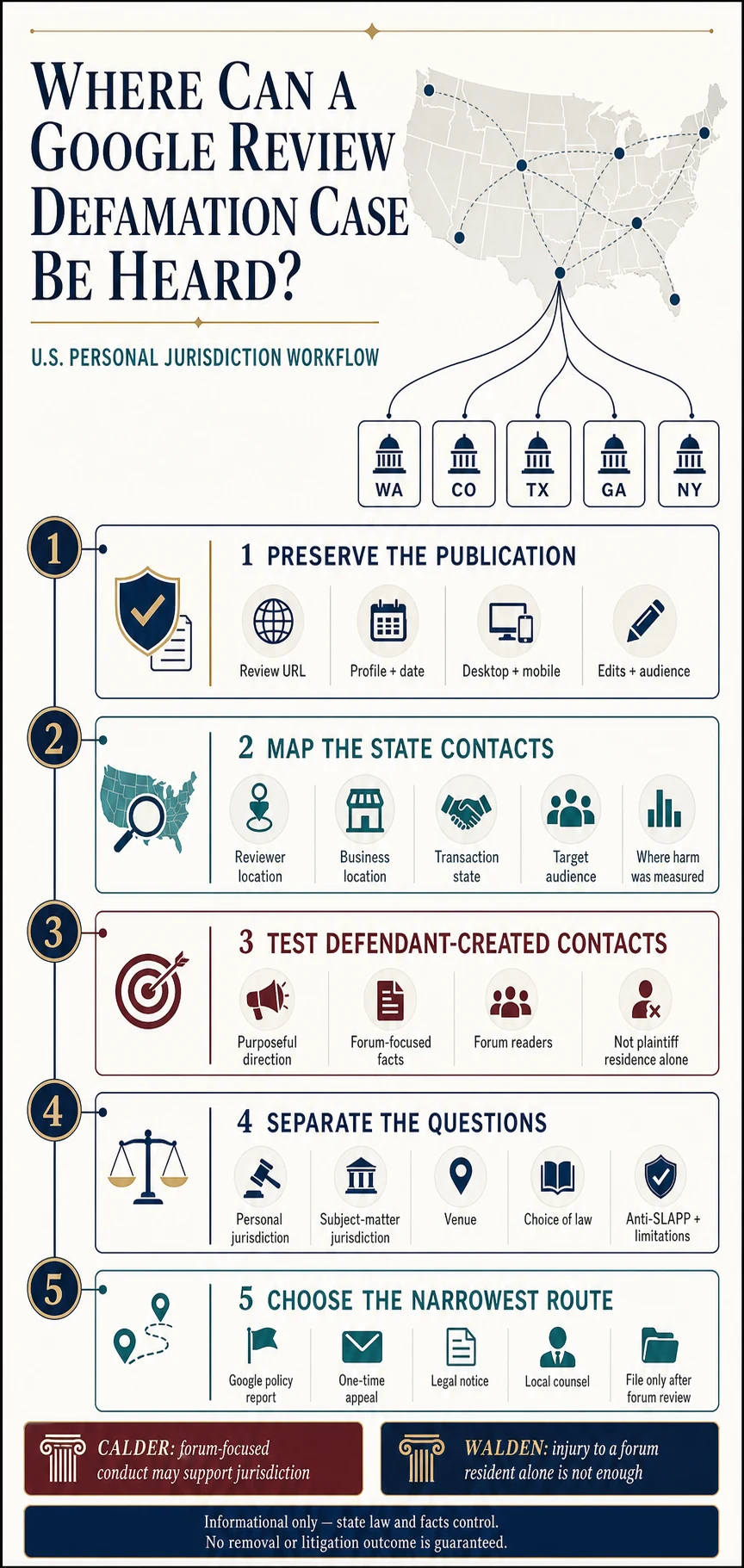
The evidence file should begin before anyone contacts the reviewer. Preserve the review URL, profile URL, display name, star rating, full text, photos, visible edit history, publication date, Google Business Profile context, local-search position if relevant, and screenshots from desktop and mobile where possible. Then compare the allegations with the exact review and profile URLs, complete desktop and mobile captures, publication and edit dates, reviewer communications, transaction location, branch and customer records, the Business Profile location, audience and impression evidence by state where available, the reviewer's forum-directed conduct, witnesses, harm records, proposed defendants, service information, and a state-by-state contact chronology. A no-match conclusion should identify which systems were searched, who searched them, when, and what limitations remain.
The strongest file is a sentence-by-sentence table. One column quotes the exact words. One column states what an ordinary reader may understand. One column classifies the phrase as opinion, hyperbole, insult, factual accusation, private information, threat, fake-engagement signal, or off-topic content. Other columns identify proof for and against, non-confidential evidence that can be shown to Google, private evidence reserved for counsel, response risk, and potential harm.
- Save the review, profile, URL, screenshots, star rating, images, publication date, edit evidence, and Business Profile context.
- Compare the challenged statements with the exact review and profile URLs, complete desktop and mobile captures, publication and edit dates, reviewer communications, transaction location, branch and customer records, the Business Profile location, audience and impression evidence by state where available, the reviewer's forum-directed conduct, witnesses, harm records, proposed defendants, service information, and a state-by-state contact chronology.
- Preserve negative checks: no booking found, no invoice found, no matching visit, no branch record, or a partial match with inaccurate allegations.
- Keep confidential records separate from the Google submission; summarize sensitive facts instead of uploading private customer, staff, payment, health, student, legal, or HR data.
- Document harm with contemporaneous proof such as prospect questions, canceled bookings, rating movement, sales impact, staff concern, partner concern, and report or appeal outcomes.
- Create one chronology that tracks first discovery, preservation, internal review, Google reports, appeals, notices, public responses, and any off-platform messages.

Platform-Policy Angle
Google's own review-reporting workflow should be used with a moderator-readable file. The submission should identify the exact review, the policy category, the non-confidential facts that support the category, and the requested action. For this topic, the likely policy angle may involve Google fake engagement, content not based on a genuine experience, misrepresentation, harassment, personal information, or unsubstantiated allegations of unethical or criminal conduct, while keeping the constitutional forum analysis separate from the product-policy submission. The important point is precision: a review may be legally troubling but still require a policy explanation before Google can act.
Google's prohibited and restricted content policy is the operational map. It covers categories such as fake engagement, misrepresentation, harassment, personal information, off-topic content, and conflicts of interest. A business should not ask Google to decide every state-law issue. It should explain why the review fails Google's own rules and support that explanation with a concise chronology. If the problem includes review extortion, use Google's dedicated extortion route as well as the ordinary review-reporting route where the facts fit.
The business must also avoid becoming the policy problem. The FTC Consumer Reviews and Testimonials Rule Q&A states that the federal rule went into effect on October 21, 2024 and addresses deceptive or unfair conduct involving consumer reviews and testimonials. A harmed business should not buy counter-reviews, pressure customers to edit truthful criticism, create insider reviews without proper controls, review-gate only happy customers, or make groundless public accusations to suppress a lawful review.
Personal Jurisdiction Is Only One Of Four Forum Questions
A business deciding where to act should separate personal jurisdiction, subject-matter jurisdiction, venue, and choice of law. Personal jurisdiction asks whether this court may bind this defendant. Subject-matter jurisdiction asks whether this type of court may hear this type of dispute. Venue asks which geographic court location is statutorily proper. Choice of law asks which jurisdiction's substantive rules govern particular issues. The same state may appear in all four answers, but that result should be demonstrated rather than assumed.
This separation matters for Google reviews because publication is distributed and the commercial relationship may cross state lines. A Texas business may have a California Business Profile, a reviewer domiciled in Nevada, an online purchase shipped from Arizona, and customers who read the review nationwide. Those contacts do not let management choose any preferred court. Each proposed defendant and claim needs its own forum analysis, while a Google policy report can proceed independently.
Start With The Defendant, The State Long-Arm Rule, And Due Process
For most federal cases, Federal Rule of Civil Procedure 4(k)(1)(A) links personal jurisdiction to whether the defendant is subject to a court of general jurisdiction in the state where the federal district court sits. State courts likewise begin with the applicable long-arm statute or rule. Some state provisions reach as far as federal due process permits; others use enumerated acts or wording that requires a separate statutory fit. Counsel should test both layers rather than cite minimum contacts and skip state authorization.
Identify the person or entity to be bound by the judgment. A review may be written by an individual, posted through a shared profile, encouraged by a competitor, or repeated by a separate speaker. Contacts should not be pooled casually. Record what each proposed defendant did, where the conduct was directed, which transaction it concerned, who the expected readers were, and how the claim arises from those contacts. Headquarters and the place where management first noticed the review are facts, not automatic jurisdictional conclusions.
Calder Supports A Forum-Focused Effects Analysis, Not A Home-State Shortcut
In Calder v. Jones, the Supreme Court upheld California jurisdiction over Florida-based writer and editor defendants in a libel case. The allegedly libelous story concerned the plaintiff's California activities, drew on California sources, was published in a magazine with its largest circulation in California, and caused the brunt of the alleged reputational injury there. California was the focal point of both the story and the harm. That combination—not residence alone—supported the result.
A Google-review file should look for forum-focused conduct. Did the review identify a particular branch and describe a transaction there? Did the reviewer communicate with employees in that state, attach a receipt from that location, select a state-specific Business Profile, or direct readers in that market to avoid the business? Did the reviewer repeat the accusation in local groups or contact local customers, regulators, press, or partners? Those facts may connect the defendant's conduct to the forum, but still require state-specific analysis.
Walden Requires Defendant-Created Contacts With The Forum Itself
Walden v. Fiore supplies the essential limit. The Supreme Court held that the defendant's relationship with a plaintiff or third party, standing alone, is not enough; the defendant's own conduct must create the necessary connection with the forum state itself. Mere injury to a forum resident is not a sufficient connection. Walden explained Calder as a case where the publication connected the defendants to California readers and California-focused events, not merely to a plaintiff who lived there.
Evidence that revenue loss was booked at headquarters can help document damages, but may not prove reviewer-created contacts with that state. A demand letter should not say jurisdiction is obvious because the reviewer knew where the company was incorporated or executives felt the impact there. Counsel should identify additional forum conduct: the targeted location, audience, transaction, communications, distribution, or another deliberate connection that makes the state part of the defendant's conduct and the dispute.
Keeton Shows Why Deliberate Forum Distribution And Audience Matter
In Keeton v. Hustler Magazine, the Supreme Court held that regular circulation of the defendant's magazine in New Hampshire supported jurisdiction in a libel action based on that publication. The defendant deliberately exploited the forum market, and the claim arose from the contents distributed there. A Google reviewer is not automatically comparable to a national publisher, and Google's nationwide availability should not be attributed to the reviewer without analysis. The case directs attention to deliberate distribution, forum readers, and the relationship between the contact and the claim.
Preserve the Business Profile's physical location, category, service area, branch name, language, and local-search setting. Record whether the review describes a location-specific event or is a generalized campaign against a national brand. Save state-specific reposts and direct outreach separately. Do not claim national jurisdiction merely because Google Search can display the review in every state. Accessibility, foreseeable injury, and purposeful forum-directed conduct are different concepts.
Build A State-Contact Matrix Before Choosing A Forum
Create one column for each plausible state and one row for each contact. Rows should include reviewer domicile and physical location when known; entity and branch locations; transaction, service, delivery, and complaint locations; Business Profile location; sources used by the reviewer; communications sent into or from the state; intended and actual audience evidence; repeat publications; witnesses; records; reputational relationships; measured harm; service options; and any contractual forum or law clause counsel must assess. Add a source citation for every factual cell.
- Mark whether each contact was created by the proposed defendant, the business, Google, a customer, or an unrelated third party.
- Link each contact to the precise claim; a contact relevant to a transaction may not support a later defamation claim in the same way.
- Separate known facts from inferences; a display name, accent, or review history rarely proves domicile by itself.
- Preserve contrary facts showing the transaction, drafting, publication, or primary audience was centered elsewhere.
- Use a defendant-by-defendant sheet where several reviewers, agencies, employees, competitors, or republishers may be involved.
- Record when each contact occurred because later activity may not establish jurisdiction for an earlier publication.
Audience And Harm Evidence Need More Than A Headquarters Assumption
Preserve customer and prospect messages that identify the review, cancellations tied to a branch, local partner concerns, state-specific sales inquiries, and lawful analytics showing where affected readers or searchers were located. Keep the underlying records, not only a management summary. Do not overstate platform analytics: impressions do not necessarily prove that a particular person read, understood, believed, or acted on the challenged statement.
The damages and jurisdiction files overlap but are not identical. Lost sales in the home state can support harm while leaving a gap in defendant-created contacts. Purposeful targeting of a branch may support a forum connection even before substantial loss can be quantified there. Label each record by the proposition it actually supports so a demand or complaint does not use one fact as proof of every element.
Federal Court Is Not An Automatic National Forum
A state-law defamation claim does not enter federal court merely because the review appeared on a national platform. One possible basis is diversity jurisdiction under 28 U.S.C. Section 1332, which includes citizenship and amount-in-controversy requirements that counsel must apply to the actual parties and claims. Even when subject-matter jurisdiction exists, personal jurisdiction, service, and venue remain separate. Filing federally does not erase state personal-jurisdiction limits for an ordinary diversity case.
Citizenship analysis can be technical for corporations, limited liability companies, partnerships, foreign parties, and pseudonymous defendants. The amount in controversy should be supported rather than inflated. Identifying an anonymous reviewer, joining additional defendants, or discovering a party's true citizenship may change the federal jurisdiction picture. Resolve those questions before public statements announce a federal lawsuit as inevitable.
Venue, Transfer, And Choice Of Law Can Change The Litigation Map
For federal civil actions, 28 U.S.C. Section 1391 includes venue in a district where defendants reside when its conditions are met or where a substantial part of the events or omissions giving rise to the claim occurred. Venue is not proven merely by subject-matter or personal jurisdiction. Map the operative review, transaction, drafting, publication, audience, and injury facts to judicial districts, not only states.
Even a proper federal venue may face a transfer request. 28 U.S.C. Section 1404(a) permits transfer for party and witness convenience and the interest of justice to a district where the action might have been brought, subject to the statute. Witness locations, records, compulsory process, related proceedings, and cost therefore matter. A forum that looks attractive may be expensive, vulnerable to transfer, or disconnected from the evidence.
Governing law is separate. In Klaxon Co. v. Stentor Electric Manufacturing Co., the Supreme Court held that a federal court sitting in diversity applies the choice-of-law rules of the state in which it sits. That rule does not itself select the substantive law for the dispute. Counsel must apply the forum's conflicts methodology to issues such as defamation elements, privileges, fault, damages, limitation periods, retraction rules, and anti-SLAPP procedure.
Anonymous Reviewer Identity Requires A Two-Stage Plan
A visible profile may not establish identity, domicile, or forum contacts. Preserve the profile URL, contribution history, text, images, dates, edits, linked sites, and lawful communications, but distinguish observation from attribution. A first-stage case may involve pre-suit discovery or a placeholder defendant under forum-specific procedure. The court still needs an adequate basis to act, and service, speech protections, subpoena procedure, and evidentiary thresholds may apply before identifying information is disclosed.
Do not send subpoenas based on guessed identity or publicly name a suspected reviewer. Work backward from the information needed: account-identifying records, subscriber data, specific communications, or proof of forum direction. Counsel should assess the Stored Communications Act, platform process, notice to the speaker, and any state anonymous-speech test. Meanwhile, preserve the public evidence and pursue ordinary Google reporting when a policy category fits.
Google Reporting And Forum Analysis Run In Parallel
Google's current Business Profile review-reporting guidance says only policy-violating reviews are eligible for removal and warns that disagreement alone is insufficient. The prohibited and restricted content policy includes fake engagement, non-genuine experience, misrepresentation, harassment, personal information, and unsubstantiated allegations of unethical behavior or criminal wrongdoing. Personal jurisdiction is not a Google policy category, so the submission should focus on the exact product rule and non-confidential proof.
If counsel identifies a legal basis, Google's Defamation Overview and legal-reporting guidance describe a separate route. Use exact URLs and challenged words without implying a preferred court has accepted jurisdiction. A rejected Google report does not establish that a court has jurisdiction or that the review is lawful. A Google removal does not establish liability or damages.
Escalation Criteria For A Multi-State Review Dispute
- Escalate before a demand or filing when the reviewer, business, transaction, audience, and alleged harm connect to several states.
- Escalate when the business relies mainly on headquarters injury and cannot identify defendant-created contacts with that state.
- Escalate when limitation, retraction, anti-SLAPP, or fee-shifting rules may differ among candidate forums.
- Escalate when identity is uncertain or service and discovery may be needed before the merits can be tested.
- Escalate when several defendants or republications require separate contacts, venue, privilege, and choice-of-law analyses.
- Escalate when measurable harm grows, a regulator or insurer is involved, or management wants to announce litigation.
The deliverable should be a short forum memorandum, not a list of states ranked by perceived friendliness. It should identify parties and claims, candidate courts, long-arm basis, defendant-created contacts, claim connection, service, subject-matter basis, venue, governing-law risks, limitation dates, anti-SLAPP exposure, evidence burdens, alternatives, and unknown facts. That document makes a Google appeal, private resolution, legal notice, or lawsuit easier to evaluate without promising an outcome.
Public Response Strategy
The public response should be written for future readers, Google, and a later evidence file. It should usually be short, factual, and privacy-safe. The business can state that it takes the matter seriously, that available records are being reviewed, and that the reviewer can contact an official private channel. The response should not disclose the evidence package. The main risk here is announcing that the business will sue in its home state before counsel tests defendant-created contacts, venue, choice of law, limitation periods, anti-SLAPP exposure, service, and whether a narrower Google policy route is available.
A public reply can become a screenshot in a later platform appeal, regulator complaint, media post, or lawsuit. Avoid calling the reviewer a criminal, extortionist, competitor, ex-employee, fake customer, or liar unless counsel has reviewed the evidence and the business accepts the risk. If the review contains private data, staff names, customer identifiers, health information, payment details, student information, legal-client facts, or HR allegations, the public response should be screened before publication.
Escalation Criteria
Escalation is not a single move. It may mean a stronger Google appeal, a legal-preservation letter, a narrow demand letter, private outreach, subpoena-readiness review, local counsel referral, law-enforcement consultation for true extortion facts, or a state-law defamation assessment. Escalation is most defensible when the accusation is specific, factual, serious, contradicted by objective records, causing measurable harm, and not adequately addressed by ordinary platform reporting.
Expectations about the platform should remain realistic. 47 U.S.C. Section 230 generally limits attempts to treat an interactive computer service as the publisher or speaker of third-party content. That does not protect the person who wrote a false review, and it does not stop the business from using Google's policy channels. It does mean that a legal strategy aimed directly at the platform needs careful analysis and usually should not be the first assumption.
- Escalate when the review makes a serious factual accusation such as fraud, theft, unsafe conduct, falsified records, discrimination, or professional misconduct.
- Escalate when the reviewer appears to be a non-customer, competitor, former staff member, supplier, transaction opponent, or part of a coordinated pattern.
- Escalate when there are threats, demands for value, personal information, images, harassment, or repeated publication across platforms.
- Escalate when Google rejects a first report because the submission lacked policy framing, chronology, or non-confidential evidence.
- Escalate when a public response would create privacy, employment, consumer-protection, confidentiality, or retaliation risk.
Risk Cautions
The Consumer Review Fairness Act, codified at 15 U.S.C. Section 45b, restricts certain form-contract provisions that prohibit, penalize, or transfer rights in honest consumer reviews. It does not protect fake, defamatory, harassing, confidential, or unlawful content, but it does warn businesses against overbroad anti-review tactics. A removal strategy should target false or policy-violating statements, not silence ordinary criticism.
The second caution is evidentiary discipline. Do not delete internal notes, alter customer records, post confidential documents, offer payment for deletion, send a template threat without reviewing state law, or submit a long emotional narrative to Google. A business should keep one clean file and separate what can be shown publicly, what can be summarized to Google, and what should remain with counsel.
Sources Consulted
- Google Business Profile Help: report inappropriate reviews.
- Google prohibited and restricted content policy.
- Milkovich v. Lorain Journal Co., 497 U.S. 1 (1990).
- New York Times v. Sullivan, actual-malice framework.
- 47 U.S.C. Section 230.
- FTC Consumer Reviews and Testimonials Rule Q&A.
- 15 U.S.C. Section 45b, Consumer Review Fairness Act.
- Calder v. Jones, 465 U.S. 783 (1984).
- Walden v. Fiore, 571 U.S. 277 (2014).
- Keeton v. Hustler Magazine, Inc., 465 U.S. 770 (1984).
- Federal Rule of Civil Procedure 4(k).
- 28 U.S.C. Section 1332, diversity jurisdiction.
- 28 U.S.C. Section 1391, federal venue.
- 28 U.S.C. Section 1404, transfer of venue.
- Klaxon Co. v. Stentor Electric Manufacturing Co., 313 U.S. 487 (1941).
- Google Maps user-generated content policy.
- Google Legal Help: Defamation Overview.
- Google Legal Help: report content for legal reasons.
Practical Conclusion
A multi-state Google review dispute needs a forum map before it needs a complaint. Preserve the publication, identify defendant-created contacts with each candidate state, separate jurisdiction from venue and governing law, keep Google reporting on its own policy track, and obtain forum-specific advice before threatening or filing suit.
Pimlegal's preliminary role is to organize the review evidence, frame the platform policy route, keep the public response proportionate, and identify when the matter should move to U.S. counsel for jurisdiction-specific legal advice. This article is general information only. It does not guarantee review removal, identify a final legal remedy, or replace state-specific counsel review.