
A Google review that says a physician is incompetent, an accountant cannot be trusted with records, a contractor is unqualified, or a lawyer does not understand the field can strike at the center of a professional business. In the United States, however, the phrase 'defamation per se' is not a shortcut to removal or liability. State law differs, the exact words and context matter, constitutional protections still apply, and a business must separate a provably false factual assertion from an insult, rating, or subjective evaluation.
This guide focuses on accusations of professional or business unfitness: statements that purport to describe a person's competence, qualifications, honesty, or fitness to perform a particular trade or profession. It explains why a September 2026 Idaho Supreme Court decision matters, how to build a record without overstating the case, how Google's policy route differs from a state-law claim, and when a measured response is safer than a legal threat. It is informational only and does not predict whether any review will be removed or whether any claim will succeed.

Recent Development: Taylor v. Davis (September 25, 2026)
On September 25, 2026, the Idaho Supreme Court issued its official opinion in Taylor v. Davis, Docket No. 52831. The case arose from statements made during a media interview about a business dispute; it was not a Google-review case. The trial court had instructed the jury that defamation per se required an accusation of imprisonable criminal conduct or a crime involving moral turpitude. The Idaho Supreme Court held that instruction was incomplete because Idaho also continues to recognize a traditional category for statements imputing conduct, characteristics, or a condition incompatible with the proper conduct of a lawful business, trade, or profession.
The court vacated the judgment and remanded for a new trial. Its official staff summary emphasizes an important limit: not every statement that harms a professional reputation qualifies. The alleged unfitness must connect to specific aspects of the plaintiff's profession. The opinion did not decide that the challenged statements were false, did not enter liability for the plaintiff, did not award damages, and did not create a nationwide rule. The remand means further proceedings were required, and public materials reviewed for this article do not establish the final result of those proceedings or any later appellate activity.
The practical connection to Google reviews is direct but limited. Consumer reviews frequently use competence language: 'cannot diagnose,' 'does not know the code,' 'unlicensed,' 'fabricated the inspection,' 'ignored basic accounting rules,' or 'is not qualified to do this work.' Taylor is a timely reminder that a state may treat a sufficiently specific and false professional-unfitness accusation as a per se category, but only after the court applies that state's law to the exact words, occupation, context, falsity, fault, and defenses. Businesses should not transplant Idaho's holding into another state or treat every one-star review as presumed-damages defamation.
Legal Issue Framing: Start With The Exact Assertion
The starting point is ordinary defamation structure, not the label attached by the business. Cornell's defamation overview describes the tort as involving a false statement purporting to be fact, publication or communication to a third person, fault, and reputational harm, subject to state variation and constitutional limits. A written online review will generally be analyzed as libel, but the elements, privileges, limitation periods, pleading rules, anti-SLAPP procedures, and damages doctrines vary across jurisdictions.
Break the review into propositions. 'I would never hire this person again' is a consumer choice. 'The work felt careless' may be an evaluative judgment. 'The architect did not have a license on the project date,' 'the accountant altered the books,' or 'the surgeon performed a procedure outside the authorized specialty' communicates a more concrete and verifiable factual proposition. A review can combine all three. The business should identify the precise sentence it challenges and the objective records that would prove or disprove that sentence, rather than treating the review's overall hostility as the legal issue.
Professional-Unfitness Defamation Per Se Is State-Specific
Traditional per se categories have often included false statements charging serious crime, certain disease, serious sexual misconduct, or professional incompetence or unfitness. Cornell's libel per se overview also cautions that context and alternative meanings matter. The doctrine can affect whether a claimant must plead or prove particularized economic loss, but it does not erase the need for a defamatory factual meaning, falsity, publication, the applicable degree of fault, and the absence of a controlling privilege or constitutional protection.
There is no single federal defamation code for Google reviews. One state may define business-unfitness narrowly and require a tight relationship between the accusation and the skills of the occupation. Another may use different categories, distinguish libel from slander, limit presumed damages, or require proof of actual harm in circumstances involving public concern. A company operating in several states may also face questions about where publication occurred, which state has the strongest relationship to the dispute, and whether the claimant is the individual professional, the employing entity, or both.
For the broader damages framework, PimLegal maintains a separate United States guide to defamation per se and Google reviews. The operational removal and escalation routes are summarized on the United States Google review removal page. These are the only two internal links in this article.
Fact, Opinion And Context Still Control
The Supreme Court's decision in Milkovich v. Lorain Journal Co. rejects a blanket rule that anything introduced as opinion is automatically protected. The question is whether the challenged language can reasonably be understood to imply a provably false assertion of fact. At the same time, loose rhetoric, obvious hyperbole, a star rating, or a disclosed personal evaluation may not communicate the kind of verifiable assertion on which a defamation claim can rest.
Review-platform context matters. Readers expect ratings, frustration, shorthand, and personal judgment. That expectation does not immunize a fabricated credential accusation or a concrete false claim about professional conduct, but it may change how a reasonable reader understands words such as 'awful,' 'incompetent,' 'amateur,' or 'scam.' Read the title, star rating, entire review, attachments, owner response, and any linked facts together. Do not isolate one adjective if the surrounding text makes it an unverifiable evaluation, and do not ignore a factual accusation merely because it appears next to opinion language.
Constitutional Fault And Falsity Cannot Be Skipped
Constitutional rules may alter the burden depending on the claimant and subject. New York Times Co. v. Sullivan supplies the actual-malice standard for public officials, and Gertz v. Robert Welch, Inc. addresses private figures and state-law flexibility subject to First Amendment limits. Actual malice is a term of art: knowledge of falsity or reckless disregard for truth, not ill will, anger, or the use of harsh language.
The subject of the speech matters too. Philadelphia Newspapers v. Hepps addresses the falsity burden in speech involving a matter of public concern, while Dun & Bradstreet v. Greenmoss Builders illustrates that speech on purely private matters can occupy a different constitutional position. A Google review about an ordinary private transaction may not be treated the same way as a review alleging risks to patients, public safety, financial integrity, licensed services, or a matter already under public investigation. Counsel should classify that issue before anyone assumes damages are presumed.
Evidence Checklist: Preserve The Review Before It Changes
Preservation should occur before a public reply, private demand, or platform report. Reviews can be edited, removed, shortened, supplemented with photos, or reposted from another profile. Capture the full screen and the review's direct context, not only a cropped sentence. Record the date and time, public URL, reviewer name as displayed, profile link, star rating, full text, images, owner responses, surrounding review count, and any visible edit marker. Keep the original files and a simple chain-of-custody note showing who collected them and how.
- Save full-page screenshots and a PDF or web archive showing the review in its original Business Profile context.
- Record the exact URL, collection date, device or browser, displayed reviewer name, profile link, rating, text, attachments, and visible edit history.
- Preserve notifications, Google emails, prior reports, appeal identifiers, owner responses, and any direct messages with the reviewer.
- Identify every concrete competence, license, qualification, safety, honesty, or professional-conduct assertion separately.
- Document later edits with a new capture; do not overwrite the first version or rely on memory to describe the change.

Evidence Checklist: Test The Underlying Professional Claim
The second file should test the merits. Match the review to the correct customer, patient, client, matter, order, property, project, appointment, or branch without assuming identity from a display name. Pull the records that address the exact professional accusation: license status on the relevant date, scope-of-practice rules, engagement terms, credential records, work product, inspection logs, approvals, change orders, communications, billing, complaint notes, quality controls, and any regulator or insurer correspondence. Record both confirming and contradictory evidence.
A business should not build a litigation file by excluding inconvenient facts. If the professional made an error, the customer experienced a real delay, a license record was temporarily unclear, or the service fell below an internal standard, document it. Substantial truth can defeat a defamation theory even when some details are inaccurate. A mixed record may call for remediation and a restrained response, not a claim that the reviewer fabricated everything. Counsel needs the unfavorable facts early to assess truth, materiality, privilege, fault, and risk.
Separate Individual, Entity And Location Harm
A review may target an individual professional, the company, a branch, or an unidentified team. Those are not interchangeable claimants. Ask who is actually named or reasonably identifiable, who provided the service, which entity owns the Business Profile, and whose reputation the words concern. A statement about one employee may not necessarily be 'of and concerning' the company, while a statement about company-wide qualifications may affect the entity and several licensed professionals. Keep the identity analysis separate from the seriousness of the accusation.
The distinction also affects evidence and public response. A company may have transaction records but lack authority to disclose an employee's licensing or disciplinary history publicly. An individual professional may have a personal claim but be bound by confidentiality, healthcare, education, employment, or professional-conduct rules. The Business Profile owner should not expose private records merely to demonstrate that the wrong person, entity, or branch was blamed.
Platform-Policy Angle: Use Google's Rules, Not A Mini-Brief
Google's prohibited and restricted content policy says contributions should reflect genuine experiences and prohibits categories including fake engagement, misrepresentation, harassment, personal information, and certain conflicts of interest. It specifically addresses false or misleading accounts of the description or quality of a good or service. Google's broader user-generated content policy also explains that content may be removed for policy violations or legal obligations. Those standards are operational rules; they are not a judicial finding of defamation.
Use the ordinary route described in Google's review-reporting guidance when the strongest argument fits a platform category. Quote the exact sentence, select the most accurate policy ground, and provide concise non-confidential context. Do not upload an entire client file, repeat protected information, or demand removal merely because the review is damaging. A moderator needs a narrow explanation of why the content violates policy, not a long memo predicting a state-law verdict.
Legal-Removal Notices Require A Different Showing
If the dispute cannot be framed adequately as an ordinary policy violation, Google's legal-reporting guidance provides a separate route for content alleged to violate law. Google's defamation overview warns that defamation law varies by country and local jurisdiction. A legal notice should therefore identify the exact URL and wording, claimant, jurisdiction, legal basis, and supporting public or non-confidential facts. It should not simply paste the phrase 'defamation per se' into a form.
A legal request should also explain material limits. If the review contains both protected opinion and a disputed factual assertion, identify the factual part. If proceedings are pending, describe them accurately. If there is no court order, do not imply that a court has adjudicated falsity. If the only authority is Taylor, explain that it is an Idaho decision concerning jury instructions and business-unfitness defamation per se, not a nationwide order directing Google to remove reviews.
Public Response Strategy: Protect The Record
A public reply should address future readers without trying the case online. A useful response can acknowledge the concern, state that professional standards are taken seriously, note that the business cannot discuss private details publicly, and invite contact through a controlled channel. If records show the reviewer has the wrong entity or location, a neutral correction may be appropriate. If the accusation is under internal or regulatory review, avoid absolute denials until the file is complete.
Do not accuse the reviewer of lying, extortion, professional jealousy, criminal conduct, or being a competitor without evidence and counsel review. Do not reveal patient, client, student, employee, payment, disciplinary, or licensing details that are not already lawfully public. Do not ask staff, family, or loyal customers to overwhelm the review with positive posts. The response can itself become evidence of publication, fault, retaliation, review manipulation, or breach of confidentiality.
FTC And Review-Fairness Cautions
The FTC's official Consumer Reviews and Testimonials Rule materials address fake or false reviews, sentiment-conditioned incentives, undisclosed insider reviews, company-controlled review sites presented as independent, review suppression, and fake social indicators. A business facing an unfitness accusation should not create a second problem by buying favorable reviews, conditioning refunds on a positive revision, or using an unjustified threat to suppress honest negative feedback.
The Consumer Review Fairness Act, codified at 15 U.S.C. Section 45b, restricts certain form-contract terms that prohibit or penalize honest consumer reviews. It does not immunize defamatory, harassing, confidential, or unlawful content. The practical lesson is narrower: target the specific false factual assertion or policy violation, not the customer's right to express a negative experience. Avoid contract clauses or settlement language that broadly silence lawful criticism without jurisdiction-specific review.
Escalation Criteria
Escalation becomes more defensible when the review makes a specific, verifiably false accusation about a license, qualification, safety duty, regulated procedure, financial integrity, or required professional skill; the statement is tied directly to the occupation; objective records contradict it; and the publication is causing measurable harm. Urgency also increases when the review is coordinated, repeated across profiles, paired with threats or demands, presented through fabricated documents, or attracting media, regulator, insurer, lender, marketplace, hospital, school, or licensing-board attention.
Counsel should usually review the file before a demand letter or lawsuit when the reviewer is in another state, the claimant is arguably a public figure, the subject involves public concern, anti-SLAPP law may apply, privileged proceedings are involved, the review is substantially true in part, or the business cannot rebut it without disclosing protected information. State limitation periods and pre-suit requirements can be short. The goal is not maximum pressure; it is a proportionate route that preserves valid claims without manufacturing fee, retaliation, confidentiality, or consumer-protection exposure.
Risk Cautions Before Suing Or Naming Google
A weak professional-unfitness claim can amplify the review, trigger anti-SLAPP procedure, increase fees, expose internal records through discovery, and generate a second story about the dispute. Presumed damages do not mean automatic or unlimited damages, and a per se category does not guarantee that the words are factual, false, unprivileged, about the claimant, or published with the required fault. A court may also find that the accusation is rhetorical opinion, substantially true, or not sufficiently connected to the plaintiff's occupation.
A strategy aimed at Google requires additional caution. 47 U.S.C. Section 230 generally limits treating an interactive computer service as the publisher or speaker of third-party content, subject to the statute and the specific claim. The reviewer remains responsible for their own speech, and Google's voluntary policy and legal-reporting channels remain available. But a business should not assume the platform is the primary defamation defendant or that sending Google an unadjudicated accusation compels removal.
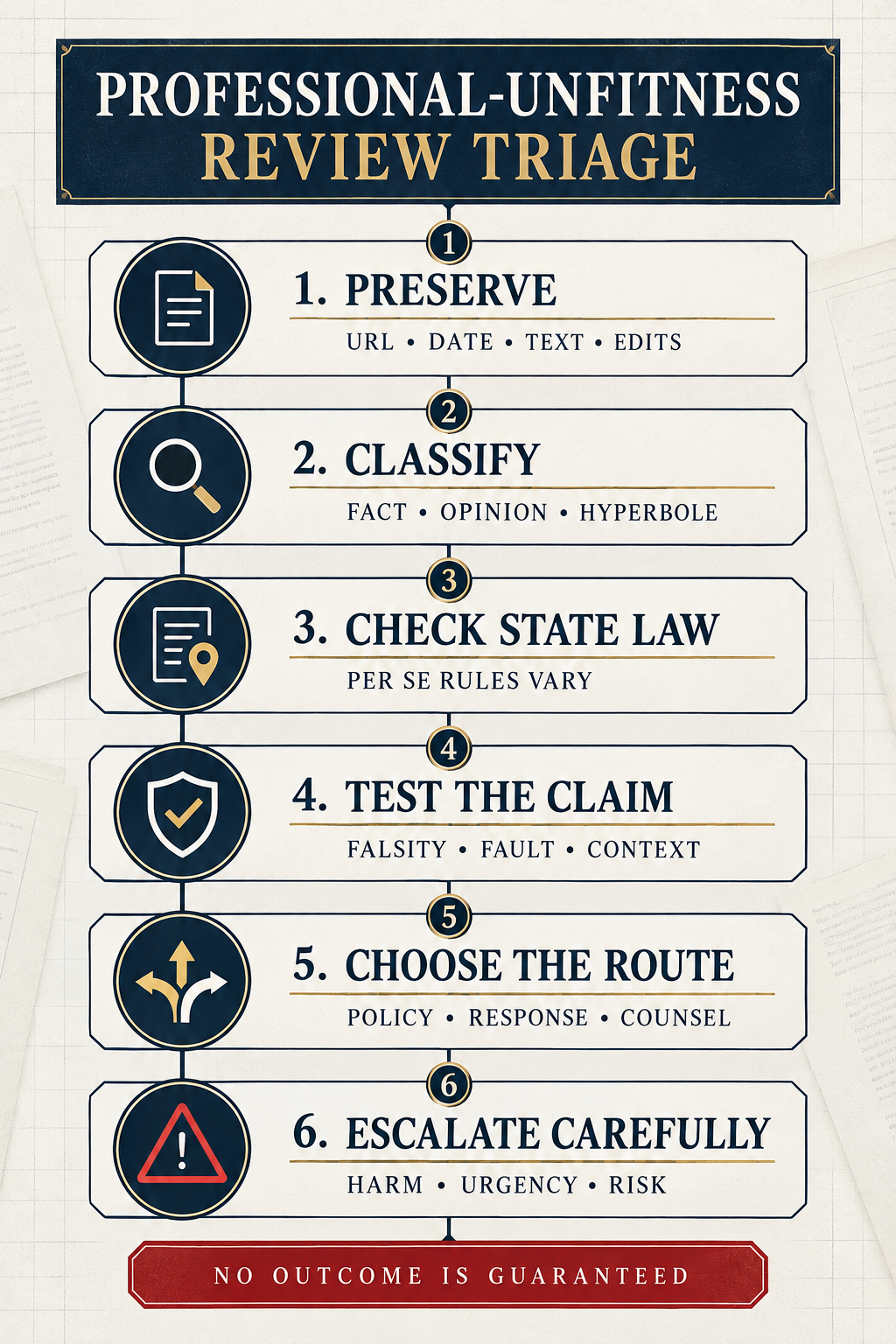
A Practical Decision Sequence
- Preserve the complete review, profile, attachments, URL, dates, edit history, reports, and owner responses.
- Classify each challenged phrase as potential fact, disclosed opinion, evaluation, or rhetorical hyperbole in its full context.
- Identify the claimant, occupation, publication states, applicable law, public-concern issues, privileges, and anti-SLAPP exposure.
- Test falsity and fault against licensing, scope, transaction, work-product, quality, communications, and harm records, including unfavorable facts.
- Choose the narrowest suitable route: internal remediation, short public reply, Google policy report, appeal, legal notice, or counsel-led action.
- Escalate only when the factual basis, jurisdiction, urgency, proportionality, confidentiality plan, and litigation risk have been reviewed.
Sources Consulted
- Idaho Supreme Court, Taylor v. Davis, Docket No. 52831 (September 25, 2026), official opinion.
- Idaho Supreme Court staff summary of Taylor v. Davis.
- Cornell Legal Information Institute, defamation overview.
- Cornell Legal Information Institute, libel per se overview.
- Milkovich v. Lorain Journal Co., 497 U.S. 1 (1990).
- New York Times Co. v. Sullivan constitutional standard.
- Gertz v. Robert Welch, Inc., 418 U.S. 323 (1974).
- Philadelphia Newspapers, Inc. v. Hepps, 475 U.S. 767 (1986).
- Dun & Bradstreet, Inc. v. Greenmoss Builders, Inc., 472 U.S. 749 (1985).
- Google Maps prohibited and restricted content policy.
- Google Maps user-generated content policy.
- Google Business Profile review-reporting guidance.
- Google guidance for reporting content for legal reasons.
- Google Legal Help defamation overview.
- FTC Consumer Reviews and Testimonials Rule materials.
- 15 U.S.C. Section 45b, Consumer Review Fairness Act.
- 47 U.S.C. Section 230.
Practical Conclusion
The September 25, 2026 Taylor decision is important because it confirms that Idaho still recognizes a professional or business-unfitness category of defamation per se and requires a real connection between the statement and the occupation. It does not convert every harsh review into a claim, decide the ultimate truth of the Taylor statements, or establish a national removal rule. For a Google review, the strongest response begins with the exact wording, state-specific law, a complete evidence record, and a separate assessment of platform policy.
A business should preserve first, classify carefully, investigate honestly, and choose the least risky effective route. Some files belong in an ordinary Google report. Some call for a restrained public response or operational correction. A smaller group may justify a legal notice or state-specific counsel review. None of those paths guarantees removal, damages, or any legal outcome. This article provides general information and is not legal advice for a particular review, person, profession, or jurisdiction.