
A practical U.S. guide for businesses deciding whether a bad Google review can be removed, answered publicly, appealed, or escalated through a legal route without turning ordinary criticism into a compliance problem. A bad Google review is not automatically removable. A review can be unfair, exaggerated, emotional, or commercially painful and still remain online if it describes a genuine customer experience without violating Google's policies or U.S. law. The business should therefore start with triage, not with deletion language. Is the review a real customer complaint? Does it contain a Google policy violation? Does it make a provably false factual accusation? Does it expose private information, threaten staff, or involve extortion? Each answer points to a different route.
This article is based on the practical theme in Olly Olly's bad-review removal guide, but it reframes the issue for U.S. businesses that need a legally safer process. The objective is not to promise that every bad review can disappear. The objective is to decide when to report, when to respond, when to appeal, when to preserve a legal file, and when the safest business decision is to improve the underlying service issue while keeping the response calm and credible.
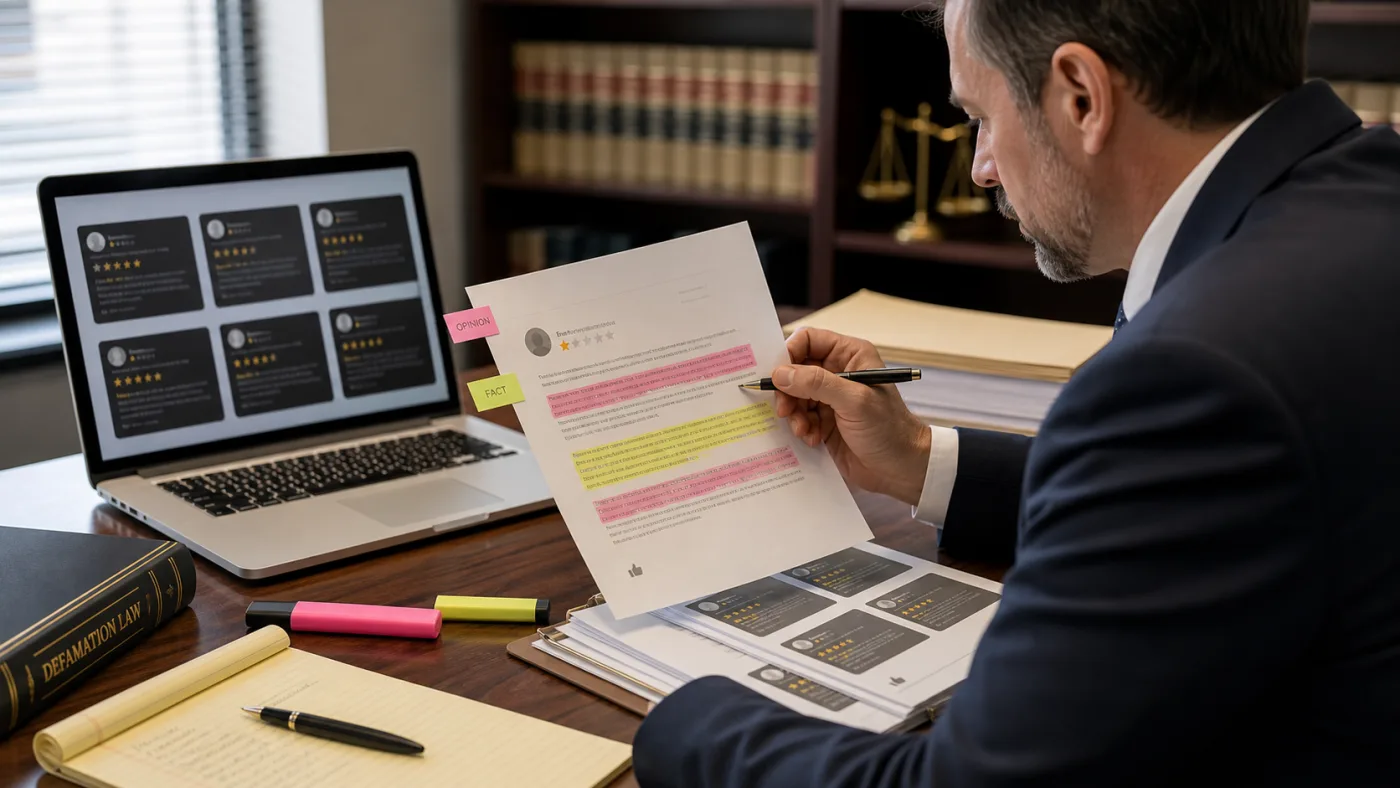
First Question: Is The Review Bad Or Removable?
Many businesses use the word bad to describe every one-star review. Google uses narrower categories. A review may be bad because a customer says the food was cold, the dentist was late, the hotel room was noisy, the contractor missed a deadline, or the staff was rude. Those statements may be ordinary customer opinion even if management disagrees. By contrast, a review may be removable if it is fake engagement, spam, off-topic content, impersonation, harassment, personal information, conflict-of-interest content, or content that presents serious unsupported wrongdoing as fact.
Google's current Business Profile review-reporting guidance says that reviews are removed only when they violate policy. Google's prohibited and restricted content policy is therefore the operating map, not the business owner's sense of unfairness. Before reporting, classify the review as one of three things: ordinary criticism that needs a response, policy-violating content that needs a Google report, or legally risky content that may need counsel and a more formal path.
That distinction protects the business. Reporting real criticism as fake without a reasonable basis can damage credibility with Google and create consumer-protection risk. Threatening a customer over a lawful complaint can make the review more visible. Posting private records to prove the customer wrong can create privacy or confidentiality exposure. A clean triage file prevents those avoidable mistakes.
Read this with the USA guide to responding to harmful Google reviews and the United States Google review removal page. Those are the two contextual internal links used in this article: one response workflow and one country-service page.
Preserve The Review Before You Decide The Route
Even when the first move may be a public response rather than a removal request, preserve the evidence. Capture the review URL, reviewer profile, display name, star rating, text, photos, visible date, edit history, owner replies, and the Google Business Profile context. If the review names staff, mentions private information, alleges crime, uses discriminatory language, threatens harm, or appears in a sudden cluster, take screenshots from desktop and mobile and save the surrounding profile context.
Next, compare the review with internal records. Search booking records, order history, invoices, contracts, emails, refund logs, support tickets, branch schedules, phone logs, staff schedules, and complaint notes. The goal is not to publish those records. The goal is to understand whether the review reflects a real experience, a mixed experience with false elements, or no identifiable customer event at all. A no-match conclusion should say which systems were searched, by whom, on what date, and with what limitations.
- Save the full review page, reviewer profile, URL, text, rating, photos, date, edit evidence, and Business Profile context.
- Make a sentence-by-sentence table: opinion, factual claim, policy issue, privacy issue, legal issue, and response risk.
- Search customer records before saying the reviewer is fake or unknown.
- Keep private records out of public replies and ordinary Google submissions unless counsel approves the scope.
- Track first discovery, report date, status, appeal deadline, public response drafts, and any off-platform messages.
When A Bad Review Should Be Reported To Google
A Google report is strongest when the review has a clear policy fit. Report if the reviewer appears not to have had a genuine experience, if the profile is impersonating someone, if the review is from a competitor or conflicted insider, if it posts personal information, if it contains harassment or threats, if it is off-topic, if it uses hate speech or restricted content, or if it is part of suspicious coordinated activity. Choose the closest category rather than calling every bad review spam.
The report should be short and readable. Identify the exact review. Quote the policy-relevant words. Summarize non-confidential evidence. Explain the relationship check. State the category. Ask for removal or review. Do not upload a long angry narrative. Do not attach sensitive customer records if a summary can make the point. Do not use legal conclusions as substitutes for proof. 'This review is defamatory' is usually weaker than a concise explanation of the exact false factual accusation and the Google category that applies.
When A Bad Review Should Be Answered Instead
If the review describes a real experience and does not violate policy, the best route is usually a measured public response plus operational repair. A good response is written for future readers. It thanks the reviewer for the feedback, avoids arguing private facts, states that the business takes the concern seriously, and offers a private channel for follow-up. It does not reveal receipts, medical facts, staff discipline, settlement discussions, security footage, or private messages. It does not accuse the reviewer of lying unless counsel has approved both the evidence and the wording.
Google's manage customer reviews guidance matters because owner replies are public and appear as the business. That makes them useful, but also dangerous. The response can become a screenshot in a later appeal, lawsuit, regulator complaint, or social-media post. If the business plans to report the review as policy-violating, the public response should not contradict the report. If the report says there is no customer record, do not reply as though the visit is remembered.
The FTC angle also matters. The Consumer Reviews and Testimonials Rule Q&A warns businesses to avoid deceptive or unfair review practices. A business should not use false accusations, threats, incentives, or selective review-solicitation tactics to make bad reviews disappear. The Consumer Review Fairness Act at 15 U.S.C. Section 45b also restricts certain anti-review clauses. A lawful response strategy can be firm, but it should not become review suppression.
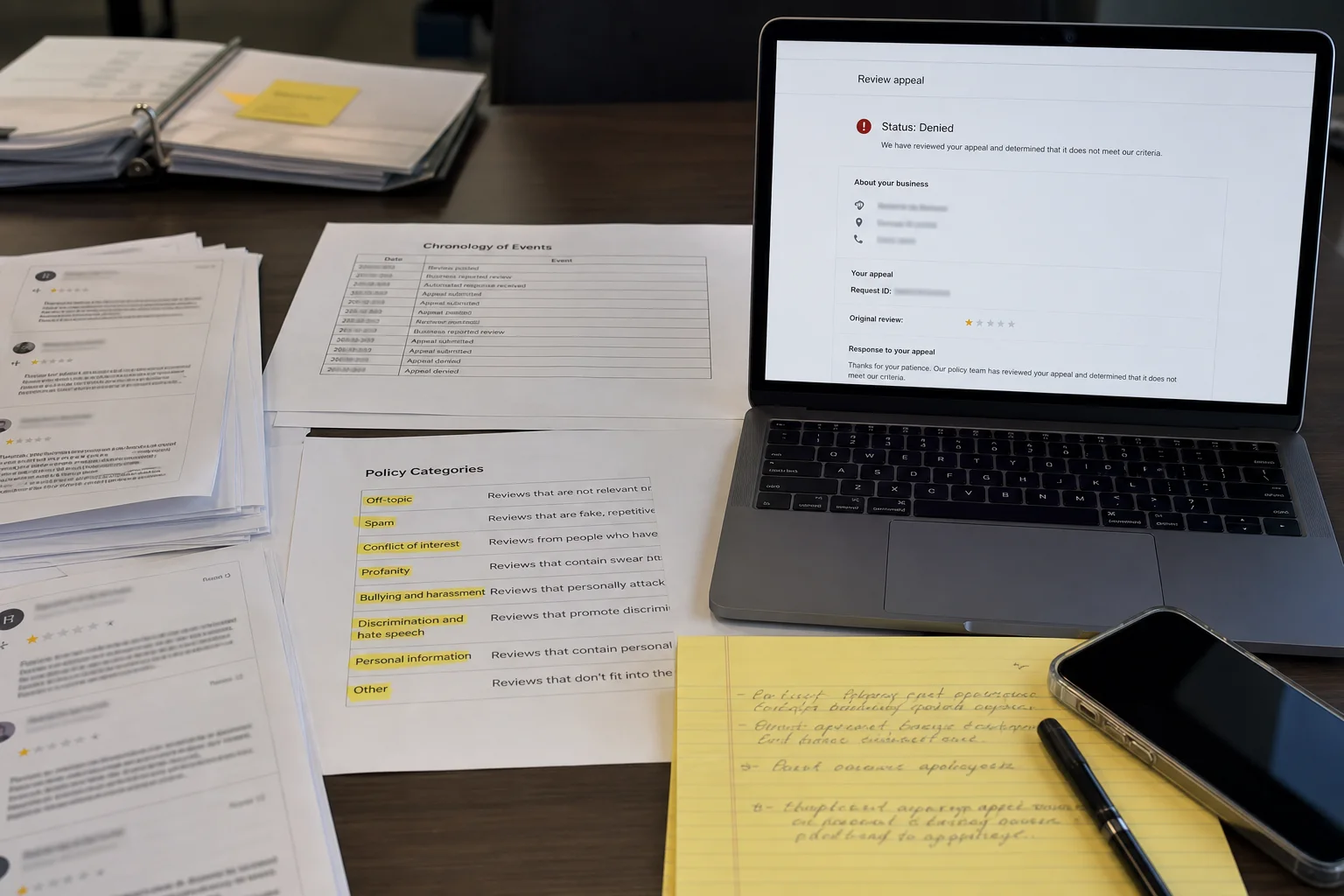
If Google Refuses: Use The Appeal Carefully
A refusal from Google is not always the end of the analysis. It may mean the first report did not show a policy violation clearly enough. Before appealing, rebuild the file. Did the first report choose the wrong category? Did it call a mixed real-customer review fake? Did it omit the customer-record search? Did it fail to identify the exact words that violate policy? Did it rely on confidential records without explaining them? Did the public response make the dispute look like ordinary customer service rather than policy abuse?
Use the one-time appeal as a structured memo. Add the missing facts, tighten the policy category, summarize the evidence, and avoid unsupported accusations. If the problem is personal information, quote the exposed field without repeating it unnecessarily. If the problem is conflict of interest, explain the relationship. If the problem is fake engagement, explain why there is no genuine experience. If the problem is a serious false factual accusation, state the precise accusation and the non-confidential contradiction. Do not repeat the same emotional complaint in stronger words.
When A Bad Review Needs Legal Review
Legal review is worth considering when the review makes a serious factual accusation rather than a general complaint: fraud, theft, fabricated records, unsafe conduct, discrimination, professional misconduct, criminal behavior, forged documents, or intentional deception. It may also be needed when the review exposes private information, threatens staff or owners, is tied to extortion, impersonates someone, or appears to be part of a coordinated competitor or former-employee attack. In those cases, the review file should be preserved before any demand letter, subpoena discussion, or legal-removal request.
U.S. defamation analysis is state-specific, but Milkovich gives a useful national caution: language presented as opinion can still imply a false assertion of fact. That does not mean every bad review is defamation. It means a business should identify exact statements capable of being proved true or false before escalating. 47 U.S.C. Section 230 also affects platform-directed theories by limiting attempts to treat the platform as the publisher of third-party content. That does not protect the reviewer who wrote a false statement, and it does not prevent Google from reviewing policy or legal-removal requests, but it does shape expectations.
Where a legal route is genuinely supported, the Google Legal Help Center may be relevant. A legal request should identify exact URLs, exact statements, the legal basis, and the remedy sought. It should not be a generic complaint that the review is bad for business. Counsel may also consider a preservation letter, demand letter, subpoena-readiness review, court-order strategy, or referral to local counsel depending on identity, jurisdiction, evidence, and proportionality.
What Not To Do
Do not pay the reviewer for deletion. Do not offer a discount or refund in exchange for changing the review. Do not buy positive reviews to bury the bad review. Do not ask employees or agencies to post disguised customer praise. Do not threaten a lawsuit before the exact statements, evidence, state law, and anti-SLAPP risk have been checked. Do not reveal private records in public. Do not report every negative review as fake. These shortcuts can create Google policy, FTC, privacy, defamation, and credibility problems.
Do build review resilience. Monitor new reviews daily. Train staff to identify policy categories. Keep a private evidence template. Ask real customers for honest reviews through a neutral process. Respond to criticism quickly and calmly. Fix recurring service issues that appear in legitimate reviews. A business with steady genuine review volume and a disciplined response workflow is harder to harm and easier to defend when a truly removable review appears.
The file should also stay open after the first decision. If Google removes the review, save the removal date, the report path, and the evidence that made the request persuasive so the team can repeat the process later. If Google refuses removal, record the reason, preserve the appeal status, update the public-response plan, and decide whether the remaining issue is reputational, operational, or legal. A bad review that stays live can still be managed: the business can answer carefully, collect better genuine reviews, improve the repeated service issue, and keep a litigation-ready file only if the statements are serious enough to justify that cost.

Sources Consulted
- Google Business Profile Help: report inappropriate reviews.
- Google prohibited and restricted content policy.
- Google Business Profile Help: manage customer reviews.
- FTC Consumer Reviews and Testimonials Rule Q&A.
- 15 U.S.C. Section 45b, Consumer Review Fairness Act.
- Milkovich v. Lorain Journal Co., 497 U.S. 1 (1990).
- 47 U.S.C. Section 230.
- Google Legal Help Center.
Practical Conclusion
A bad Google review in the United States can be removed only when the facts support the route. Start by preserving the review. Classify it as ordinary criticism, Google policy violation, or legal-risk content. Report only the policy issue that actually fits. Answer real criticism without exposing private facts. Use the one-time appeal with evidence. Escalate legally only when the review contains a serious factual accusation, privacy exposure, threats, extortion, impersonation, or another legally meaningful issue.
Pimlegal's approach is to turn a bad-review dispute into a controlled decision file: exact review capture, customer-record check, policy category, response draft, appeal strategy, and counsel escalation when justified. The objective is not to erase lawful criticism. The objective is to preserve leverage, avoid avoidable mistakes, and take the strongest defensible route for the specific review.