
A practical U.S. guide for businesses that need to remove fake Google reviews with evidence, precise policy mapping, safe public replies, appeal discipline, and legal escalation only when the facts justify it. The most common mistake is treating every damaging review as fake. Google does not remove reviews because a business dislikes them, because the star rating hurts, or because management remembers the event differently. The workable question is narrower: can the business show that the review violates a specific Google policy, exposes private information, contains harassment or extortion, impersonates someone, reflects a conflict of interest, or states a serious false factual accusation that justifies a legal path?
This article is based on the practical removal theme in WiserReview's fake-review playbook, but it uses a legal and evidence-led U.S. framework. The goal is not to promise deletion in three days. The goal is to show what a business should do immediately, what should be preserved before anything changes, how to write a report that a Google reviewer can understand, when the one-time appeal should be used, and when a matter needs counsel instead of another angry support ticket.
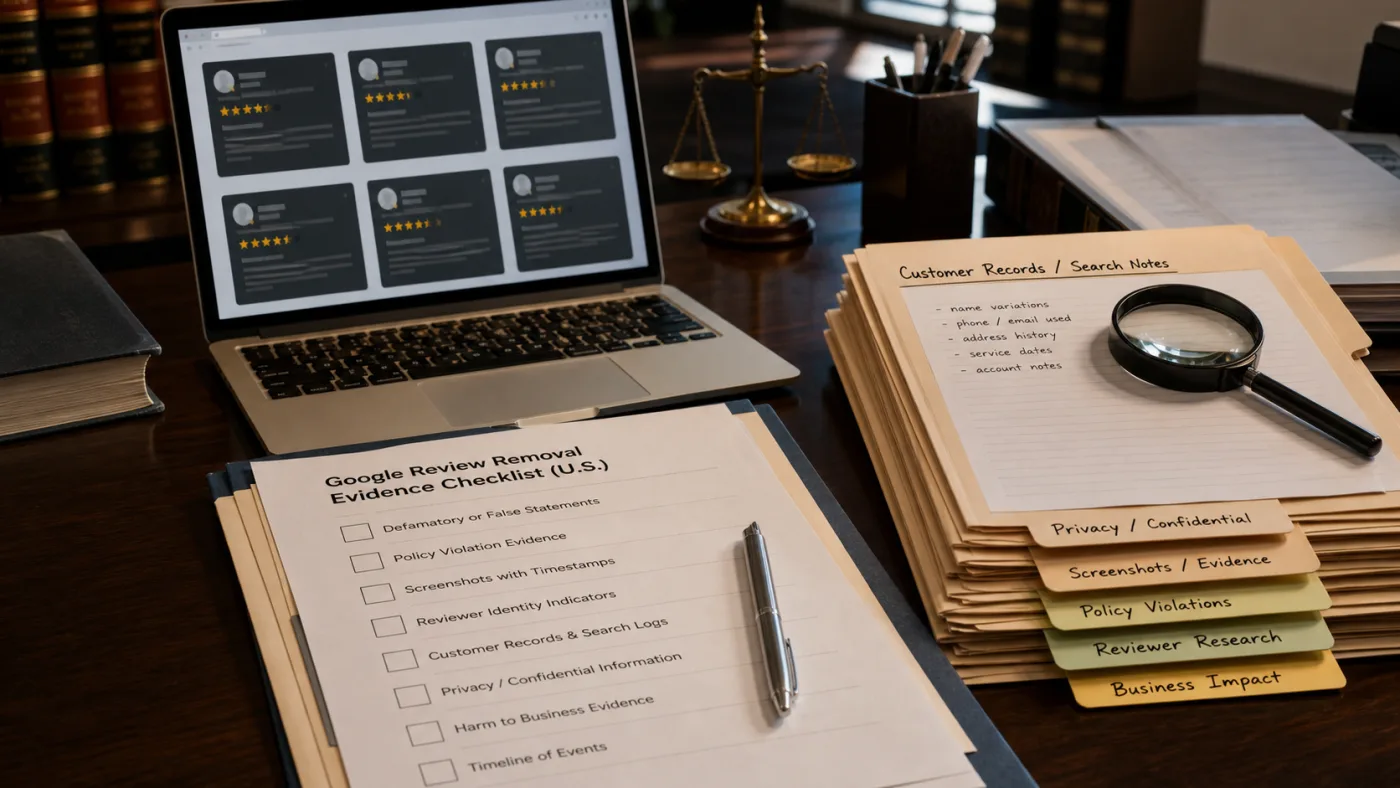
Step 1: Decide Whether The Review Is Actually Fake Or Merely Harmful
A fake Google review is not the same as an unfair Google review. A real customer can exaggerate, write emotionally, misunderstand the facts, or leave a harsh one-star review after a bad experience. That may still be lawful criticism and may not violate Google policy. A fake review usually has a different problem: no genuine customer experience, reviewer identity mismatch, paid or coordinated posting, competitor involvement, former-employee conflict, impersonation, automated spam, or a pattern of similar attacks across multiple profiles.
Google's own Business Profile review-reporting guidance says that only reviews violating Google policies are eligible for removal and that Google does not get involved merely because a business disagrees with a customer. Google's prohibited and restricted content policy then gives the operational categories: fake engagement, rating manipulation, conflict of interest, impersonation, harassment, personal information, off-topic content, restricted content, and other policy problems. A business should classify the review before it reports the review.
The first internal note should therefore be blunt and careful: what exactly makes this review removable? If the answer is only 'we think it is unfair,' the business may be better served by a calm public response and a service recovery process. If the answer is 'the reviewer was never a customer, their profile shows the same attack pattern, the post names a competitor, and the accusation contradicts transaction logs,' the business has the beginning of a removal file.
Read this with the USA fake customer review evidence guide and the United States Google review removal page. Those are the two contextual internal links used in this article: one evidence workflow and one country-service page.
Step 2: Preserve The Evidence Before Replying Or Reporting
The evidence file should be created before anyone contacts the reviewer, flags the review, edits a public reply, or asks staff to investigate informally. Reviews can be edited, accounts can disappear, photos can be removed, and staff memories can drift. Capture the review URL, reviewer display name, profile link, profile photo, star rating, review text, image attachments, date, visible edit history, owner replies, and the Business Profile context. If the review appears in local search, preserve that context too.
Then test the claimed experience against business records. Search booking systems, POS records, CRM records, invoices, order IDs, phone logs, email records, refund records, branch schedules, employee rosters, delivery records, membership records, and complaint files. Do not simply write 'not a customer.' Write which systems were searched, by whom, on what date, and what limitations remain. For a walk-in business, preserve transaction logs, camera-retention notes, shift schedules, menu or service availability, receipt ranges, and any other objective material that can test the claimed visit.
- Save full-page screenshots of the review, reviewer profile, star rating, date, photos, and any owner reply.
- Record the exact URL and visible identifiers because screenshots alone are weaker if the review later changes.
- Search customer, booking, POS, CRM, email, invoice, refund, call, branch, and staff records for a match.
- Preserve negative search results with date, system name, search terms, and the person who ran the check.
- Collect pattern evidence: similar wording, sudden timing, new accounts, shared profile behavior, or links to a competitor, ex-employee, contractor, or demand message.
- Separate public evidence from confidential records so the Google submission does not expose private customer, staff, patient, payment, or legal material.
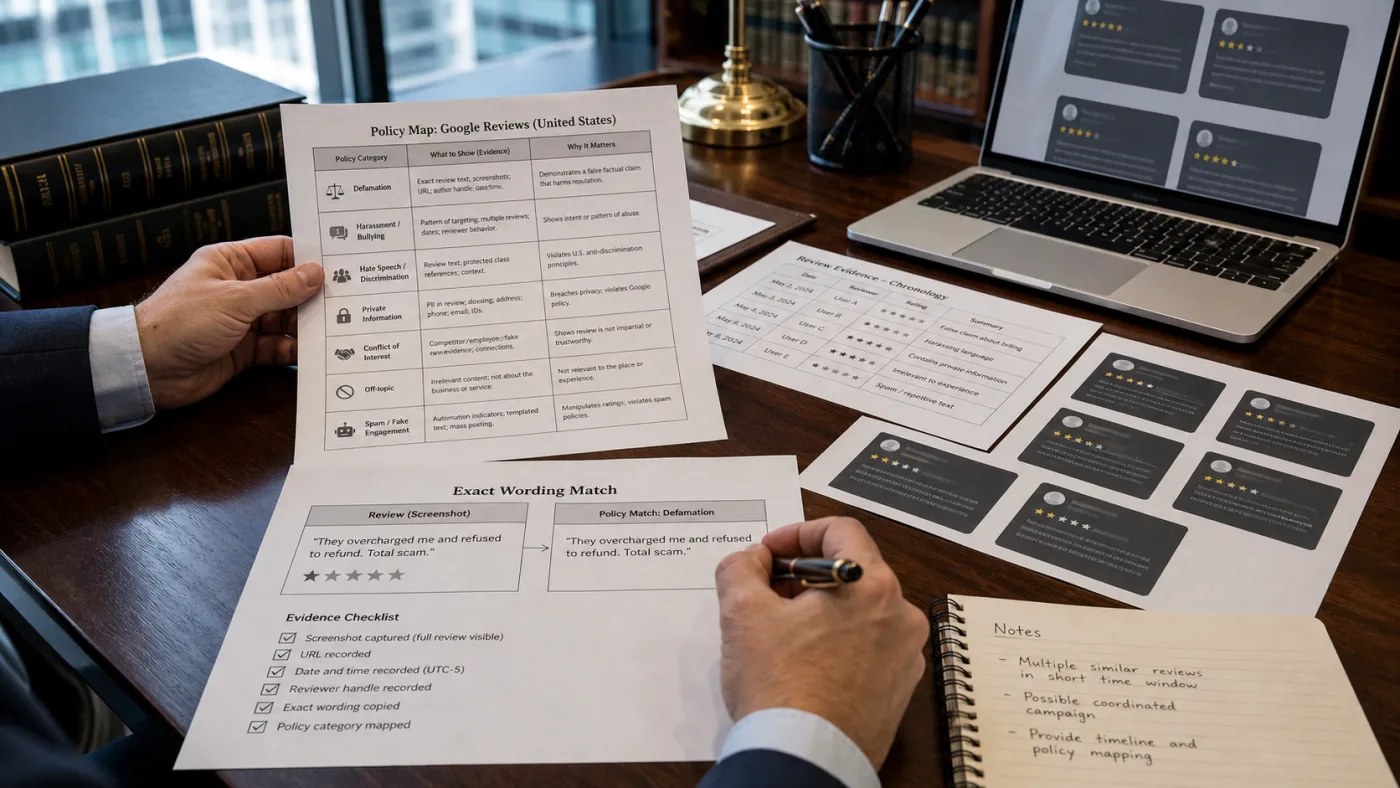
Step 3: Map The Review To The Strongest Google Policy Category
A weak report says, 'This review is fake. Please remove it.' A stronger report says, 'This review violates the conflict-of-interest policy because the reviewer is a former employee terminated on this date, had no customer transaction, and posted after a documented workplace dispute.' The difference is not tone. It is usefulness. Google reviewers need to understand which policy is triggered and why the evidence supports that category.
Policy mapping should follow the facts. If the reviewer never had a genuine experience, the category may be fake engagement. If the reviewer is a competitor, current or former employee, supplier, contractor, family-linked account, or agency contact, the category may be conflict of interest or rating manipulation. If the review uses another person's name or identity, consider impersonation. If it contains staff doxxing, threats, repeated personal attacks, or private information, the report should identify that instead of forcing everything into 'spam.' If the matter includes a demand for money, free service, refund, or silence in exchange for deletion, Google's negative review extortion guidance becomes relevant.
A simple allegation table is often the best format. Column one quotes the exact review language. Column two explains the factual meaning. Column three lists the business record or pattern evidence. Column four identifies the Google policy category. Column five states what can safely be sent to Google and what should remain with counsel. This keeps the report short without making the file thin.
Step 4: Use A Public Response Without Creating A Second Problem
A public response does not remove the review by itself. It protects future readers while the removal process runs. The response should be calm, short, and written for the next customer who reads the thread. It can say that the business takes feedback seriously, cannot locate a record matching the described experience where appropriate, and invites the reviewer to contact a private official channel. It should not call the reviewer fake, criminal, extortionist, a competitor, or a liar unless counsel has approved both the evidence and the wording.
The FTC layer matters here. The FTC Consumer Reviews and Testimonials Rule Q&A explains that businesses should be careful with public responses and review practices. A business trying to remove fake reviews should not make false public accusations about reviewers, threaten honest customers, offer incentives for deletion, buy positive counter-reviews, or selectively solicit only happy customers. The Consumer Review Fairness Act at 15 U.S.C. Section 45b also warns against overbroad anti-review contract provisions. A fake-review response should protect credibility, not become a new consumer-protection issue.
The public response should also match the report. If the Google report says the reviewer is not in records, do not reply as if the business remembers the visit. If the report says the review exposes private information, do not repeat the private information in the public thread. If the report says the review is a competitor attack, do not name the competitor publicly unless the file is strong enough and counsel approves the risk.
Step 5: Flag The Review, Track The Status, And Preserve The Report Record
After the evidence is captured and the policy category is selected, report the review through the Business Profile or the Reviews Management Tool. Use the most specific category available. Save the date, the selected reason, the report confirmation, status updates, and any case or appeal reference. If the report is rejected, do not immediately submit the same argument again. First identify why the first submission was weak: no policy category, no evidence summary, too much emotion, confidential attachments, no customer-record search, or a mismatch between the public response and the report.
Google's reporting guidance describes status outcomes such as decision pending, no policy violation, and appeal escalated. It also describes a one-time appeal when a flagged review does not qualify for removal. That appeal should be treated as a single-shot legal-style memo, not a complaint box. Add new evidence, tighten the category, remove unsupported accusations, and explain the exact policy fit. A business that wastes the appeal on 'this is fake and unfair' may lose the best available platform route.
When Google Refuses: Rebuild The File Instead Of Repeating The Complaint
A refusal does not always mean the review is legitimate. It may mean the first submission did not prove a policy violation. Rebuild the file around the reason Google likely refused. If the review appears to be subjective opinion, isolate any separable factual accusation or policy issue. If Google found insufficient evidence of fraud, add reviewer-pattern evidence and a clearer customer-record search. If the reviewer is a real person but conflicted, stop arguing authenticity and focus on conflict of interest. If the review contains a false factual accusation of fraud, theft, unsafe conduct, forged records, or professional misconduct, consider whether a legal route is more appropriate than another policy report.
Legal expectations should stay realistic. Milkovich is a useful U.S. defamation reference because some statements framed as opinion can still imply objective facts, but not every harsh review is actionable. 47 U.S.C. Section 230 also limits attempts to treat a platform as the publisher of third-party content. That does not protect the reviewer who wrote a false review, and it does not prevent Google from reviewing policy or legal-removal requests. It does mean a business should choose the target, theory, and remedy carefully.
If the review is defamatory, exposes personal information, threatens physical safety, includes extortion, or is connected to an identifiable campaign, the Google Legal Help Center and counsel-led escalation may be appropriate. That route is different from ordinary Business Profile moderation. It requires exact URLs, exact statements, evidence of unlawfulness or privacy risk, and a proportional request. A legal notice or demand letter may also be appropriate for serious repeat attacks by known competitors, former employees, vendors, or harassers, but it should be drafted from evidence rather than frustration.
Prevention: Build Review Volume Without Buying Reviews
The best long-term defense against fake reviews is a steady stream of genuine reviews, fast monitoring, and a trained team. Turn on review alerts. Check new reviews daily for high-risk language, staff names, private information, demands, suspicious timing, and customer-record mismatches. Ask real customers for honest feedback through a neutral process. Do not buy reviews, do not ask employees to post disguised customer reviews, do not trade discounts for positive ratings, and do not pressure customers to remove criticism in exchange for benefits.
A business with three reviews is fragile because one fake one-star review can dominate the profile. A business with hundreds of genuine, recent, diverse reviews is more resilient. That does not mean fake reviews should be ignored. It means removal strategy and reputation growth should run together: preserve and report the fake review, respond carefully for future readers, appeal where the evidence supports it, and continue collecting honest reviews in a compliant way.
Sources Consulted
- Google Business Profile Help: report inappropriate reviews.
- Google prohibited and restricted content policy.
- Google Business Profile Help: manage customer reviews.
- Google negative review extortion scam reporting guidance.
- FTC Consumer Reviews and Testimonials Rule Q&A.
- 15 U.S.C. Section 45b, Consumer Review Fairness Act.
- Milkovich v. Lorain Journal Co., 497 U.S. 1 (1990).
- 47 U.S.C. Section 230.
- Google Legal Help Center.
Practical Conclusion
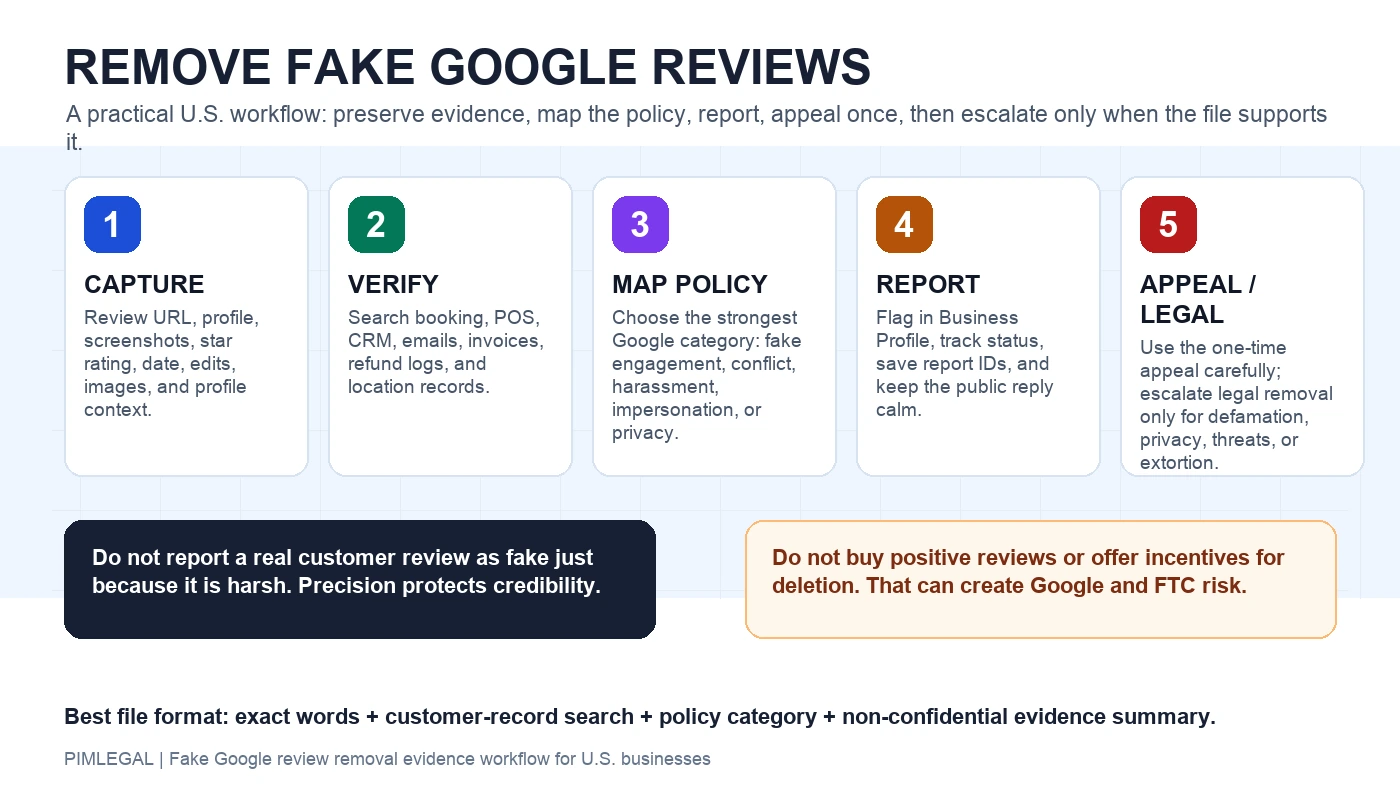
To remove fake Google reviews in the USA, do not start with anger and do not start with a generic report. Start with capture. Verify the customer record. Map the exact words to the strongest Google policy. Reply publicly only if the wording is safe. Track the report. Use the one-time appeal carefully. Escalate legally only when the facts support defamation, privacy, threats, extortion, impersonation, or another recognized route.
Pimlegal's approach is to turn a chaotic review attack into a readable file: exact review evidence, customer-record verification, policy mapping, non-confidential Google summary, public-response control, and counsel referral when needed. The objective is not to guarantee removal. The objective is to preserve leverage, avoid avoidable compliance mistakes, and make each next step defensible.