
A practical U.S. guide for dental practices that need stronger online reputation management across Google, insurance directories, Healthgrades, Zocdoc, and review-removal risk without creating HIPAA or FTC problems. A dental practice cannot manage reputation by watching its Google star rating alone. Patients choose dentists through several paths: emergency searches on Google Maps, insurance-provider directories, referral checks, branded searches, Healthgrades comparisons, Zocdoc booking screens in large metro markets, and cosmetic-treatment research that may include before-and-after proof. A strong practice has to know which path is actually losing calls before deciding where to spend time.
This guide is written for a U.S. dental office, orthodontic practice, oral surgery clinic, or multi-location dental group that wants more patient trust without creating a legal or privacy problem. It is inspired by the practical platform-stack view of dental reputation management, but it applies a Pimlegal lens: preserve evidence, keep protected health information out of public replies, avoid review-suppression tactics, and distinguish ordinary reputation work from a real Google review removal or legal escalation file.
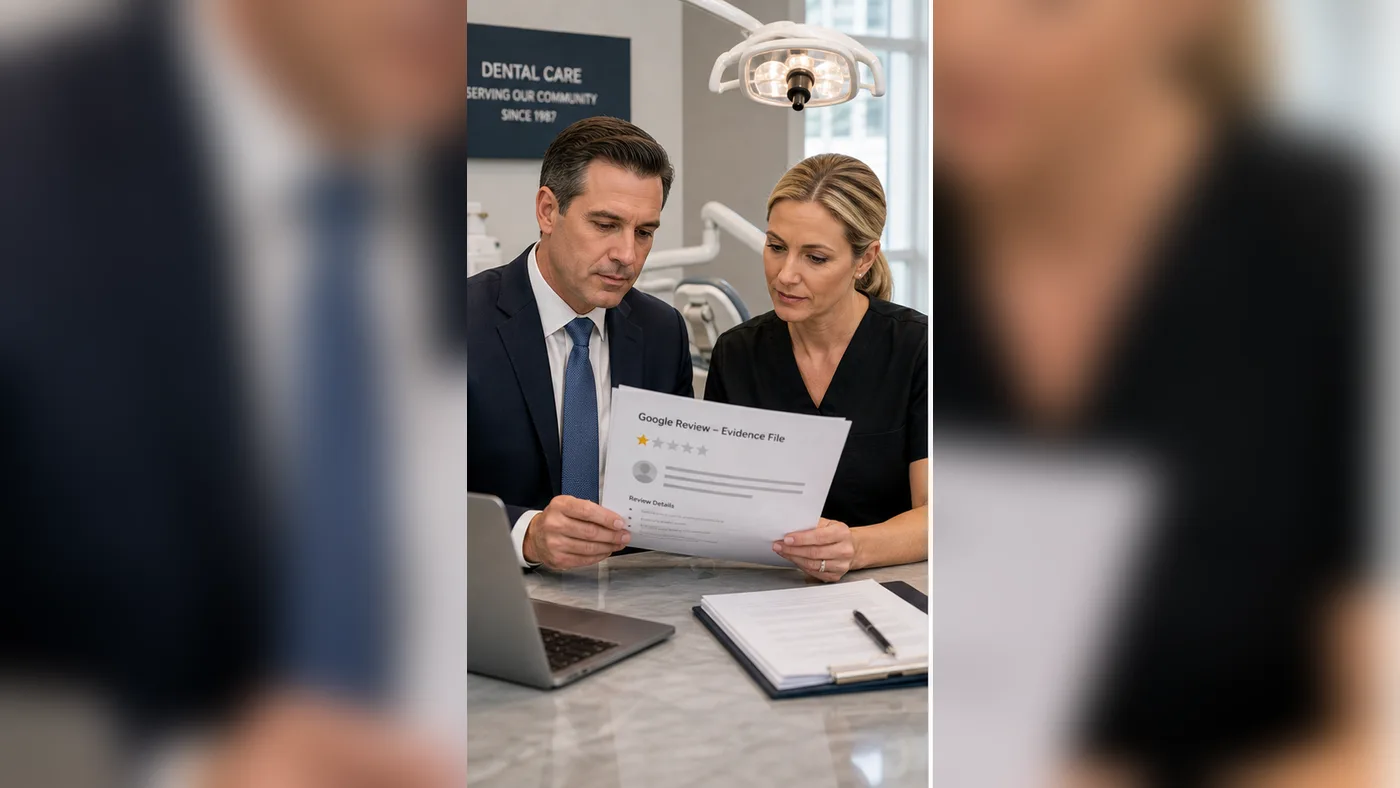
Why Google Alone Is Not The Whole Dental Reputation System
Google is still the baseline. It appears when a patient searches for an emergency dentist near me, checks a referral from a friend, compares nearby practices, or verifies that a provider is open and reachable. Review count, recency, response quality, photos, categories, hours, and address consistency all affect the first impression. A practice with a clean Google Business Profile and recent reviews looks alive. A practice with old reviews, no owner replies, incomplete hours, or unanswered criticism can look neglected even when the clinical care is excellent.
But many dental patients do not start on Google. Insurance-guided patients may open Delta Dental, Cigna, Aetna, MetLife, Guardian, Humana, or another provider directory before they ever search the web. If the insurance profile has an old phone number, no photo, missing accepted-plan information, or weak satisfaction signals, the practice can disappear from a high-intent patient journey while still looking good on Google. Reputation management therefore includes directory maintenance: quarterly checks of carrier listings, NAP consistency, accepted insurance, appointment links, provider names, specialties, photos, and location details.
Healthgrades and Zocdoc create a different risk. They can rank for the dentist's name, appear during branded search, and sit directly beside competitor profiles. Healthgrades matters when patients are researching credentials, insurance, specialties, or a referred dentist before calling. Zocdoc matters most where patients use the platform as the booking interface. If a practice has a strong Google rating but a neglected Healthgrades profile or a lower Zocdoc average, the conversion loss may happen after Google already did its job.
Read this with the United States guide to Google review removal for dentists and the United States Google review removal page. Those are the two contextual internal links used in this article: one dental resource and one country-service page.
The Dental Review Funnel Should Be Ethical, Consistent, And Documented
A healthy dental reputation program does not wait for occasional happy patients to post. It uses a documented post-visit request process that is consistent, neutral, and easy to audit. The office can ask patients for feedback after visits, make the review link easy to find, and train front-desk staff to invite honest feedback without pressure. The practice should not offer discounts, whitening upgrades, gift cards, raffle entries, or billing concessions in exchange for reviews or review changes. It should not route only happy patients to public review sites while diverting unhappy patients into private forms if the system is designed to suppress negative feedback.
The FTC's Consumer Reviews and Testimonials Rule Q&A is important for dental marketers because the federal review rule targets deceptive or unfair review practices. The Consumer Review Fairness Act at 15 U.S.C. Section 45b also warns against form-contract terms that prohibit, penalize, or strip rights from honest consumer reviews. A dental practice can still challenge fake, defamatory, harassing, confidential, or unlawful content. The compliance line is this: ask for honest reviews, preserve false-review evidence, and avoid tactics that pressure or punish patients for truthful criticism.
- Ask for feedback through a consistent post-visit workflow rather than only when staff sense the patient is happy.
- Use one neutral review request template across locations and document any automation settings.
- Do not offer incentives for a positive review, a five-star review, or deletion of a negative review.
- Keep private complaint handling separate from public review solicitation so the practice does not look like it is filtering negative patients away from public platforms.
- Monitor Google, insurance directories, Healthgrades, Zocdoc where used, Facebook, Yelp where relevant, and branded search results for the dentist and practice name.
- Audit the process monthly: number of requests sent, review volume, response time, negative themes, privacy-risk reviews, and unresolved platform reports.
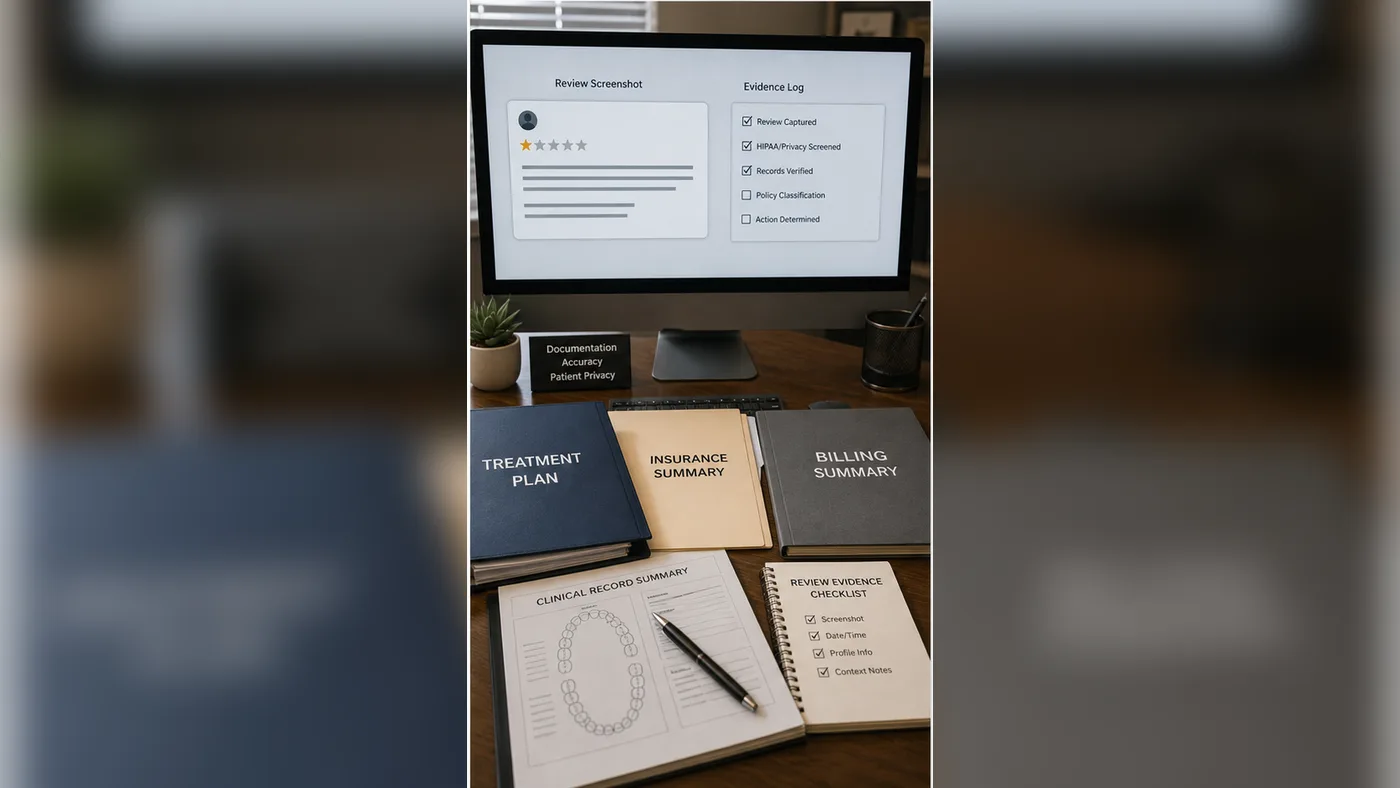
HIPAA-Safe Review Responses For Dental Practices
Dental reviews create a special response problem because the reviewer may voluntarily mention treatment, pain, billing, anesthesia, insurance, x-rays, implants, braces, extractions, cosmetic results, or a child patient's visit. That does not mean the practice can confirm, deny, correct, or expand the clinical facts in public. A safe owner response is usually written for future readers, not as a point-by-point argument with the reviewer. It can acknowledge concern, state that the practice takes feedback seriously, and invite the person to contact the office manager or privacy contact through a private channel.
HHS Office for Civil Rights materials on health information privacy and the HHS enforcement example involving a provider's response to negative online reviews show why health-care businesses need a separate privacy screen. HHS described potential HIPAA Privacy Rule issues where patient information was disclosed in response to online reviews. For a dental practice, the practical rule is strict: do not confirm patient status, appointment dates, treatment plans, billing details, insurance facts, chart notes, x-ray history, or staff observations in the review thread.
The same privacy discipline applies even when the review is unfair. A dentist may know that the accusation about unnecessary treatment is false. The practice may have records showing informed consent, post-operative instructions, insurance pre-authorization, or a different chronology. Those materials can help counsel, a Google report, or an internal quality review, but they rarely belong in a public reply. The public response should be narrower than the evidence file.
When Reputation Management Becomes A Removal File
Most negative dental reviews should not be treated as removal cases. Patients can describe pain, delay, anxiety, cost concerns, scheduling problems, bedside manner, and dissatisfaction. The practice may disagree, but disagreement is not enough. A removal or legal escalation file becomes more realistic when the review appears fake, comes from a non-patient, exposes private information, names staff with unsupported misconduct allegations, includes threats or harassment, appears tied to a competitor or former employee, republishes confidential documents, or makes specific false factual accusations about fraud, unnecessary procedures, unsafe care, forged records, or intentional deception.
Google's review-reporting workflow and prohibited and restricted content policy should be used with precision. A dental practice should not submit a long emotional complaint saying that a review is unfair. It should identify the exact words, the non-confidential evidence summary, the policy category, and the requested action. If the review contains protected health information, the office should summarize the issue without attaching chart material unless counsel approves the scope. If the reviewer cannot be matched to records, the submission should explain which systems were searched and when.
A useful removal file has two layers. The first layer is public and non-confidential: review URL, reviewer name, star rating, screenshots, date, exact text, visible images, profile link, and the Google Business Profile context. The second layer is private: appointment records, consent forms, treatment plans, insurance communications, billing records, refund notes, lab orders, phone logs, internal incident notes, and privacy-review notes. The second layer supports legal analysis, but the first layer and a careful summary usually drive the platform report.
- Preserve the review URL, profile link, text, rating, images, date, screenshots, edit history, and Business Profile context.
- Compare each factual accusation with appointment, billing, insurance, consent, and treatment records without copying private chart material into the public file.
- Create a sentence-by-sentence table: opinion, factual accusation, privacy issue, harassment, fake-engagement signal, policy category, evidence, and response risk.
- Use a privacy-screened summary for Google and reserve clinical records for counsel or legally controlled review.
- Keep report IDs, appeal outcomes, response drafts, patient-contact attempts, and harm indicators in a single chronology.
Insurance Directories, Healthgrades, And Zocdoc Need Their Own Audit
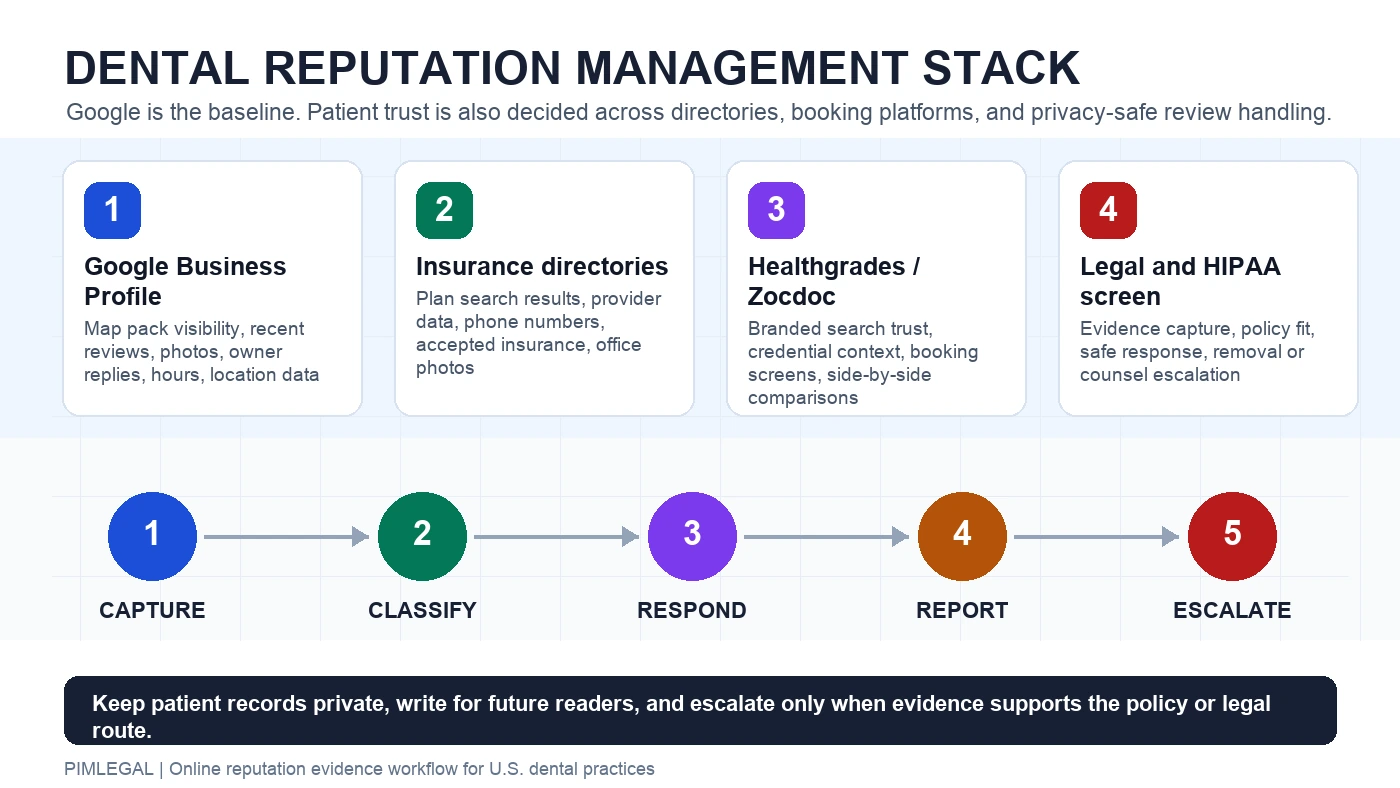
The platform stack matters because each channel answers a different patient question. Google answers, 'Is this practice nearby, active, and trusted?' Insurance directories answer, 'Can I use my plan here?' Healthgrades answers, 'Does this dentist look credentialed and credible when I search the name?' Zocdoc answers, 'Can I book now and how does this office compare beside others?' Cosmetic and elective dental patients add another layer: they want proof of aesthetic judgment, before-and-after quality, financing clarity, and a calm response to bad outcomes.
A quarterly dental reputation audit should therefore list every platform, owner login, location, provider, specialty, phone number, appointment link, photo set, accepted insurance entry, review volume, average rating, response status, and unresolved negative-review theme. The practice should also search each dentist's name, the practice name, and common services such as veneers, implants, Invisalign, emergency dentist, pediatric dentist, and oral surgeon with the local city. The goal is not to make every platform perfect at once. The goal is to identify where a high-intent patient is likely to lose trust before calling.
Public Response Templates That Do Not Create New Risk
For positive reviews, the practice can be warm without confirming treatment. A safe response may thank the reviewer for the kind feedback, say the team appreciates the trust, and invite them to contact the office if they ever need help. Avoid phrases such as 'we are glad your extraction healed well' or 'your Invisalign plan is going great' because those details confirm care. For mixed or negative reviews, avoid debating facts publicly. A safer structure is: thank the person for the feedback, state that the office takes concerns seriously, explain that privacy rules prevent discussing individual matters online, and provide a private contact route.
Do not use the reply to accuse the reviewer of lying, fraud, extortion, non-payment, missed appointments, drug-seeking behavior, insurance misuse, or treatment noncompliance unless counsel has reviewed the exact evidence and wording. Even then, the public response may still be the wrong place for that information. A strong reputation strategy protects future readers without turning the review thread into a HIPAA, defamation, consumer-protection, or retaliation problem.
Escalation Criteria For Dental Practices
Escalation is justified when the review crosses from ordinary criticism into a documented risk category. Examples include a non-patient review that describes impossible treatment, a competitor-linked pattern, a former employee posting as a patient, a review that exposes another patient's information, a threat against staff, a demand for money or free treatment in exchange for deletion, or a specific accusation of fraud or malpractice contradicted by records. Escalation may mean a stronger Google appeal, a private preservation letter, a legal notice, a subpoena-readiness review, state-law defamation analysis, or referral to local U.S. counsel.
Expectations should remain realistic. Milkovich is useful because some statements framed as opinion can still imply false facts, but not every harsh dental review is actionable. 47 U.S.C. Section 230 also limits attempts to treat a platform as the publisher of third-party content. That does not protect the person who wrote a false review, and it does not prevent Google policy reporting. It means the practice should choose the target and remedy carefully.
Sources Consulted
- Google Business Profile Help: report inappropriate reviews.
- Google prohibited and restricted content policy.
- Google Business Profile Help: manage customer reviews.
- FTC Consumer Reviews and Testimonials Rule Q&A.
- 15 U.S.C. Section 45b, Consumer Review Fairness Act.
- HHS Office for Civil Rights HIPAA resources.
- HHS OCR online-review HIPAA enforcement example.
- Milkovich v. Lorain Journal Co., 497 U.S. 1 (1990).
- 47 U.S.C. Section 230.
Practical Conclusion
Reputation management for dentists in the United States works best when it is treated as a system, not a panic reaction to one bad review. Keep Google strong, but audit insurance directories, Healthgrades, Zocdoc, and branded search. Ask for reviews consistently and ethically. Respond in a way that protects patient privacy. Preserve evidence before reporting or replying. Use Google policy categories precisely. Escalate only when the file supports a proportionate removal, legal, or counsel-led route.
Pimlegal's role is to help dental practices organize a privacy-safe evidence file, distinguish lawful criticism from fake or unlawful review content, frame the strongest Google submission, and decide whether a public response, review appeal, legal notice, subpoena-readiness review, or local counsel referral is the next defensible step. The objective is not to promise deletion. The objective is to protect trust, avoid avoidable mistakes, and keep every reputation decision documented.